
The table games you will find across Asia
Walk into a casino anywhere in Asia, from Macau to Singapore to South Korea, and you will see the same core set of table games. Baccarat is by far the biggest. In Macao's VIP rooms, baccarat is typically the only game offered, and it is the preferred game among Chinese players1. It is especially popular with high-rollers across the region7.
Blackjack, roulette and the two great dice games, sic bo and craps, fill out the floor. Sic bo, an ancient Chinese game played with three dice, goes by different names in different places: tai-sai in Macau and Hong Kong, and you will find six tai-sai tables alongside 160 other table games at Kangwon Land in South Korea8. Craps is more of an American import but appears in major resorts and in live dealer casinos online.
The games divide neatly into two kinds. Baccarat, roulette, sic bo and craps are pure chance: no skill improves your odds3. Blackjack is the exception, a decision game where how you play your cards changes what the house edge actually costs you. If you want to dig into that distinction, see does skill matter in casino games.
This page walks through each game in turn: the rules, the payouts, and the house edge, which is simply the share of each bet the casino keeps over the long run. For how that edge is built into every payout, see true odds vs payout odds.
Baccarat: rules, payouts and why the banker bet costs least
Baccarat, also known as punto banco, is a simple guessing game. Two hands are dealt, the Player and the Banker, and you bet on which one will end up closer to 9 points, the highest possible total9. No matter how many people are at the table, only those two hands are dealt9. Tables seat seven to 14 players depending on the version9.
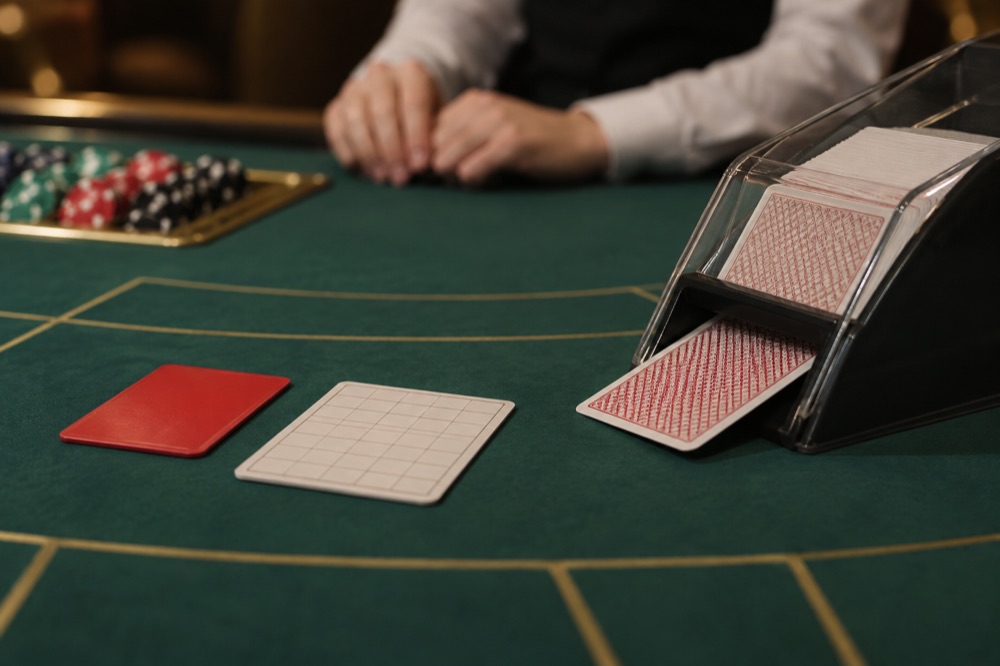
Card values are simple. Aces count as 1, cards 2 through 9 count at face value, and 10, jack, queen and king count as 03. If a hand's total exceeds 9, the first digit is dropped: a total of 12 becomes 2, and 25 becomes 510. Only the rightmost digit matters3.
Each round starts with four cards dealt face up, two for the Player box and two for the Banker box9. If either hand totals 8 or 9 on the first two cards, that is a natural, no more cards are dealt, and all bets are settled at once3. Otherwise the drawing rules take over, and they are fixed, not chosen by anyone:
- The Player hand draws a third card if its first two cards total 0 to 5, and stands on 6 or 73.
- The Banker draws if its total is 0 to 5, and stands on 6 or 7 when the Player hand stood3.
You have three bet boxes in front of your seat: Player, Banker and Tie9. All bets must be placed before the cards are dealt10. The payouts:
- Player wins: paid 1 to 13.
- Banker wins: paid 1 to 1, minus a 5% commission. A 20 unit bet on the banker hand wins 20 minus that commission9.
- Tie: paid 8 to 13.
That 5% commission is the whole reason the banker bet is the cheapest bet in the game. The banker hand actually wins slightly more often than the player hand, so without the commission the casino would lose money on it. The commission claws most of that back, but not all, which is why the banker bet still costs less. For the full breakdown, see baccarat odds and house edge.
There are no skills that improve your odds in baccarat3. Even card counting, which works in blackjack, barely helps here: the best it can do is tell you to bet Player on rare running counts of -4 or less and Banker otherwise11.
What each baccarat bet costs you
The house edge is the clearest way to compare the three bets. These are the standard figures for the common multi-deck game:
The banker bet's edge of about 1.06% is one of the lowest in the casino1. The number of decks shifts these figures slightly: in a single-deck game the banker bet costs about 1.01%, the player bet 1.29% and the tie 15.75%12. Eight-deck, six-deck and one-deck games each have their own return tables7.
The tie bet is the one to understand clearly. At 14.36%, it costs more than ten times the banker bet3. The 8 to 1 payout looks tempting, but ties simply do not happen often enough to justify it. We cover this in detail in the tie bet in baccarat.
Blackjack rules: card values, dealer draws and player options
Blackjack, also known as 21, is a game against the dealer, not against the other players. You win by holding a higher total than the dealer without going over 21, or by the dealer busting6. Tables have six or more seats13.
Card values: numbered cards count at face value, and the ace is worth either 1 or 11, your choice depending on the hand14. An ace plus a ten-value card on the deal is a natural blackjack, and it beats everything.
The deal: each player gets two cards face up, and the dealer gets one card face up and one face down6. If the dealer's up card is a ten or an ace, she checks the face-down card for blackjack before players act; if she has it, the round is over and everyone loses, except a player who also has blackjack, who keeps their original bet14.
Then it is your turn, and this is where blackjack differs from every other game on this page. Your options:
- Hit: take another card.
- Stand: keep your total.
- Double down: double your bet and take exactly one more card.
- Split: with two cards of the same value, separate them into two hands. You must place a second bet equal to the original, and each hand is then played in turn14.
- Surrender (where offered): give up half your bet and end the hand.
The dealer has no choices. She follows fixed rules, typically standing on 17 and drawing on 16 or lower15. In live dealer versions the software signals the dealer to draw until the hand reaches a hard or soft 17 through 2116. If your total matches the dealer's, the hand is a push and your bet is returned14. In Macau, the official rules also allow up to three players to bet on one spot, with the seated player making the decisions13.
Because your decisions matter, there is a mathematically best play for every hand. That chart is blackjack basic strategy, and the rule details that change the math, like how many decks are in the shoe and whether the dealer hits soft 17, are covered in blackjack rule variations.
Blackjack odds: how your starting hand changes the house edge
With good play, blackjack is among the cheapest games in the casino. Standard blackjack carries a house edge of roughly 0.4%17, and the game overall varies from about 1% with basic strategy, with card counting able to lower it a further 1 to 2%18. A four-deck game played with correct strategy comes in at 0.46%19.
What surprises people is how much the edge swings with the cards you are actually holding. Your starting hand changes your chances dramatically15:
| Your hand | Chance of winning | Chance of losing | House edge |
|---|---|---|---|
| 8 or lower | low | high | 4%15 |
| 13 | 35% | 55% | 2.5%15 |
| 15 | 50% | 42% | 2%15 |
| 16 | 60% | 32% | 1.5%15 |
| 18 | 77% | 15% | 1%15 |
The pattern is clear: weak hands are expensive, strong hands are cheap. This is why basic strategy exists. It tells you the least costly action for every combination of your hand and the dealer's up card. Even the composition of your hand matters at the margins: in single-deck blackjack you normally stand on 12 against a dealer's 4, but if your 12 is made of a 10 and a 2, the odds favor hitting instead20.
If you want to compare the two big decision-free and decision-heavy games side by side, see baccarat vs blackjack.
Roulette rules and payouts: inside bets, outside bets and the zero
Roulette is a spinning wheel and a betting layout. The table has two main areas: an inside area for betting on numbers, and an outside area for betting on outcomes like odd or even and red or black21.
Inside bets are wagers on specific numbers or small groups of numbers. They have lower odds but much higher payouts, as high as 35 to 1 for a straight-up bet on a single number22. The casino's payout on a single number is 35 to 123.
Outside bets cover large groups. You can bet high or low, odd or even, red or black, or the first, second or third dozen22. These pay 1 to 1 for the even-money bets and 2 to 1 for dozens and columns16. The trade-off is the reverse of the inside: better odds, smaller payouts22.
One rule catches new players. You must place the full table minimum on either the inside or the outside, and you cannot split it between the two. On outside bets, the whole minimum must go on one individual wager; on the inside, you can spread it across different numbers21.
The zero is where the house gets its edge. Every payout is calculated as if the zero slots did not exist, so the green slots are what the casino keeps. For the payout on every single bet type, see roulette odds.
European or American roulette: which wheel you are playing on
Before you sit down, check which wheel the table is using, because it changes the price of every bet on the layout.
- European roulette: a 37-number wheel with a single zero24. The house edge is 2.7%, or 1 in 37, on all bets5. Any single number has a 1 in 37 chance5.
- American roulette: a wheel with 38 slots in all, the numbers 1 through 36 plus the two green slots, 0 and 0021. The house edge is 5.26%5.
The extra zero nearly doubles the cost of playing. European roulette is still offered in many casinos as an alternative to the American version21, and some live dealer studios run a standard single zero European layout16. There are also worse wheels to watch for: quadruple-zero roulette carries a 10% house edge on every bet24. The full comparison, including where each version is common, is in European vs American roulette, and the newer wheel formats are covered in roulette variants.
Sic Bo: three dice, the betting layout and what each bet pays
Sic Bo, originally pronounced SEE-BO, is an ancient Chinese dice game25. It is played with three dice, and players bet on the outcome of each roll25. It is a game of pure chance: no strategy or skill is involved, and it moves quickly25. Each table has two dealers who exchange chips, monitor the bets and keep the game moving25. In Macau the game is known as cussec, played with three balanced dice shaken under an opaque cup26.
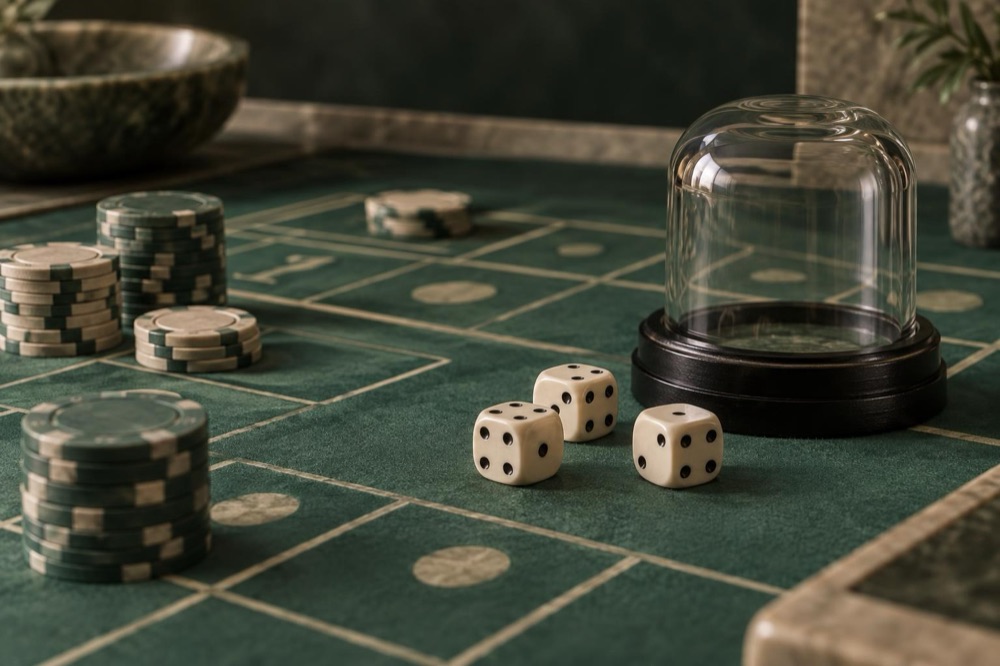
There are six main categories of bets25:
- Single number bets: pick one number. In Macau's rules, the single dice bet pays 1 to 1 if your number appears on one die, 2 to 1 if it appears on two, and 3 to 1 if all three dice show it27.
- Two number combinations: pick two numbers to appear together.
- Three dice total bets: bet on the sum of all three dice. The payouts fall as the total gets more likely: 60 to 1 for a total of 4 or 17, 30 to 1 for 5 or 16, 18 to 1 for 6 or 15, 12 to 1 for 7 or 14, 8 to 1 for 8 or 13, 7 to 1 for 9 or 12, and 6 to 1 for 10 or 1127.
- Triple bets: all three dice showing the same number. Any triple pays 30 to 127.
- Pair bets: two of your chosen number.
- Big and small bets: small is a total of 4 to 10, big is 11 to 1725. These pay even money, but with one catch: if all three dice show the same number, both big and small bets lose26.
The rule of thumb for reading the layout: the higher the payout odds, the less likely the outcome25. For the full house edge on every bet area, see sic bo odds, and for how the game compares to craps, see sic bo vs craps.
Craps: dice combinations and why some bets have no house edge at all
Craps is a dice game played on a specially designed table where players bet on the outcome of the next roll, and it is considered the fastest game in the casino28. Like sic bo, it is pure chance with no skill or strategy28.
Two dice give 6 times 6, so every roll has 36 possible combinations4. That is the whole mathematical basis of the game. For example, a 5 can be rolled 4 ways out of 36, a 1 in 9 chance, and the chance of rolling a 5 before a 7 is 40%4. The odds for the main bets are usually written right on the table29.
There are more than 10 types of wagers, and they vary enormously in cost28. The house edge across the game runs from 0% up to 16.67% depending on where you bet4. Two rules of thumb help you navigate:
- The bets with the lowest house edge are the pass line bets, come bets, place bets and odds bets28.
- Bets on the outside of the table have better odds than those in the middle28.
The odds bet is the remarkable one. It pays out at true odds, which means there is no house edge at all2. It is an additional wager you can make after a point is established, and it is one of the only bets in the casino where the payout exactly matches the risk. The catch is that you generally need to have a line bet working first. For the full rules of the come-out roll and the point, see craps rules, and for the payout on every wager, see craps odds.
House edge compared: which games give you the most back
House edge is the single most useful number in gambling. It is the average share of each bet the casino keeps over time. Here is how the main games and bet types stack up, using the standard figures with optimal play:
| Game or bet | House edge with optimal play |
|---|---|
| Craps odds bet | 0%2 |
| Blackjack (standard) | roughly 0.4%17 |
| Baccarat banker bet | 1.06%3 |
| Baccarat player bet | 1.24%3 |
| Craps (overall) | 0.8%3 |
| Poker | 2 to 3.5%30 |
| European roulette | 2.7%5 |
| American roulette | 5.26%5 |
| Slot machines | 8% average30 |
| Baccarat tie bet | 14.36%3 |
| Lottery | 50% average30 |
A few things stand out. The dice games and blackjack, played well, cost a fraction of what slots cost. Slot machines are less favorable than table games such as blackjack and roulette in terms of return to player31. Poker sits in the middle: less favorable than blackjack, more favorable than roulette32. And the baccarat tie bet, at 14.36%, is among the priciest wagers on this list, though the lottery, with a 50% average house edge, costs far more30.
Remember what these numbers mean. A 1% house edge does not mean you lose 1% of your money on a visit; it means the casino keeps about 1% of everything wagered over the long run. On any given night, variance swamps the edge. For why betting systems cannot beat that math, see casino betting systems.
Side bets and multipliers: pair bets, Lucky 6, Lightning Roulette and Super Sic Bo
Most tables offer extra wagers alongside the main game. They are optional, they pay big, and they cost more than the bets they sit next to.
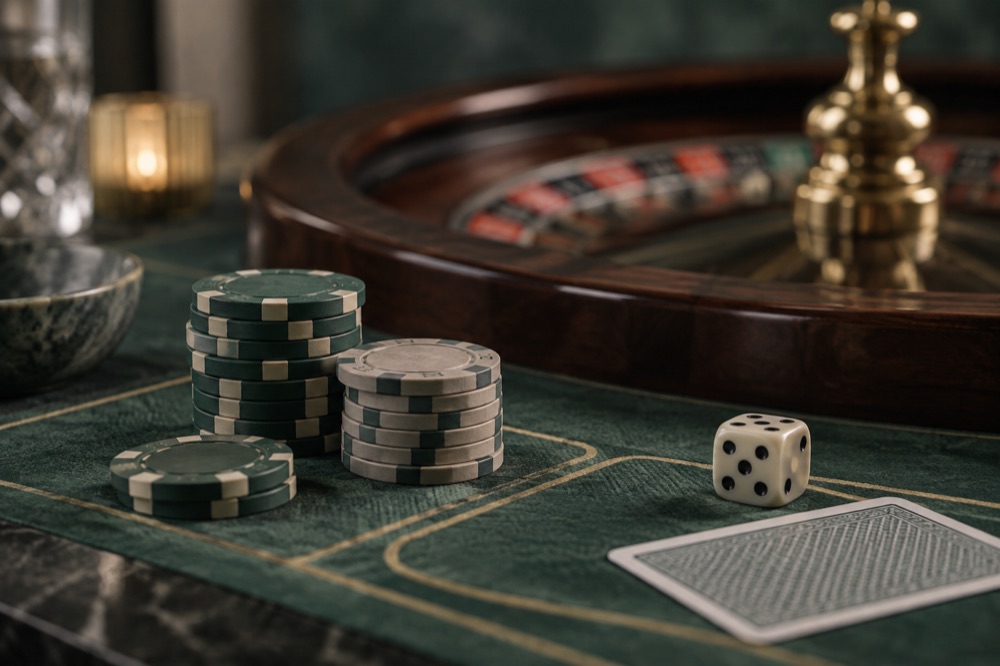
In baccarat, the side bet menu is long: Dragon Bonus, 4-5-6, Lucky Bonus, 3-Card Six, Dragon 7, Panda 8, Royal Match, Bellagio Match and Matching Dragon7. Pair bets, wagering that the first two cards of a hand make a pair, are among the most common. How favorable a pair bet is depends on the number of decks in the shoe, and return tables are published separately for eight-deck, six-deck and single-deck games12. The full list with payouts is in baccarat side bets.
Blackjack tables carry their own side bets, like pair wagers attached to the main game. For the blackjack versions, see blackjack side bets.
Online and live dealer studios have taken the side bet idea further and built whole games around multipliers. Lightning Roulette and Super Sic Bo add random multipliers to selected numbers before each round, boosting payouts well above the standard table in exchange for a higher base edge. These games, along with speed and squeeze versions of baccarat, are covered in live dealer table game variants, and the money-wheel multiplier games in live casino game shows. The general differences between playing online and in person are in live dealer vs casino floor.
Table etiquette and limits: OTPC chips, betting windows and minimums
A few practical things to know before your first table.
Chips. Wagers at a casino table are made with casino chips, and in some jurisdictions that is the formal rule: in Singapore, a wager on any approved casino gambling conducted at a table must be made with casino chips and, if applicable, one or more match play coupons33. You buy chips at the table with cash and color them back up when you leave. At the sic bo table, casino chips are the only thing that really belongs on the table34.
Minimums. The lowest minimum tables usually run bets of about $5 to $15, and new players are often pointed there6. Minimums vary by game, table and casino. Every craps table layout is exactly the same, but betting limits and dollar amounts vary between tables and casinos28. In poker rooms, a table with a $1/$2 bet limit might have a buy-in range of $50 minimum and $300 maximum35.
Betting windows. All bets must be placed before the action starts. In baccarat, all bets must be placed before the cards are dealt, with no betting after the first two cards10. In sic bo, the window closes when the dealer covers the dice. If you miss the window, wait for the next round.
Pace. Sic bo is fast-paced and requires some quick thinking34. Craps is the fastest game in the casino28. Baccarat rounds are over in seconds once the cards are out. Do not feel rushed; it is fine to watch a few rounds before you sit down.
Rule variations. Some rules and pay tables vary slightly by casino, especially in novelty and side bet games11. If a payout looks different from what you expect, ask the dealer before you bet, not after.
For the fuller version of this, including buying in, hand signals and whether you may touch the cards, see casino table etiquette, and for what happens when something goes wrong, see dealer errors and misdeals.
All Pages in Section
- Baccarat Odds and House Edge
- The Baccarat Tie Bet
- Baccarat Side Bets
- Baccarat Big Road and Scoreboards
- Baccarat vs Blackjack
- Blackjack Basic Strategy
- Blackjack Rule Variations
- Blackjack Insurance
- Blackjack Side Bets
- Card Counting in Blackjack
- Spanish 21
- European vs American Roulette
- Roulette Odds: Probability and Payout for Every Bet
- Roulette Call Bets: Voisins du Zero, Tiers, Orphelins and Neighbors
- Roulette Variants: Automated, Lightning, Double Ball and Triple Zero
- Sic Bo Odds and House Edge by Bet
- Sic Bo vs Craps: How the Two Casino Dice Games Differ
- Craps Rules
- Craps Odds, Payouts and House Edge: Odds Bets, Place Bets and Proposition Bets
- Live Dealer Table Games: Speed, Squeeze, Lightning and No-Commission Versions
- Live Casino Game Shows: Money Wheels and Multiplier Games Explained
- Live Dealer vs Casino Floor: How Table Games Differ Online and in Person
- Who Sets Casino Game Rules? Statutory Rules and Regulator Approval in Asia
- True Odds vs Payout Odds in Casino Games
- Casino Betting Systems
- Does Skill Matter in Casino Games? Decision Games vs Pure Chance
- Casino Table Etiquette: Buying In, Hand Signals and Touching Cards
- Dealer Errors and Misdeals: What Happens to Your Bet
- Baccarat vs Dragon Tiger: Rules, Speed and House Edge Compared
Common Questions
What is the best bet in baccarat?
The banker bet. It carries a house edge of about 1.06%, slightly lower than the player bet at 1.24%, because the banker hand wins slightly more often. The casino takes a 5% commission on winning banker bets to make up for that. The tie bet is far worse at 14.36%.
What does a tie bet pay in baccarat?
A winning tie bet pays 8 to 1. It looks attractive, but the house edge is 14.36%, about 13.5 times the cost of the banker bet, so it is the most expensive of the three main baccarat wagers.
How many decks are used in baccarat?
It varies by casino and table. Eight decks is the most common setup, but six-deck and single-deck games exist. The number of decks slightly changes the house edge: with one deck the banker bet costs about 1.01%.
What is a natural blackjack?
A natural blackjack is an ace plus any ten-value card on your first two cards, totaling 21. It beats every other hand. If the dealer also has blackjack, the hand is a push and you keep your original bet.
When does the dealer have to hit in blackjack?
The dealer follows fixed rules, typically drawing on 16 or lower and standing on 17 and above. The dealer has no choices. Some tables make the dealer hit soft 17, which slightly raises the house edge.
What is the difference between European and American roulette?
The wheel. European roulette has 37 slots with a single zero; American roulette has 38 slots with a zero and a double zero. That extra slot nearly doubles the house edge, from 2.7% on the European wheel to 5.26% on the American one.
What does Sic Bo mean?
Sic Bo, originally pronounced SEE-BO, is an ancient Chinese dice game played with three dice. The name translates roughly to precious dice. You bet on the outcome of each roll, from single numbers to the total of all three dice.
Sources35 sources
- The Transformation of Macao's Gaming Industry, University of Macau repository, 2026
- How to Play Craps Details, PlaySmart, 2026
- Baccarat, GameSense, 2025
- Craps Odds, PlaySmart, 2026
- European Roulette, PlaySmart, 2026
- How to Play Blackjack, PlaySmart, 2026
- Baccarat, Wizard of Odds, 2026
- Kangwon Land Casino, High1, 2026
- How to Play Baccarat, PlaySmart, 2026
- Baccarat, Natural8, 2026
- Ultimate Texas Hold'em, PlaySmart, 2026
- Baccarat, Wizard of Odds, 2011
- Blackjack rules, DICJ Macao, 2004
- How to Play Blackjack, PlaySmart, 2026
- How to Play Blackjack, Las Atlantis, 2026
- House Rules, Natural8, 2026
- How to Play Blackjack Details, PlaySmart, 2026
- 控除率, Wikipedia, 2026
- Blackjack: 4-Deck Strategy, Wizard of Odds, 2026
- Blackjack Appendix 15, Wizard of Odds, 2026
- How to Play Roulette, PlaySmart, 2026
- How to Play Roulette Details, PlaySmart, 2026
- All About Gambling, Responsible Gambling Council, 2026
- Roulette Basics, Wizard of Odds, 2026
- How to Play Sic Bo, PlaySmart, 2026
- Cussec rules, DICJ Macao, 2004
- The Gaming Tables (Cheating) Regulations 2002, OPSI, 2002
- How to Play Craps, PlaySmart, 2026
- Odds and Probability, GameSense, 2025
- How to Play Blackjack, GameSense, 2020
- How Do Slot Machines Work, GameSense, 2021
- Poker Essentials, GameSense, 2020
- Baccarat Basics, Wizard of Odds, 2017
- Sic Bo Etiquette, PlaySmart, 2026
- How to Play Poker, PlaySmart, 2026















