
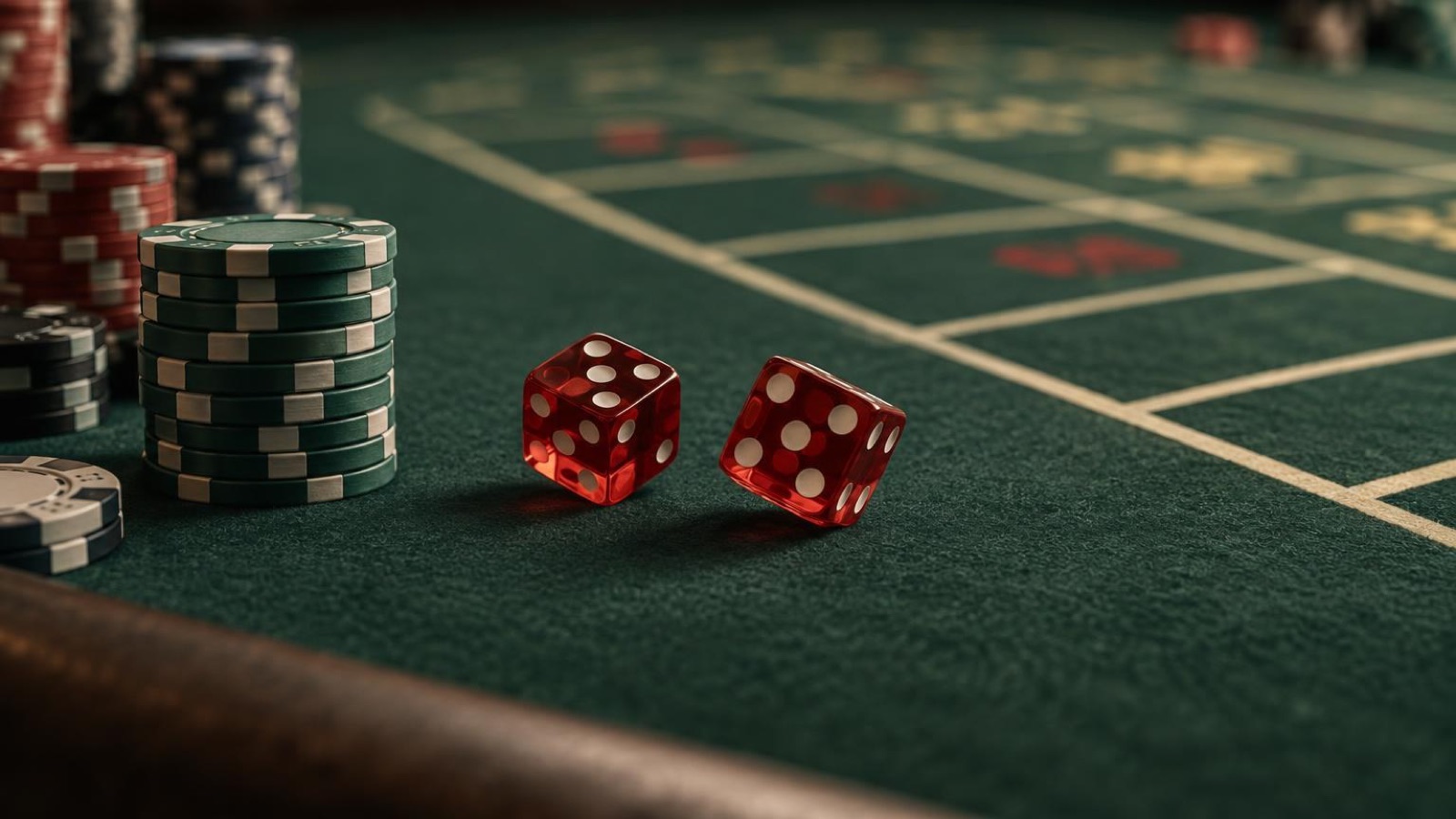
How a craps round works: come-out roll, point and seven out
A craps round has two phases, and almost every bet on the layout is tied to which phase you are in.
The first roll of a round is the come-out roll. If the shooter rolls a 7 or 11, that is a natural, and Pass Line bets win. If the shooter rolls 2, 3 or 12, that is craps, and Pass Line bets lose2. Any other total, meaning 4, 5, 6, 8, 9 or 10, becomes the point3.
Once a point is set, the round changes shape. The shooter keeps rolling until they either repeat the point or roll a 7. If the point comes first, Pass Line bets win. If a 7 comes first, that is the seven out, the round ends, and the dice move clockwise to the next player3.
Every player gets a turn as the shooter as long as they have an active Pass or Don't Pass wager, and the honor moves around the table in order3. You do not have to shoot. You can pass the dice and keep betting.
The Don't Pass side runs in mirror image. A Don't Pass bet loses on a natural of 7 or 11 and wins on craps, a 2 or 32. Once a point is set, the Don't Pass bettor wins if a 7 comes before the point repeats, and loses if the point is made first2.
Come and Don't Come bets work the same way, except they are placed after the come-out roll rather than before it. A Come bet wins on 7 or 11 and loses on 2, 3 or 122. A Don't Come bet loses on 7 or 11 and wins on a 2 or 32.
The 36 dice combinations behind every odds figure
Every number in craps comes from the same small pool of outcomes. Two dice produce 36 possible combinations on each roll, six faces on one die multiplied by six on the other1.

That is the whole engine. The chance of rolling a 5, for example, is 4 out of 36, which reduces to 1 in 91. The chance of rolling a 5 before a 7 is 40%, or 6 to 41. Once you know how many of the 36 combinations produce a total, you know the true odds of that total appearing, and you can compare it against what the table pays.
The dice themselves are tightly specified in regulated markets. In Macao, craps dice must have:
- intersecting lines of equal length
- opposite faces summing to seven
- faces of equal diameter with clearly visible pips
- absolutely equal size and weight5
The table uses four or five dice, a dedicated box and layout, and a wooden hook or equivalent device for moving the dice5. That is why the game looks the same wherever you sit down.
Pass Line and Don't Pass: the baseline house edge of 1.41%
The Pass Line is the bet most players start with, and it is one of the cheapest on the table. It pays even money, 1 to 11, and it wins 244 times out of 495, or about 49.29%1. The gap between that and a fair coin is the house edge: 1.41%1.
The Don't Pass and Don't Come bets are marginally cheaper at 1.36%1. They win 251 times out of 495, or 50.71%1. The difference between the two sides is small, and it comes down to how the 12 is handled on the come-out roll rather than to any big structural gap.
The bets with the lowest house edge across the whole layout are the Pass Line bets, Come bets, place bets and odds bets3. That is the short list worth remembering. Everything else on the table is a step up in cost.
Odds bets: the craps wagers with no house edge at all
The odds bet is the extra wager you put behind your Pass, Don't Pass, Come or Don't Come bet once a point is established. It pays at true odds, which means there is no house edge2. Some craps bet options have no house edge at all, and this is the one1.
The payout depends on the point:
| Point | True odds of making it | Odds bet pays |
|---|---|---|
| 4 or 10 | 1 in 3, about 33.33% | 1 to 2 |
| 5 or 9 | about 2 in 5, 40% | 1 to 1.5 |
| 6 or 8 | 5 in 11, 45.46% | 1 to 1.2 |
Those figures apply to the Pass and Come odds bet1. The Don't Pass and Don't Come odds bet pays the mirror image: 2 to 1 on points of 4 or 10, 3 to 2 on points of 5 or 9, and 6 to 5 on points of 6 or 85.
The practical point is that the odds bet is the only place on a craps table where the casino takes no mathematical cut. It is also the reason the size of your odds bet matters more than almost anything else you do at the table.
Place bets: true odds versus payouts by point
A place bet is a wager that a specific number will be rolled before a 7, without waiting for the come-out cycle. You can place the 4, 5, 6, 8, 9 or 10.
The payouts are fixed by the point:
| Point | Place bet pays | True odds | House edge |
|---|---|---|---|
| 4 or 10 | 1 to 1.8 | 1 in 3, about 33.33% | 6.67% |
| 5 or 9 | 1 to 1.4 | 2 in 5, 40% | 4% |
| 6 or 8 | 1 to 1.2 | 5 in 11, 45.46% | 1.52% |
All of those figures come from the same set of published odds1. The pattern is worth reading carefully. The place bet on 6 or 8 is close to the Pass Line in cost, at 1.52%. The place bet on 4 or 10 is more than four times as expensive, at 6.67%, because the payout of 1 to 1.8 is a long way from the true 1 in 3.
Place bets are still on the list of the lowest house edge bets in craps, alongside the Pass Line, Come and odds bets3. That is true as a group, but the group covers a wide range, and the 4 and 10 sit at the expensive end of it.
House edge by bet: from 1.36% up to 16.67%
Here is the same information as a single comparison, from cheapest to most expensive:

| Bet | House edge |
|---|---|
| Don't Pass / Don't Come | 1.36% |
| Pass Line / Come | 1.41% |
| Place bet on 6 or 8 | 1.52% |
| Place bet on 5 or 9 | 4% |
| Place bet on 4 or 10 | 6.67% |
| Odds bet | none |
The first five figures are published odds for the standard bets1. The odds bet sits outside the table entirely because it pays at true odds2.
At the other end, some craps bet options carry a house edge as high as 16.67%1. Those are the proposition bets, and they are the ones to understand before you put money on them.
Hardway and proposition bets: where the edge peaks
The single most useful rule of thumb for a craps table is that the bets on the outside portion of the layout have better odds than the bets in the middle2. The same rule appears in the standard description of the game: bets on the outsides of the table have better odds than those in the middle3.
The middle of the table is where the proposition bets live, and that is where the edge climbs toward 16.67%1. These are the one-roll and hardway wagers that pay big numbers and hit rarely.
The hardway bets are a good illustration. In Macao, the hardway pays 1 to 9 on pairs of 3 and pairs of 4, and 1 to 7 on pairs of 2 and pairs of 55. Those are the bets that a pair of 3s or a pair of 4s comes up before a 7 or an easy way. The payouts look generous next to a 1 to 1 Pass Line bet, and that is exactly the point: the higher the payout odds, the less likely the outcome is to occur6.
The same principle shows up across every dice and table game. In roulette, inside bets have lower odds but much higher payouts, as high as 35 to 1, while outside bets have better odds but lower payouts at 1 to 1 or 2 to 17. Craps is built on the same trade.
If you want a simple way to sort the layout in your head: the boxes nearest the dealers in the center are the expensive ones, and the long line running around the outside is where the cheap bets sit.
Maximum odds multiples: 100 to 1,000 times the table minimum
The odds bet is capped as a multiple of your flat bet or the table minimum, and the multiple varies by casino. Some houses allow 100 times, some go far higher, up to 1,000 times the table minimum. The exact figure is posted at the table, and it is worth checking before you buy in, because it decides how much of your money can sit on the only bet in the game with no house edge.
Table minimums themselves vary. Every craps table layout is exactly the same, but betting limits and dollar amounts can vary between tables and casinos3. So the same game can cost you very different amounts depending on where you sit down.
For a sense of scale on table minimums in the region, published minimums for other table and betting products in Asia run from P 2.00 for a quartet bet and P 5.00 for a place, win or forecast bet in the Philippines8, up to a $200 minimum stake for certain Hong Kong betting products9. Craps minimums are set by each casino and posted at the table.
The practical move is to ask the dealer or the floor staff two questions before you put chips down: what is the table minimum, and what is the maximum odds multiple. Those two numbers tell you what the game will actually cost you.
Where you can play craps in Asia: Okada Manila, City of Dreams and online tables
Craps is not as widely spread across Asia as baccarat or sic bo, but it is available. Okada Manila runs table games and electronic games across its floor10, and it is the property that has pushed craps variants hardest in the region.

Okada Manila also holds the largest progressive jackpot in the country10, which is a separate draw from the craps tables but part of the same floor.
If you are comparing dice games, it is worth knowing how craps differs from its regional cousin. Sic bo uses three dice and a single roll, with a payout structure where higher payouts mean less likely outcomes6. Craps uses two dice, runs over multiple rolls, and gives you a bet with no house edge at all, which sic bo does not have. The two games look similar from across the floor and behave very differently once you are sitting at them.
For the wider picture of what is on offer across the region, see casino table games in Asia, and for the rules side of the game itself, craps rules covers the come-out roll, the point, and Pass and Come bets in detail.
Crapless Craps at Okada Manila: how the variant changes the game
Crapless Craps is a variant that removes the craps numbers from the come-out roll and turns them into points instead. Okada Manila offers it on the casino floor, and the property describes it as available exclusively there4.
The change is simple to state. In standard craps, a come-out roll of 2, 3 or 12 loses your Pass Line bet immediately. In Crapless Craps, the game puts more point numbers in play, including 2, 3, 11 and 12 alongside the standard 4, 5, 6, 8, 9 and 104. Nothing can craps out on the come-out roll, so the round always goes to a point.
That sounds like a gift, and it is not. Turning 2, 3, 11 and 12 into points means you can now be stuck trying to repeat a 2 or a 12 before a 7, which are the hardest points on the layout. The trade is fewer instant losses for much longer odds on the points you can draw.
Okada Manila frames the game as a longer-play, higher-energy version of the standard table4. If you have played standard craps and understand the point cycle, the variant is easy to pick up: the layout looks familiar, and the difference is which totals can become your point.
Common Questions
What is the house edge on a Pass Line bet?
The Pass Line and Come bet carry a house edge of 1.41%. The Don't Pass and Don't Come bets are slightly cheaper at 1.36%. Both pay even money on the flat portion of the bet, so the difference comes from how often each side wins over the long run.
Which craps bets have no house edge?
The odds bet, the extra wager you place behind your Pass, Don't Pass, Come or Don't Come bet, pays at true odds and carries no house edge at all. It is the only craps wager where the casino takes no mathematical cut.
What are the true odds of making a point of 6 or 8?
A point of 6 or 8 is made 5 times out of 11, or 45.46%. Points of 5 or 9 come in at 40%, and points of 4 or 10 at 33.33%. The harder the point is to repeat, the more the odds bet pays.
What is the payout on a place bet on 4 or 10?
A place bet on 4 or 10 pays 1 to 1.8, while the true odds are 1 in 3. That gap gives the bet a house edge of 6.67%. Place bets on 5 or 9 pay 1 to 1.4, and on 6 or 8 they pay 1 to 1.2.
What is the minimum bet at a craps table?
Table minimums vary by casino and by table, and craps layouts are identical everywhere even though the limits and dollar amounts are not. Check the sign at the table before you buy in, because the minimum also sets the size of your odds bet.
What does 'seven out' mean in craps?
Seven out is when the shooter rolls a 7 before repeating the point. The round ends, all Pass Line bets lose, and the dice move clockwise to the next player, who becomes the new shooter as long as they have an active Pass or Don't Pass wager.
Is craps available at Okada Manila?
Yes. Okada Manila offers Crapless Craps on its casino floor, and the property says the game is available exclusively there. Crapless Craps adds 2, 3, 11 and 12 as point numbers alongside the standard 4, 5, 6, 8, 9 and 10.
Sources10 sources
- Craps Odds, PlaySmart
- How to Play Craps: Details, PlaySmart
- How to Play Craps, PlaySmart
- Crapless Craps, Okada Manila
- Craps Rules, DICJ Macao
- How to Play Sic Bo, PlaySmart
- How to Play Roulette: Details, PlaySmart
- Getting Started with Betting, Philracom
- All Up Betting Guide, HKJC
- Okada Manila, Okada Manila















