Traditional card games played in Cambodia
Walk through a Cambodian casino floor or a village gathering during a festival and you will find a set of games that traveled here from across the region rather than from Las Vegas. The best known are Pok Deng, a quick two- and three-card game against a dealer; Bai Bửu, a four-card bluffing game; and bau cua, a dice game known in Khmer as klah klok, where players bet on pictures of animals. Alongside these, streamed cockfighting has become one of the most popular ways to bet in the country.
The games sit side by side with the international casino offer. Popular games in Cambodian casinos include traditional options like blackjack, poker and roulette, plus slot machines6. Foreigners and tourists are allowed to gamble at the country's regulated gaming venues, with a minimum age of 185.
If you want the full casino picture, see casinos in Cambodia, and for the border towns, casinos in Poipet, casinos in Bavet and casinos in Sihanoukville.
Pok Deng hands and payouts
Pok Deng uses a standard 52-card deck and seats between 2 and 17 players, though each player is playing against the dealer, not against the other players1. You start with two cards and may draw a third, so a hand always has between 2 and 3 cards1.
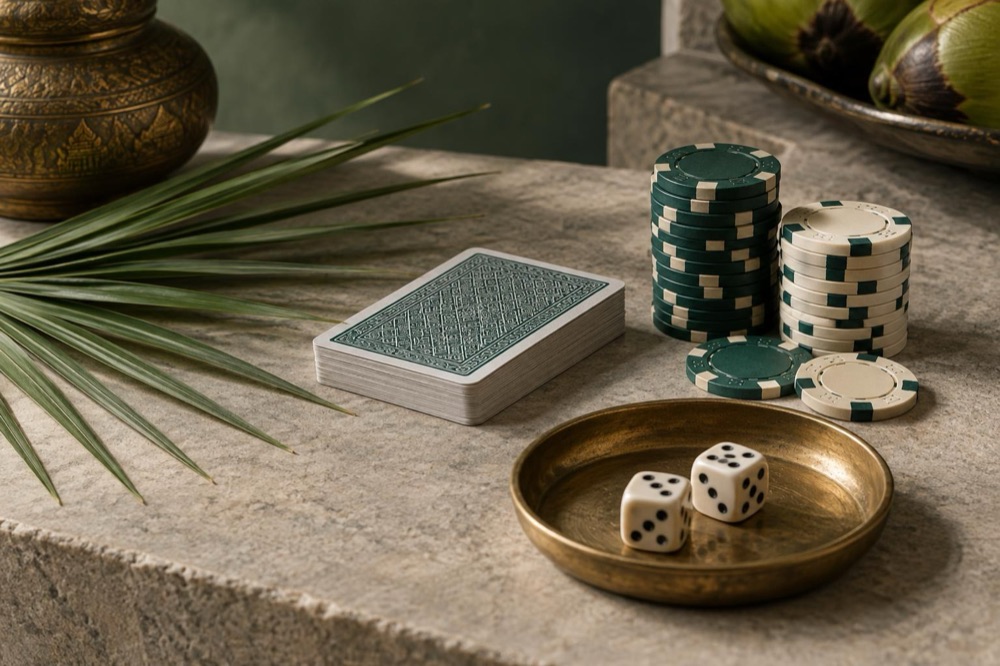
The name of the game comes from its best hand: a pok is a two-card hand totaling exactly 8 or 9 points, and it usually settles the hand on the spot1. Card values are simple, with picture cards counting low and the rest at face value, and the hand total is counted in single digits, the last digit of the sum being your score.
Beyond the point totals, the game ranks poker-style hands. Like poker, Pok Deng looks at flushes, pairs and trios, and it also ranks straights and straight flushes as distinct hands7. A winning hand that is also a pair, a flush or better typically pays more than even money, which is where the game's bigger payouts come from: a plain win pays 1:1, while a decorated hand can pay multiples of your stake depending on the house rules.
The pace is the appeal. A hand takes 2 to 3 minutes at a table, and online versions can finish in a couple of minutes or even a few seconds1. Because everyone plays the dealer, there is no waiting for a long chain of player decisions.
Bluffing matters less here than in poker against other players. Observers of the game note that bluffing frequency in Pok Deng is low, and the strongest tell that a player is up to something unusual is odd bet sizing8. Since you are facing the dealer, most of the game is simply how you play your own cards.
Bai Bửu (Four Card Brag): rules and betting
Bai Bửu, also called Four Card Brag or Four Card Poker, and in Vietnamese Brag 4 lá or Poker 4 lá, is a popular card game in Vietnam and other parts of Southeast Asia2. It is a player-against-player game with betting rounds, closer to poker than to baccarat.
The setup: before the cards are dealt, each player places an ante bet2. Each player is then dealt four cards face down2.
From there the betting works in rounds. Your options each turn are:
- Call: match the initial bet and stay in the hand2
- Raise: increase the bet2
- Fold: surrender your hand and forfeit your ante bet2
If you fold, you are out of the hand and the money you have already put in stays in the pot for the remaining players2. A showdown is optional: if multiple players are still in after the betting rounds, they may choose to show their hands to determine the winner2. Because showing is optional, a player can sometimes take the pot uncontested if everyone else folds, which is what gives the game its bluffing character.
Bai Bửu hand rankings
Hands in Bai Bửu are ranked, from top to bottom2:
- Three of a kind: three cards of the same rank, for example three Kings
- Straight flush: three consecutive cards of the same suit
- Flush: three cards of the same suit
- Straight: three consecutive cards of any suit
- Pair: two cards of the same rank
- High card: the highest single card determines the winner
Note that only three of your four cards count, so you are choosing your best three-card combination. A straight flush, three consecutive cards of the same suit such as 7, 8 and 9 of hearts, is the second-strongest hand and is beaten only by three of a kind2. An ace-high flush beats all lower flushes, though it still loses to the hands above it in the list10.
Bau cua: equipment and how a round is played
Bau cua, known in Khmer as klah klok and in Vietnamese as lắc bầu cua, is a dice game played at Khmer New Year and other festivals across the region. The equipment is minimal: three standard six-sided dice, each face showing a symbol instead of a number (typically a gourd, a crab, a shrimp, a fish, a rooster and a deer or similar animal), a betting mat with six betting areas matching the dice symbols, chips or money, and a dice cup or bowl to shake them11.
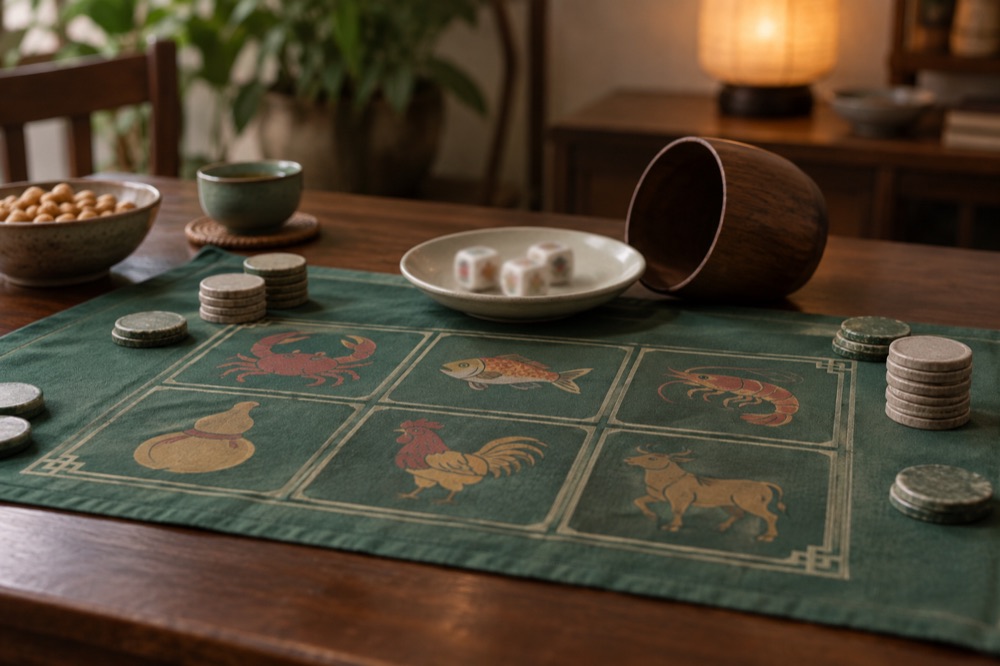
A game seats 2 to 8 players11. A round runs like this:
- Players place their chips or money on one or more of the six symbols on the mat.
- The banker covers the dice with the cup or bowl, shakes, and reveals the result.
- Each die shows one symbol, so a round produces three symbols, which may include repeats.
- Bets on any symbol that appears win; the payout depends on how many dice show it.
The banker role rotates. In casual play, players often pass the banker job around, usually after every 3 to 5 rounds or when the banker loses significantly11. The banker can also set a maximum bet per position and can refuse bets mid-round if the pot grows too large; some games add side bets on the total sum of the dice or on odd/even results, depending on local rules11.
Bau cua payouts and house edge
The core payouts are simple. A winning bet pays 1:1 if your symbol appears on one die, 2:1 if it appears on two dice, and 3:1 if all three dice show it3.
The probabilities explain why the game favors the banker. For any given symbol, the chance of being paid 1:1 is 75 in 216, the chance of the 2:1 payout is 15 in 216, and the chance of the 3:1 payout is 1 in 216. The chance of losing outright is 125 in 2163. Add it up and the player loses an average of 7.87% of the stake per bet to the house3.
House-rule variations can sweeten or complicate this. If all three dice show the same symbol, some bankers pay 5 to 10 times the bet instead of 3 times, and some games pay 2 to 3 times for a two-symbol combination bet such as gourd plus crab11.
For comparison, that 7.87% average loss is high next to the main casino tables. The house edge of several popular games stacks up as follows:
| Game | House edge |
|---|---|
| Blackjack played with the ideal move in every scenario | around 0.5%12 |
| Baccarat, banker bet | 1.06%13 |
| Fortune pai gow poker, player following a smart strategy | around 3%14 |
| Caribbean stud poker | 5.2%15 |
| Bau cua | 7.87% average loss per bet3 |
| Slot machines | around 8%16 |
Slot machines average around 8%, so bau cua sits in similar territory to the slots16.
Casino table games in Cambodia
Inside the licensed casinos, the offer is international. Popular games in Cambodian casinos include traditional options like blackjack, poker and roulette, along with slot machines6. The minimum age for legal casino gambling in Cambodia is 18, and regulated gaming venues allow foreigners and tourists to gamble5.
For detail on specific games, see casino games in Cambodia, baccarat in Cambodia, dragon tiger, slot machines in Cambodia and poker in Cambodia. The biggest single venue is covered in NagaWorld: entry rules, games and getting there, and a border resort that spreads regional games is Ha Tien Vegas Entertainment Resort.
Cockfighting streams and how the betting works
Cockfighting is the oldest gambling tradition in the region and has moved online. Betting sites now stream matches live from arenas including Thomo, on the Cambodia-Vietnam border, and venues in the Philippines, in sharp 1080p HD with a delay of under 3 seconds, broadcasting 24/7. One major operator carries more than 500 matches a day and reports over 2.5 million active members4.

The betting is three-way. You can back the red corner to win, the blue corner to win, or the draw. Win bets are usually priced at odds of 1.70 to 2.20, while draw bets pay far more, typically 8.00 to 9.004.
The money side is built for speed. The minimum bet is VND 50,000 per bet, and for large matches the maximum can reach VND 50,000,000. Bets are confirmed within about 1 second, winnings are credited within about 30 seconds after the result is confirmed, and withdrawals take 3 to 5 minutes to MoMo or ZaloPay or 10 to 15 minutes to a bank account. The minimum deposit is VND 50,000 via MoMo or ZaloPay, and account verification takes under 2 minutes with a Vietnamese phone number4.
Participation is restricted to people aged 18 and over, and the platforms offer account self-limitation tools if you want to cap your own play4.
Where these games are found across Southeast Asia
None of these games is uniquely Cambodian, which is part of why you will recognize them across the region.
Pok Deng is a traditional card game played in Thailand and other countries, and it can be seen played in parks and open spaces across Thailand, especially around festivals7. At casinos, Pok Deng is offered at some Asian casinos and is more common in Cambodia, Laos, Vietnam and some Chinese territories1. Some online casinos in the region feature it alongside roulette, poker, blackjack and virtual slot machines7.
Bai Bửu is a popular card game in Vietnam and other parts of Southeast Asia, and it is a staple at casino resorts near the Cambodian border such as Ha Tien Vegas9.
Bau cua in its Vietnamese form, bầu cua tôm cá, is a fixture of Tết, the Vietnamese New Year, just as klah klok is at Khmer New Year, and the same game appears in other guises across the region, including the Chinese dice game hoo hey how (fish, prawn, crab).
For the wider picture of what is legal and where to play, see gambling in Cambodia, gambling in Cambodia as a visitor and gambling trips abroad from Cambodia.
Common Questions
How many players can join a game of Pok Deng?
Between 2 and 17 players can take part. Everyone plays against the dealer rather than against each other, so a full table still moves quickly because each hand only takes a couple of minutes.
What counts as a pok in Pok Deng?
A pok is a two-card hand totaling exactly 8 or 9 points. It is the best result you can be dealt and usually ends the hand immediately in your favor.
How long does a hand of Pok Deng take?
Roughly 2 to 3 minutes per hand at a normal pace. Online versions can be faster, sometimes finishing in seconds, because there is no chip handling or waiting for other players.
What is a straight flush in Bai Bửu?
Three consecutive cards of the same suit, for example 7, 8 and 9 of hearts. It is the second-strongest hand in the game, beaten only by three of a kind.
What happens if I fold in Bai Bửu?
You surrender your hand and forfeit your ante bet. Folding takes you out of the rest of the hand, and you cannot win any of the money already in the pot.
How much does the house win on average in bau cua?
The house keeps about 7.87 percent of the amount staked on average per bet. That comes from the payout structure: a single symbol wins 1 to 1, two dice pay 2 to 1 and all three pay 3 to 1.
Which casinos offer Pok Deng outside Cambodia?
Some Asian casinos offer it, and it is most common in Cambodia, Laos, Vietnam and some Chinese territories. A number of online casinos serving the region also feature it alongside roulette, blackjack and slots.
Sources16 sources
- Pok Deng FAQ, Pokers, September 26, 2026
- Bai Buu, Ha Tien Vegas, April 14, 2025
- Lắc bầu cua, Wikipedia, 2026
- Đá gà (cockfighting), Max88, 2026
- Best online casinos for players from Cambodia, Wizard of Odds, May 28, 2026
- Casino in Cambodia: a deep dive into gaming culture and regulation, IEEE ETCM, April 11, 2024
- Pokdeng: traditional Thai gambling and online gambling, TLC88, October 24, 2022
- How to read opponents' psychology in online card games, V9Bet, April 15, 2026
- Bài Bửu, Ha Tien Vegas, May 4, 2025
- Ace-high, 888poker, May 31, 2019
- Bầu Cua Tôm Cá rules, Pokers, September 26, 2026
- How to play blackjack, GameSense, 2020
- Baccarat, GameSense, 2020
- How to play fortune pai gow poker, GameSense, 2020
- Caribbean stud poker, PlaySmart, September 25, 2026
- How do slot machines work?, GameSense, 2021