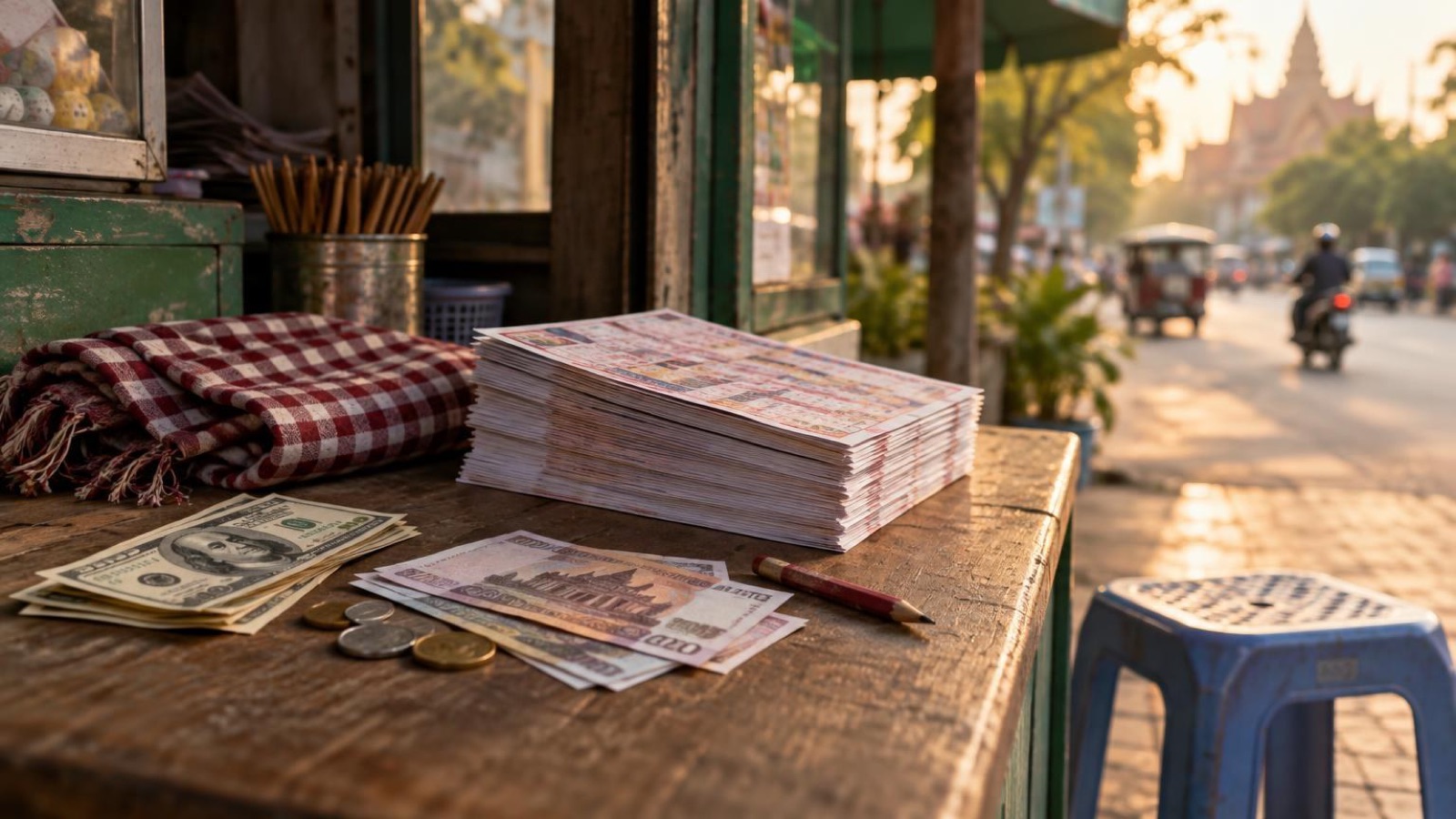
Cambodia is not a big lottery country in the way Vietnam or Thailand are, but it has a real lottery history, with licensed operators coming and going over three decades. The names that matter are Cambodia Pools, the Naga Lottery and 5D Pan Cambodian Lottery, and each worked differently: a numbers game with small stakes and big multiples, a monthly draw with a life-changing top prize, and a 5-digit game sold through a network of street agents. This page covers what each one offered, what it cost, what it paid, and how the buying worked on the day, plus how to tell a licensed seller from an unlicensed one.
What lottery play is legal in Cambodia
The starting point is the Law on the Suppression of Gambling, adopted in 1996, which prohibits gambling of all kinds throughout the Kingdom except what the Royal Government permits5. In practice that permission has carved out two separate worlds. Casino gambling is reserved for foreigners: Cambodians themselves are not allowed to gamble in the casinos, only visitors6. Cambodian citizens, on the other hand, are allowed to gamble through government-sponsored gaming, which has included several privately run national lotteries2.
Within that permitted space, Cambodia Pools is the only legal lottery dealer in the country, and TOTO is described as the lawful type of lottery it holds1. At various points the picture has been narrower still: in 2016, after a raid in Siem Reap, officials stated that the only permissible lottery in Cambodia was the sale of scratch cards8. The government has also been actively regulating the market, and illegal gambling of other kinds remains outlawed4.
The line matters in daily life. Cambodian citizens are allowed to gamble through government sponsored gaming, including five separate privately run national lotteries9, and online betting is illegal even when the process happens over the internet7. Foreigners and tourists, by contrast, can gamble at regulated gaming venues, including licensed lotteries and casinos10. So a visitor buying a licensed lottery ticket is on safe ground, and a Cambodian buying one from a licensed operator is too, but anything outside the licensed channel carries real risk for locals, from prosecution to simply losing your stake to an operator the police may shut down tomorrow.
Bets, prizes and payouts at Cambodia Pools
Cambodia Pools Ltd. opened its gaming windows on October 28, 1992 and ran four different lotteries2. It is also the only lawful bookie and totalizer for association football and motor racing betting in the country1.

The stakes were genuinely small. Bets averaged 2,000 riels, and you could place your bet in either dollars or riels2. The payouts, though, scaled dramatically: prizes ranged from 25 times your bet up to 200,000 times it2. A 2,000-riel wager that hit the top multiple would therefore have returned an enormous sum by local standards, while the smallest wins still paid back 25 times the stake.
| Item | Detail |
|---|---|
| Lotteries operated | Four different lotteries2 |
| Average bet | 2,000 riels2 |
| Currencies accepted | Dollars or riels2 |
| Prize range | 25 to 200,000 times the bet2 |
| Sales network at launch | 150 agent outlets, later planned at 8002 |
| Bet closing time | 4:30 p.m.2 |
| Claim deadline | One week2 |
The company paid a small commission to its 150 agent outlets, and within a few months of launch it expected to have 800 agents in major towns throughout the country2. Officials refused to reveal what percentage of gross proceeds was paid to the State of Cambodia2.
Later in its history, Cambodia Pools was given an exclusion permit under the Remote Gambling Act 2014, allowing online and telephone betting for 4D and TOTO lotteries, motor racing and football1. Its modern operation also spans a casino and poker room alongside the 4D numbers games11.
Naga Lottery: prizes and where to buy tickets
The Naga Lottery is the biggest-prize story in Cambodian lottery history. It launched its first product on June 8, 2012, with a first prize of US$218,0003. That is a serious sum anywhere, and in Cambodia in 2012 it was extraordinary.
The structure was built around volume rather than a single giant payout. There were two draws every month, and over 15,000 prizes available in each3. So while one player took the US$218,000 top prize, thousands of others won smaller amounts across the same draw.
Getting a ticket was easy by design. Tickets were available from 1,500 sellers across Cambodia, with a seller in every province3. You did not need to travel to Phnom Penh or find a special shop; the network was nationwide.
NagaWorld's contest terms also give a sense of who these promotions are aimed at: participants must reside in Cambodia12. If you are visiting, that is worth knowing before you assume a Naga-run promotion is open to you.
5D Pan Cambodian Lottery: agents and coverage
The 5D Pan Cambodian Lottery is a Malaysian-backed operation with a bumpy history. It announced an official return to operations on January 21, 2015, after a failed start-up the first time around4. The relaunch was framed as a second bet on the Cambodian market, with the company hoping the second attempt would charm where the first had not.
On its return, 5D Pan had 90 staff and 400 sales agents spread across 13 provinces4. That is a wide footprint for a 5-digit numbers game, and it means the game was genuinely reachable for much of the population, not just city dwellers.
The "5D" in the name tells you the format: a 5-digit numbers game, in the same family as the 4D and 6D games popular across Southeast Asia. You pick or receive a five-digit number, and the draw determines which numbers win. The agent-based model means you buy from a person at a counter or stall rather than a machine, and you keep a paper ticket as your proof of play.
The context for the relaunch was a government that was starting to regulate the lottery market while continuing to outlaw illegal gambling4. 5D Pan positioned itself on the licensed side of that line, which is what its agent network and public relaunch were meant to signal.
Buying a ticket on the day
If you buy from a licensed lottery agent in Cambodia, the process follows the pattern these operators have used for decades.
You go to an agent outlet, choose your numbers or game, and pay your stake in either dollars or riels2. The average bet has historically been small, around 2,000 riels, so this is not an expensive pastime2. The agent records your bet and gives you a ticket or receipt. Keep it: that paper is your claim on any prize.
Timing matters. Betting windows close at 4:30 p.m. on draw days2. If you arrive after that, you are buying for the next draw, not today's. Winners are announced by radio at 6:30 p.m. and on television later in the evening2, so results reach you the same day through ordinary broadcast media, not just through the agent.
If you win, do not sit on the ticket. Winners have one week to make their claim2. After that window, the claim is gone, so check your numbers the evening of the draw and act quickly.
The draws themselves are worth knowing about, because they were designed to be open. Draws were done in public and notarized by rotating witnesses2. That means the drawing is not a closed-room mystery: members of the public could see it, and different witnesses notarized each one, so no single person or fixed group controlled the record.
How to spot an unlicensed lottery
Because licensed lottery in Cambodia has been limited to specific operators at specific times, a lot of what looks like lottery activity in the country is not licensed, and some of it is actively pursued by the police.

The clearest sign is the product itself. When authorities raided a lottery operation in Siem Reap in 2016, they stated flatly that the only permissible lottery in Cambodia was the sale of scratch cards8. Anything beyond the currently permitted format, sold outside the licensed operator's agent network, is not the licensed product.
Alleged lottery operators have ended up in court, charged under the Law on the Suppression of Gambling, which strictly prohibits gambling of all kinds for Cambodians13. Online betting rings have been smashed by police, with the law reaching betting even when the process is online7. Enforcement has not been uniform over the years, with the gambling law at times loosely enforced14, but the direction has been toward tightening, with authorities moving against illegal gambling operations15.
For a buyer, the practical test is simple. A licensed seller works within the licensed operator's network: the named agent outlets of Cambodia Pools, the 1,500 sellers of the Naga Lottery, or the 400 agents of 5D Pan in their provinces2. A stall or website that cannot be traced to those networks, offering lottery-style betting on numbers or anything else, is outside the permitted channel. If you are a Cambodian citizen, playing through an unlicensed channel is illegal for you, and the operator you paid can be shut down with your money in their till. If you are a foreigner, you have licensed alternatives, including the casinos, so there is little reason to take the risk.
Beyond the lottery
Lottery is only one corner of Cambodia's gambling landscape, and most of it is aimed at visitors rather than locals.
Casinos are legal in Cambodia but only for foreigners6. They cluster in the border towns and Phnom Penh, with Chinese punters flocking to Poipet and Vietnamese gamblers from across the border known to frequent the border casino towns6. The games on offer are the familiar international set17:
- Blackjack
- Poker
- Roulette
- Slot machines
You can read more in our pages on casinos in Cambodia, casinos in Phnom Penh, casinos in Sihanoukville, casinos in Poipet and casinos in Bavet.
Poker has a real following, with hold'em, Omaha and Caribbean Stud the three most popular variations10. Bingo sits in an odd spot: legal for foreign visitors to play, but illegal for Cambodians to participate in or host10. For the wider picture, see gambling in Cambodia, and for the rules in detail, gambling laws in Cambodia.
Online gambling has grown quickly in popularity, with platforms offering sports betting, live betting and casino games, and payment through local bank transfers, international payment gateways and e-wallets18. But online gambling via agents, including internet cafés running betting for Cambodians, is explicitly illegal under the Law on the Suppression of Gambling19. If you are weighing that option, our pages on online gambling in Cambodia and gambling payments in Cambodia cover the mechanics, and gambling scams in Cambodia covers what goes wrong.
For foreign visitors who want the full picture of what they can and cannot do, see gambling in Cambodia as a visitor. And if gambling has stopped being fun, gambling help in Cambodia lists where to turn.
Common Questions
What is the average bet in the Cambodia Pools lotteries?
When the games launched, bets averaged 2,000 riels, and tickets could be bought in either dollars or riels. Prizes ranged from 25 to 200,000 times the amount staked.
Can I pay in dollars or only riels?
Both. Cambodia Pools accepted bets placed in dollars or riels at its agent outlets, so you can use either currency when you buy a ticket.
What time do bets close for the draw?
Betting windows at Cambodia Pools closed at 4:30 p.m. on draw days, with winning numbers announced by radio at 6:30 p.m. and on television later the same evening.
What was the Naga Lottery first prize?
The Naga Lottery launched on June 8, 2012 with a first prize of US$218,000, drawn twice a month, with over 15,000 prizes available across each draw.
How many prizes does the Naga Lottery offer?
Each Naga Lottery draw offered over 15,000 prizes, with two draws held every month and tickets sold through 1,500 sellers across Cambodia.
How long do winners have to claim their prize?
Cambodia Pools gave winners one week from the draw to make their claim, so check your ticket promptly after the results are announced.
How are the draws supervised?
Cambodia Pools draws were conducted in public and notarized by rotating witnesses, giving buyers an open, witnessed process rather than a closed-room draw.
Sources19 sources
- Keputusan Lotto purchase in Cambodia 2025, DayNews, 2025
- Foreign firm launches new lottery, Phnom Penh Post, 1992
- Naga Lottery launch, Phnom Penh Post, 2012
- Lottery firm hopes second bet charm, Phnom Penh Post, 2015
- Law on the Suppression of Gambling, Open Development Cambodia, 2026
- Chinese punters flock to Poipet, Bangkok Post, 2019
- Police smash online betting ring, Phnom Penh Post, 2013
- Siem Reap lottery raided, Phnom Penh Post, 2016
- Gambling in Cambodia, wiki2, 2026
- A comprehensive guide to gambling and casinos in Cambodia, 8s.co.za, 2022
- Cambodia Pools responsible gaming, Cambodia Pools Evening, 2026
- NagaWorld contest terms and conditions, NagaWorld, 2024
- Unlucky numbers: alleged lotto operators tried in court, Phnom Penh Post, 2015
- Cambodia's gambling law loosely enforced, Phnom Penh Post, 1996
- Authorities tighten noose around illegal gambling, Khmer Times, 2022
- Cambodia to open three new casinos this year, Macau Business, 2015
- Casino in Cambodia: a deep dive into gaming culture and regulation, IEEE ETCM, 2024
- Challenges as online gambling increases in popularity in Cambodia, Asia News Network, 2024
- Gambling law: post in depth, Phnom Penh Post, 2017