Can you play?
For most readers the answer is yes, at least for the games on this page. Rummy has a special status in India: it is counted among the only broadly legal forms of gambling in the country, alongside state-run lotteries in some states, horse racing and casinos in two states, because it is treated as a game of skill rather than pure chance3. That standing no longer extends to the online game: the Promotion and Regulation of Online Gaming Act, 2025, in force since May 1, 2026, outlaws every form of online money game in India, rummy included3.
Teen Patti and the other games here are a mixed picture. Playing them socially at home is universal and uncontroversial. Playing them for money outside rummy falls under state gambling law, which varies from state to state, and casino card games are only offered in a small number of states, mainly Goa and Sikkim. If you want the detail, see gambling laws by state; if you are visiting from abroad, start with gambling in India as a visitor.
Teen Patti: the game and its variations
Teen Patti, also called Indian Flush, is the game most people picture when they think of cards in India. It is played with a standard 52-card deck, and each player receives only three cards. The objective is simple: hold the highest-ranking three-card combination at the table1.
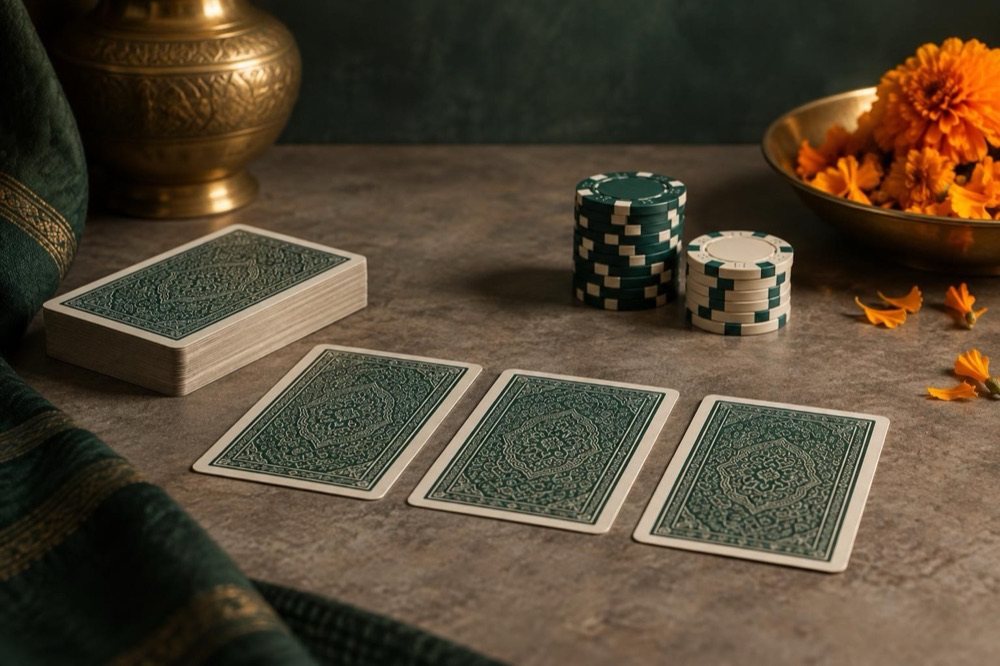
The hand rankings, from best to worst, are Trail (three of a kind), Pure Sequence, Sequence, Colour, Pair and High Card4. That ranking list will look familiar to anyone who knows Three Card Poker, and the comparison is fair: Teen Patti is close cousins with that casino game, though the betting and the social play around it are entirely Indian.
At live casinos in Goa, Teen Patti appears under the name Indian Flush, dealt at real tables alongside international games5. Online, it has spread well beyond India: live dealer studios offer Teen Patti tables6, and some international casinos list poker-style variants such as Poker Teen Patti alongside Hold'em and video poker7. For the full rules, side bets and table etiquette, see our dedicated page on Teen Patti.
Indian Rummy: formats, dealing and the pure sequence rule
Indian Rummy is the other pillar of Indian card play, and it is the game with the strongest claim to being a national pastime. It is played between 2 and 6 players with two decks of cards, which together carry four printed jokers, and the game adds one randomly selected wild joker on top of those2. Each deck holds 52 cards plus 2 printed jokers, and the game uses two kinds of joker: the printed joker, which acts as a wild card, and a randomly selected card chosen before the game starts8.
Each player is dealt 13 cards, one at a time, and the hand can never hold more than 13 cards at any moment: every time you draw, you must discard7. The game comes in two formats, 13-card and 21-card, and the 21-card version uses two jokers instead of one8. In practice the 13-card game is the more popular of the two because it finishes faster8.
To win, you must declare at least two sequences, one of which must be a pure sequence9. A pure sequence is three or more cards of the same suit in consecutive order, made without using a joker or wild card as a substitute10. A pure sequence can run to four or five cards, though six cards in a row count as two sequences10. An impure sequence is the same thing but with one or more jokers filling gaps10.
The rest of your 13 cards are arranged into sets or more sequences. A set is three or more cards of the same value in different suits; two cards of the same suit in a set makes it invalid, and a set can stretch to five cards when a joker is included10. One quirk worth knowing: in some variations, players cannot make a set of four identical cards, such as four aces11. When you have a valid hand, you declare and discard your 14th card into the finish slot7.
Our full page on Indian Rummy covers dealing, jokers and strategy in depth, and if you want to play on your phone, see online rummy in India.
Indian Rummy scoring: drops, penalties and the 80-point cap
Scoring in Indian Rummy is what gives the game its tension, because every card left in your hand costs you points when someone else declares.
Card values are straightforward: Ace, King, Queen and Jack are each worth 10 points, every other card is worth its face value, and jokers and wild cards count zero2. If you lose and you have not formed two sequences including a pure sequence, the value of all your cards is added up and capped at 80 points2. If you have one pure sequence but not two sequences, only the pure sequence goes uncounted; with no pure sequence at all, every card counts12.
You can also leave a game early, which is called dropping:
| Action | Points |
|---|---|
| First drop | 20 |
| Middle drop | 40 |
| Wrong declaration | 80 |
| 3 consecutive misses | Counted as a middle drop, 40 |
The table above applies to the standard points game9. In pool rummy the drop scores shift with the format: 20 points in a 101 pool and 25 points in a 201 pool, while drops are not allowed at all in best-of-two and best-of-three games2. A wrong or invalid declaration, meaning you declare without actually completing the objective, costs the full 80 points7.
Ganjifa: India's historic painted cards
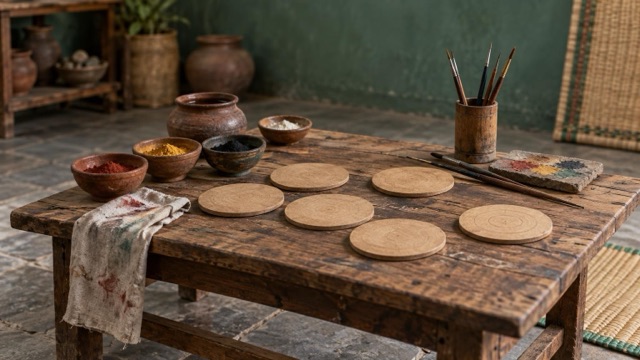
Before printed decks arrived, India had its own card tradition: Ganjifa, painted cards made in sets of circular or rectangular discs, traditionally hand-painted and often commissioned as works of art in themselves. Different regions produced different suits, colors and numbers of cards, and the games played with them ranged from simple matching games to elaborate courtly pastimes. Ganjifa decks are still made by craftspeople today, more often as collectibles than as working decks, and the game survives in pockets of Odisha and a few other states. Our Ganjifa cards page tells the story of the decks, the painters and the games that used them.
Other family games
Beyond the big two, a cluster of other Indian games shows up wherever cards are dealt. Andar Bahar and Jhandi Munda sit alongside Teen Patti in the Indian games section of live casinos13, and Dragon Tiger, a fast two-card game, is another Indian-first favorite at live tables14. Casino floors in Goa spread all of these alongside international games15, and online casinos aimed at Indian players carry the same mix16.
Trick-taking partnership games such as Dehla Pakad, Court Piece (Coat Peacees), Twenty-Eight and Fifty-Six are also long-standing Indian family favorites, particularly in the north and in Kerala, though they remain mostly home and club games rather than casino products. If you are curious about the wider picture of what India plays, see casino games in India, and for Andar Bahar specifically, we have a dedicated page on Andar Bahar.
Where to play: apps and online casinos offering Indian games
If you want to play these games against real opponents, you have three broad options:
- rummy and Teen Patti apps
- online casinos built for Indian players
- the live casino floors of Goa and Sikkim
Online, several casinos are designed specifically around Indian players. Casinodays has an Indian website and a mobile casino app with a large games portfolio for players from India17. BigBoost offers a dedicated mobile app that players from India can download to their phone18. Casino Khajana is built for Indian players who want real-money games and live casino action, with INR accounts19. Rajabets lists slots, live dealer games and Indian favorites like Teen Patti and Andar Bahar16, and Lotus365's live casino puts Teen Patti, Andar Bahar and Dragon Tiger alongside baccarat, roulette and blackjack14. Puntit offers Indian games including Teen Patti, Andar Bahar and Jhandi Munda among more than 5,000 online and live casino games13.
In person, the action is concentrated in Goa. Big Daddy Casino in Goa spreads popular games ranging from Indian Teen Patti to American Roulette, with a variety of stakes across three levels15, and Majestic Pride offers a curated selection of Indian and international table games20. India's casino culture has grown quickly in recent years, with casinos offering poker, blackjack, roulette, baccarat and slot machines21. For the full picture, see our guides to casinos in India, Goa casinos and Sikkim casinos, or start with the country overview at gambling in India.
Common Questions
How many cards are dealt in Indian rummy?
Each player gets 13 cards in the standard format, dealt one at a time from two decks. The 21-card variant deals 21 cards instead, but 13-card rummy is the version most people play because games finish faster.
What is a pure sequence in rummy?
A pure sequence is three or more cards of the same suit in consecutive order, made without using a joker or wild card as a substitute. You need at least two sequences to win, and one of them must be pure.
How many players can play Indian Rummy?
Indian Rummy works for 2 to 6 players at a table, played with two decks of cards. Online tables usually follow the same range, so it works equally well as a two-player game or a full table of six.
What does it cost in points to drop in Indian rummy?
A first drop costs 20 points and a middle drop costs 40 points. In pool rummy the drop score depends on the format: 20 points in a 101 pool and 25 points in a 201 pool, while some best-of formats do not allow drops.
What is the penalty for a wrong declaration in rummy?
If you declare without meeting the requirements, you get 80 points, the maximum loss in the game. That is the same cap applied to a losing player who has not formed two sequences including a pure sequence.
Sources21 sources
- 7 Up 7 Down, Deltin, accessed October 2026
- Rummy Rules, RummyCircle, accessed October 2026
- Gambling in India, LSHTM Research Online, January 2017
- Casino in Goa, Big Daddy Casino, July 2026
- Playtech Live, PAGCOR, July 2026
- Lucky Block, Lucky Block, accessed October 2026
- Indian Rummy (Hindi), RummyCircle, accessed October 2026
- Indian Rummy (Telugu), RummyCircle, accessed October 2026
- Rummy Rules (Kannada), RummyCircle, accessed October 2026
- Rummy Rules (Tamil), RummyCircle, accessed October 2026
- Rummy Variations, RummyCircle, accessed October 2026
- Deals Rummy Format, RummyCircle, accessed October 2026
- Puntit, Puntit, accessed October 2026
- About Lotus365, Lotus365, accessed October 2026
- Big Daddy Casino, Big Daddy Casino, July 2026
- Rajabets, Rajabets, accessed October 2026
- Casino Days, Casino Days, accessed October 2026
- BigBoost, BigBoost, accessed October 2026
- Casino Khajana, Casino Khajana, accessed October 2026
- Majestic Pride Casino, Majestic Pride, accessed October 2026
- Rise of Casino Culture in India 2026, Big Daddy Casino, June 2026