
Where the name and the game came from
Ganjifa arrived in India in the 16th century, brought in and popularized by the Mughal emperors. The usual explanation of the name points to Persia: the Persian word ganj means treasure, treasury or minted money, and the cards are thought to have traveled to India from there along with the court culture that embraced them1.
Not everyone agrees. One researcher has proposed that the name may instead derive from a Chinese term for playing cards, "Han Zhi Pai," which could have shifted through forms like Gan Je pai and Ganjefei into the Ganjafa and Ganjifa we know today5. Both theories share the same idea: the cards, or at least their name, came to India from somewhere else along the trade and conquest routes of Asia.
The earliest Indian record of the game is old. Babur, the first Mughal emperor, mentions the cards in his memoirs, so the game in India can be traced back to the 16th century6. At the Mughal court the game was a genuine pastime of emperors, played with decks that could be made from precious metals and stones, a sign of how highly the court valued it7.
From the court, the game spread outward and downward. In Odisha, the local form, called Ganjapa, was used as playing cards by the royal class as well as the common mass throughout the state4. The same cards that amused an emperor in a palace also filled evenings at ordinary social gatherings, and each region that adopted the game reshaped it in its own style.
The designs and suits on a ganjifa deck
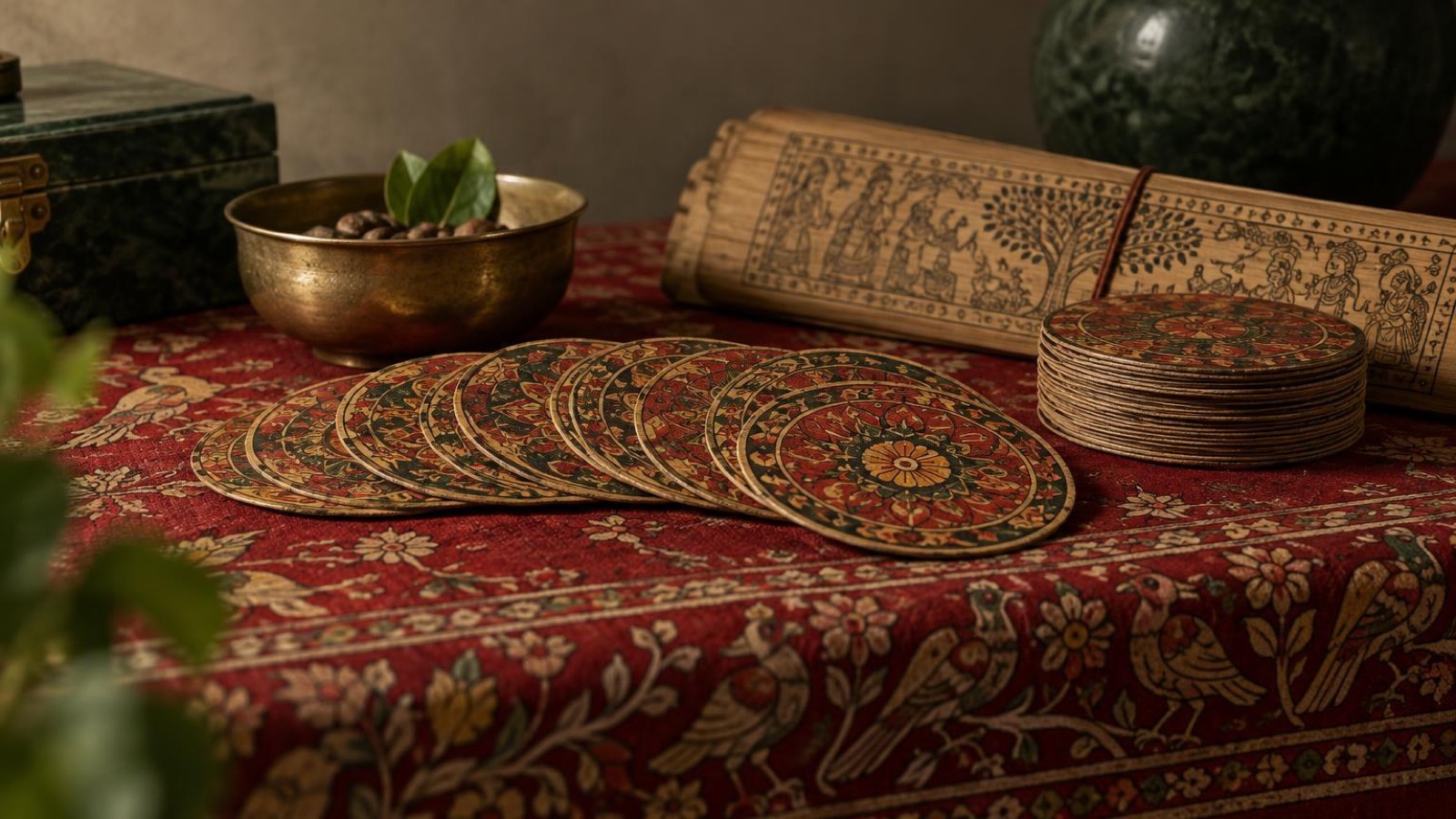
A ganjifa deck does not look like the deck you may know. The most striking difference is the shape: in Odisha the cards are circular, and the paintings on them are drawn in the traditional pattachitra style of the region2. Because each card is hand painted, each pack of Ganjapa cards differs from every other2.
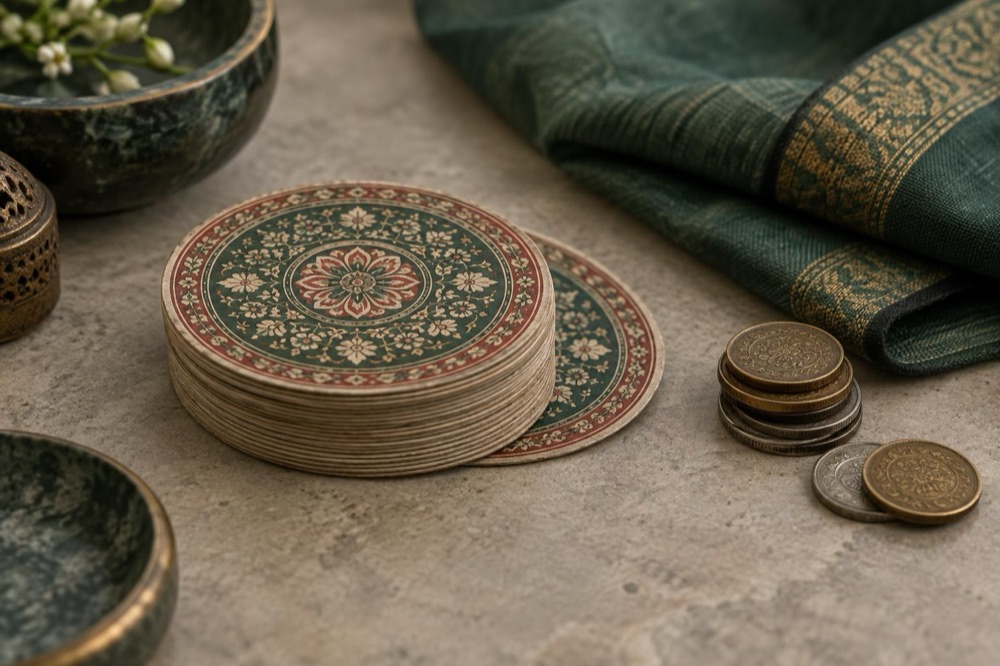
The structure of the deck also varies by tradition. The classic Mughal ganjifa pack holds 96 cards in eight suits, with twelve cards in each suit: two picture cards and ten numeral cards8. Indian ganjifa cards in general always carry only two court cards per suit, unlike the three of a European deck5.
The Hindu tradition built its own version. The Dashavatara ganjifa of Bishnupur, in Bengal, has 120 cards, and every suit of a Dasavatara pack consists of 12 cards1. The game played with this particular deck, known as Dashabatar tash, started 400 years ago in the court of King Bir Hambir9.
The Odisha sets follow their own counting. Each Ganjapa playing card set contains 98 or 104 cards2. The sets are named according to the number of colors used6.
| Number of colors | Name of the set |
|---|---|
| Eight | Atharangi |
| Ten | Dasarangi |
| Twelve | Vararangi |
| Fourteen | Chaudarangi |
| Sixteen | Solarangi |
The pictures on the cards tell stories. In Odisha, the number a card represents is usually shown through images of a common theme element, such as a tree, a fruit, a leaf, a bird or mythological creatures, and whole packs depict tales of the Ramayan or Krishna's mythological stories6. So a deck is not just equipment for a game; it is a painted narrative you can hold in your hands, and the round format and epic imagery are what make a ganjifa set instantly recognizable.
How ganjifa was played
The Persian ancestor of the game is old but shadowy. The 96-card Ganjafa pack was in use in the 16th and early 17th centuries, and perhaps even earlier, but no surviving cards are known and no rules of any of the games played with it have come down to us8. What we know about play comes from the Indian traditions.
The Mughal ganjifa of 96 cards, played mainly in Sawantwadi in Maharashtra, is a game for three persons only10. The Odisha version, the Ath-Rangi Moghul Ganjifa, also uses 96 cards in eight suits of eight colors, and play begins with eight cards laid on the dais, taken by the winner as a first hand10.
The details of play in some regional traditions have thinned out. In Nirmal, Andhra Pradesh, the artists still make Moghul Ganjifa and Dashavatara Ganjifa cards, but no specific rules are supplied with the games or are known to the Ganjifa artists there10. The cards survived; the games, in some places, did not survive with them.
What the historical record does make clear is how widespread the playing was. In Odisha, Ganjapa was once a part of ordinary social get-togethers and recreational life, used by the royal class and the common mass alike4. It was a game for evenings with friends as much as for courtly display, closer in spirit to a neighborhood card night than to the high-stakes tables of a casino.
What a set can tell you about itself
If you come across a ganjifa set, a few details will tell you what tradition it belongs to. Start with the shape and the painting style. Round cards painted in the pattachitra style point to Odisha, where the local name is Ganjapa and the set is still known as Mughal Ganjifa in many regions of the state6.
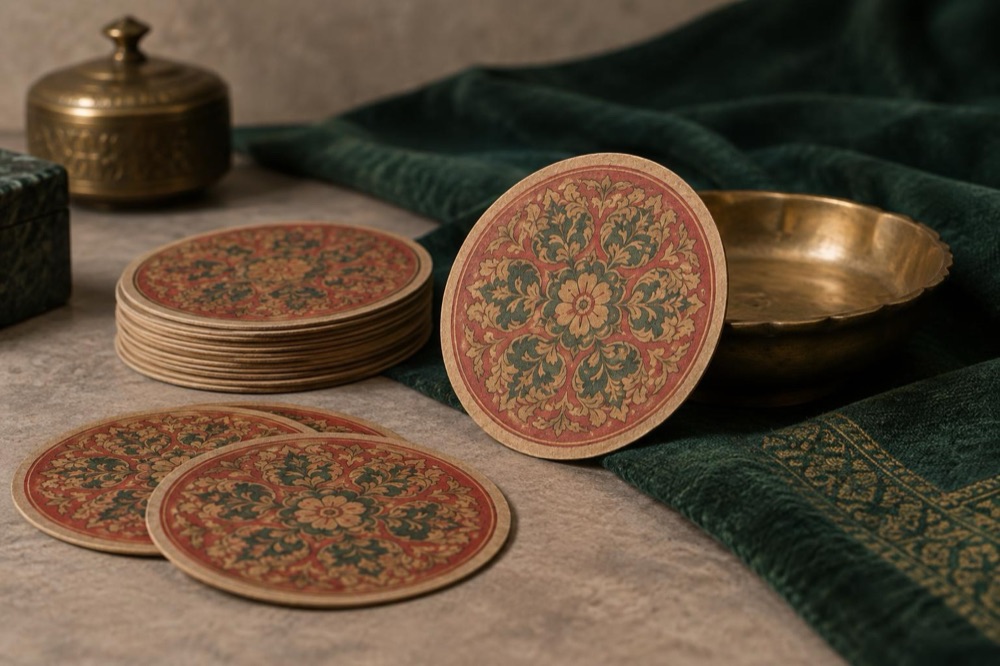
Count the cards, because the total points to a tradition1.
- A 96-card pack in eight suits points to the Mughal tradition10
- 120 cards point to the Dashavatara tradition of Bishnupur1
- 98 or 104 cards point to Odisha2
Then count the colors, because in Odisha the number of colors gives the set its name, from eight-color Atharangi up to sixteen-color Solarangi6.
Look at the pictures. Suits built around trees, fruits, leaves, birds or mythological creatures, and packs telling stories from the Ramayan or from Krishna's tales, are the hallmark of the Odisha painting tradition6. And remember that every pack is unique, because each card is hand painted2. Two sets from the same workshop will never be identical, which is part of what collectors value in them.
Where to see ganjifa cards today
Ganjifa today sits between a living tradition and a museum piece. The cards are well known to playing-card collectors but unknown to most Indian card players, and there are very few places where they are still used for play3. In Odisha, the craft is described as a dying art form, almost out of use, with only a few master artists still able to create the packs6.
Most Ganjapa sets now serve a different purpose: they are mostly used as decorative collectible items for art lovers2. That is not a small thing. Many works have found a place in museums across the world, including in Germany and London6, so the cards that emperors once held have ended up in display cases on several continents.
The regional traditions have not all faded equally. Some forms of the card game still exist in Bengal, Andhra Pradesh, Maharashtra and Karnataka, while the Ganjapa of Odisha remains unique for its pata patterns and colors, an artistic avatar of the local pata paintings6. Within Odisha, the cards were historically most popular in the Ganjam and Puri districts6.
If you want to see the tradition in its setting, the places to look are the craft centers of Odisha, the heritage town of Bishnupur in Bengal, and Sawantwadi in Maharashtra, each with its own style of deck. For the wider story of how games of chance took root across the subcontinent, see our page on gambling culture and history in Asia, and for a closer comparison of the two best-known Indian card traditions, see Ganjifa vs Ganjapa.
Common Questions
What does the word ganjifa mean?
The most common explanation links it to the Persian word ganj, meaning treasure, treasury or minted money, since the cards probably traveled to India from Persia with the Mughals. Another researcher suggests the name may instead derive from a Chinese term for playing cards.
How many cards are in a ganjifa deck?
It depends on the type. The classic Mughal ganjifa pack has 96 cards in eight suits of twelve. The Dashavatara ganjifa of Bishnupur has 120 cards, with twelve in each suit. Ganjapa sets from Odisha contain 98 or 104 cards.
What are ganjifa cards made of?
Traditional ganjifa cards are hand painted, often on a round face, which means every pack differs slightly from every other. In Odisha the paintings follow the pattachitra style, and at the Mughal court some decks were made from precious metals and stones.
Is ganjifa the same as playing cards?
Yes, ganjifa is a family of playing cards, but it is not the familiar 52-card deck. Ganjifa decks have eight or more suits, round cards in many regional styles, and painted figures from Hindu epics or court imagery instead of the standard kings and queens.
Which Indian regions are known for ganjifa?
Odisha is the most famous, especially the Ganjam and Puri districts, where the local form is called Ganjapa. Related forms exist in Bengal, Andhra Pradesh, Maharashtra and Karnataka, and Sawantwadi in Maharashtra is known for its Mughal ganjifa.
Can you buy ganjifa cards today?
You can, mainly as art objects rather than game equipment. Because each card is hand painted by a small number of master artists, packs are sold to collectors and art lovers, and many works have ended up in museums in Germany and London.
Is ganjifa still played anywhere?
Only in a very few places. The cards are well known to collectors but unknown to most Indian card players, and in Odisha the craft is described as a dying art kept alive by a handful of master artists who make the packs.
Sources10 sources
- Lost Game Dashabatar Taas of Bishnupur, Chitrolekha, 2013
- A unique pack of cards, The Hindu, August 29, 2012
- Card games of India, Pagat.com, June 19, 2026
- A unique pack of cards (archive), The Hindu, August 29, 2012
- ZentralAsien playing cards research, Alta Carta, 2006
- Ganjapa cards of Odisha, The Telegraph (India), February 5, 2014
- Indian rummy: origin and gameplay, Mumbai Gullies, February 23, 2023
- Card games of Iran, Pagat.com, February 21, 2024
- Preserving Bishnupur's heritage, The Hindu, December 5, 2015
- Eight-handed and related ganjifa games, Kishor Cards















