Lucky days to gamble: how players pick them
Ask a regular lottery buyer in China when they play and the answer is often about routine as much as luck. Draw schedules themselves create the rhythm, and fans plan their weeks around them:
| Game | Country | When it draws |
|---|---|---|
| Shuangseqiu (Double Color Ball) | China | Every Tuesday, Thursday and Sunday5 |
| Kuaile 8 | China | Daily at 21:306 |
| Numbers lottery | Japan | Set weekdays, with different games tied to Tuesday or Wednesday7 |
| Halloween Jumbo | Japan | Fixed dates such as October 268 |
On top of that fixed calendar, many players layer a personal one. Some consult the almanac for an auspicious day to buy; others simply stick to a day they consider theirs. The devotion can be remarkable:
- One Chinese lottery fan, Mr. Liu, bought the same Double Color Ball number set for 11 years straight9.
- Another, Mr. Jin, described as a devoted welfare lottery fan, had 12 years of buying experience behind his choices9.
Players like these are not chasing a system that works; they are honoring a ritual, and the ritual is part of the fun.
Scratch tickets have their own following. The "hao yun shi bei" (ten times good luck) scratch ticket uses a classic match-the-numbers format with a "one to many" structure that gives multiple winning chances on a single ticket1, which appeals to players who like the feeling of several bites at the apple in one lucky moment.
If you want to go deeper into the wider world of belief that surrounds all this, our page on gambling superstitions in Asia covers the rituals players perform at the table, and asking spirits for numbers explains the temple and shrine rituals some players use to pick their digits.
The Chinese almanac (Tong Shu) and how it marks auspicious days
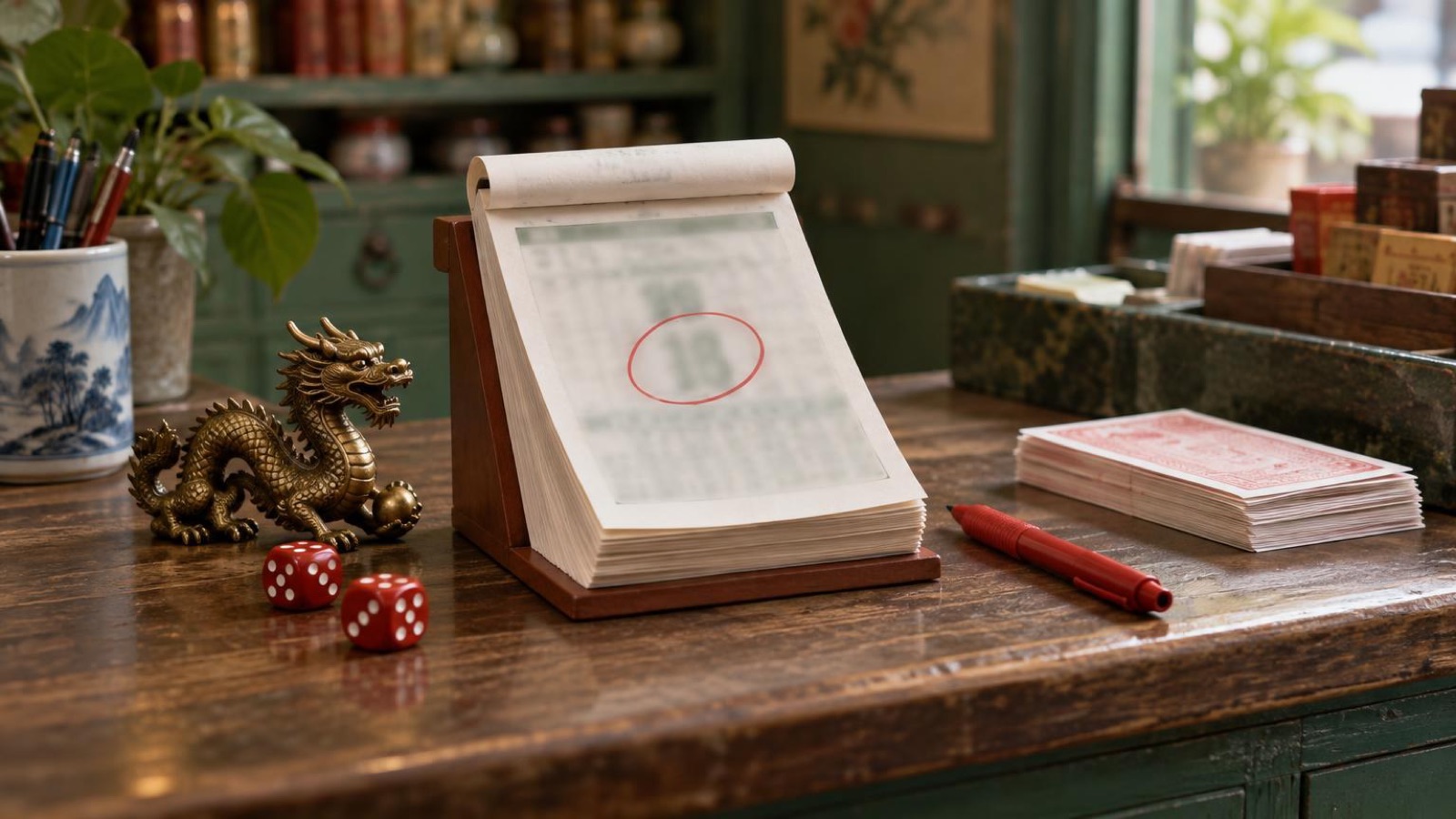
The Tong Shu, the traditional Chinese almanac, is the reference work at the heart of lucky-day thinking. For each day of the lunar calendar it tells you:
- which activities are auspicious that day
- which are to be avoided
- which zodiac signs the day clashes with
- which directions are lucky or unlucky
Families have used it for centuries to choose wedding dates, business openings, travel and, yes, trips to the casino or lottery counter. In Hong Kong, Taiwan and Chinese communities across Southeast Asia, newspapers still print a daily almanac column, and phone apps now do the same.
The almanac's logic is not random. It draws on the sexagenary cycle, the rotating pairing of ten heavenly stems and twelve earthly branches that also underlies the zodiac. A day that harmonizes with your birth year's sign is considered favorable for you specifically, which is why two players at the same table may disagree about whether the day is lucky: it can be lucky for one and clash with the other.
The habit of consulting chance-reading tools before gambling is old. The research on Shengguan Tu, the "promotion game," shows how deeply dice-based fortune was woven into traditional play. Shengguan Tu was an ancient gambling game played on paper, printed with the names and ranks of civil and military officials arranged as a board, played with dice and chips10. Regional versions varied:
- In Taiwan, a version used a four-sided spinning top instead of dice, with each face carved with one of four characters: de (virtue), cai (talent), gong (merit) and zang (corruption)10.
- The Hong Kong version, from the Shanghai Sanxing Shushe, mapped dice pairs onto those same moral categories: two fours meant de, two sixes cai, two fives gong, two threes liang, two twos rou, and two ones zang10.
The idea that a throw reveals a moral verdict, fortune or misfortune, is exactly the mindset the almanac serves: the day, like the dice, is thought to carry a verdict of its own. You can read more about these old games on our page about ancient board games played for stakes.
Numbers, colors and zodiac signs players trust
Beyond the calendar, players lean on numbers, colors and their zodiac year. The number 8 is the most famous example in Chinese communities, prized because its pronunciation echoes the word for prosperity, while 4 is avoided because it sounds like the word for death. Our dedicated page on lucky and unlucky numbers in Asian gambling goes through the full list, including how 9 plays differently in Chinese and Japanese.
The number 8 even shows up in the names of games and bets:
- Kuaile 8, the daily Chinese lottery mentioned above, carries the lucky digit in its very title6.
- At the baccarat table, the "Panda 8" side bet pays 25 to 1 when the Player hand wins with a three-card total of 82, a wager built squarely on the number's reputation.
- In Vietnam, xoc dia, the dice game, has its own culture of trusted numbers and rituals, though playing it online can carry criminal liability there11.
Zodiac years matter too. A person's birth-year animal shapes which days, colors and even which gambling companions suit them, and years considered clash years, when the current year's animal conflicts with your own, are times many players choose to sit out big bets. Colors follow the same logic: red is the great auspicious color of the Chinese world, worn at weddings and New Year, and you will see it at the tables too, a habit explored on our lucky colors and charms page.
None of this changes the mathematics. A craps table offers more than 10 types of wagers with varying combinations, and many of them lean heavily in the house's favor12; a lucky day does not move those numbers. What the beliefs change is when people play, how they feel playing, and how crowded the floor is.
Days players avoid: Ghost Month and inauspicious dates
If Chinese New Year is the great auspicious season, Ghost Month is its opposite. Falling in the seventh month of the lunar calendar, it is the period when spirits are believed to return to the world of the living, and many players across Taiwan, Hong Kong, Vietnam and Chinese communities in Malaysia and Singapore avoid gambling during it, particularly on days the almanac marks as inauspicious. Water is associated with danger during Ghost Month, which is one reason the period has a special reputation among racing and casino crowds.
Chinese New Year, by contrast, is when belief and gambling meet most visibly. In Macau, the law itself acknowledges the season: casino employees, who are normally banned from entering casinos, are allowed to enter during the first three days of Chinese New Year, though they still may not gamble directly or through others in casinos operated by their own employer1. The first days of the lunar new year are considered the luckiest of the year for starting anything, betting included, and the floors are packed accordingly.
Where the beliefs show up at the tables
You can see the almanac mindset in the physical rituals of play:
- At the craps table, players blow on the dice, shake them high, or call numbers aloud before throwing, and the game supports the theater: the table offers more than 10 wager types, and a common rule of thumb is that bets on the outside of the table have better odds than those in the middle12.
- At baccarat, players squeeze their cards slowly to build suspense, and side bets like the Dragon Bonus, wagered in marked areas on either the Player's or Banker's hand2, give the ritual more stages.
- In pai gow, the Banker role carries advantages that players treat as a position of power: the Banker covers the other players' wagers each round, wins on all ties, and may bet up to 10% more than the other players at the table14. Securing the Bank seat at the right moment, on the right day, is part of the game's appeal for superstitious players.
- Even in poker, the plain spoken bet, saying "I bet $5"14, becomes a small ceremony when a player has waited for what they believe is their moment.
The beliefs also shape the venues themselves. Casino design in Asia leans heavily on feng shui, from entrance orientation to the placement of lucky objects, a subject covered in full on our casino feng shui page. And the belief economy extends to dreams: across the region, players convert dream images into lottery numbers, a tradition explained on our dream numbers page.
The wider context matters too. In South Korea, the chance-and-skill games on offer include horse racing, cycle racing (keirin), boat racing, poker and blackjack15, and Kangwon Land, the casino open to Koreans, runs all year without holidays16, so there is no calendar gate on when you may play, only the ones players impose on themselves. Japan's keirin betting rules cap a day's betting at 3,000 bets17, and Korean boat racing's simplest wager, the win bet, has a hit probability of about 1 in 618, numbers that no almanac can improve.
Legal forms of gambling in Thailand: state horse racing and the lottery
Thailand is a country where the calendar of belief is lively but the legal menu is short. Thai law recognizes only one legal category of gambling: the government lottery and state-run horse racing19. The Thailand Gambling Act of 1935 makes everything else illegal20, and with a population of about 65 million using the Thai baht20, the state lottery is a genuine mass institution, with draws that millions of players plan their months around. Thai lottery culture is thick with number beliefs: players read omens, temple visits and even truck license plates for digits, and first-prize numbers are scouted with the same seriousness the almanac gets in Chinese communities.
Horse racing has a long pedigree in Thailand:
- Horse racing in Thailand is state-controlled, and betting on the races is one of the few forms of gambling permitted alongside the official lottery4.
One recent change deserves mention: tournament poker was officially legalized in Thailand in August 2025, when the government overturned a long-standing ban21, though a full legal framework for the new law has yet to be implemented21. In practice, online poker players in Thailand have not reported cases of individual players getting into trouble20, but the safe assumption remains that the lottery and the racetrack are the legal options. For the full picture, see our guide to gambling in Thailand.
Vietnam's casinos: who may enter and where
Vietnam legalized brick-and-mortar casinos in pursuit of economic stabilization, and for over a decade locals were banned from the land-based floors while foreigners played22. That changed at the end of 2025. From November 26, 2025, a resolution permits eligible Vietnamese citizens to enter the casino at the Phú Quốc casino project in An Giang province23, and the policy discussion around it anticipated two groups of people being allowed into casino business points24.
Who may enter, and on what terms:
| Who | Conditions |
|---|---|
| Vietnamese citizens | At least 10 million dong a month in income, no criminal record; family can ask the casino to bar you from visiting25 |
| Foreigners and overseas Vietnamese with foreign passports | May receive winnings and transfer or carry winnings abroad in foreign currency under Vietnam's foreign exchange rules; working minimum age 1825 |
Authorities have also sought higher entry fees for locals as a way of simplifying verification of financial eligibility22.
For the full picture, see our guide to gambling in Vietnam.
Online play in the region: what is regulated and what is not
The online picture varies sharply by country, and it is worth knowing plainly before you rely on any site.
In mainland China, all gambling is prohibited, in every form: an official Liaoning province notice lists mahjong, poker, dominoes, dice, the underground "Mark Six" lottery, electronic gaming machines, computer networks and even WeChat red packets as banned forms28. Online football betting specifically is treated as a criminal offense, with organizing, acting as an agent for, or participating in it exposing a person to administrative or criminal liability29. There is no regulator like those found in licensed markets31, players face hefty fines and imprisonment31, and because the market is unregulated there are no official channels of support for people experiencing gambling-related harm31. Foreigners residing in China can face blacklisting and a 10-year entry ban31.
In Japan, the police guidance is equally blunt: gambling conducted online, whether baccarat, slots or sports betting, is a crime regardless of the game's name or content32. In India, 2025 legislation prohibits online money games outright, whether based on skill, chance or both33. Vietnam, as noted above, does not regulate online gambling and does not allow locals to play online22.
Where does that leave the player who enjoys the game? With the licensed options:
- China's state lotteries, with their published draw schedules and prize structures, such as the Super Lotto's fixed eighth prize of CNY 1534 and a 60-day redemption window on the 9-match football game35
- Japan's takarakuji
- Macau's casinos
- Vietnam's newly opened floors
- The state lottery and racetracks of Thailand
Singapore, meanwhile, offers a reminder that even legal play comes with guardrails: family members there can apply for a Family Visit Limit to cap a relative's casino visits in a calendar month when gambling has caused harm36, part of a broader official view that gambling can become highly addictive if not controlled37.
The lucky-day traditions of Asia are, at bottom, about giving play a rhythm and a meaning. They tell you when the crowd will be at the tables, why the man next to you is wearing red, and why the eighth of the month feels special. They will not change the odds. For that, the only calendar worth consulting is your own budget.
Common Questions
What is a good lucky day to gamble according to the Chinese almanac?
The almanac rates each day of the year as more or less favorable for different activities, and players look for days marked auspicious for wealth or taking risks. There is no single fixed lucky day; the rating changes daily, so players check the almanac or a newspaper listing for the current date.
Is the number 8 really considered lucky in gambling?
Yes, in Chinese-speaking communities 8 is widely treated as lucky because its pronunciation resembles the word for prosperity. The belief shows up in license plates, phone numbers and betting choices, though it has no effect on the odds of any game.
What is Ghost Month and should gamblers avoid it?
Ghost Month, the seventh month of the lunar calendar, is when spirits are believed to walk the earth, and many players avoid gambling during it, especially on the days seen as most inauspicious. It is a matter of tradition rather than any change in how games actually pay.
Do casinos in Asia change their layouts for feng shui?
Yes, feng shui has a strong influence on casino design in Asia, especially in Macau, where entrances, table placement and decor are often arranged to keep luck flowing. See our page on casino feng shui for how it works.
Can foreigners gamble in Vietnam's casinos?
Yes. Foreigners can enter licensed casinos with a passport, and since late 2025 eligible Vietnamese citizens can also enter certain casinos, starting with the Phú Quốc project, if they meet age and financial conditions.
What gambling is legal in Thailand?
The government lottery and state-run horse racing are the legal forms. Tournament poker was also legalized in 2025, though the full framework has not yet been implemented. Everything else remains illegal under the Gambling Act of 1935.
Is online gambling legal for players in China?
No. All gambling is prohibited in mainland China, including online betting, and players face fines and imprisonment. There is no regulated market and no official support channel for gambling-related harm.
What is the minimum age to enter a casino in Vietnam?
Vietnamese citizens must be 21 or older with full civil capacity to enter a licensed casino. Foreign visitors are generally held to the standard 18-and-over rule that applies to legal casino gambling in Vietnam.
Sources37 sources
- Hao yun shi bei scratch ticket, zhcw.com, April 6, 2023
- Baccarat how to play, PlaySmart, September 25, 2026
- Cross-border gambling fraud warning, Chifeng Public Security Bureau, January 12, 2026
- Thailand horse racing history, Thammasat University Library
- Shuangseqiu draw information, zhcw.com, accessed September 26, 2026
- Kuaile 8 game rules, zhcw.com, accessed September 26, 2026
- Takarakuji official lottery brands, Takarakuji Official, accessed September 26, 2026
- Jumbo lottery brands and draws, Takarakuji Official, 2026
- Lottery fan stories, zhcw.com, March 28, 2023
- Shengguan Tu research paper, NTNU, June 2005
- Xoc dia and online liability, Thu Vien Phap Luat, November 9, 2023
- Craps how to play, PlaySmart, September 25, 2026
- Special Cash Sweep play responsibly, Cash Sweep, 2026
- Pai Gow and poker betting rules, PlaySmart, September 25, 2026
- Korean chance-and-skill games FAQ, K Boat, September 25, 2026
- Kangwon Land Casino, Visit Korea, September 25, 2026
- Keirin betting terms, Keirin, May 1, 2026
- Boat racing win bet odds, K Boat, September 26, 2026
- Legal gambling in Thailand, Thai Wikipedia, 2026
- Thailand poker guide, Somuchpoker, February 20, 2026
- Tournament poker legalized in Thailand, Asia Gaming Brief, August 6, 2025
- Vietnam casino guide, Wizard of Odds, May 5, 2026
- Vietnamese citizens allowed at Phú Quốc casino, Vietnam News, November 26, 2025
- Two groups allowed into casino business points, Bao Chinh Phu, August 6, 2025
- Casino entry conditions for Vietnamese citizens, Thu Vien Phap Luat, November 28, 2025
- Online gambling money laundering arrests, Vietnam News, June 10, 2026
- Ho Chi Minh City betting ring dismantled, Ministry of Public Security, July 7, 2026
- Liaoning crackdown on gambling crimes, Liaoning Public Security, January 20, 2023
- Online football betting is illegal, official news, August 18, 2026
- Online football betting warning, Ministry of Justice, July 20, 2026
- China online casino guide, Wizard of Odds, May 5, 2026
- Online casino warning, National Police Agency of Japan, September 25, 2026
- Online money game prohibition, Ministry of Electronics and IT, August 22, 2025
- Super Lotto prize structure, Sporttery, September 26, 2026
- 9-match football game redemption rules, Sporttery, September 26, 2026
- Family Visit Limit, MSF NCPG, September 25, 2026
- When gambling becomes a problem, MSF NCPG, September 25, 2026