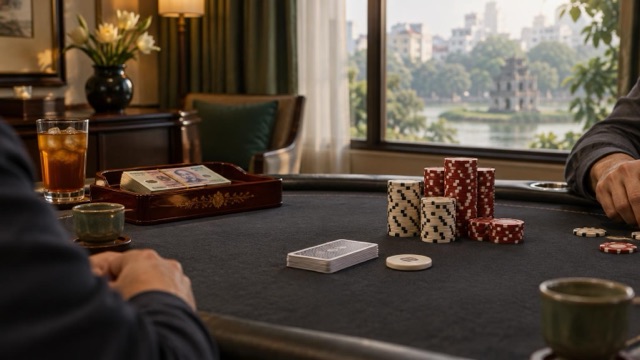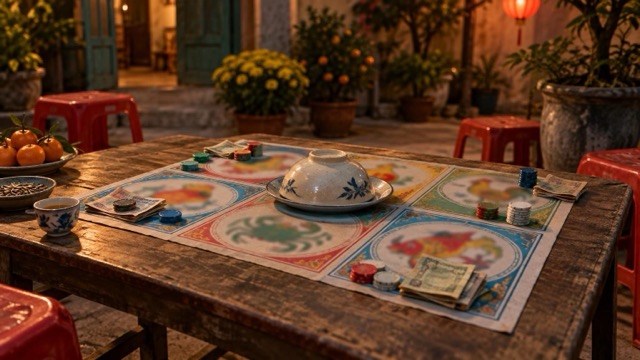
Xoc dia is one of the simplest gambling games in Asia, and that is exactly why it has traveled so far. The name means "shake the plate": a dealer drops a handful of coins onto a plate, covers them with a bowl, shakes, and everyone bets on what is underneath. No cards, no dice, no strategy. A round takes seconds, the equipment costs almost nothing, and the game turns up anywhere people gather, from village festivals to livestreamed tables on the internet.
If you have seen bau cua tom ca at Tet, xoc dia is its even faster cousin. Where bau cua uses three dice and a picture mat, xoc dia uses nothing but coins and a bowl. This page covers the equipment, how a round runs, the four classic bets, what the odds look like with four two-sided tokens, the online versions, and where the game stands in Vietnam today.
Equipment: plate, bowl and coins
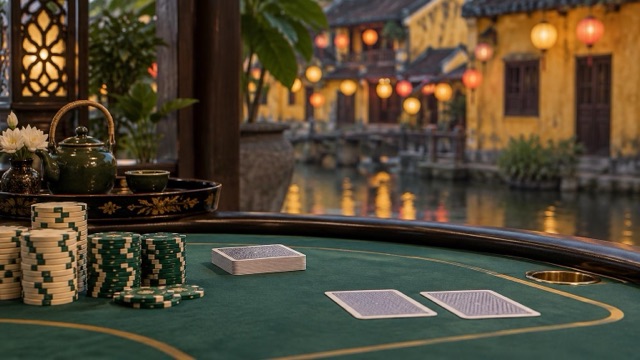
The beauty of xoc dia is that you can start the game with three household items: a plate, a bowl and some coins1. That is the entire kit. There is no special table, no printed layout, no casino-grade equipment. In its traditional form the game is played on whatever flat surface is available, with the plate in the middle and the bowl upside down over the coins.
The coins themselves are ordinary two-sided coins, and the game works because each coin has two distinguishable faces. In Vietnam the faces are usually described by color: one face is "red" and the other "white." Players bet on how many of each color will be showing when the bowl is lifted2.
How many coins? Most games today use either 2 or 4 coins1. Four is the classic count, and it is what gives the game its full set of bets: with four coins you can bet Even or Odd on the count of face-up coins, and you can bet the rarer outcomes, All Red or All White. Two-coin versions exist and play faster, but they shrink the menu of bets. Everything in this page assumes the four-coin game unless stated otherwise.
Because the equipment is so cheap, xoc dia has always been a street and home game first. The same simplicity that makes it easy to set up anywhere also makes it easy to set up anywhere it should not be, which is part of the game's complicated legal story in Vietnam, covered near the end of this page.
How a round is played
A round of xoc dia runs in four quick steps.
- Place your bets. Players put money (or chips) on the outcome they want: Even, Odd, All Red or All White. Betting on the number of face-up and face-down coins in the plate is the heart of the game2.
- The shake. The dealer drops the coins onto the plate, covers them with the upturned bowl, and shakes the whole thing so the coins tumble. This is the "xoc" that gives the game its name.
- The reveal. The dealer lifts the bowl, and everyone can see how the coins landed.
- Settle. Winning bets are paid, losing bets are swept, and the next round begins immediately.
That is all there is to it. There is no turn order, no decision point during the round, and no way for a player to influence the outcome once the bowl goes down. Compare that with a card game like xi dach, where play starts from the player to the right of the dealer and moves clockwise5, or poker, where you choose whether to check, bet, call, raise or fold on every betting round6. In xoc dia your only decision is made before the shake, and it is simply which outcome to back.
The pace is the appeal. A dealer can run a round every few seconds, which makes xoc dia one of the fastest gambling games you will ever watch. It also means money moves quickly in both directions, so it pays to know exactly what each bet means before you put anything down.
The bets: Even, Odd, All Red or All White
The four-coin game offers four classic bets, and they come in two pairs.
Even (chẵn) and Odd (lẻ). These are the workhorse bets. You are betting on the count of coins showing a particular face: an Even bet wins if an even number of coins land face up, an Odd bet wins if an odd number do2. The Vietnamese names chẵn and lẻ are the same words used for even and odd numbers generally, so if you hear "chẵn lẻ" around a table, that is this pair of bets. The Even bet pays even money, 1:1, in line with how the equivalent even-money bet pays in the closely related dice game sic bo3. Odd pays the same way.
All Red and All White. These are the long-shot bets. Instead of betting on the count, you bet that every single coin lands the same way: all four showing red, or all four showing white. They hit far less often than Even or Odd, which is why they carry the bigger payout and why tables often draw a crowd when one lands.
If the structure feels familiar, it should. Betting odd or even, or on a color, is exactly how outside bets work in roulette, where you can bet the winning number is odd or even, red or black7. Xoc dia compresses that idea into four coins and a bowl.
A quick word on what "red" and "white" mean, since it can confuse first-timers: the colors refer to the two faces of the coins, not to anything on the table. Before you bet at any table, online or in person, make sure you know which face counts as red and which counts as white, because that is the entire basis of the All Red and All White bets.
Odds with four two-sided tokens
With four two-sided tokens, every shake lands on one of the possible face combinations, and if the coins are fair, each combination is equally likely. The bets then divide those combinations into groups: Even and Odd each cover a large group of outcomes, while All Red and All White each cover a single combination, which is why they are rare and pay more.
For a documented payout on this kind of four-token structure, the closest relative is fan-tan, the old Chinese game that also resolves bets on a count of hidden objects. Fan-tan's SSH bet, a wager on the split of the four tokens used in that game, pays odds of 3:48. That is a useful reference point for how games of this family price their bets: the frequent outcomes pay short, the rare ones pay long, and the house keeps the difference.
The practical takeaway for a player is simple. Even and Odd will win often and pay 1:13. All Red and All White will rarely win and pay a multiple of your stake. No bet is smarter than another in terms of influencing the outcome, because the outcome is fixed the moment the bowl comes down. What differs is only how often each bet wins and what it pays when it does.
That also means the game is wide open to cheating in unregulated settings. A dealer who can control the shake, or a table using weighted coins, changes the odds entirely, and you would have no way to tell. This is the single biggest practical risk of playing xoc dia anywhere outside a properly audited environment, and it is worth more thought than the mathematics.
Is it skill or chance?
Xoc dia is a game of pure chance, full stop. Once the coins are under the bowl, nothing you do, say or believe changes how they land. This puts it in the same family as sic bo, which is described plainly as a game of pure chance with no strategy or skill involved9, and craps, which requires no skill or strategy to play10. It is unlike poker, which is a skill-based game in which both chance and strategy influence your outcome11.
So the honest answer to "is there a system?" is no. Anyone selling a xoc dia strategy is selling noise. What you can control is which bets you take, at what stakes, and for how long, and those are bankroll decisions, not game decisions. If you enjoy games where your choices matter, look at poker in Vietnam instead. If you enjoy the suspense of a quick reveal, xoc dia delivers that as well as any game in Asia.
Tokens used today
In person, the tokens are still just coins. But online, "tokens" has taken on a second meaning, because much of the internet's xoc dia now runs on cryptocurrency platforms.
Some platforms issue their own tokens.
| Item | Detail |
|---|---|
| $DICE token | Runs on the Solana network, chosen for its fast transaction speeds and low costs, and can be purchased using SOL, ETH or BNB12 |
| Coins accepted at one crypto casino | BTC, BCH, LTC, ETH, DOGE, USDT, XRP, ADA, BNB, TRX, USDC and SOL13 |
| Expanding payment rails | Platforms add coins like Toncoin (TON) and others as supported currencies14 |
If you are curious about how money moves in and out of gambling sites from Vietnam, including crypto and other methods, see gambling payments in Vietnam.
Xoc dia online: features and fairness
Online xoc dia websites exist2, and the live-dealer versions are the closest thing to sitting at a real table. Stakes can be low: on at least one platform, live xoc dia and live baccarat start from VND 10,000 per round, with most slots playable from a few thousand VND per spin4. For scale, that is about the price of four coins in a fish-shooting arcade game, where one "xu" costs about VND 2,500 and equals 5 points15.
What should you look for in an online version?
- A fairness check. Some platforms offer a "verify fairness" feature that lets you confirm a round's outcome was not tampered with16. On a game as physically simple as xoc dia, where a rigged shake is invisible to the viewer, this matters more than it would on a card game.
- Responsible play tools. Look for a dedicated Responsible Gaming section16, and check whether the platform runs live support alongside a responsible gambling page17. Guidance on safer play applies to social casino games too, which are now freely available on social networks, websites, apps, smartphones and tablets18.
- Fixed stakes. In online versions, the stake is set by the house rather than negotiated at the table, as is the case with the online version of pokdeng19. Check the table limits before you sit down.
One more thing worth knowing: online gambling in Vietnam is not regulated, a point the next section covers in full. The sites that serve Vietnamese players do so from outside the Vietnamese system, which is the context for that section.
Legal status in Vietnam
Here is the plain version. Playing xoc dia is treated as an act of gambling under Vietnamese law1, and the game is considered by the Vietnamese government an illegal form of gambling2. Online xoc dia carries the same character: it is not a regulated product, and playing it online can expose you to criminal liability1. Locals are not allowed to gamble online in the country20.
The practical risk in one sentence: outside the licensed casino system, which serves foreign visitors rather than residents, a xoc dia table in Vietnam is an illegal gambling operation, and being at one can get you in trouble regardless of how small your bet is.
If you want gambling you can take part in legally, the options differ by who you are. Foreigners who enter Vietnam legally may participate in licensed products such as Vietlott's Max 3D Pro21, and the licensed casinos described in casinos in Vietnam are open to visitors. Vietnamese players have the state lottery products, covered in the Vietnam lottery. For the wider picture, see gambling in Vietnam.
A little culture
Xoc dia belongs to a family of quick, equipment-light gambling games that spread across Asia through ports, markets and festivals. Its nearest relatives are the Chinese games that also resolve a hidden count: fan-tan, with its four tokens and its 3:4 SSH bet8, and sic bo, the three-dice game that traveled from the same region into casinos worldwide and now appears on the floors of Vietnamese resorts alongside blackjack and baccarat22. Even and Odd betting, the heart of xoc dia, echoes through roulette's outside bets7 and sic bo's even-money Even bet3.
What makes xoc dia distinctly Vietnamese is how little it needs. Games like tu sac and Vietnamese mahjong require tiles and skill; xoc dia requires a plate, a bowl and pocket change1. That made it the people's gambling game, the one anyone could run at a wedding or a wake, and also the one the authorities have spent decades trying to stamp out. The same low barrier to entry that made it everywhere made it impossible to license or tax.
Today the game lives two lives. In person, it survives in the informal settings it has always occupied, with all the risk that carries. Online, it has been reborn as a livestreamed live-dealer product with crypto rails and fairness verification16, played for stakes that can start at the price of a bowl of pho4. The bowl and the plate have not changed. Everything around them has.
Common Questions
How many coins are used in xoc dia?
Most games today use either 2 or 4 coins. Four is the classic setup, because it gives the Even, Odd, All Red and All White bets their familiar shape. Two-coin versions are quicker and more common in casual settings.
What does an Even bet mean in xoc dia?
You are betting that an even number of coins will land face up after the bowl is lifted. It is the simplest bet on the table and, like the Even bet in sic bo, it pays even money, 1:1, when it wins.
What are the tokens made of today?
In person, the game still uses ordinary coins. Online, the tokens are often cryptocurrency: some platforms let you buy in with tokens on the Solana network, and crypto casinos accept coins like BTC, ETH, USDT and SOL.
Can you play xoc dia online?
Yes, online xoc dia websites exist, and some live-dealer versions start from VND 10,000 per round. However, online gambling is not regulated in Vietnam and locals are not allowed to gamble online, so these sites sit outside Vietnamese law.
What tools do online platforms offer for responsible play?
Some platforms carry a dedicated Responsible Gaming section, and some also run a live support service alongside a responsible gambling page. These are worth checking before you play anywhere online.
Is xoc dia a game of skill or chance?
It is a game of pure chance. Once the coins are in the bowl, nothing you do changes the outcome, so there is no strategy that improves your odds, only bets with different payouts.
Sources22 sources
- Xóc đĩa là loại hình gì? Chơi xóc đĩa online có thể bị truy cứu trách nhiệm hình sự như thế nào?, Thư Viện Pháp Luật, 2023
- Xóc đĩa, Wikipedia, 2026
- Sic Bo, CoinPoker, 2026
- Trò chơi phổ biến, W88 Poker, 2026
- Hướng dẫn cách chơi Xì dách, Casino Corona, 2026
- How to Play Texas Hold'em Poker, partypoker, 2026
- How to Play Roulette, PlaySmart, 2026
- Fan-Tan, Wikipedia
- How to Play Sic Bo, PlaySmart, 2026
- How to Play Craps, PlaySmart, 2026
- Poker Essentials, GameSense, 2020
- MegaDice FAQ, MegaDice, 2026
- About Us, Bets.io, 2026
- New Coins Alert: Cloudbet Launches Support for TON, sUSDe and More, Cloudbet, 2024
- Triệt phá nhóm tổ chức đánh bạc trá hình bằng máy bắn cá, Bộ Công an, 2026
- Cybet, Cybet, 2026
- Stake Casino, Stake, 2026
- Gaming and Gambling, Responsible Gambling Council, 2026
- Pokdeng: Traditional Thai Gambling and Online Gambling, TLC Casino, 2022
- Best Online Casinos for Players from Viet Nam, Wizard of Odds, 2026
- Cách chơi Max 3D Pro, Vietlott, 2026
- Sicbo, Hoiana Resort & Golf, 2026