Horse racing in Vietnam is a small, old-fashioned sport compared with what you find in Hong Kong, Singapore or Japan. There is one working horse track with betting, in Ho Chi Minh City, one greyhound stadium on the coast, and a lot of paperwork about how the sport should grow. This page covers where the racing is, how betting at the track works, what the rules say about who can take part, and what to expect if you go on a race day.
Where the racing happens
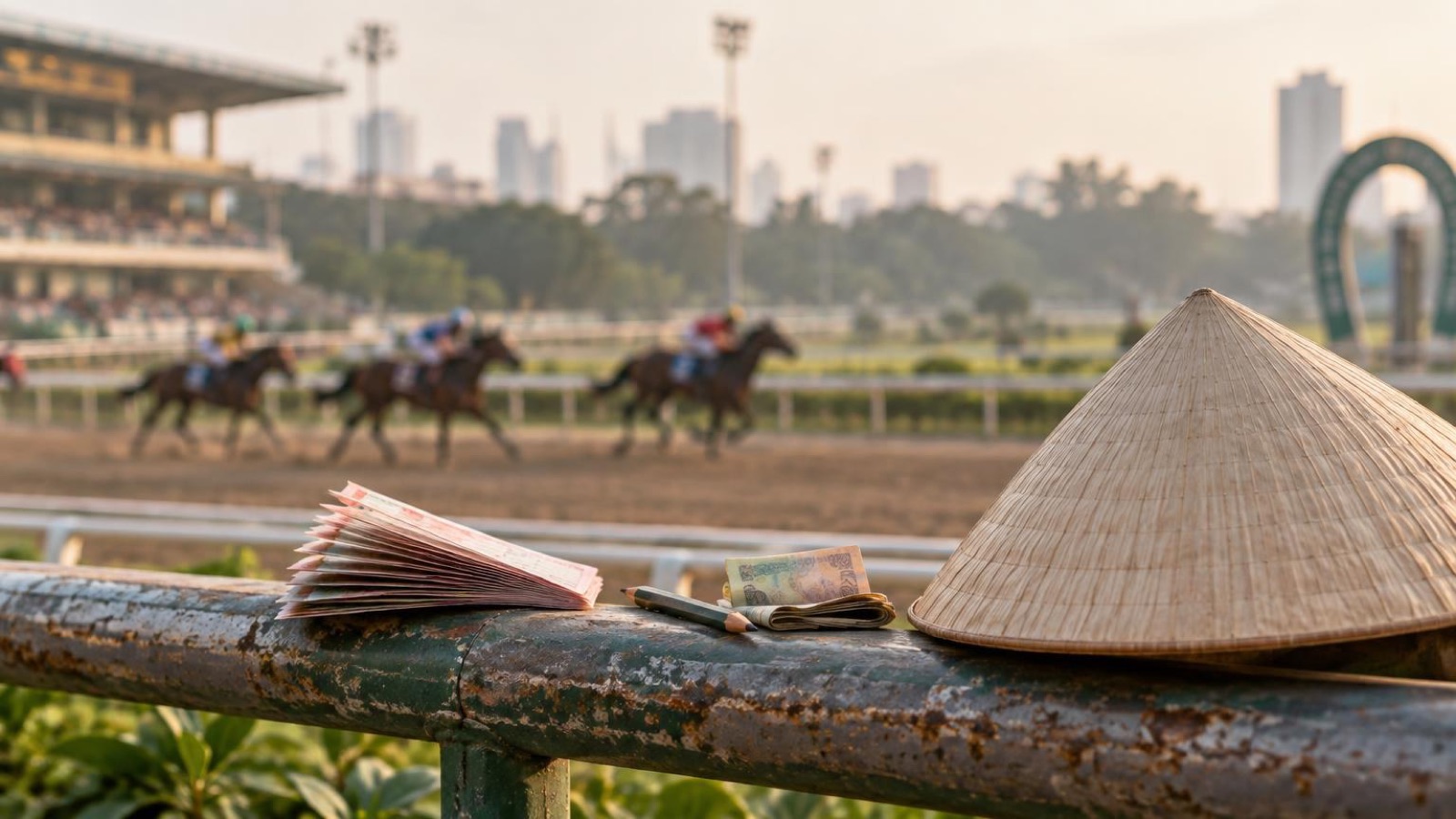
The home of horse racing in Vietnam is the Phu Tho racecourse in Ho Chi Minh City. Betting on horse races has been organized there since 1998, making it the oldest licensed racing operation in the country1. It is an old colonial-era venue, and the racing on it has always been on a modest scale.
The second venue is not a horse track at all but a greyhound stadium: Lam Son stadium in Vung Tau, the beach city a couple of hours from Ho Chi Minh City, where dog race betting has been organized since 20001. Greyhound racing is regulated under the same rules as horse racing, so if you are in Vung Tau the experience is similar: a small stadium, a handful of races, and betting windows.
Since 1998, Vietnam has allowed four companies in total to hold horse and dog racing, but only for small-scale betting8. A larger future venue has been on the drawing board for years: Hanoi Tourist Corporation has had plans to build a horse racing track in Soc Son, a suburban district on the northern edge of Hanoi9. That project has been discussed since at least 2017 and has not produced a working racecourse, so for now the racing you can actually watch is in Ho Chi Minh City and Vung Tau.
The racing calendar and race days
There is no long published season with a fixture list like a European or Australian racing calendar. What the rules set instead is a ceiling: racing with betting may take place at most three days per week at each racecourse, and the races must all finish before 23:00 on the betting day2.

In practice that means race days are concentrated, often on weekends, and the schedule is set by the operator rather than by a national racing authority. If you want to catch a meeting, check with the racecourse or local listings for the current race-day schedule before you travel, because the days can shift.
One more timing rule matters if you plan to bet: bets on each race must be placed within the 12 hours before that race starts3. So there is no long-range ante-post betting on Vietnamese races. You bet on the day, close to the off.
Betting at the track: how it works
Betting at a Vietnamese racecourse is pool betting, not fixed-odds betting with a bookmaker. The bets themselves are simple: you are betting on the rank of the horses when they cross the finish line in a race3. The permitted bet types across the three licensed forms of betting in Vietnam are horse racing betting, greyhound racing betting and international football betting10.
Everything is in Vietnamese dong. The rules require that the dong be used to purchase betting tickets and to pay out awards12. A draft decree from the earlier pilot era proposed a maximum bet of one million VND per player, which gives you a sense of the scale the state has in mind: this is small-stakes racing, not high-roller territory13.
How the payout works: winners are paid in money, or in goods or services convertible to money, based on the result of the event under rules the operator publishes in advance14. In a pool system like this, the money staked on a race forms a pool, and winnings are declared per unit bet from the net pool divided by the number of unit bets on the winning combination. For a sense of how such pools are structured in the region, Singapore Pools, which runs the equivalent betting in Singapore, declares winnings in multiples of S$1, rounded down, and offers a full menu of bet types from simple win and place bets to forecast, tierce, trio and quartet bets on combinations of finishers15. Vietnamese racing offers a narrower version of the same idea, built around finishing positions.
A few practical obligations come with buying a ticket. You must present personal documents on request, follow the published betting rules, meet any tax obligations, commit no fraud, and, most importantly, keep your betting ticket: you need it to claim a prize14.
A newer draft decree proposes modernizing the mechanics: betting would run through a player account opened at the betting enterprise, connected to a payment account and e-wallet owned by the player, with betting, payment and prize payment all flowing through that account for identification and limit control16. Under that draft, enterprises would also be free to decide their own betting products based on finishing ranks and events during the race, rather than a fixed menu16. None of this is in force yet, so expect cash-and-ticket betting at the window for now.
One structural rule shapes where you can bet. Under Decree 06/2017, horse and dog racing betting must happen inside the racetrack, by terminal. Only after an enterprise has operated for a year inside the track may it distribute betting tickets outside the track, across the country, by terminal and telephone2. So the track itself is the center of the action, and off-track betting networks are something that comes later, if at all.
Online betting options for Vietnamese racing
There are none, legally. Online betting business is prohibited in Vietnam, full stop, and the Ministry of Finance has confirmed it has not granted recognition to any betting enterprise7. Vietnam does not currently permit a simple online horse betting operation, and online sports betting is listed as prohibited in regional industry trackers17.
This has not stopped unlicensed sites from serving Vietnamese players. Offshore sportsbooks have covered local races in Saigon or Hanoi alongside bigger Asian meetings such as the Japanese Champions Cup and the Hong Kong Sprint, and Vietnamese-language virtual football products with Asian handicap betting exist on international platforms11. But these operate outside Vietnamese law, and the country has busted online betting rings running through such brands before20. The practical risk for a player using them is that they are unprotected and illegal under Vietnamese rules.
If you want to bet on racing within the law while in Vietnam, the track is the only place. For the wider picture on what is and is not allowed online, see our page on online gambling in Vietnam.
Who may attend and bet
The 2017 decree opened race betting to Vietnamese citizens: the government explicitly allowed Vietnamese citizens to bet on horse and dog races in Vietnam, alongside international football betting12. Foreigners can bet at the track too. The wider split in Vietnamese gambling law is that casinos are permitted for foreigners but not for Vietnamese nationals, so the racecourse is one of the few venues where locals and visitors stand at the same window22.

Three permitted bet types exist in total: horse race betting, dog race betting and international football betting23. Betting as a whole is treated as a conditional business activity, meaning it is not encouraged and is under strict state control, and only enterprises with betting licenses may sell gambling tickets12.
Some people are excluded from betting entirely. The rules prohibit managers, executives and employees of betting businesses, members of the race supervisory council, and jockeys, players and referees attending or officiating the races from placing bets5. People connected to the horses, the betting business or the race supervision are likewise barred4. In short: if you have any hand in running the race, you cannot bet on it.
What the sport does not yet have
The honest summary of Vietnamese horse racing is that the framework exists on paper but the industry has not caught up. Despite the rules allowing betting, no enterprise has been licensed for the pilot of international football betting, and the same bottleneck has affected racing projects6. The Ministry of Finance has not granted recognition to any betting business7.
The history is one of fits and starts. Horse race betting was allowed in a pilot project at Phu Tho in 1998, while Vung Tau's Lam Son stadium has been a dog racing venue since 20001, but for years there was no concrete legal framework for licensing and operation13. The 2017 decree was meant to fix that, but launch attempts have been hampered by onerous restrictions, including strict limits on wagering volume, a narrow field of eligible betting events and a ban on online betting24. A 2026 analysis of the market puts horse race betting in Vietnam in the pre-regulation category, with licensing and implementation still unresolved17.
What that means for you as a visitor is simple: the racing that exists is the small-scale racing that has run for decades. There is no modern multi-track industry, no online product, no big race calendar, and no licensed operator under the newer rules yet.
Culture and background
Horse racing arrived in Vietnam with the French, and the racecourse described above is a colonial-era survivor. For a long stretch, Vietnamese law allowed only limited betting on the state-run lottery, at that racecourse, and at a greyhound stadium in Vung Tau25. Those three outlets were the entire legal gambling offering for decades.
The 2017 decree was the moment the state formally let ordinary Vietnamese bet on races and international football, and it was reported regionally as a long-awaited step12. But the state's attitude has stayed cautious: betting is described as a conditional business, not encouraged and strictly controlled12. Racing culture in Vietnam is therefore quiet and local, a day out at a small track rather than a national pastime, in contrast to the enormous pari-mutuel industries of Hong Kong or Japan.
Other gambling near the track
If you are in Ho Chi Minh City for a race day, other options are nearby. The state lottery is legal and everywhere; see our pages on the Vietnam lottery and Vietlott Keno. Foreigners can also play at licensed casinos, which are open to visitors but not to Vietnamese nationals; start with our guide to casinos in Vietnam.

Further afield, spring festivals in the Vietnamese countryside feature cockfighting, with wagers on a single fight reaching tens of millions of dong26. That world sits outside the licensed betting system, and we cover it separately in our page on cockfighting betting.
First-visit checklist
Here is what to know before your first race day.
| Item | What to know |
|---|---|
| Where to go | The Ho Chi Minh City racecourse for horses, Lam Son stadium in Vung Tau for greyhounds. Nothing else is operating1. |
| When to go | At most three race days a week, all racing finished before 23:00. Confirm the schedule before you travel2. |
| What money to bring | Vietnamese dong, in cash. Tickets are bought and prizes paid in dong12. |
| How to bet | Pick the finishing rank of the horses. Bets close within 12 hours of the race, so bet on the day3. |
| Keep your ticket | You need it to claim any prize14. |
| Bring ID | You may be asked to present personal documents at the window14. |
| Who cannot bet | Jockeys, referees, betting-business staff and race supervisors are barred; everyone else, local or foreign, can take part5. |
| No online betting | Anything offering Vietnamese racing bets online is operating outside the law7. |
For the wider picture of what you can legally play as a visitor, see gambling in Vietnam as a visitor, and for the country's gambling history, our page on gambling culture and history in Vietnam.
Common Questions
Is there horse racing in Vietnam?
Yes. Horse racing with betting has been organized at the Phu Tho racecourse in Ho Chi Minh City since 1998, and greyhound racing with betting has run at Lam Son stadium in Vung Tau since 2000. Both operate on a small scale, with racing on at most three days a week.
Can foreigners bet on horse races in Vietnam?
Yes. The 2017 decree allows Vietnamese citizens to bet on horse and dog races inside Vietnam, and foreigners can take part at the track as well. Gambling more broadly is permitted for foreigners at casinos, while Vietnamese nationals may not enter those.
When is the racing season?
There is no long published season. The rules cap racing at a maximum of three days per week at each racecourse, and all races must finish before 23:00 on the betting day. Check with the racecourse for the current race-day schedule.
How much do tickets cost?
There is no fixed admission price for the racecourses. Bets themselves are placed in Vietnamese dong, and a draft decree once proposed a maximum bet of one million VND per player, so stakes stay small.
Is online betting on Vietnamese races legal?
No. Online betting business is prohibited in Vietnam, and no enterprise has been licensed to run horse race betting under the newer framework. Betting on races is meant to happen at the track, by terminal, with nationwide terminal and telephone betting only allowed after a year of on-track operation.
How do I get to the racecourse?
The Phu Tho racecourse is in Ho Chi Minh City, and the Lam Son greyhound stadium is in Vung Tau, a beach city about two hours from Ho Chi Minh City. A new track has been proposed for the Soc Son district on the northern edge of Hanoi.
Are there other gambling options near the track?
In Ho Chi Minh City you can play the state lottery, and foreigners can use casino games at licensed venues. Spring festivals in the countryside feature cockfighting with wagers that can reach tens of millions of dong per fight, though that sits outside the licensed system.
Sources26 sources
- Sẽ thí điểm kinh doanh đặt cược bóng đá, Bao Chinh Phu, 2010
- Nghị định 06/2017/NĐ-CP của Chính phủ về việc kinh doanh đặt cược đua ngựa, đua chó và bóng đá quốc tế, VCCI, 2017
- Decree No. 06/2017/ND-CP on business of betting on horse racing, greyhound racing and international soccer, VN Law Firm, 2017
- Công dân từ 21 tuổi có thể được cá cược bóng đá, VnExpress, 2017
- Nghị định mới kiểm soát chặt chẽ việc kinh doanh đặt cược, cá độ, Bao Chinh Phu, 2017
- Cá cược bóng đá, đua ngựa, đua chó: vì sao chưa có dự án nào được cấp phép?, Tuoi Tre, 2024
- Bộ Tài chính chưa cấp chứng nhận cho kinh doanh đặt cược, Bao Chinh Phu, 2020
- NA committee ponders racing betting proposal, Vietnam News Biz Hub, 2013
- Gov't approves horse, dog racing gambling, Vietnam News Biz Hub, 2017
- Decree No. 06/2017/ND-CP dated January 24, 2017, He Thong Phap Luat, 2017
- Exploring Vietnamese animal racing games and betting traditions, Gaming.net, 2025
- Vietnamese allowed to bet on football games, horse and dog races, The Straits Times, 2017
- Horse race betting in Vietnam: don't back the wrong horse, Mondaq, 2015
- Bắt đầu được phép cá cược bóng đá quốc tế tại Việt Nam, VnExpress, 2017
- Horse Race Betting Game Rules, Singapore Pools, 2026
- Đề xuất quy định mới về kinh doanh đặt cược đua ngựa, đua chó, bóng đá quốc tế, Bao Chinh Phu, 2025
- Vietnam horse race betting: navigating the regulatory track from licensing to implementation, Duane Morris Vietnam, 2026
- Vietnam country profile, iGaming Times, 2026
- Virtual sports simulation payout structure explained, V9BET, 2026
- Vietnam busts online betting ring Fun88, Calvin Ayre, 2019
- Gov't approves horse, dog racing gambling, Vietnam News, 2017
- Vietnam charges 141 people over illegal gambling at French-owned Pullman Hanoi hotel, PokerScout, 2025
- Bet thủ là gì? Bet thủ phải đủ bao nhiêu tuổi thì được tham gia các loại hình cá cược ở Việt Nam?, Thu Vien Phap Luat, 2024
- Vietnam busts online betting ring Fun88 (archived), Calvin Ayre, 2019
- Facts and Details: Vietnam gambling, Facts and Details, 2002
- Đầu năm, trăm kiểu cờ bạc tràn lan tới mức thanh bình thường (archived), Tuoi Tre, 2020