Gambling in Vietnamese society and culture
Gambling sits in an unusual place in Vietnamese life. Games of chance and skill are woven into family and festival culture, yet the state permits real-money play only inside a narrow set of licensed channels: state-run lotteries and a handful of casino resorts. Everything outside those channels, including online football betting, is prohibited, and the authorities run regular campaigns against it5.
Those campaigns are not symbolic. Ahead of the 2026 World Cup, the Ministry of Public Security pushed to dismantle organized gambling rings and football betting operations, warning that illegal gambling feeds loan sharking, theft, robbery, fraud and assault6. The scale of these busts tells you how strong demand is: Vietnamese players bet enormous sums through channels the state does not license.
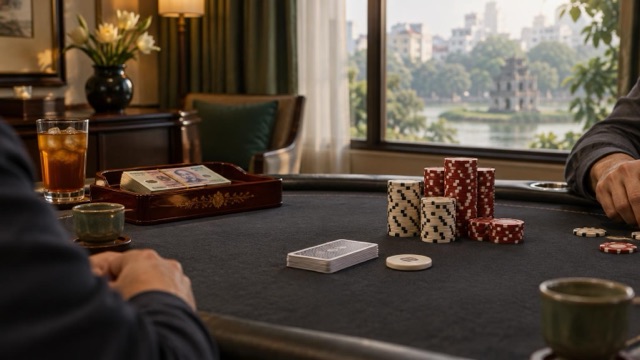
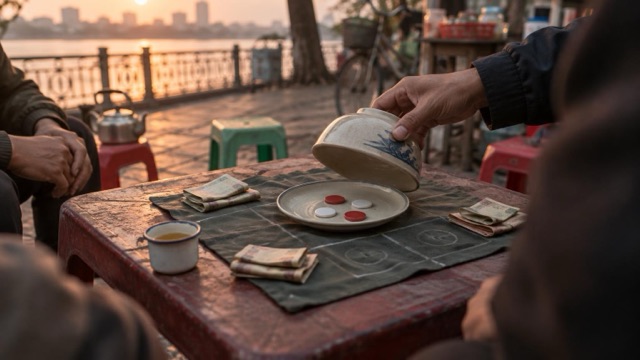
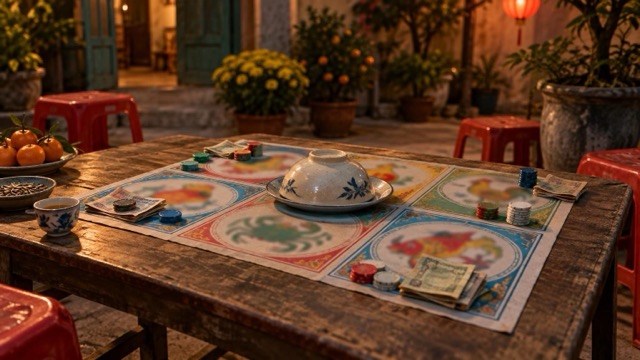
The games themselves have deep local roots. Xoc dia, the coin-and-bowl game, and bau cua tom ca, the dice game with gourds, crabs and fish, are fixtures of home play and festival stalls, especially around Tet, when casual wagering between friends and family spikes. Card games like tien len, xi dach (Vietnamese blackjack) and tu sac are played in homes and cafes across the country. None of this is exotic to Vietnamese players; it is simply part of how people socialize. The legal line is drawn at money: playing xoc dia for stakes, particularly through organized or online operations, can carry criminal liability4.
For the licensed side of life, the state lottery is the most widely played form of gambling in the country, with provincial draws and Vietlott games like Mega 6/45 and Keno sold at street kiosks everywhere. You can read more in our guide to gambling in Vietnam.
Where the casino resorts stand today
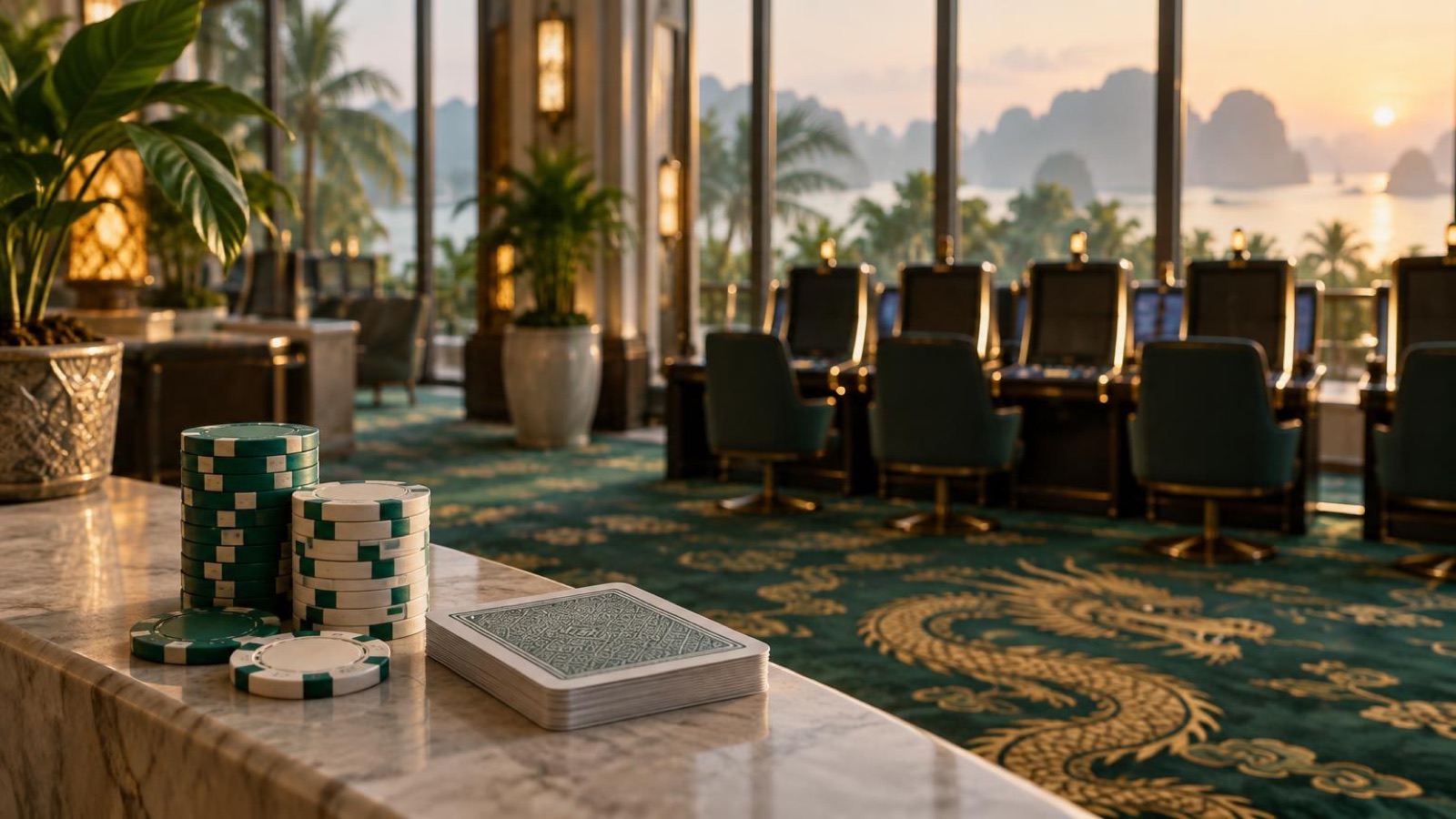
Vietnam's licensed casino scene is small but growing, made up of around 9 casinos, most of them attached to large integrated resorts1. The first legal casino in the country was Casino Do Son, in the coastal area of Do Son, Hai Phong, which opened the door for everything that followed7. Today the biggest names are spread along the coast and the islands:

| Casino | Where | What it offers |
|---|---|---|
| Corona Casino Phu Quoc | Bai Dai area, Phu Quoc | 18,500 m² floor, 100+ tables, 1,000+ machines; largest in Vietnam1 |
| Hoiana (Nam Hoi An) | Tay Son Tay Village, Duy Xuyen District, Quang Nam | 140 gaming tables, 300+ slot machines8 |
| The Grand Ho Tram | Ho Tram Hamlet, former Ba Ria - Vung Tau Province | Full resort casino floor9 |
| Loi Lai Casino | Lợi Lai International Hotel, Móng Cái, Quang Ninh | Baccarat, blackjack, craps8 |
| Casino Do Son | Đồ Sơn, Hải Phòng | The country's first legal casino7 |
Foreign visitors have the run of all licensed casinos, and several venues cater almost exclusively to them. Ha Tien Vegas, near the Cambodian border, serves only foreign passport holders and may ask for your passport and visa at the door10. If you are planning a trip, our pages on casinos in Vietnam and new casino resorts in Vietnam list venues, games and how to get there.
Who may gamble legally in Vietnam: age, income and ID rules
The rules split cleanly between foreigners and Vietnamese citizens, and the difference is large.
Foreign visitors may gamble at any licensed casino with a valid passport or international travel document and lawful entry into Vietnam, provided they have not been barred from casinos11. The minimum age for foreigners is 18 at most venues, though some casinos set it at 21 for everyone2. No income proof and no entry fee apply. Bring your original passport; photocopies are not accepted at any casino, and photography on the gaming floor is generally prohibited1.
Vietnamese citizens face a much higher bar, and it applies only at the approved pilot venues. To enter, a Vietnamese player must3:
- Be 21 or older with full civil act capacity under Vietnamese law
- Prove financial capacity: a regular income of VND 10 million per month or more, or income taxable at bracket 3 or higher under the Personal Income Tax Law
- Not be subject to a bar requested by themselves or a close family member
- Buy an entry ticket (covered in the next section)
The income proof is the part that catches most people. Acceptable documents include payroll records or tax filings showing the VND 10 million monthly threshold; the tax bracket route works if your income was taxable at level 3 or higher within the year before you play12. At Corona Casino Phu Quoc, Vietnamese visitors register for membership at the reception desk, where staff check ID and income documents together13. Since January 1, 2025, only the new-style citizen ID card (can cuoc cong dan) or a valid passport works as ID; old ID cards are no longer accepted2.
One more restriction applies to Vietnamese players: citizens who committed crimes abroad resulting in more than three years of imprisonment, including those serving time, are not admitted14. And no player, local or foreign, may be related to the casino's owners in any way14.
The framework dates to Decree 03/2017, which first lifted the blanket ban on locals gambling and created the pilot scheme at Van Don and Phu Quoc14. From December 1, 2017, Vietnamese who could show the minimum income became eligible to gamble at those two casinos15. A newer decree effective November 26, 2025 opened all legal casino venues to Vietnamese players who meet the conditions, not just the two pilot sites16.
For betting on horse racing, dog racing and international football under the separate betting decree, the minimum age is 21 with full civil act capacity17. A draft from the Ministry of Finance has proposed lowering that to 18 for both domestic and foreign bettors, but it had not taken effect as of late 202618.
Entry levy: VND 1,000,000 a day or VND 25,000,000 a month
Vietnamese players must buy a ticket to enter the casino floor. The current prices are3:
- Day ticket: VND 1,000,000 per person, valid for 24 continuous hours from the moment of purchase
- Month ticket: VND 25,000,000 per person, valid for one month
Foreign visitors pay nothing; the levy applies only to Vietnamese nationals2.
The monthly ticket suits anyone planning several visits within a month. Note that the ticket buys entry, not chips; your play money is separate.
These prices may rise. In August 2025 the Ministry of Finance proposed lifting the levy to VND 2.5 million per 24 hours (about USD 95) or VND 50 million per month (about USD 1,906), which would be 2.5 times and 2 times the current levels respectively19. The same draft floated issuing all players, Vietnamese and foreign, electronic ID cards containing personal details, access permissions and expiry dates19. Check the current price with the casino before you travel if you are a Vietnamese player.
Currency rules: dong only, in and out
Vietnamese players may only use Vietnamese dong at the tables. You exchange dong for the casino's convention currency (chips or tokens), and you may exchange back into dong only what is unspent or won3. The rule is strict on both ends: no dollars, no yuan, no cards for Vietnamese nationals buying chips.
For exchanging convention currency, Vietnamese nationals are limited to Vietnamese dong cash only; the rules do not permit them to use foreign currency, bank transfers or bank cards for this purpose3. In practice, most casinos accept USD, VND and major credit cards for chip purchases by foreign visitors1.
Foreign players and overseas Vietnamese with foreign passports have a clear path for winnings. When you win, the enterprise must confirm and pay in full, and you may receive prize money and transfer or carry it abroad in foreign currency under Vietnam's foreign exchange rules3. Foreign winners are permitted to buy foreign currency at licensed banks for exactly this purpose14.
For the separate world of licensed sports betting, Vietnamese dong is likewise the only currency for buying tickets and paying prizes20.
Player rights: payouts, privacy and complaints
Vietnamese casino rules give players a short but meaningful list of rights at licensed venues3:
- Full payout: the enterprise must confirm and pay winnings in full when you win
- Privacy: you may request that the business keep your winning and payout information confidential, except where a competent state authority requires disclosure
- Complaints: you may complain to, or sue, the business over payout results, and report fraud or other violations
The same rights extend to players at electronic gaming with prizes venues, along with the obligations that mirror them: carry documents proving you are eligible to play, follow the game rules and house rules, meet your tax obligations, and not cause insecurity or disorder on the premises21.
The tax point is worth remembering. Players must fully perform tax obligations to the state as required by law; our page on tax on gambling winnings in Vietnam explains what is owed and how it is collected.
Self-exclusion and family exclusion orders
Vietnam builds exclusion directly into the casino rules rather than leaving it to operator goodwill. A person may not play if they themselves, or a relative with full civil act capacity, has asked the casino business to bar them. The relatives who may make the request are specific: father, adoptive father, mother, adoptive mother, wife, husband, or biological child3. The same mechanism exists in the betting decree, where a player's own request or a family request filed with the operator triggers exclusion20.

In practice, the operators run these as formal programs. Hoiana offers voluntary self-exclusion and family exclusion as a free, strictly confidential service; you apply by email to its Responsible Gaming team22. Ha Tien Vegas runs a self-exclusion program as part of its responsible gaming policy10. If you are worried about your own play or a family member's, the gambling help in Vietnam page lists where to turn.
What players may not do at the tables
The prohibited conduct list is short and practical. Players may not3:
- Use the results of casino games to bet directly with each other, meaning side bets between players on outcomes are off limits
- Cause insecurity, disorder or social safety problems at the casino
- Cheat at any stage of preparation, organization or participation in the games
- Use gambling machines, tables, tokens or other devices whose content has not been approved by the government
The ban on player-to-player betting on game results applies equally at electronic gaming venues21. The cheating and device rules are aimed mostly at operators and organized groups, but they bind players too, and the decree that sets them out also bars anyone related to casino owners from playing at all14.
For a first visit, the practical version is simple: bring your original passport (or, if you are Vietnamese, your new citizen ID card and income documents), expect the levy if you are a citizen, exchange dong for chips if you are, and keep your play between you and the house. The full picture of venues, games and getting there is in our casinos in Vietnam guide.
Common Questions
What is the minimum age to enter a casino in Vietnam?
Vietnamese citizens must be 21 or older with full civil act capacity. Foreign visitors are generally admitted at 18, though some licensed casinos set the bar at 21 for everyone. Bring a valid passport or ID, as age is checked at the door.
How much income do I need to prove to gamble in a Vietnamese casino?
Vietnamese players must show a regular income of at least VND 10 million per month, or documents proving their income is taxable at bracket 3 or higher under the Personal Income Tax Law. Foreign visitors do not need to prove income.
Can foreigners take their casino winnings out of Vietnam?
Yes. Foreign players and overseas Vietnamese with foreign passports may receive winnings in full and transfer or carry them abroad in foreign currency, following Vietnam's foreign exchange rules. Licensed banks can sell you foreign currency for this purpose.
Which ID documents are accepted at Vietnamese casinos?
Vietnamese players need a valid citizen ID card (can cuoc cong dan) or passport; old-style ID cards are no longer accepted. Foreign visitors need their original passport, lawful entry into Vietnam, and no bar from casinos. Photocopies are not accepted.
Can a family member bar someone from a casino in Vietnam?
Yes. A relative with full civil act capacity, such as a father, mother, wife, husband or biological child, can ask a casino operator to bar a person from playing. Players can also request to bar themselves. Operators run these programs free and confidentially.
Where was the Dai The Gioi casino area located?
Dai The Gioi was the casino quarter of old Cho Lon, the Chinese district of Saigon, where casino-style gaming halls operated before the current licensing system. Today's licensed casinos are large integrated resorts in places like Phu Quoc, Quang Nam and Quang Ninh.
Can I keep my casino winnings private in Vietnam?
Yes. Players may ask the casino business to keep winning and payout information confidential, except where a competent state authority requires disclosure. Operators confirm and pay winnings in full, and you can complain or sue over payout results.
Sources22 sources
- Gambling in Vietnam, Corona Casino, 2026
- Choi casino co bi phat khong?, Corona Casino, 2026
- Casino Ho Tram co cho nguoi Viet Nam vao choi khong? Dieu kien nguoi Viet Nam duoc phep vao choi tai..., Thu Vien Phap Luat, 2025
- Xoc dia la loai hinh gi? Choi xoc dia online co the bi truy cuu trach nhiem hinh su nhu the nao?, Thu Vien Phap Luat, 2023
- HCM City police bust online football betting rings worth over $132m, Vietnam News, 2026
- Lam Dong: dau tranh triet xoa duong day to chuc danh bac va danh bac duoi hinh thuc ca do bong da trong mua World Cup 2026, Ministry of Public Security, 2026
- Baccarat casino in Vietnam, Hoiana, 2024
- Top legal casinos in Vietnam, Corona Casino, 2026
- The Grand Casino Ho Tram, The Grand Ho Tram, 2026
- Huong dan choi tai casino Ha Tien Vegas 2026: toan bo tro choi 24/7, phan 1, Ha Tien Vegas, 2026
- Nguoi Viet co duoc choi casino khong?, Corona Casino, 2026
- Chung minh thu nhap vao casino, Corona Casino, 2026
- Announcement: identification documents must be presented to verify Vietnamese customers' identity at Corona Casino Phu Quoc from July 01, 2024, Corona Casino, 2024
- Vietnamese to be permitted to gamble in casinos, Vietnam News, 2017
- From December, Vietnamese eligible to gamble at casinos, Vietnam News, 2017
- Tu 26/11/2025: mo cac dia diem casino hop phap cho phep nguoi Viet Nam du dieu kien vao choi, Thu Vien Phap Luat, 2025
- Nghi dinh 06/2017/ND-CP cua Chinh phu ve viec kinh doanh dat cuoc dua ngua, dua cho va bong da quoc te, VCCI, 2017
- Bet thu la gi? Bet thu phai du bao nhieu tuoi thi duoc tham gia cac loai hinh ca cuoc o Viet Nam?, Thu Vien Phap Luat, 2024
- Finance ministry proposes higher casino entry fees for Vietnamese citizens, Vietnam News, 2025
- Casino Phu Quoc co an toan khong?, Corona Casino, 2026
- Quy dinh moi ve kinh doanh tro choi dien tu co thuong danh cho nguoi nuoc ngoai, Bao Chinh Phu, 2021
- Hoiana casino regulations, Hoiana, 2026