Tứ Sắc is one of the classic Vietnamese card games, sitting alongside Tiến Lên and Xì Dách in the repertoire most Vietnamese players grow up around3. The name means "four colors," and it describes the deck perfectly: instead of suits and numbers, every card is one of four colors and one of seven ranks drawn from a Chinese chess-style cast of kings, guards and cannons. It is a rummy-like game at heart. You draw, discard, and steal cards from the table to build sets, and the first player to assemble a complete legal hand wins outright, with no second or third place2.
The game uses a deck of 28 unique cards1, and each player starts with a hand of 20 cards, except the first player, who takes 211. A hand may also grow by one additional active card during play1. Scoring turns on special sets: a khạp (three of a kind) held in hand is worth 3 lệnh2, while a quan, khui, or khạp is valued at 8, 6, and 3 points respectively3. If a win includes a quan, with a sanh or an opened khui, the score is doubled2. When claiming a discarded card, chẵn (sets) take priority over lẻ (sequences)2, and the number of khạp a player holds must be announced to everyone, shown as small dots on the game board3.
The deck: 112 cards in four colors
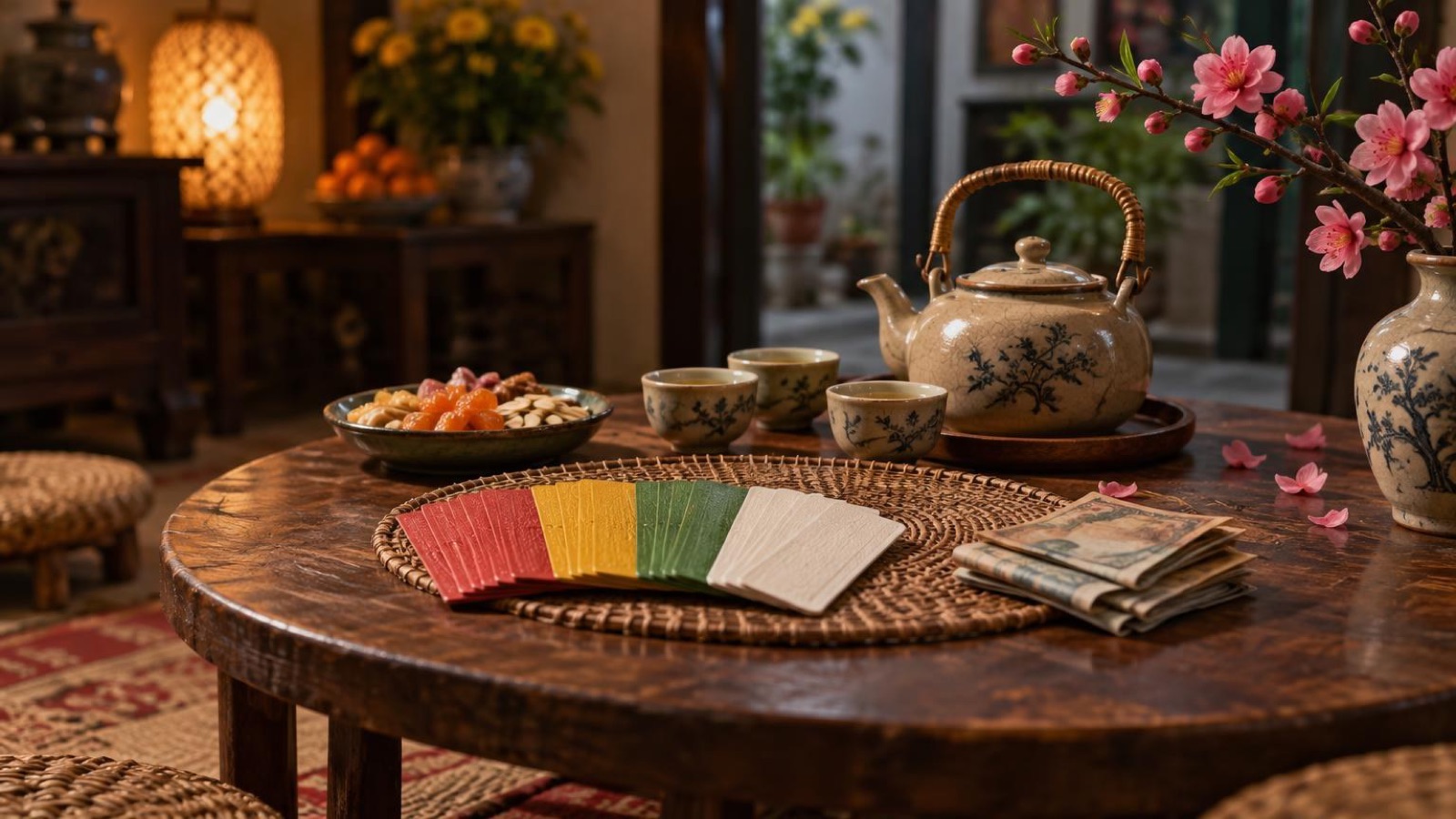
A pack of Tứ Sắc contains 112 cards. There are 28 unique cards, and each one appears four times, so every rank-and-color combination exists as four identical copies1. Each card has a color, either red, yellow, green or white, and a rank, which is one of seven: king, guard, minister, rook, cannon, knight or pawn1.
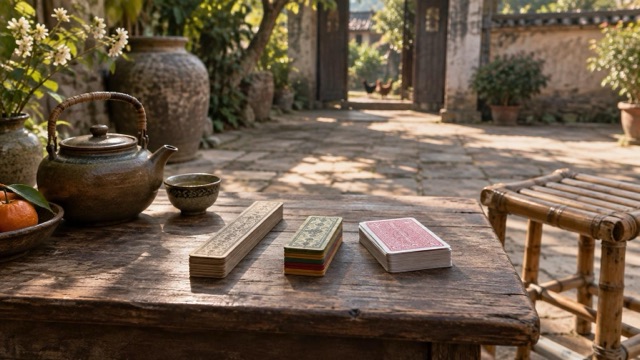
If you know Chinese chess (cờ tướng), the ranks will look familiar, because they are the same pieces: Tướng (king), Sĩ (guard), Tượng (minister), Xe (rook), Pháo (cannon), Mã (knight) and Tốt or Chốt (pawn). The cards are small rectangles, narrower than playing cards, printed with the Chinese character for the rank. The color of the card matters as much as the character on it: three cards of the same rank in the same color form one kind of set, while three Chốt cards in three different colors form another2.
Because each unique card exists in four copies, four of a kind is always possible, and the game's scoring system is built around how you come by that four of a kind: dealt it in your original hand, melded it during play, or held it concealed until the end. Those three routes give the three most valuable melds in the game, explained below.
The physical deck is sold in stationery and game shops across Vietnam for a modest price, and it is the same deck used for tam cúc-style play in some regions and for bài xệp in Huế2.
Players, hands and how a round starts
Tứ Sắc is for two to four players, and it is best with four1. With four players the draw pile, the discards and the stealing opportunities all stay lively; with two the game becomes a slower, more calculating duel.
Each player receives 20 cards, dealt five at a time until everyone has their full hand. The player who holds the deal (cầm cái) receives six cards for the first turn, which lets them make the first move2. In practice this means the first player starts with 21 cards: their 20-card hand plus one extra card to lead with1.
During play, a hand consists of 20 cards plus possibly one additional active card1. The active card is the one you have just drawn or taken from the table and have not yet either melded or discarded. Your turn always ends with a discard, which returns your hand to 20 cards.
Play proceeds like this:
- Draw the top card of the pile, or take a card from the table (a discard you can use, or a card that completes a set for you).
- Lay down any melds you can form, face up.
- Discard one card face up onto the table.
The table itself is part of the game. Cards melded by any player stay visible, and discards sit in the open where other players can claim them. A key rule of claiming is "chẵn trước, lẻ sau": sets (chẵn) take priority over sequences (lẻ) when two players want the same discarded card2.
The round ends when one player tới, meaning they have arranged all 20 cards into valid groups and go out. That player wins, and there is no ranking of the others: no nhì, no ba, no bét2. If nobody manages to tới and the draw pile shrinks to seven cards with no winner, the game is aborted and declared a draw1.
Sets and melds: khạp, quằn, khui and quan
The heart of Tứ Sắc is building sets, and the game distinguishes carefully between how a set was formed. The four key terms you need are:
- Khạp: a set of three identical cards, meaning the same rank and the same color. A khạp held concealed in your hand is worth 3 lệnh2. When you meld a khạp, the number of khạp you hold must be announced to all players, and it is shown on the board as one or more small dots5.
- Quằn: four identical cards held concealed in your hand, never shown until the end. A quằn is worth 8 lệnh2.
- Khui: a four-of-a-kind formed during play, by melding a khạp and then capturing the fourth copy with an active card. A khui is worth 6 lệnh when opened2.
- Quan: a four-of-a-kind that was dealt to you complete in your original 20-card hand. A quan must be shown to all players at the beginning of the game5. It is the most valuable quadruple, worth 8 lệnh, and a win that includes a quan doubles your score2.
Besides the identical-card sets, there are mixed sets built from different ranks and colors:
- Xe-Pháo-Mã: one rook, one cannon and one knight, a three-card set2.
- Tướng-Sĩ-Tượng: king, guard and minister, another three-card set2.
- Three same-color cards of any ranks form a valid three-card set2.
- Three Chốt of different colors: three pawn cards in three different colors2.
- Four Chốt of different colors: four pawn cards in four different colors, a special set worth 2 lệnh2.
- Đôi (pair): two identical cards. A pair is a valid part of a finished hand but scores nothing on its own2.
A complete winning hand is made entirely of these groups: sets of three, sets of four, and pairs filling out the count. When you go out, everything must fit, and the total of your lệnh must follow the odd-number rule covered in the next section.
Scoring in lệnh: what each combination is worth
Every scoring combination in Tứ Sắc is measured in lệnh, the game's unit of points. The values are:
| Combination | Lệnh |
|---|---|
| Đôi (pair) | 02 |
| Opened set of 3 cards (Xe-Pháo-Mã, Tướng-Sĩ-Tượng, three same-color cards, or three Chốt of different colors) | 12 |
| Four Chốt of different colors | 22 |
| Khạp held in hand | 32 |
| Opened set of 4 cards (khui) | 62 |
| Quằn held in hand | 82 |
| Quan (four of a kind dealt in the original hand) | 85 |
The same values appear in the online version at Vinagames, expressed as points: a quan, khui and khạp are valued at 8, 6 and 3 points respectively, a set of four pawns is worth 2 points, a pair has no value, and all other sets are worth 1 point1.
Two extra rules shape the final count:
- The winner gets a bonus of 3 lệnh added to their total2.
- If the win includes a quan, with a sanh or an opened khui, the score is doubled2.
And the rule that catches every beginner: the final score must be an odd number, either 15 or 21 lệnh. If your total comes out even, you have played something wrong along the way, and declaring tới with an even score means you broke the rules and can be penalized2. This is why experienced players watch their running lệnh count the whole round: a hand that is one lệnh short of odd needs a 1-lệnh set added, not a 2-lệnh one.
The winning payment formula
Tứ Sắc is almost always played for money, with the lệnh count converted into payment at an agreed rate per lệnh. The payment structure at Vinagames, which mirrors the traditional settlement, works like this: the amount each losing player pays to the winner is (3 + hand value) + 101.
So if the winner's hand is worth 6 points, each of the other players pays (3 + 6) + 10 = 19 units. With four players, the winner collects that from each of the three losers.
If the winner has a quan or a khui, the formula changes to (3 + hand value) × 2 + 101. A winning hand worth 6 points with a khui in it collects (3 + 6) × 2 + 10 = 28 from each loser.
There is also a side payment that runs independently of the winner. The winner pays for any quan and khui they hold, while all other players pay for every quan, khui and khạp on the table1. In other words, quadruples and triples are taxed both ways: the holder pays for the privilege, and everyone else pays tribute to them. This is why a hand stuffed with quằn can be lucrative even when you do not win the round.
Penalties: đền and discarding the worst card
The word đền means "to compensate," and it covers the penalties that keep the game honest. The two situations every player needs to know:
Discarding the worst card. On your turn, you are expected to discard the card that is least useful to you. If you discard a card that is not your worst, and another player melds that card into a winning hand, you alone pay the full winning amount on behalf of all the other losing players1. This is the game's biggest single risk: one careless discard can cost you three players' worth of payment.
Tới with an odd card. You must count your hand so that every card fits a valid group before declaring tới. If you declare a win while a card is left over outside any set, you must pay a đền penalty for it2. The related odd-score rule above works the same way: an even final score means the hand was not built legally, and the winner can be penalized instead of paid.
At Vinagames, all of this is handled for you. The program performs every meld the rules require automatically, and it tells you whether the card you are about to discard is your worst card, which removes the most common way to incur a đền penalty1. Around a physical table, you are on your own, and experienced players will call out a bad discard immediately.
Playing Tứ Sắc online at Vinagames
Vinagames is the long-running Vietnamese gaming site where Tứ Sắc can be played online against other people. The site has offered Java-based Vietnamese card games, including Tiến Lên, since well before online card rooms became mainstream in the region6, and its Tứ Sắc table follows the traditional rules described on this page1.
The online version differs from the kitchen table in a few practical ways:
- All melding required by the rules is done automatically, so you never have to prove a khạp or remember to announce one1.
- The program indicates whether a discard is your worst card, protecting you from the most expensive đền penalty1.
- The draw-abort rule is enforced exactly: with seven cards left in the pile and no winner, the game ends as a draw1.
- The payment formulas, including the doubled rate for a quan or khui and the side payments for melds, are settled automatically at the end of each round1.
For a learner, the automatic melding is the real draw. Working out by hand which of your 20 cards forms which set, and whether your running lệnh total is heading toward 15 or 21, is the hardest part of the game, and the software does that bookkeeping while you learn the patterns.
A first game: what to expect
If you are joining a table for the first time, here is how the round will actually feel.
Someone shuffles the 112-card deck and deals 20 cards to each player, five at a time, with the dealer taking a sixth card to lead2. If anyone was dealt a complete four of a kind, a quan, they must show it immediately5. Then the first player draws or takes a card, lays down any meld, and discards, and the turn passes.
Your first job is to sort your hand. Look for three-of-a-kind groups in the same color, count how close you are to a quằn, and note whether you hold the pieces of a Xe-Pháo-Mã or Tướng-Sĩ-Tượng run. Keep a running total of your lệnh in your head, and remember the target: an odd number, 15 or 21, plus the 3-lệnh winner's bonus2.
Watch the discards. When a card hits the table that completes a set for you, you can take it, and if another player wants the same card, the set (chẵn) beats the sequence (lẻ)2. Be careful about what you throw away, because the discard that completes someone else's win is the one that costs you everybody's payment1.
The round ends in one of two ways. Either a player lays down a complete hand, announces tới, and collects according to the formula, with the doubled rate if they hold a quan or khui1. Or the pile runs down to seven cards with no winner, and the game is scrapped as a draw1.
Expect the first few rounds to be slow while you learn the seven ranks and the four colors, and expect to lose a few small settlements to đền penalties before the discard discipline becomes instinct. The game rewards memory more than luck: knowing which copies of a card have already been melded tells you whether the fourth copy is still out there waiting to complete your khui.
Tứ Sắc sits in the same family of traditional games as Bầu Cua Tôm Cá and Vietnamese mahjong, games played at gatherings for modest stakes rather than in casinos. If you want to see how it fits into the wider picture of what you can play in the country, see gambling in Vietnam and the overview of traditional Vietnamese card games.
Common Questions
How many cards does each player get in Tứ Sắc?
Each player receives 20 cards, dealt five at a time. The first player holds 21 cards, and during play a hand consists of 20 cards plus possibly one additional active card picked up from the table.
What does tới mean?
Tới means a player has completed their hand by arranging all cards into valid sets and sequences, and that player wins the round. There is no second or third place; the first player to tới takes the whole pot.
Why must the final score be an odd number?
The winning player's total must come to an odd number of lệnh, either 15 or 21. An even total means the hand was built against the rules, and the winner can be penalized instead of paid.
What is the difference between a quan and a khui?
A quan is a set of four identical cards that a player was dealt in the original hand, and it must be shown to everyone at the start. A khui is a quadruple built during play by melding a khạp with an active card.
How many people can play Tứ Sắc?
The game works for two to four players, and it is best with four. The same deck is also used in Huế for a different three-player game called bài xệp.
What happens if nobody wins and the pile runs out?
When no one has won and only seven cards remain in the draw pile, the game is aborted and counted as a draw. Nobody pays anybody.
What is a đền penalty?
Đền is the penalty paid by a player who breaks a rule. The most common case is discarding a card that another player uses to complete a winning hand, which makes the discarder pay the winner's amount on behalf of the other losers.