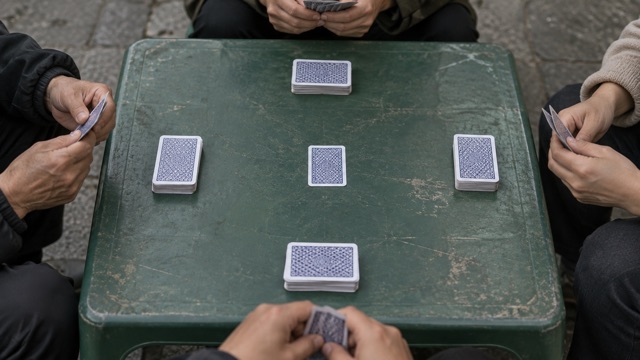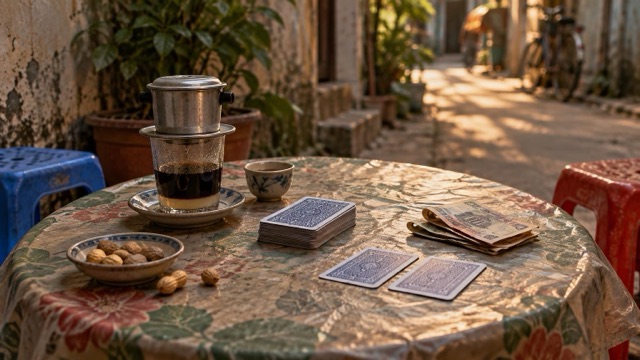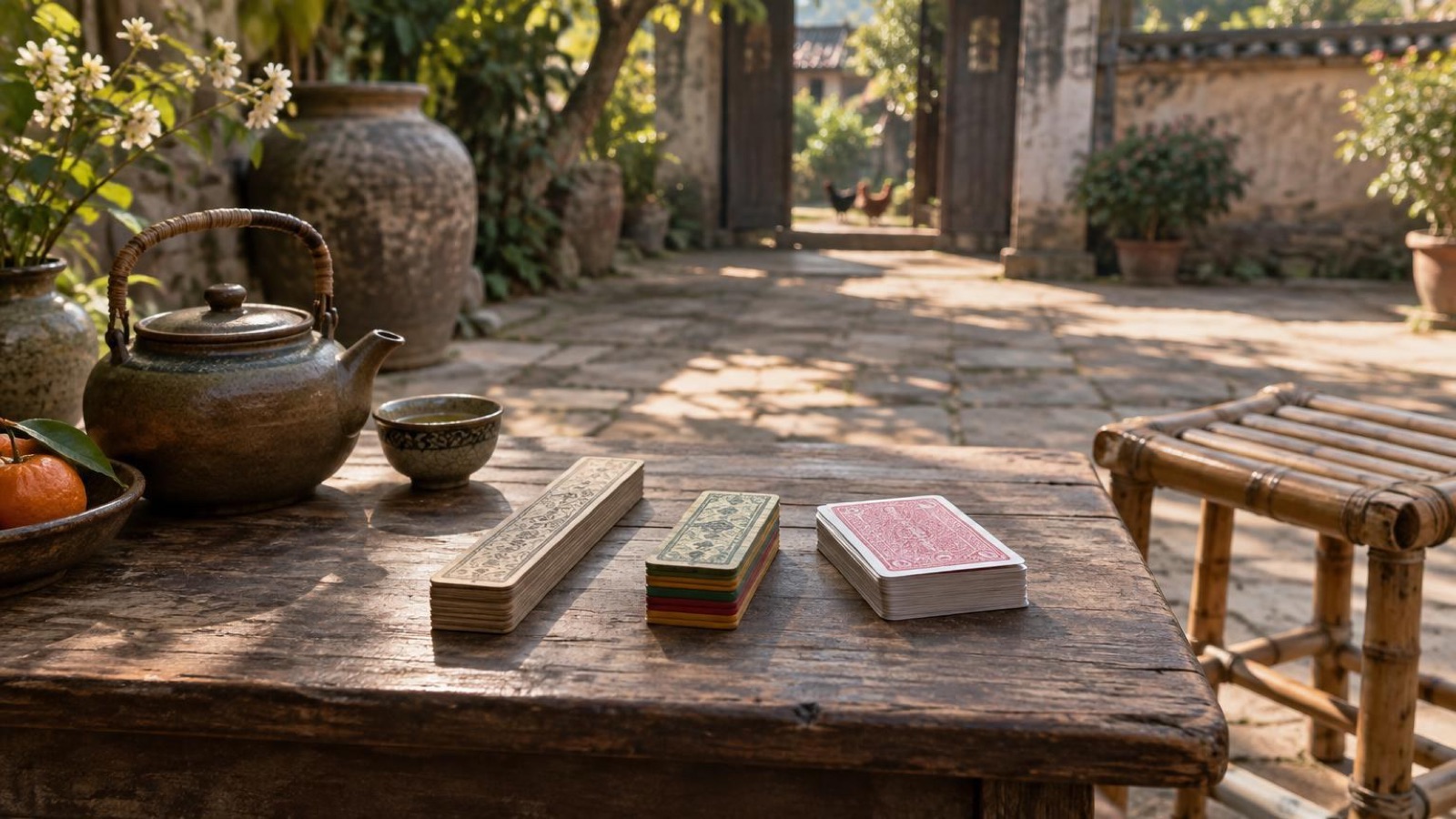
Vietnam plays cards the way other countries play football: everywhere, enthusiastically, and with fierce local pride in the rules. Some games use the familiar 52-card deck, others use decks that exist nowhere else on earth. This page walks through the main ones, how each works, and where you can still find them, from a kitchen table in Bắc Ninh to a casino floor on Phú Quốc.
Tien Len: how the game works
Tien Len is the game most Vietnamese people think of when someone says "cards." It is a shedding game: the winner is the first player to empty their hand, and the standard setup is four players with 13 cards each from a 52-card deck1.
The heart of the game is beating combinations. A pair, for example, is two cards of the same rank and same color in the Northern style, or simply two cards of the same rank in the Southern style7. That difference between the Northern and Southern variants runs through the whole game, and the in-depth page covers the full combination rules, the special role of the 2, and the customs around the table.
If you learn one Vietnamese card game, this is the one: it is played at family gatherings, over beer after work, and on every long train journey in the country.
Xì Dách: the Vietnamese twist on twenty-one
Xì Dách is Vietnam's home-grown version of blackjack, and the twist is real. In Vietnamese homes it is played with flexible traditional rules, while Vietnamese casinos run standard international blackjack instead8. The home version has quirks that would surprise any Las Vegas dealer.
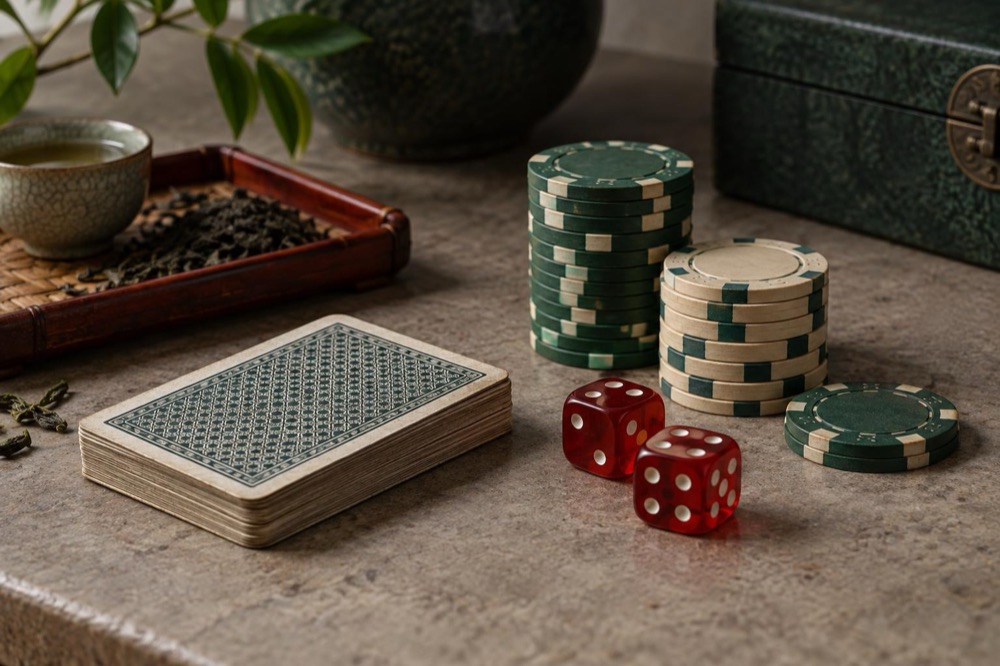
The game uses a 52-card deck. Number cards count their face value, J, Q and K count 10 points, and an Ace counts as 1 or 11, whichever helps you most9. An Ace plus a 10-point card is a hand called Xì Dách and wins immediately, and two Aces, called Xì Bàng, beat even that8.
Two rules set the Vietnamese game apart. First, Ngũ Linh: five cards totaling less than 21 wins outright, and if several players manage it, the lowest total wins9. Second, and most unusual, lower points win ties, a rule unique to Vietnam8. You can also double your initial bet after the first two cards, but then you may draw only one more card9.
Tu Sac: the 32-card game from the north
Tu Sac is a Northern Vietnamese card game played with a special 32-card deck of Chinese-derived cards, closer in spirit to Tien Len than to any Western game. It is a shedding and combination game in which you beat what was played before you, and it rewards knowing the deck's internal rankings cold. The dedicated page covers the deck, the combinations and how a session runs. It is the least known of the big Vietnamese games outside the country, but in the northern provinces it remains a staple.
Liêng: betting, bluffing and hand rankings
Liêng is Vietnam's answer to poker: a three-card game of betting, bluffing and psychology, played with a standard 52-card deck without jokers10. Each player receives three cards, a round lasts two to five minutes, and the ideal table has four to six players10.
The hand rankings, from top to bottom, are:
- Sáp (Wax): three cards of the same rank, the strongest hand. 2-2-2 is the lowest Sáp, A-A-A the highest10
- Liêng (Straight): three consecutive cards, such as 4-5-610
- Ảnh (Pictures): three face cards10
- Điểm (Points): everything else, scored by card values10
Points hands make up about 75 percent of all hands, and the average winning hand is 7-8 points or Pictures10. The betting actions mirror poker: check (xem), bet (tố), call (theo), raise (tố thêm), fold (úp) and all-in (tất tay)10. Games run fixed-limit, pot-limit or no-limit, and the ante is called tẩy or góp gà, while the pot is called gà10. In the north the game is often called Cào Tố and played conservatively; southern tables bet higher and play more aggressively10.
Bài Cào: home play versus casino play
Bài Cào is really two games with one name. At home, each player gets three cards and the highest total wins: cards 2 through 10 (or 2 through 9, depending on the house) count face value, an Ace is 1 point, and J, Q, K count 1011. If the total has two digits, only the units digit counts, so a total of 15 scores 5, and the best possible score is 911. A round seats two to six players besides the banker, though in practice more can play if the cards stretch11.
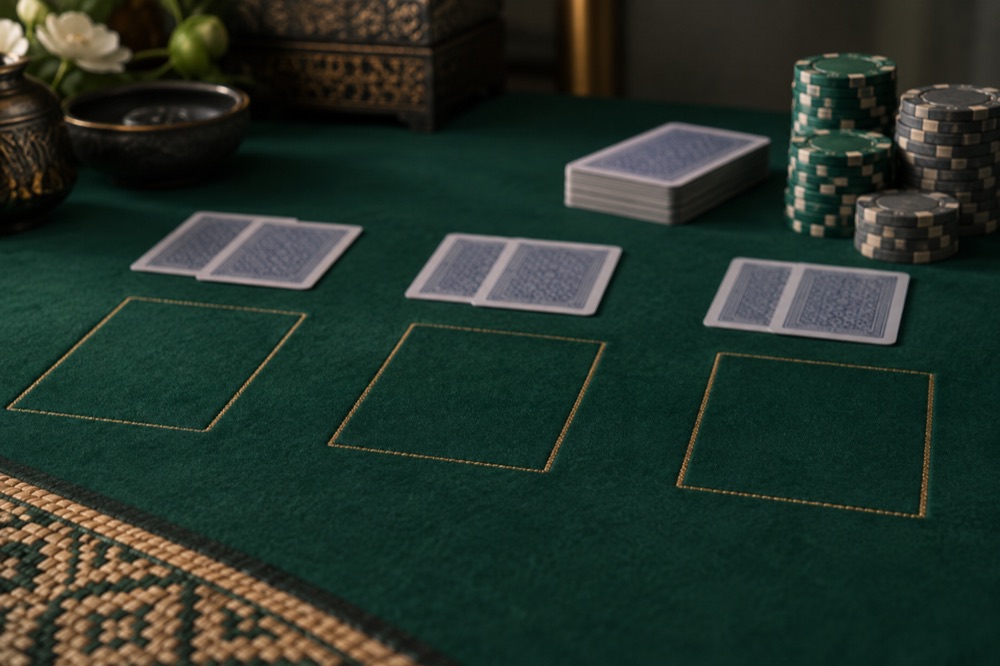
Three special hands sit above the point totals: sáp, three cards of the same rank with three Aces the highest; then liêng, three consecutive cards; then ba tây, any three face cards J, Q, K, all of which rank equally11. Rules genuinely vary from house to house11.
In casinos, Bài Cào becomes a baccarat-style game with three bets:
Each side is dealt two to three cards, and the side closer to 9 wins; in the casino version 10 through K count as 0 rather than 1011. The player draws a third card on 0-5 and stands on 6-9, and the banker follows a fixed drawing schedule11.
Bai Buu: four cards, two hands
Bai Buu, also called Four Card Brag or Four Card Poker, is a traditional Vietnamese game that shares DNA with Chinese Poker (Mậu Binh) and is popular across Vietnam and Southeast Asia12. Each player is dealt four cards face down and must arrange them into two hands of two cards: a front hand and a back hand12.
The catch is the setting rule: your front hand must be stronger than your back hand. Get it backwards and you have a binh lủng, an invalid hand that loses automatically12.
Card values are simple: Aces count 1, cards 2-9 count face value, and 10, J, Q, K count 012. A hand's value is the last digit of the sum of its two cards, so a 7 and an 8 make 15, which counts as 5, and the maximum hand score is 912. Pairs beat everything regardless of point value, ranked from a pair of Aces down to a pair of 2s12. When comparing, front hands are checked first, then back hands, and you win the round only if both of your hands beat the opponent's corresponding hands12. Suits can break ties between equal pairs, though this varies by house12.
Betting starts with an ante before the deal, then continues with call, raise or fold13.
Tam cúc: the 32-card trick-taking game
Tam cúc is a trick-taking game played with a 32-card deck modeled on Chinese chess pieces. The cards are Tướng, Sĩ, Tượng, Xe, Pháo, Mã and Tốt, and they rank in that order, with red cards beating black cards of the same name4. Each color has one Tướng and five Tốt, and two of every other card4.
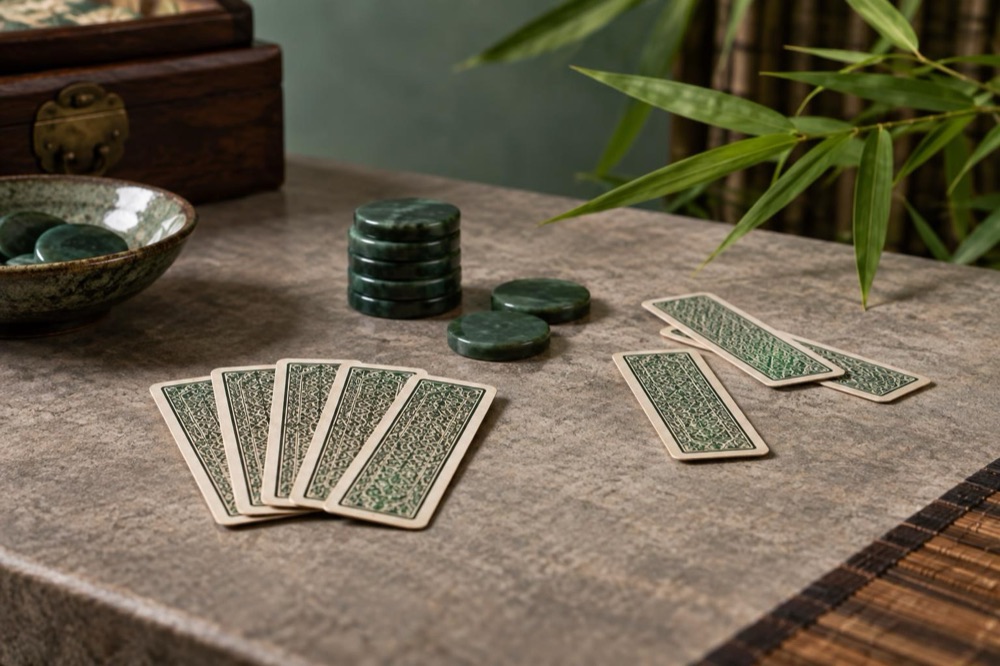
The first lead has a strict rule, remembered as a rhyme: in two- and four-player games, "cấm tướng, cấm sĩ lấy tượng cầm đầu," meaning only the red Tượng may lead the first call, and leading Tướng or Sĩ is a foul that cannot win the trick4. In the three-player variant the rhyme changes and the red Xe becomes the highest card allowed to lead4. For three players, one red and one black Tốt are removed from the deck4.
Special combinations add spice. A pair is two cards of the same color and name; a triple is Tướng-Sĩ-Tượng or Xe-Pháo-Mã of the same color; tứ tử is four Tốt of one color and ngũ tử is five4. In the final round the dealer calls a pair of black Tốt, and winning it, called kết đôi, adds 2 points, with kết ba adding 3 and tứ tử wins adding 8, though scoring varies by group4.
Tổ tôm and Chắn: the 120-card deck
Tổ tôm is the grand old game of northern Vietnam, played with a 120-card deck divided into three suits, Vạn, Sách and Văn, each with nine ranks from nhất to cửu and four cards per rank, 108 cards in the suits plus extras5. It needs exactly five players, called chân, seated in a circle on a mat; the dealer divides the deck into six parts of 20 cards, five for the players and one set aside as the bài nọc5.
The winning hand, called ù, is when all 21 of your cards form complete sets with no leftover card and at least one lưng5. Scoring follows a traditional verse, "suông hai, dịch một, tôm bốn, lèo năm," though it varies by locality5. A player caught in báo, an improper declaration, loses the right to continue the hand and must pay points to the whole table5.
Today Tổ tôm survives mainly in northern provinces such as Bắc Ninh, Hưng Yên, the former Hà Tây and Bắc Giang5. Its historical roots trace back to Chinese domino-card games recorded in the region in the nineteenth century14. From the same deck, five cards are removed (nhất vạn, nhất văn, nhất sách, thang thang and ông cụ) to play chắn, the trick-taking game that gave Vietnam the phrase "danh chắn"5.
Other traditional games: Xi Dach, Bầu Cua Tôm Cá and Bài Choi
Beyond the card tables, Bầu Cua Tôm Cá is the great dice game of festivals: three dice whose six faces show a gourd, crab, shrimp, fish, rooster and deer, with two to eight players betting on which symbols will come up2. It takes seconds to learn and is the game you will see most at Tết.
Xì Dách deserves its second mention here as the bridge between home play and the casino: the same name, two different games, as covered above. Bài Choi, the folk game of central Vietnam, blends singing, riddles and cards into a village performance rather than a gambling game, and lives on at festivals rather than in casinos.
Who can play
Card games at home are simply part of Vietnamese life, and visitors invited to a family table are welcome to join. Casino play is different: foreign visitors can play freely in licensed casinos across the country, while Vietnamese citizens have limited access, allowed under a pilot scheme at certain locations, including Vân Đồn and Phú Quốc3. Vietnamese players in casinos may use only Vietnamese đồng to buy chips, with unused chips exchanged back into đồng15.

Where to see and play these games today
The easiest place to find the casino versions is a licensed resort casino. Corona Casino on Phú Quốc offers Bài Cào, Xì Dách (blackjack), Texas Hold'em poker and slots16, while Hoiana near Hội An runs more than 140 gaming tables including blackjack, pai gow, Niu Niu and sic bo3. The three large-scale casino resorts are in Nam Hội An, Hồ Tràm and Phú Quốc6, and The Grand Ho Tram sits in Ho Tram Hamlet, formerly Bà Rịa - Vũng Tàu province17. Dress is smart-casual: shorts, sandals and sleeveless tops are typically not permitted18.
Away from the casinos, poker clubs exist in Hanoi, Ho Chi Minh City and many provinces, with tournament tickets ranging from a few hundred thousand to a few tens of millions of dong19. Offshore online casinos also carry slots, table games and live dealer versions of these games for Vietnamese players20, though their legal standing is far murkier than the licensed resorts.
For the oldest games, travel north: Tổ tôm circles still gather in Bắc Ninh and Hưng Yên5, and Tam cúc turns up wherever the old 32-card decks are kept. For everything else, a Tết family gathering is the best showroom in the country.
Common Questions
What is the highest suit in Tien Len?
In the Northern style, hearts rank highest among suits, followed by diamonds, clubs and spades. In the Southern style, suits do not matter at all: only the rank of the cards counts.
How many cards do you get in Liêng?
Each player receives three cards from a standard 52-card deck with no jokers. You either bet on those three cards, bluff with them, or fold.
What is a 'binh lủng' in Bai Buu?
It is an invalid hand. Your front hand must be stronger than your back hand, and if you arrange your four cards the wrong way round, the hand automatically loses.
How many players does Tổ tôm need?
Exactly five players, called chân, who sit in a circle on a mat. The 120-card deck is dealt in six parts of 20 cards, five for the players and one set aside.
What is the difference between sáp and ba tay in Bài Cào?
Sáp is three cards of the same rank, with three Aces the highest, and it beats everything. Ba tay is any set of three face cards J, Q, K, and all ba tay hands rank equally, below sáp and liêng.
Which card leads the first trick in Tam cúc?
In games with two or four players, only the red Tượng may be led on the first call. In the three-player variant the rule changes, and the red Xe is the highest card allowed to lead.
Sources20 sources
- Online card games basic rules, V9BET, 2026
- Bầu Cua Tôm Cá rules, Xoviet Pokers, 2026
- Hoiana Casino, Hoiana, 2026
- Tam cúc, Wikipedia, 2026
- Tổ tôm, Wikipedia, 2026
- Pilot programme allowing Vietnamese to gamble in casinos extended, Vietnam News, 2024
- Bài Tiến lên, Wikipedia, accessed 2026
- Xi Dach history, Xoviet Pokers, 2026
- Hướng dẫn cách chơi Xì Dách, Casino Corona, 2026
- Liêng rules, Xoviet Pokers, 2026
- Hướng dẫn cách chơi Bài Cào, Casino Corona, 2026
- Master Bai Buu at Ha Tien Vegas, Ha Tien Vegas, 2026
- Bai Buu, Ha Tien Vegas, 2025
- Chinese games with dice and dominoes, Stewart Culin, 1893
- Người Việt có được chơi casino không?, Casino Corona, 2026
- Trò chơi tại Casino Corona, Casino Corona, 2026
- The Grand Casino Ho Tram, The Grand Ho Tram, 2026
- Gambling in Vietnam, Casino Corona, 2026
- Trường hợp nào chơi poker bất hợp pháp và hợp pháp tại Việt Nam, Xay Dung Chinh Sach, 2025
- Best online casinos for players from Viet Nam, Wizard of Odds, 2026