What Xì Dách is
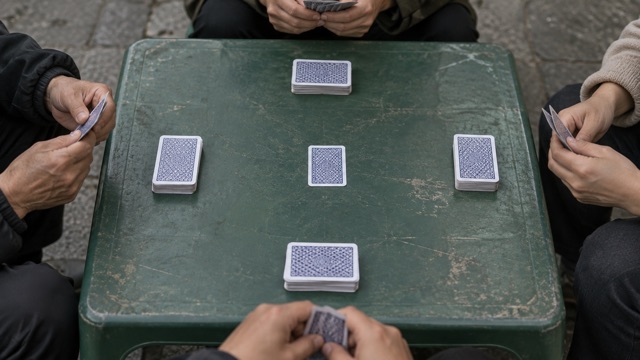
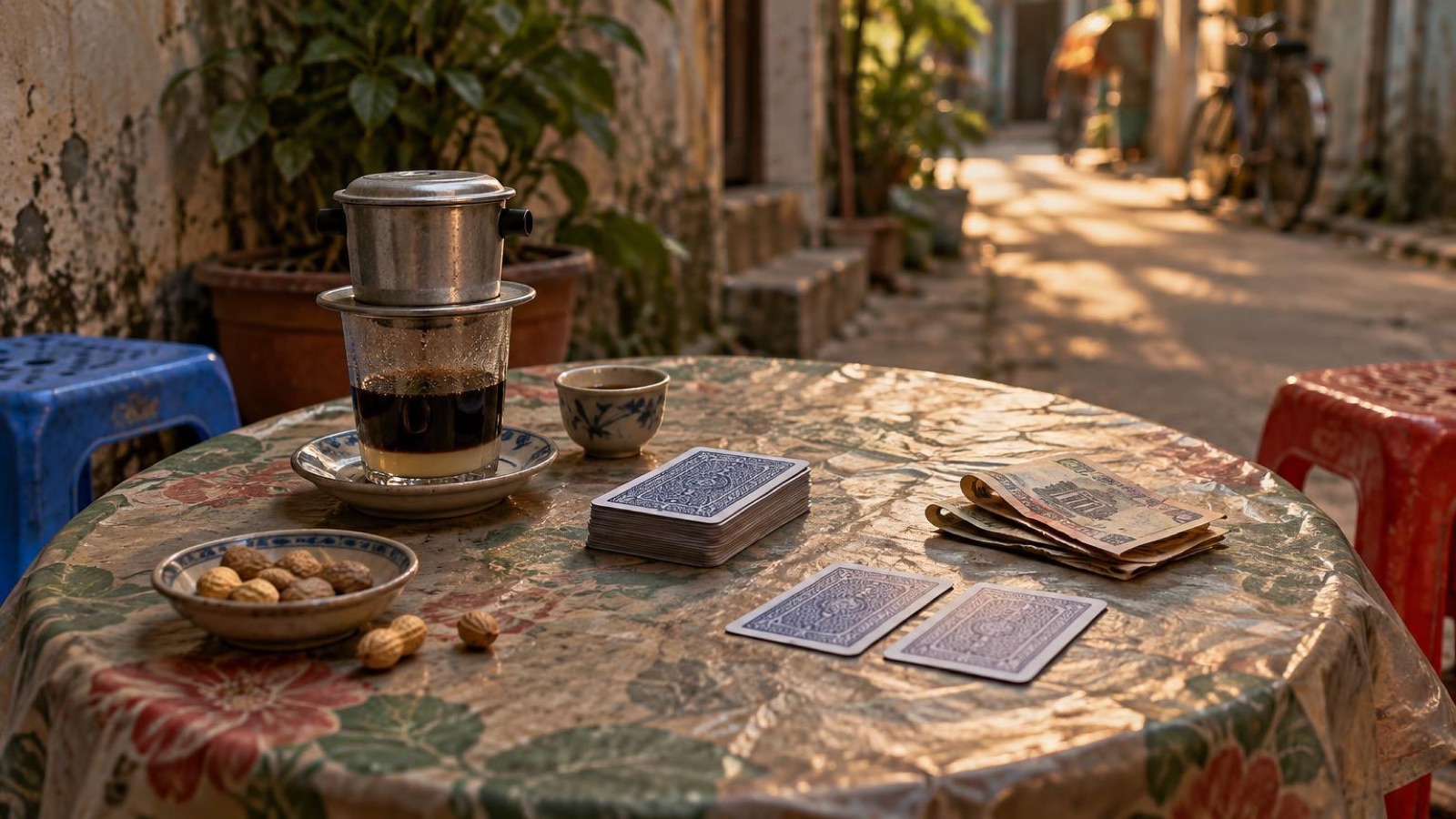
Xì Dách is the Vietnamese take on blackjack, and it is one of the most familiar card games in the country. You will see it played at family gatherings, especially around Tết, in cafes and among friends, usually for small symbolic stakes rather than serious money2. The name also refers to the game's best-known hand: an Ace paired with a 10-point card, dealt as your first two cards, which wins on the spot1.
The game shares its core idea with Western blackjack: you are playing against the dealer, not the other players, and you win by having a higher total than the dealer without exceeding 21 points1. But Xì Dách has its own personality. It uses a single deck rather than a shoe of six or eight, it has special hands with Vietnamese names that have no exact equivalent in casino blackjack, and in the traditional home version the rules flex from house to house1.
If you know blackjack, you can sit down at a Xì Dách table within minutes. If you learned Xì Dách first, casino blackjack will feel familiar but stricter, with fixed dealer rules and no room for negotiation. Both directions of that journey are covered below.
Card values and point counting
Xì Dách uses a standard 52-card deck1. The point values are simple:
- Numbered cards 2 through 10 are worth their face value1
- J, Q and K (the picture cards) are each worth 10 points1
- An Ace is worth either 1 or 11 points, whichever is more favorable to your hand1
So a hand of K + 6 is 16 points, and a hand of A + 6 can be counted as 7 or as 17, depending on what helps you. This flexible Ace is what players call a "soft" hand in blackjack: because the Ace can drop from 11 to 1, a soft hand cannot bust on the next card4.
One useful fact to keep in mind: 10-point cards are the most common cards in the deck. The 10, J, Q and K together make up about 30.8% of the deck, so more than three cards in every ten you or the dealer draw will be worth 10 points1. That is why hands built around reaching 21 are realistic, and why the dealer's fixed drawing rule (explained below) matters so much.
Winning hands: Xì Dách, Xì Bàng and Ngũ Linh
Three special hands sit above ordinary point totals, and they are what give the game its name and flavor.
Xì Dách is an Ace plus one 10-point card (10, J, Q or K) as your first two cards. This is the equivalent of a natural blackjack, and it wins immediately1.
Xì Bàng is two Aces as your first two cards. It is the strongest possible hand in the game: it beats a regular Xì Dách and wins the round on the spot1.
Ngũ Linh is the hand that has no direct equivalent in Western blackjack. If you draw cards and end up holding five cards that together total 21 points or less without busting, you win for sure, no matter what the dealer holds1. It ranks just below Xì Bàng and Xì Dách, and above a regular 212. If more than one player has Ngũ Linh in the same round, the player with the lowest total wins1.
Below these special hands, the ranking is simply by points: the closer to 21 without going over, the better. A hand of 21 made by drawing (say, 5 + 7 + 9) is a strong hand, but it loses to any of the three named hands above.
How a round plays out
A round of Xì Dách follows a rhythm anyone who has played blackjack will recognize, with a Vietnamese twist in the seating.
Play starts from the player to the right of the dealer and proceeds clockwise1. Each player places a bet, and the dealer deals two cards to each player and to themselves. In the traditional game the dealer is often just one of the players taking the bank for a round, and the deal rotates around the table.
From there, each player in turn decides whether to draw more cards or stand with what they have (the options are covered in the next section). Once every player has finished, the dealer plays out their own hand according to the fixed rule: the dealer must keep drawing until reaching 175. Then the hands are compared, and the bets are settled.
The object throughout is simple: reach a higher total than the dealer without exceeding 21 points1. You are not trying to beat the other players at the table, only the house or the player acting as dealer6.
Player options: draw, stand, double down and Chạy Làng
On your turn you have several choices, and the traditional game adds one that casino blackjack rarely offers.
Draw (rút). You take another card to raise your total. You can keep drawing as long as you stay at or under 21, and reaching five cards without busting is the Ngũ Linh hand described above1.
Stand (dừng). You keep your total and let the dealer play. The usual guideline is to stand when your total is 17 or higher, since one more 10-point card (the most likely draw, at about 30.8% of the deck) would bust you1.
Double down (gấp đôi). After receiving your first two cards, you may double your original bet, but you then get only one more card and no further draws. Players usually double with totals of 9, 10 or 11, where one good card is likely to land them close to 211.
Chạy Làng. This is the traditional Vietnamese surrender option, and it is common in home play2. If your first two cards are poor, you can fold the hand and give up only part of your stake rather than playing it out and risking the full bet. Casino blackjack tables outside Asia rarely offer surrender at all, so this is one of the clearest differences between the two versions of the game.
Insurance, by contrast, is rare in Vietnamese Xì Dách2. In casino blackjack, insurance is a side bet offered when the dealer shows an Ace, but in the traditional game it is simply not part of the culture.
Dealer rules and tie outcomes
The dealer in Xì Dách has no choices to make. The rule is fixed: the dealer must hit (draw cards) until reaching 17, and then must stand5. This is the same dealer rule you will find at most blackjack tables, where the house draws to 16 and stands on 177.
Ties work differently depending on where you play, and this is worth knowing before you sit down:
- Both bust. If both you and the dealer go over 21, the traditional Xì Dách result is a tie, not a loss1. This is friendlier than casino blackjack, where a player who busts loses immediately regardless of what the dealer does later8.
- Equal totals. In casino blackjack, an equal total with the dealer is a push: you keep your original bet9. In traditional Vietnamese Xì Dách, the local custom is that the lower points win ties, a rule unique to Vietnam2. In practice this means a standoff is often settled in the player's favor at home, though each house plays it its own way.
House rules: where the traditional and casino versions differ
The single most important thing to know about traditional Xì Dách is that the rules are not fixed. They vary from place to place depending on the house or the players at the table1. Before a home game, it is worth asking how the host handles ties, whether Chạy Làng is allowed and how Ngũ Linh is paid, because the answers will not be the same at every table.
The main differences between the traditional and casino versions:
| Feature | Traditional Xì Dách (home play) | Casino blackjack |
|---|---|---|
| Deck | Single 52-card deck2 | Multiple decks in a shoe at many tables6 |
| Dealer | Often a rotating player | A house employee with fixed rules |
| Surrender | Common (Chạy Làng)2 | Rarely offered |
| Insurance | Rare2 | Standard when the dealer shows an Ace |
| Both bust | Tie1 | Player loses8 |
| Rules | Flexible, agreed by the table1 | Fixed by the casino |
At licensed casinos in Vietnam, the table listed as Xì dách plays by standard Western blackjack rules rather than the flexible home version. Hoiana Resort & Golf near Hoi An, for example, offers Xì dách alongside Sicbo, Dragon Tiger Baccarat, Hoiana Pai Gow, Hoiana Stud Poker and Roulette3. If you sit down at one of these tables, expect the international version of the game, not the one played at a Tết gathering. You can read more about where to find these tables in our guide to casinos in Vietnam.
Where Xì Dách is played in Vietnam
Xì Dách lives two separate lives in Vietnam.

The first is at home. It is a staple of family gatherings and holiday play, especially at Tết, where it sits alongside other traditional card games like Tiến lên and Bài Cào. Home play uses the traditional flexible rules described above, with symbolic stakes2. Bài Cào, a cousin game dealt as three cards per player with J, Q and K counting 10 points, follows the same pattern of rules varying by house and by players10.
The second is at licensed casinos, which are open to foreign visitors and, at a small number of venues, to Vietnamese who meet entry conditions. Nam Hoi An Casino in Quang Nam Province and Silver Shores Casino in Da Nang are among the licensed venues, and table-game floors like Hoiana's spread include Xì dách under standard rules3. For the full picture of what is open to visitors and residents, see gambling in Vietnam.
Online, Vietnamese players who use card-game apps and sites overwhelmingly prefer the traditional version of Xì Dách, a cultural preference that holds even in digital play, while international sites offer standard blackjack under Western rules2. Our pages on traditional Vietnamese card games and online gambling in Vietnam cover those options in detail.
Stakes, bankroll and session length
Traditional Xì Dách is a low-stakes, social game. Typical stakes are symbolic, in the range of $1 to $5 per hand, and a session usually runs 2 to 4 hours2. Nobody at a family table is playing for rent money; the game is about the company as much as the cards.
If you are playing with real money, whatever the size, the standard bankroll advice for the game is to bet only a small part of your total funds on each hand, usually 1-5% of your bankroll per hand1. The reasoning is simple: Xì Dách is a game of swings. Even a good player loses hands in streaks, and betting too large a share per hand means a short run of bad cards can wipe you out before the evening is over.
At a casino table, stakes are set by the house rather than the table of friends. Minimums and limits vary between tables and between venues, so check the table signage or ask the floor staff before you buy in, the same as you would at any blackjack table6.
Common Questions
What does Xì Dách mean in English?
Xì Dách is the Vietnamese name for blackjack. The word comes from the game's Chinese-influenced card slang, and the name also refers to the best two-card hand: an Ace plus a 10-point card.
Is Xì Dách the same as blackjack?
It is a Vietnamese cousin of blackjack. The goal is the same, to beat the dealer without going over 21, but Xì Dách uses a single deck, has special hands like Xì Bàng and Ngũ Linh, and in the traditional version lower points can win ties.
What is Xì Bàng?
Xì Bàng is a pair of Aces as your first two cards. It is the strongest hand in Xì Dách, beats a regular Xì Dách (Ace plus a 10-value card), and wins the round immediately.
What happens if both player and dealer go over 21?
In Xì Dách, if both the player and the dealer bust, the result is a tie rather than a loss for the player. This differs from casino blackjack, where a busted player loses even if the dealer also busts.
How many cards are in a Xì Dách game?
Xì Dách is played with a standard 52-card deck, usually a single deck in traditional play. Players start with two cards and can draw more, up to five cards in total for the special Ngũ Linh hand.
What is a weak hand in Xì Dách?
A hand totaling under 16 points is called bài non, meaning it is too weak to stand on. A hand of 16 to 21 points is considered sufficient (bài đủ) and can stand against the dealer.
What is Ngũ Linh?
Ngũ Linh is a special winning hand of five cards that together total 21 points or less without busting. It beats a regular 21 and ranks just below Xì Bàng and Xì Dách. If several players have it, the lowest total wins.
Sources11 sources
- Cách chơi Xì Dách, Corona Casino, 2026-03-20
- Xì Dách history and variants, Xoviet Pokers, 2026-09-26
- Table games, Hoiana Resort & Golf, 2026
- How to play blackjack, PlaySmart, 2026-09-25
- Online card games: basic rules, V9BET, 2026-03-21
- How to play blackjack, GameSense, 2020
- How to play blackjack, Shuffle, 2026-08-20
- How to play blackjack, PlaySmart, 2026-09-25
- Poker essentials, GameSense, 2020
- Cách chơi Bài Cào, Corona Casino, 2026-03-20
- Top legal casinos in Vietnam, Corona Casino, 2026-08-27