What Tien Len is and how it is played
Tien Len is a shedding game: you are dealt a hand of cards and the winner is the first player to get rid of every one of them. In Vietnam it goes by several names. The full Southern form is Tiến lên miền Nam, often shortened to Tiến lên or just TLMN. Abroad it is usually called Thirteen, or Vietnamese Thirteen, after the 13 cards each player holds. Whatever the name, the shape of the game is the same: a fast, chatty, competitive race where the luck of the deal matters but reading your opponents matters more1.
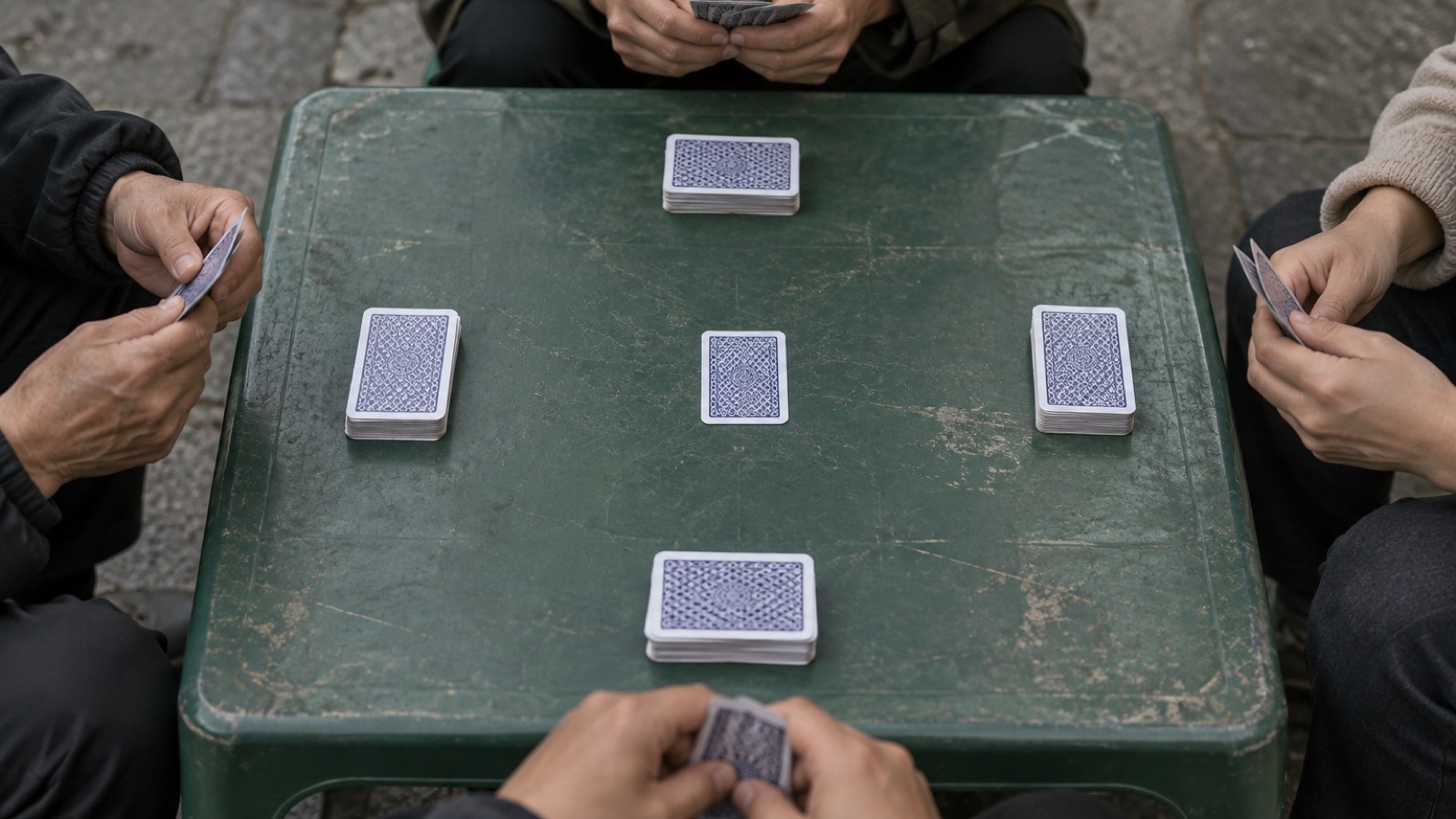
The standard game seats four players, each dealt 13 cards from a single 52-card deck with no jokers and no wild cards. Two or three players also works, and with more than four you simply put two decks together. With three players, an alternative deal of 17 cards each can be agreed in advance, with the starting player taking the final leftover card1.
Play is normally clockwise, though a table can agree in advance to go counterclockwise instead. The player who holds the 3 of Spades leads the very first game and must include that card in the opening play, either alone or as part of a combination. After that, the winner of each game leads the next one and can open with anything they like1.
From there the game runs in rounds. The leader plays a card or a combination, and each following player in turn must either beat it with a higher combination of the same type, or pass. Play continues around the table until everyone but one player has passed. That player has won the round, and they lead the next round with any combination they choose. The game ends the moment one player runs out of cards1.
One house-style detail worth knowing before you sit down: at some tables, the player who won the last round can keep playing successively higher combinations of the same type while everyone else has passed, rather than waiting for a fresh lead. Ask how the table handles this before the first deal, because it changes how you hold back your big cards1.
Tien Len is above all a social game. It is played at family gatherings, in cafes, on the sidewalk, and on every long bus or train ride in the country. Among some longtime players, peeking at other players' cards or playing out of turn is tolerated if you can get away with it, which tells you a lot about the casual, teasing spirit of the game. Agree on the rules and the stakes before you start, because tables vary1.
Cards, ranking and the 3 of Spades
The card ranking in Tien Len is unusual and is the first thing that trips up new players. The 2 is the highest card in the deck, not the lowest. The full order from high to low is: 2, Ace, King, Queen, Jack, 10, 9, 8, 7, 6, 5, 4, 31.
Suits also rank, which matters whenever two players hold cards of the same rank. From highest to lowest the suits are Hearts, Diamonds, Clubs, Spades. That makes the 2 of Hearts the single highest card in the game, and the 3 of Spades the very lowest card in the deck1.
The 3 of Spades has a special role beyond being the smallest card. Its holder is forced to open the first game with it, alone or inside a combination, so everyone at the table knows exactly who is stuck with the weakest card in the deck. In later games the previous winner leads instead and may play anything1.
Because the 2 sits above the ace, hands that look weak in poker terms are strong here. A pair of twos beats any other pair. A single 2 beats any single ace. And the twos, called heos in Vietnamese, carry their own penalty values in the Southern game when players are caught holding them at the end, which we cover below.
Legal combinations and the beating rule
There are six legal plays in Tien Len1:
- Single card: any one card.
- Pair: two cards of the same rank.
- Triple: three cards of the same rank.
- Four of a kind: all four cards of one rank.
- Sequence (sảnh): three or more cards of consecutive rank, such as 4-5-6.
- Double sequence (đôi thông): three or more consecutive pairs, such as 4-4-5-5-6-6.
The core beating rule is simple: a combination can only be beaten by a higher combination of the same type and the same number of cards. A pair only beats a pair, a five-card sequence only beats a five-card sequence, and so on. You cannot answer a pair with a triple, or a sequence with a four of a kind, under the general rule1.
Sequences have one hard limit: they cannot turn the corner between the 2 and the 3. A-2-3 is not a valid sequence, because the 2 is high and the 3 is low. Sequences run only from the 3 up to the ace, and twos cannot be used in them at all1.
There are exceptions to the same-type rule, and they are the heart of the game's strategy. These "bombs" or cuts (chặt) let special combinations jump on top of twos:
- A four of a kind can beat any single 2, but not any other single card such as an ace or king.
- A double sequence of three consecutive pairs can beat any single 2.
- A double sequence of four consecutive pairs can beat a pair of 2s.
- A double sequence of five consecutive pairs can beat a set of three 2s1.
Some tables play an even more aggressive version of this rule, where a four of a kind can beat any single card or any pair, not just a 2. Check which version your table uses before you rely on it1.
Northern and Southern variants: how the rules differ
Vietnam plays two main styles of Tien Len, and the differences are big enough that a Southern player at a Northern table will genuinely be playing a different game. The Southern form, Tiến lên miền Nam, is the one most people mean when they say Tien Len, and it is the version described in most international rules2.
The differences start with the basic combinations:
- Pairs: in the Northern style, a pair must be two cards of the same rank and the same color (both red or both black). In the Southern style, any two cards of the same rank form a pair.
- Sequences: in the Northern style, a sequence must be three or more consecutive cards of the same suit, essentially a straight flush. In the Southern style, a sequence is just three or more consecutive cards, suits irrelevant. In both styles the 2 cannot appear in a sequence, and a sequence running all the way from 3 to ace is called a dragon straight (sảnh rồng)2.
The treatment of twos differs too. In the Northern game, a four of a kind can block a single 2 or a pair of 2s, and in some places a suited sequence of five or more cards can also be used to block a 2. The Southern game has a much fuller system of cuts, described in the next section2.
The Northern game also handles the lowest card differently. If a player is dealt all four 3s, everyone else at the table must immediately lay down all their 2s. And in the Northern style there is no instant win: the special automatic-win hands that make Southern Tien Len famous are simply not played2.
One more Northern quirk worth knowing: for the purposes of cutting, suits are ordered Spades, then Clubs, then Diamonds, then Hearts, with Hearts highest2.
Special win conditions in Southern Tiến lên
The Southern game has a set of hands that win instantly (tới trắng) the moment they are dealt, before a single card is played. If you are dealt one of these, you show it and the round is over. In the opening round, the instant-win hands are2:
- Four 3s.
- Three consecutive pairs containing the 3 of Spades.
- Four consecutive pairs containing the 3 of Spades.
- Three triples, such as 444-555-666.
- Four triples, such as 444-555-666-777.
- Three four-of-a-kinds, such as 4444-5555-6666.
- Five pairs plus one triple, such as 33-66-88-99-JJ-AAA.
- Five consecutive pairs plus one triple, such as 44-55-66-77-88-JJJ.
In later rounds of a session, the list changes to2:
- Four 2s (the 2 of Hearts, 2 of Diamonds, 2 of Clubs and 2 of Spades together).
- Five consecutive pairs.
- Any six pairs.
- A dragon straight, the full run from 3 to ace.
- A hand entirely of one suit and color, all black (Clubs and Spades) or all red (Hearts and Diamonds).
- A hand containing no card that anyone else has led.
The Southern cutting system is also richer than the Northern one. Three consecutive pairs cut a single 2. Four consecutive pairs cut a single 2, a pair of 2s, three consecutive pairs, a four of a kind, and any smaller run of four consecutive pairs. A four of a kind cuts a single 2, a pair of 2s, three consecutive pairs, and a smaller four of a kind. Five consecutive pairs are the strongest cut of all, taking out one, two or three 2s, runs of three, four or five consecutive pairs, and four of a kinds2.
Penalties and stake values for players left holding cards
In the simplest scoring version, the moment someone runs out of cards the game ends and every other player pays the winner one stake unit per card left in their hand. That is the clean, entry-level way to settle up1.
The Southern game layers extra penalties on top. A player who has not managed to play a single card the entire game, a fate known as thua cóng, loses double the stake, and then has their remaining hand checked and counted for heos and hàng (special combinations) still sitting in it, each of which adds further penalties2.
The penalty values, in units of the table's stake, are2:
| Item left in hand | Penalty |
|---|---|
| Black 2 (2 of Spades or 2 of Clubs) | half a stake |
| Red 2 (2 of Hearts or 2 of Diamonds) | one stake |
| Three consecutive pairs | 20 stakes |
| Four of a kind | 10 stakes |
| Four consecutive pairs | 30 stakes |
Some tables settle in points instead of cash units, in which case the 2 of Spades costs 1 point, the 2 of Clubs 2 points, the 2 of Diamonds 3 points, and the 2 of Hearts 4 points, while any hàng (three consecutive pairs, a four of a kind, or four consecutive pairs) costs 4 points2.
Regional variants: Huế, Da Nang and Bình Trị Thiên
Beyond the broad North-South split, central Vietnam has its own local rules, and they change the game again.
In the old Bình Trị Thiên provinces, the region around Huế, the 3 of Clubs is played first rather than the 3 of Spades, a small difference that shifts who opens the game2.
The Huế style also has two distinctive penalty customs. If a player wins the game while holding only the 3 of Spades as their final card, a situation called "ba mù", the other three players are all counted as losing last, a sting that multiplies the damage. And a player who finishes last while still holding only the 3 of Spades is penalized separately for it, a fault called thúi 3 bích2.
Da Nang plays its own version of the cutting rules. There, three consecutive pairs can only be used to seize the lead, not to cut a 2. A four of a kind cuts only a single 2, not a pair of 2s. But four consecutive pairs may cut a pair of 2s or any four of a kind at any time, even without holding the turn, though they cannot cut a single 2. Da Nang also adds a payment custom around offering cards: if you offer a 2 you must return with a card below 10, and if you offer an ace you must return with a card below 52.
Stakes and payment between players
How the money actually moves depends entirely on the table. In the basic settlement, the loser of a game pays a fixed stake to each of the other players. Among serious players, a typical figure quoted for a single game is $2000 paid to each of the others, which gives a sense of the scale some circles play at, though most friendly tables run far, far smaller1.
In the per-card version, each losing player pays the winner one stake unit per card remaining in hand, with the penalty items from the previous section added on top in the Southern game1.
Some tables add a trading rule between deals: the loser of the previous deal gives their two highest cards to the winner, and the player who came second-to-last gives their highest card to the player who came second, with the recipients passing back unwanted cards. This punishes repeated losses and rewards streaks, so ask whether it is in effect1.
A note on the law, said once and plainly: playing Tien Len for money with other people is gambling, and organizing or taking part in unlicensed games for stakes is against the law in Vietnam. Police do raid underground card games, and stakes in the cases that make the news have run from VNĐ10 million to VNĐ100 million per player. Playing the game itself, with family and friends for nothing or token amounts, is a normal part of daily life across the country3.
Other games you will meet at the same table
Tien Len rarely travels alone. The same deck and the same circle of players support a whole family of Vietnamese card games, and a session often drifts from one to another as the evening goes on.
The closest cousin is Xi Dach, Vietnam's version of blackjack. After everyone bets, the dealer hands out two cards apiece to the players and to themselves, and players can then take extra cards as they try to outscore the dealer, with aces counting low and face cards counting ten. It is the most common game in Vietnamese homes, played with flexible house rules, and it shares Tien Len's fast, social rhythm4.
Tu Sac, or Tứ sắc, is the four-color card game played with a special deck of 80 cards in four colors. Each player is dealt 20 cards, five at a time, and the dealer takes six cards for the first turn. It is a slower, more tactical game than Tien Len, closer to rummy, and it carries its own penalty customs, including a payment owed by a player who declares a win while holding an odd card5.
Bau Cua Tom Ca is the dice game that appears at every festival, where players bet on six pictures (gourd, crab, shrimp, fish, rooster, deer) and three dice decide the payouts. It seats two to eight players and is about as beginner-friendly as Vietnamese gambling games get6.
Liêng is a three-card poker-style game where each player receives three cards and hands are ranked as three of a kind, straight, flush and so on, with A-2-3 counting as the lowest straight. It is popular in the south, where it is often played with higher minimum bets and a more aggressive style, and in the north it is often called Cào Tố and played more conservatively7.
And for a sense of how deep the tradition runs: Tien Len is not one game but a family of regional styles. The Northern style counts a pair only when the two cards match in color, and a straight only when the cards share a suit, while the Southern style loosens both rules. Huế has its own twist, where finishing first while holding only the 3 of Spades makes the other three players all lose last, and Da Nang players settle heo and ace payments by how many cards are left. Same table, different house rules8.
If you want the full picture of what else is played in Vietnam, from casino poker to traditional Vietnamese card games, those pages cover each game in the same detail.
Common Questions
How many players does Tien Len need?
The standard game is for four players, each dealt 13 cards from a 52-card deck. Two or three players work too, and with more than four players you can combine two decks.
What is the highest card in Tien Len?
The 2 of Hearts. Card order runs from 2 (highest) down to 3 (lowest), and among cards of the same rank, suits rank Hearts, then Diamonds, Clubs and Spades.
Can A-2-3 be played as a sequence?
No. Sequences cannot turn the corner between the 2 and the 3, because the 2 is high and the 3 is low. Sequences run from 3 up to the ace only, and twos cannot be used in them.
What is a heo in Tien Len?
A heo is a two, the highest single card in the game. In the Southern style, black heos (2 of Spades or Clubs) and red heos (2 of Hearts or Diamonds) carry different penalty values if you are caught holding them.
What is 'thua cóng'?
It means losing without having played a single card the whole game. In Southern Tien Len, a player who is caught this way pays double the stake, and then gets checked for remaining twos and special combinations that add further penalties.
Who plays first in Tien Len?
In the first game, the player holding the 3 of Spades leads, and must include that card in the opening play. In later games, the winner of the previous game leads and may open with anything.
How many cards are dealt in Tien Len?
Thirteen cards to each of four players, using the whole 52-card deck. With three players, 17 cards each is an option by prior agreement, with the starter taking the final card.
Sources8 sources
- Thirteen (Tien Len), Pagat.com, November 25, 2016
- Bài Tiến Lên, Wikipedia, accessed October 9, 2026
- 21 arrested in poker ring bust in HCM City, Vietnam News, 2018
- Xi Dach History, Xoviet Poker, 2026
- Tứ sắc, Wikipedia, accessed October 9, 2026
- Bầu Cua Tôm Cá Rules, Xoviet Poker, 2026
- Liêng Rules, Xoviet Poker, September 26, 2026
- Chinese Games with Dice and Dominoes, Smithsonian Institution, 1893