What a slot machine is and how a spin works
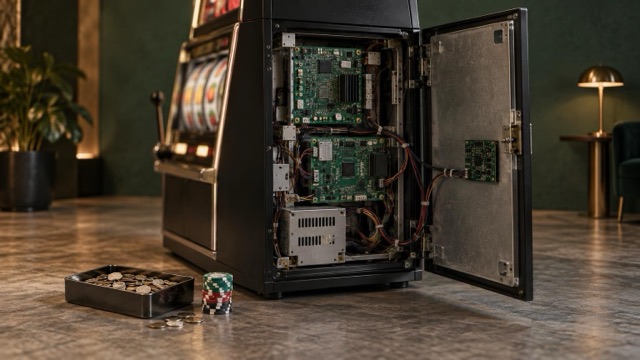
A slot machine looks like a game of spinning pictures, but under the hood it is a computer. Modern slot machines use a random number generator to determine the outcome of each play, generating hundreds or thousands of numbers every second. The result of your spin depends on the number that comes up at the exact instant you activate the machine1.
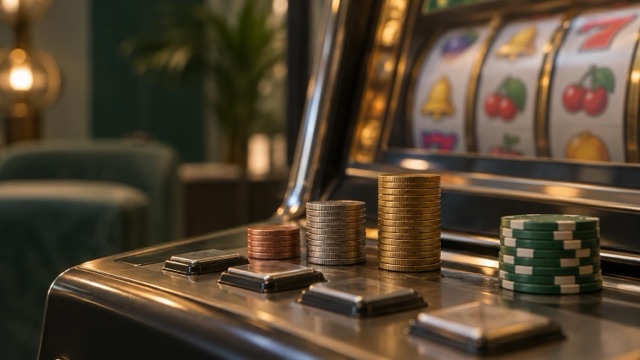
The visible part is the reels. Slot machines generally have three or more reels, the vertical strips of symbols that appear to spin and then stop one by one. When the reels stop, the symbols line up across the face of the machine, and certain combinations pay prizes according to the machine's paytable2.
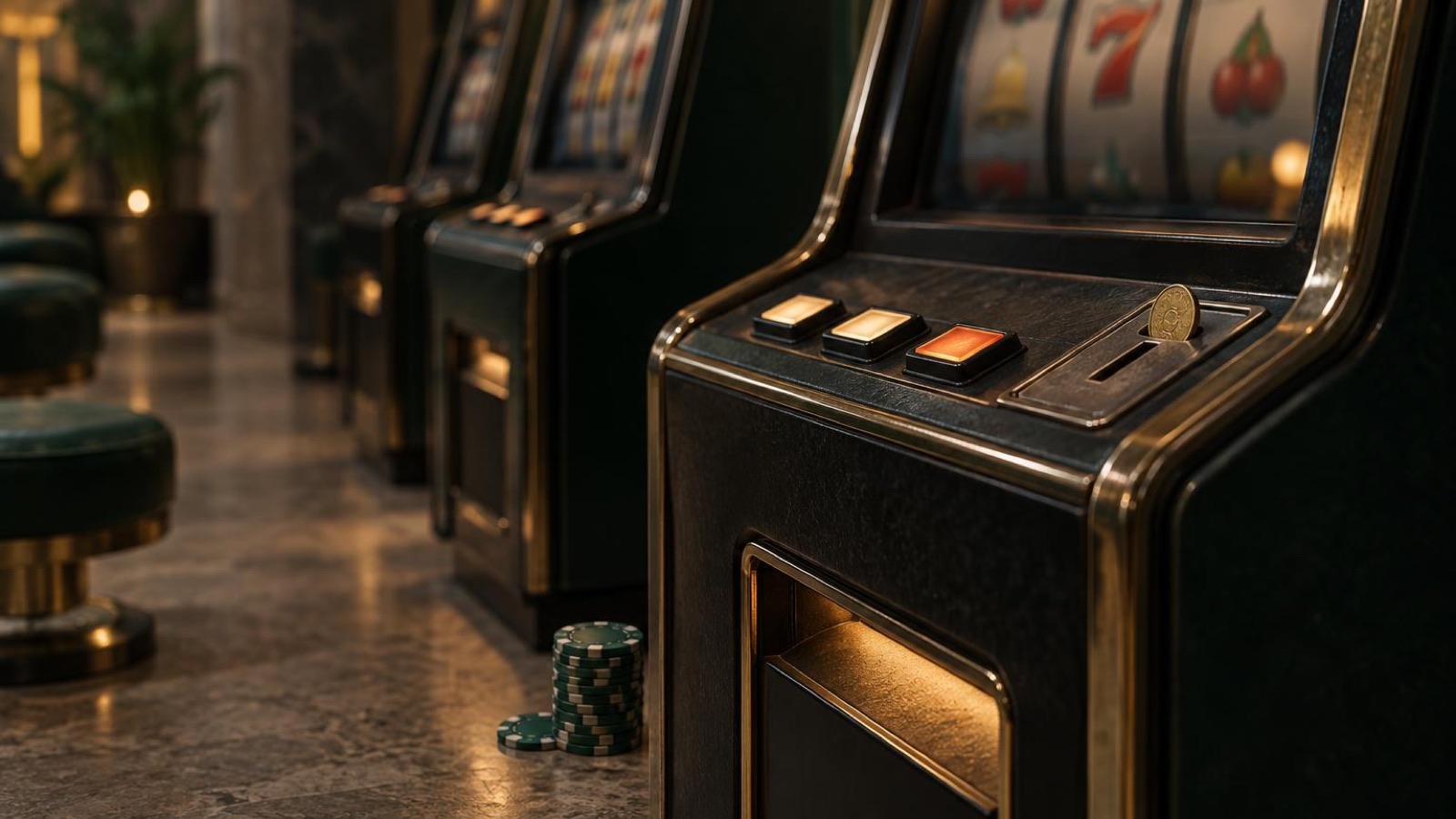
The basic routine never changes. You insert your money, press a button, and watch the reels spin8. That simplicity is the whole appeal: there is no strategy to learn before your first spin, unlike table games where the rules take time to absorb. Each machine has its own paytable, which shows the different symbols, paylines, and bonus features, so the paytable is the first thing worth checking on any new machine8.
Machines differ widely in feel even though the core is the same. Slot machines come with different themes, betting limits, and payout rates, and some include bonus rounds and progressive jackpots8. Two machines sitting side by side can be entirely different games. For a deeper look at the mechanics, see how slot machines work.
Paylines, bets and credits: the rules that decide a win
A payline is the line across the reels where matching symbols must land for you to win. Classic machines had a single line straight across the middle; modern machines have many, and some use systems like Megaways or cluster pays instead of fixed lines. Before you spin, you choose how much to bet, and on many machines, how many lines to cover.
Money goes into the machine as credits. Your cash becomes credits at the denomination the machine is set to, and your bet is taken from those credits each spin. Wins are added back as credits, and when you finish, you cash out the remaining credits, either into a coin tray or as a printed ticket at machines using ticket-in, ticket-out systems. See slot paylines, ways to win, Megaways and cluster pays and how much a slot spin costs for the details.
Japanese pachislo machines work on a related but distinct system: you bet medals rather than credits. The medals themselves have a cash exchange value set by the parlor, which we cover in the pachislo section below.
Reading the paytable before you play tells you three things: which symbols pay, which lines are active, and what the bonus features do. If you want to work out exactly what a combination pays, see how to calculate winnings from a slot paytable.
Wilds, scatters and bonus features
Some slots have special symbols like wilds and scatters, which can potentially increase your chances of winning8. A wild substitutes for other symbols to complete winning combinations; a scatter typically pays anywhere on the reels and often triggers a bonus round. What each symbol does varies from machine to machine, which is another reason the paytable matters.
Bonus features are where modern slots get their personality. Free spins, pick-a-prize rounds, cascading reels and multipliers all fall under this umbrella, and the details are in cascading reels, multipliers, expanding symbols and other slot features and how free spins and bonus rounds trigger.
One point worth knowing early: most slot play is purely luck, but on some machines a bonus game offers a chance to influence the outcome through arcade-style interaction. Even then, the random number generator usually determines whether you get to play the bonus game and how much money is available to win, so luck remains the dominant factor1. If you have wondered whether skill matters at all, see does skill matter when playing slot machines.
Not all slot machines are the same, and this is true of the base game as well as the features. Some machines have more frequent prizes and bonus games, while others pay less often but with bigger prizes1. That difference is what the volatility of a machine describes, covered in slot volatility and hit frequency.
Random Number Generators: why every spin is independent
The random number generator, or RNG, is the heart of every modern slot machine, and it works whether the machine sits in a casino or runs as an online game. All spingo slot games, for example, use certified Random Number Generator technology audited by independent testing bodies9. The certification matters because it is what assures players the outcomes are genuinely random rather than tilted by the operator.
The key consequence of the RNG is independence. Each play is completely independent of the previous play, and the random number generator makes the outcome of each play nearly impossible to predict1. Each spin is independent, random and unrelated to previous or future spins, so it is impossible to predict what will happen next2.
This kills a whole family of popular beliefs. Machines never come due to win, and they do not freeze after a win; payouts are determined by the machine's preset odds, and the internal mechanism cannot predict the outcome1. Nor does a machine's position matter: slot machines do not depend on arrangement or location, and how often a machine is played is not related to whether it will pay out on the next play1.
So a machine that has not paid all evening is not more likely to pay on your spin, and a machine that just hit a jackpot is not less likely to pay again. If you have heard otherwise, see are slot machines due to pay out after a losing streak and do slots pay more the longer you play.
House edge and RTP: what slots pay back
Return to player, or RTP, is the percentage of all money wagered on a machine that it pays back over time. If a slot shows 96% RTP, the remaining 4% is the house edge, the built-in slice that stays with the casino over time10. The two numbers always add up to 100 percent, so a higher RTP means a lower house edge.
One land-based reference point: the average return to the player is 92 percent on slot machines2. Online slots tend to run higher, with most having an RTP of over 95% and some select games reaching up to 99%3. Anything above 96.5% is treated as a high-RTP slot in curated selections9.
The crucial caveat is what "over time" means. A slot machine's payout percentage is averaged over its lifetime, not just one session, day, or week11. Your evening at a machine is a tiny sample, and your actual results can sit far above or below the advertised percentage. The RTP is a long-run average, not a schedule.
The odds themselves are fixed. Slot machine odds are fixed and do not change regardless of how you play12. There is no playing style that improves the return; the only lever you control is which machine you sit at. For the full picture, see slot return to player and house edge, and if you wonder whether the same game can pay differently in different places, see can the same slot have different RTP versions.
Land-based slots across Asia's casinos
Land-based slot machines are spread unevenly across Asia. In Cambodia, popular games in casinos include traditional options like blackjack, poker, and roulette, and also slot machines13. Foreigners and tourists are allowed to gamble at regulated gaming venues there5, so the casino slot floors are open to visitors.
In South Korea, the government's own counseling service lists slot machines among the chance-based gambling games available in the country, alongside lotteries, roulette, video poker and baccarat14. The best-known venue for locals is Kangwon Land Casino, the country's only casino where Korean citizens may gamble, whose homepage is www.high1.com/casino_eng15. Every other casino in South Korea is foreigner-only.
In the Philippines, casino slot machines come with different themes, betting limits, and payout rates, and some include bonus rounds and progressive jackpots8. Japanese players looking at offshore options will find the Japanese Yen listed among supported currencies at casinos accepting Japanese players3, though Japan's domestic slot scene is the pachislo network described later on this page.
Vietnam's situation is the mirror of Cambodia's in one respect: locals are still not allowed to gamble online in the country, and online gambling is not regulated for them16. Land-based casino access for Vietnamese nationals is limited to specific licensed casinos under trial conditions, while foreign visitors can play at the casino resorts.
For the jurisdiction-by-jurisdiction picture, see where slots are legal in Asia, and for the country guides, start with Cambodia, South Korea, Vietnam and Japan.
Online slots: 3-reel, 5-reel and progressive variants
Online slots take the same RNG principle and remove the cabinet. The classic division is by reel count: 3-reel slots are the direct descendants of the original machines, simple and fast, while 5-reel slots are the modern standard, with more symbols, more paylines and more room for features. Beyond the reel count, the meaningful categories are volatility, feature set and jackpot type.
Progressive jackpots are the headline variant. A progressive machine takes a slice of every wager and adds it to a growing jackpot, which keeps climbing until someone wins it. The odds reflect the size: jackpot odds can be as low as 1 in 17,000,000 spins4. The trade-off is straightforward, and it applies to all slot machines: you are more likely to win smaller prizes than the top prize1.
An interesting edge case from the progressive world: on the MEGABUCKS progressive slots in Las Vegas area casinos, at one period when the jackpot had gone unclaimed for a long time, the expected value exceeded 100%17. That is, the jackpot had grown so large that the theoretical return to a player was above the total wagered, an unusual situation that illustrates how a progressive's size changes the math. How a progressive resets after a win is covered in what is a progressive jackpot.
Stakes online can be very low. Jackpot slots at spingo offer prizes from as little as RM0.20 per spin9. Whether the games themselves are fair is a fair question, and the answer is in are online slot machines rigged; on the payout side, do online slots have higher RTP than land-based casino slots compares the two.
Where slots are legal for locals and where they are not
Access to slot machines across Asia depends heavily on who you are. The short version for the major jurisdictions:
- Cambodia: Foreigners and tourists are allowed to gamble at regulated gaming venues5. Citizens are prohibited; locals using foreign online sites can be committing illegal gambling, though authorities rarely prosecute locals for it5.
- Vietnam: Online gambling is not regulated and locals are not allowed to gamble online16. Foreign visitors can play at licensed casino resorts.
- Hong Kong: Casino-style gambling in Hong Kong is generally not legal, including land-based casinos, online casino games, and live dealer casinos10.
- South Korea: Slot machines exist in casinos, but only Kangwon Land admits Korean citizens15; the rest are foreigner-only.
- Japan: Pachislo parlors are open to residents and visitors alike, operating under the medal system described below.
The pattern across the region is consistent: where slot machines exist for locals, they tend to be heavily structured (Japan's medal system, Kangwon Land's monopoly), while casino slot floors elsewhere are generally built around foreign visitors. The practical risk for a local playing where they are not permitted is simply that the activity is unlawful, and winnings would have no protection.
The full comparison across all 12 jurisdictions, including who may play what and where, is in where slots are legal in Asia.
Japan's pachislo machines: settings, skills and medal play
Japan's version of the slot machine is the pachislo, and it is a different animal from the casino slots described above. Pachislo machines are Type 5 machines under Japan's classification system, as with Pachi-Slot Sengoku Musou18, and they are played with medals rather than credits. Some machines even use pachinko balls instead: on ball-type pachislo machines, 5 balls are treated as 1 medal19.
The distinctive feature is that the player stops each reel manually. On machines with digital displays, a "bonus confirmed" display only indicates the state where bonus symbols can be aligned; the player must stop the bonus symbols manually by eye20. This is the one place in the slot world where a measure of player timing enters, though the underlying odds remain machine-controlled.
Bonus rounds have hard payout limits set by regulation and machine generation6.
| Machine generation | Big bonus max payout, machines without the second type special prize device | Big bonus max payout, machines with the second type special prize device |
|---|---|---|
| 5th generation | 480 medals | 360 medals |
| 6th generation | 300 medals | 225 medals |
A regular bonus pays around 100 medals, less on some machines19. Individual machines vary: one big bonus ends when payout exceeds 345 medals, a maximum net increase of 311 medals21, while another ends at a payout of 346 or more medals, and the middle bonus ends at 254 or more medals22.
The odds of hitting the bonus state are published per machine. Examples from pachinko and pachislo models: 1/220 on Kyukaiou23, 1/359.5 with a high probability state of 1/35.95 on CR Soba-ya no Gen-san24, 1/100.25 and 1/199.25 on two versions of CR Nakamori Akina Utahime Densetsu25, 1/5 in the high probability state on CR Gyoza no Ohsho M226, and 1/496.5 on CR Iijima Naoko no Casino Bisty27. These are manufacturer-published figures, and they show how widely machines differ.
Machine settings also matter. Wanbaa 1-30 is an Okinawa-style pachislo, a B-type AT machine and the Okinawan version of Golden Bell 728, and Aqua Venus 30 is an Okinawa-style slot with a different coin size29. Even the video poker cabinets in these halls follow their own conventions: Jacks Or Better pays on a hand of one pair of jacks or better, and some cabinets display only "DRAW POKER"30.
Cashing out is a two-step process. The machine pays medals; you then exchange them. At automatic ticket machines, you insert the winning ticket and press the seisan (settlement) button to withdraw your cash31. For more on the comparison with pachinko, see is pachinko the same as slots.
Higher denominations, better payouts: how machine type matters
Not all slot machines are the same, and one of the clearest patterns is denomination. Generally, slot machines with higher denominations, for example PHP 100 or PHP 500 per credit, tend to have better payout percentages than machines with lower denominations8. The reason is simple economics: a machine taking larger bets can afford to return a higher percentage while earning the same or more per hour.
Machine type matters in other ways too. Some machines have more frequent prizes and bonus games, while others pay less often but with bigger prizes1. Neither is better in an absolute sense; it depends on whether you want many small hits or rare large ones, which is the volatility question covered in slot volatility and hit frequency.
Japan's parlors show the denomination effect through exchange rates. At Maruhan Yattajima, slot exchange rates are 11.11 yen and 2.22 yen, with the 11.11 yen slots at even (equivalent) exchange and the 2.22 yen slots unlimited, meaning no payout ceiling32. The lower-rate machines with no ceiling are the high-variance end of that market.
The one thing denomination does not change is the odds on a given machine. Slot machine odds are fixed and do not change regardless of how you play12. Choosing a higher-denomination machine changes which machine you are playing, not how any machine behaves once you sit down. Whether betting max makes sense is a separate question, covered in should you bet the max on a slot machine.
Playing responsibly: pace, no skill, no guarantees
Slot machines are based on luck rather than skill, and that makes it easy to get caught up in the excitement8. The pace of a slot machine is faster than almost any other gambling game, and there is no natural pause between rounds, so the practical habits matter more than at a table game.
The standard advice from the game guides themselves applies directly. Set a budget and stick to it so you do not lose more than you can afford, use cash only and leave credit cards at home, and set a win limit in advance33. Do not borrow to play34. These are not legal points but practical ones: the RTP averages described earlier mean the house edge works over time, and no session is guaranteed anything.
Two facts from this page are worth holding onto as guardrails. First, each spin is independent, so chasing losses has no mathematical basis; the machine does not know you are behind1. Second, the payout percentage is a lifetime average, not a promise for your session11. For a game with no strategy or skill involved, the only decisions you fully control are when to start, how much to bring, and when to stop35.
If you find stopping difficult, voluntary self-exclusion is a common program at many gambling venues in North America, Australia, South Africa, Europe and Asia4. It is a voluntary agreement with an online or land-based gambling operator not to gamble for a chosen period of time36. It is a real option across much of Asia, not just a Western practice.
All Pages in Section
- How Slot Machines Work
- Slot Return to Player
- Slot Volatility
- Slot Paylines and Ways to Win
- Slot Bonus Features
- Hold and Win Slots
- Bonus Buy Slots
- Slot Bet Sizes
- Slot Max Win
- Demo Slots vs Real Money Slots
- Slot Machine Laws in Asia
- Slot Machine Malfunctions
- Hitting a Slot Jackpot in a Casino: Hand Pays, ID Checks and How You Are Paid
- How to Cash Out a Slot Machine
- Fish Shooting Games: How Fish Hunter Arcade-Style Slots Work
- Can the Same Slot Have Different RTP Versions?
- Are Slot Machines Due to Pay Out After a Losing Streak?
- Do Slots Pay More the Longer You Play or the Further You Sit?
- Does Skill Matter When Playing Slot Machines?
- What Wild and Scatter Symbols Do in Slot Machines
- How Free Spins and Bonus Rounds Trigger in Online Slots
- What Is a Progressive Jackpot and What Happens After It Is Won?
- What Are the Different Types of Slot Machines?
- Should You Bet the Max on a Slot Machine?
- How to Calculate Winnings From a Slot Paytable
- How to Tell if Online Slots Are Rigged
- Do Online Slots Have Higher RTP Than Land-Based Casino Slots?
- Is Pachinko the Same as Slots?
- Near Misses on Slot Machines: Are They Programmed?
- Autoplay, Turbo Spin and Minimum Spin Times on Slots
Common Questions
What are the odds of hitting a slot machine jackpot?
Jackpot odds can be as low as 1 in 17,000,000 spins on the biggest prizes. Smaller prizes hit far more often than the top one. On Japanese pachinko machines, published jackpot odds range from about 1 in 100 to 1 in 500.
What is a good RTP for online slots?
Most online slots have an RTP of over 95%, and some reach up to 99%. Anything above 96.5% is generally considered a high-RTP slot. The figure is a long-run average, not a promise for one session.
Do slot machines follow trends or hot and cold streaks?
No. Each spin is independent, random and unrelated to previous or future spins. Machines never come due to win and do not freeze after a payout. The odds are fixed no matter how you play.
Can Cambodian citizens play slot machines in casinos?
No. Cambodia's regulated gaming venues allow foreigners and tourists to gamble, including slots, but citizens are prohibited. Locals who use foreign online sites are rarely prosecuted, though it can constitute illegal gambling.
How do you cash out of a medal-based slot machine?
In Japan, the machine pays out medals, which you exchange at the counter. At automatic ticket machines, insert your winning ticket and press the seisan (settlement) button, and the cash comes out.
What is the minimum bet on slot machines at Kingsway Casino?
Kingsway Casino does not publish a minimum bet. For comparison, jackpot slots at spingo start from RM0.20 per spin, and Japanese pachislo machines typically take a 3-medal bet per game.
Do higher-denomination slot machines pay more?
Generally yes. Machines with higher denominations, such as PHP 100 or PHP 500 per credit, tend to have better payout percentages than lower-denomination machines. The odds on any given machine stay fixed.
Sources36 sources
- How Slots Work, GameSense, 2026
- How Do Slot Machines Work?, GameSense, 2021
- Best Online Casinos for Players from Japan, Wizard of Odds, 2026
- Gambling FAQs, Responsible Gambling Council, 2026
- Best Online Casinos for Players from Cambodia, Wizard of Odds, 2026
- Bonus Game, Wikipedia, 2026
- Bet, Sonoda, 2026
- Playing Slots for the First Time, NUSTAR, 2026
- Spingo Slots, spingo, 2026
- Best Payout Slots in Hong Kong, Wizard of Odds, 2026
- Slot Machine Myths, GameSense, 2025
- Gambling FAQs, Responsible Gambling Council, 2026
- Casino in Cambodia: A Deep Dive into Gaming Culture and Regulation, IEEE, 2024
- FAQ, Korea Boat Racing, 2026
- Kangwon Land Casino, Jeongseon County, 2016
- Best Online Casinos for Players from Viet Nam, Wizard of Odds, 2026
- Payout Rate, Wikipedia, 2026
- Pachi-Slot Sengoku Musou, Wikipedia, 2026
- List of Pachislo Terms, Wikipedia, 2026
- Reach (Pachinko)), Wikipedia, 2026
- Harlem Ace 2, Wikipedia, 2026
- Sonic Live, Wikipedia, 2026
- CR Kyukaiou, Wikipedia, 2026
- CR Soba-ya no Gen-san, Wikipedia, 2026
- CR Nakamori Akina Utahime Densetsu, Wikipedia, 2026
- CR Gyoza no Ohsho M2, Wikipedia, 2026
- Iijima Naoko no Casino Bisty, Wikipedia, 2026
- Wanbaa 1-30, Wikipedia, 2026
- Aqua Venus 30, Wikipedia, 2026
- Video Poker, Wikipedia, 2026
- Bet, Sonoda, 2026
- Maruhan Yattajima, minpachi, 2026
- How to Play Craps, PlaySmart, 2026
- Play Responsibly, Cash Sweep, 2026
- How to Play Sic Bo, PlaySmart, 2026
- Self-Exclusion, Responsible Gambling Council, 2026