How the arcade-style gameplay works
A fish shooting game puts you at the bottom of a screen full of moving fish. You control a gun, you aim it, and you fire. Every shot costs credits. When a bullet connects with a fish, that fish pays out according to its value, and it disappears from the screen. When you miss, the credits are gone.
That is the whole loop, and it is why the format feels different from anything with reels. There is no spin button, no payline and no symbol grid. You are not waiting for a result; you are producing one with every shot you take.
The games are officially catalogued as arcade-type casino games rather than slots. Regulators list titles such as BOMBING FISHING, MEGA FISHING, HAPPY FISHING, ROYAL FISHING, ALL STAR FISHING, JACKPOT FISHING and FISH PRAWN CRAB under that arcade-type heading, each with its own game ID and version number1. A newer title, Big Bass Crash, is filed the same way4.
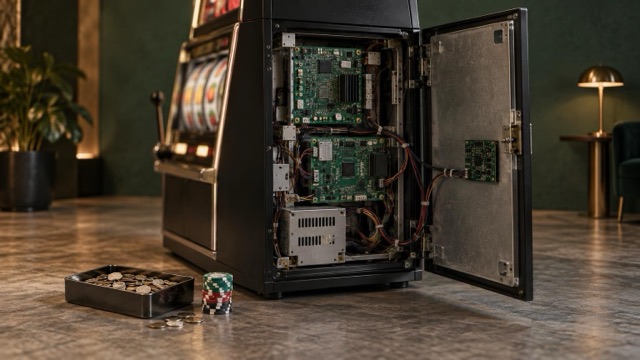
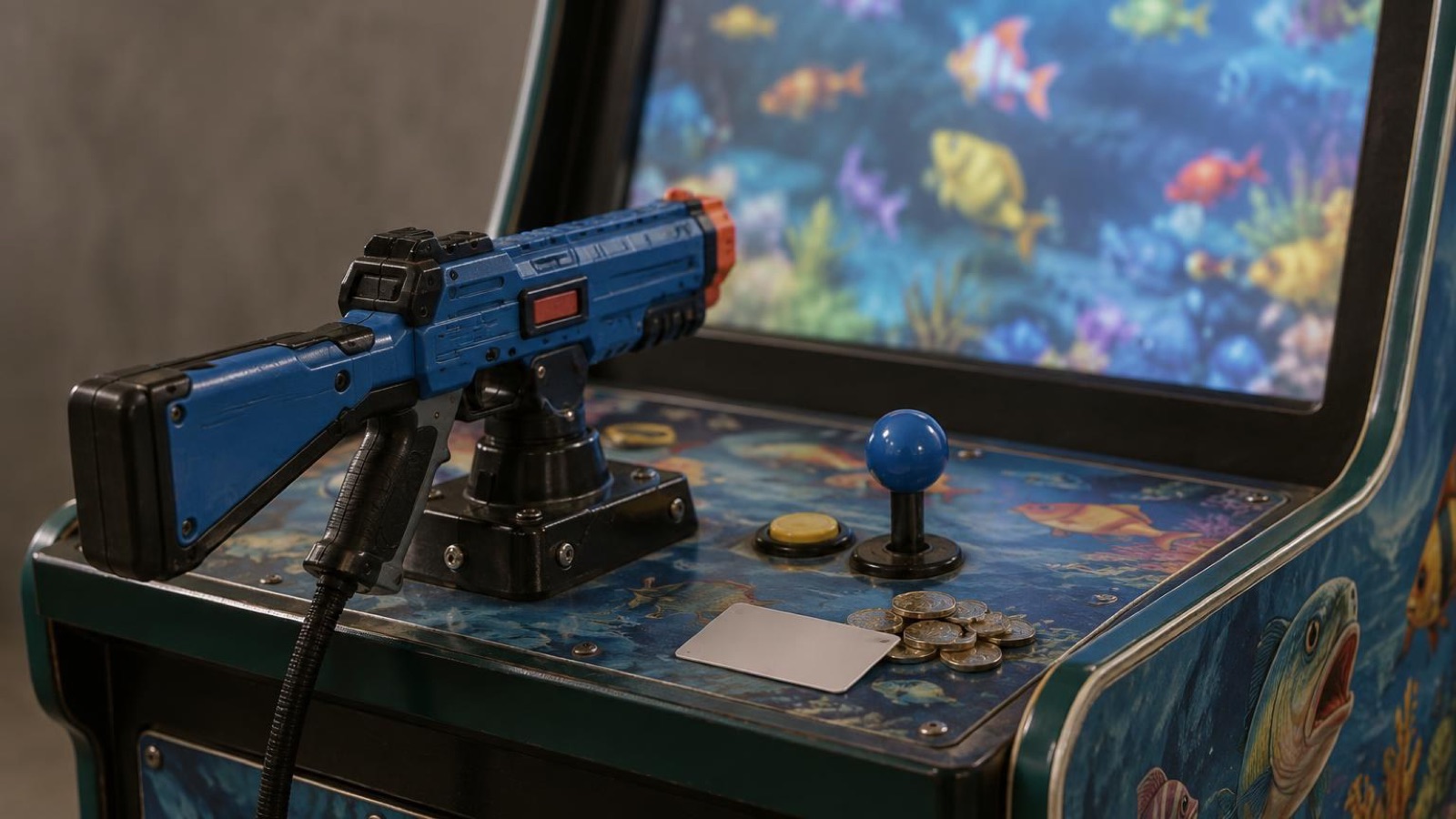
In a live venue the machine is a cabinet with a screen, a gun or joystick control and a card reader. In an online casino the same game runs as a live arcade table, streamed or rendered in your browser, with your balance shown on screen instead of a card meter.
The practical steps are the same in both:
- Load credits onto the machine or into your account.
- Choose your gun level, which sets the cost of each bullet.
- Aim at a fish and fire.
- Collect the payout when a fish is caught.
- Change gun level or move rooms whenever you want.
If you have played video poker, the rhythm will feel familiar in one way: you set a budget, you commit to a wager, and the machine pays automatically when your result qualifies5. The difference is that in a fish game you keep firing, and each shot is its own wager.
Guns, bullets and cost per shot
The gun level is the single most important number on the screen. It decides two things at once: how much each bullet costs you, and how much a caught fish pays back.
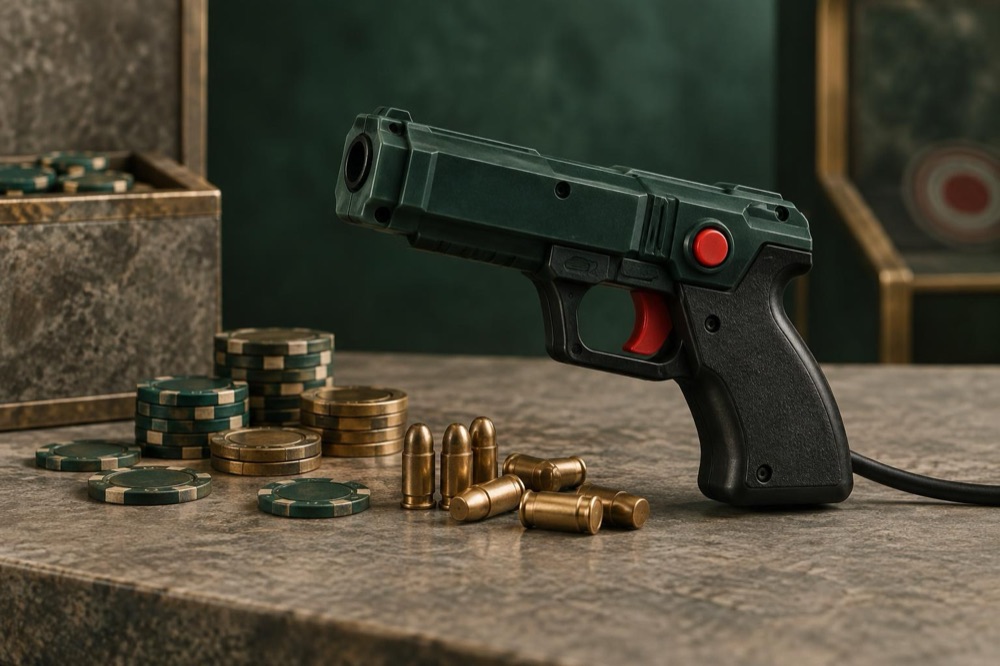
At the lowest level, bullets are cheap and fish pay small amounts. At the highest level, bullets are expensive and fish pay large amounts. The ratio between cost and payout is roughly consistent, so raising the gun level does not improve your odds. It simply raises the stakes on every single shot.
This is where the format differs most sharply from a slot. On a slot you choose a bet size and then spin; the spin either pays or it does not. In a fish game you are paying continuously. Fire 200 shots in a session and you have made 200 separate wagers, each one deducted whether or not it hits anything.
A worked example makes the drain clear. Suppose a bullet costs 100 credits at your chosen gun level. If you fire 300 shots in twenty minutes, you have staked 30,000 credits, and that is before any fish have paid you back. If you had set the gun level at a tenth of that, the same 300 shots would have staked 3,000 credits. Same aim, same fish, one tenth of the money at risk.
That is why experienced players treat the gun level as a budget dial rather than a difficulty setting. If you want a long session, keep it low. If you want a short, volatile session with a shot at a big catch, raise it and accept that your balance will fall quickly between hits.
Two practical points that catch people out:
- Misses still cost. A bullet that sails past every fish is money spent with nothing to show for it.
- Changing level mid-session changes your whole economics. Dropping from a high level to a low one does not refund anything; it just slows the bleed.
Small fish versus boss and special fish rooms
Most fish shooting games split the screen into tiers of targets, and many split the game itself into rooms.
Small fish are the everyday targets. They are common, they move in loose schools, and they pay modest amounts. They are the bread and butter of the format: you hit them often, and the small, regular payouts are what keep your balance from emptying too fast.
Medium fish sit in the middle. They are less common, they take more hits to bring down, and they pay more when they finally go.
Boss fish and special targets are the headline act. They appear rarely, they soak up a lot of bullets, and they pay the largest amounts on the screen. Some games give them their own room or a timed appearance, and some attach a jackpot to them.
The trade-off is straightforward. A boss target that takes fifty bullets to bring down has cost you fifty bullets' worth of credits before it pays anything. If it pays, the catch can be large. If another player lands the final shot, your fifty bullets are simply gone. In a shared room, that is a real risk, because you are not the only gun firing at the same fish.
Special rooms usually charge more per shot to enter, or they run at a higher minimum gun level. That is the price of access to the bigger targets. It is not a better bet in percentage terms; it is a bigger, faster bet.
A sensible way to think about it: small-fish rooms are for time on the screen, boss rooms are for swings. Neither is "better," but they suit different budgets and different moods.
Fish shooting games compared with online slots
The two formats get lumped together because they sit side by side in the same casino lobbies, but they work differently.
| Feature | Fish shooting game | Online slot |
|---|---|---|
| What you do | Aim and fire at moving targets | Press spin and watch the reels |
| How you bet | Per shot, at a gun level you choose | Per spin, at a bet size you choose |
| How you win | Hitting a fish, which pays its value | Matching symbols on paylines or ways |
| Skill input | Aim and timing affect which fish you hit | None after the spin starts |
| Session feel | Continuous, fast, interactive | Discrete rounds with a result each time |
| Classification | Arcade-type casino game1 | Slot |
The classification point matters more than it sounds. Regulators file fish games under an arcade-type category, separate from slots, and the games carry arcade-type labels in official registers1. That is a signal about how the format is built: it is a shooting game with a betting layer, not a reel game with a fish skin.
The betting layer is what makes it a casino game. In a venue, players load a points card, bet with those points, and on a win the coins are bought back and paid in cash. That is the mechanism that turns an arcade game into money gambling, and it is exactly the mechanism that has drawn enforcement attention in some markets2.
If you want the mechanics of the reel-based side, our guide to how slot machines work covers the random number generator and why each spin is independent. The short version for comparison: a slot decides your result the moment you press spin, while a fish game decides it shot by shot, with your aim shaping which target you are testing.
RTP and what it means in these games
Return to player, usually written RTP, is the share of the money paid into a machine that is given back to players as prizes over the long run3. It is the number that tells you what the game keeps and what it returns.
The critical word is "average." RTP is measured over a significant number of game plays, not on each individual play3. For compensated machines, the average is generally measured over 10,000 or 100,000 games, and for other machine types over even more3. That is a very long run, far longer than any session you will ever play.
The practical consequence is easy to state and easy to forget. If a machine displays 85% RTP, that figure does not mean an average of 85 pence back for every pound staked during a playing session3. The 85% describes the machine's behavior across tens of thousands of plays. A session is a tiny sample inside that average, and it can land anywhere.
For fish shooting games specifically, the same logic applies to the bullets. Every shot is a wager, and the game's return is spread across all of them. A session where you catch three big fish and a session where you catch nothing are both consistent with the same long-run RTP.
Two things follow from this:
- A high gun level does not change the RTP. It changes the size of each wager, not the percentage returned over time.
- A long session at a low gun level is not "safer" in percentage terms. It is the same game, played in smaller units, for longer.
If you want to go deeper on how return percentages are set and why the same game can carry different versions, our pages on slot return to player and whether the same slot can have different RTP versions cover the mechanics.
A beginner tip: start with small fish
If it is your first time on a fish shooting game, start at the lowest gun level in a small-fish room. That is the whole tip, and it is worth more than any aiming trick.
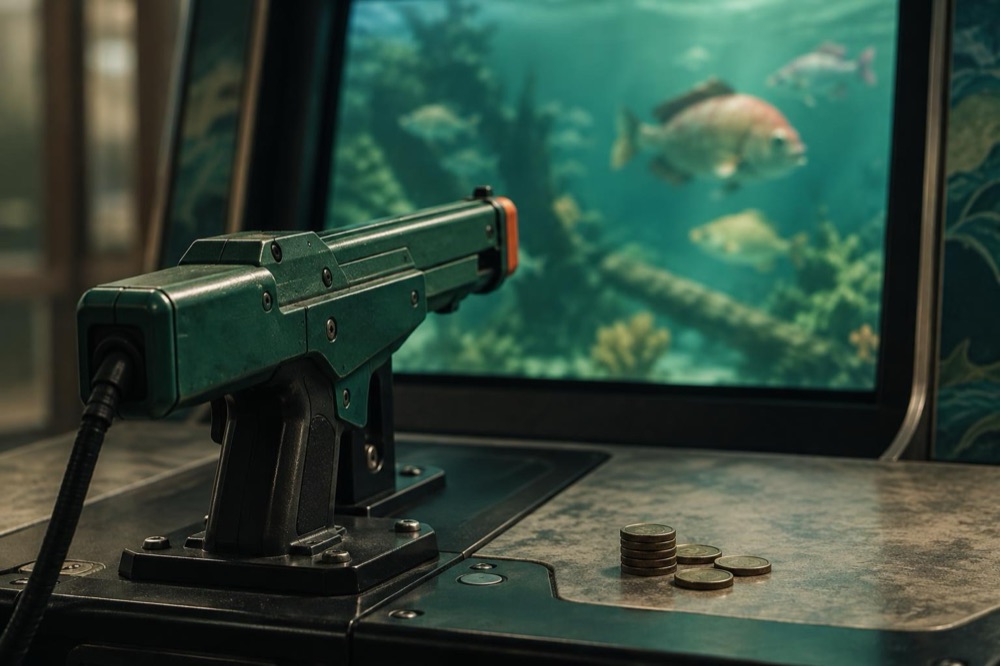
Here is why. At the lowest level, each bullet costs the least the game allows, so your credits stretch the furthest while you learn. You get to see how the fish move, how many hits a medium fish takes, how often a boss appears, and how the payout lands when you catch something. None of that learning costs you much at a low level. At a high level, the same learning curve costs ten or twenty times as much.
Once you understand the rhythm, you can decide whether to raise the level. Many players never do, and treat the low level as the way the game is meant to be played: small, frequent catches, slow drain, long session.
A few practical habits that fit the format:
- Set a session budget before you load credits, and treat it as spent money rather than money you expect back.
- Pick one gun level and stay there. Flipping between levels makes it hard to know what you are actually spending.
- Watch the room before you commit. In a shared room, see how many other guns are firing at the same targets.
- Leave the boss rooms for later. They are not a beginner's room, and the cost per shot reflects that.
The format rewards patience more than reflexes. A player who fires slowly at small fish and keeps the gun level low will usually spend far less per hour than one who chases every boss on the screen.
Where fish shooting games appear online
Fish shooting games show up in two main places: physical venues and online casinos.
In venues, you will find them as arcade cabinets in shopping centers, amusement areas and casino floors. In Vietnam, for example, machines in a shopping center play area in Thanh Sen ward were found operating as money gambling: players inserted a points card to bet, lost everything staked on a loss, and on a win outside parties bought back the coins and paid cash2. The coins on those machines were priced at about VND 2,500 each, with each coin worth 5 points2. That case is a useful illustration of how the cabinet format works in practice, and also of why the same format attracts enforcement.
Online, fish shooting games run as arcade-type tables inside licensed casino platforms. Regulators publish lists of authorized online remote gaming platforms, and arcade-type games appear in the approved game catalogs of licensed suppliers1. If you are playing online, the operator's license and the game's presence in an approved catalog are the two things worth checking.
The format also has cousins that are not fish games at all but share the arcade feel. FISH PRAWN CRAB, for instance, is filed as an arcade-type game and is a dice-style game rather than a shooting game1. In Macau, the fish, prawn and crab dice game pays 1 to 50 on a bet covering 4 or 17 points and 1 to 14 on 6 or 15 points7. It is a different game with a similar name, and worth knowing about so you do not confuse the two.
Where you can actually play depends on where you are. Fish shooting games are a casino-floor and online-casino product, so the rules that apply are the rules for casino gambling in your jurisdiction. Our country guides cover the practical position in each market, including Cambodia, China, Hong Kong, India, Japan, South Korea, Macau, Malaysia, the Philippines, Singapore, Thailand and Vietnam.
One warning worth stating plainly: playing on unlicensed offshore casino sites is illegal in some Asian jurisdictions, and players have been prosecuted. If you are unsure whether a site is licensed where you live, that is the question to answer before you deposit, not after.
If you want the wider picture of how these games sit alongside reel slots in the region, our guide to slots in Asia and the comparison of where slots are legal in Asia set out the landscape.
Common Questions
What is a fish shooting game?
It is an arcade-style casino game where you aim a gun at fish swimming across a screen. Each shot costs money, and when you hit a fish it pays out according to its value. It is usually played on a cabinet in a venue or as a live arcade game inside an online casino.
How do you win at fish shooting games?
You win by hitting fish. Every shot costs credits whether it hits or misses, and each fish carries a value that is paid when it is caught. Bigger fish and boss targets pay more but are harder to bring down, so your results depend on aim, timing and luck.
Are fish shooting games the same as slots?
No. Slots spin reels and pay on symbol combinations, with no input from you after you press spin. Fish shooting games are arcade-type games where you aim and fire, and you pay per shot rather than per spin. Both are games of chance, but the format and the way you bet are different.
What does gun level mean in fish hunter games?
The gun level sets how much each shot costs and how much a caught fish pays. A higher level means bigger bullets and bigger potential payouts, but every shot drains your balance faster. Lower levels keep the cost per shot down and stretch your credits further.
What is the RTP of fish shooting games?
Return to player is the share of money paid into a machine that is given back as prizes over a long run of play. It is an average measured over many thousands of games, not a promise for your session. A machine showing 85% RTP does not mean you get 85 back for every 100 you stake in one sitting.
Are boss rooms worth playing?
Boss and special rooms put rarer, higher-value targets on screen, and they usually cost more per shot to enter. They suit players who accept bigger swings for a shot at bigger catches. If you want your credits to last, the ordinary small-fish room is the calmer choice.
Can beginners play fish shooting games?
Yes. The controls are simple: aim, fire and watch the payout. Start at the lowest gun level in a small-fish room so each shot costs as little as possible, and treat the first session as a way to learn how targets behave rather than a way to win.
Sources7 sources
- JILI, PAGCOR
- Triệt phá nhóm tổ chức đánh bạc trá hình bằng máy bắn cá tại trung tâm thương mại, Bộ Công an
- Return to player: how much gaming machines payout, Gambling Commission
- PRAGMATIC PLAY, PAGCOR
- How to Play Video Poker, PlaySmart
- List of Authorized Online Remote Gaming Platforms, PAGCOR
- Jogo PCC, DICJ