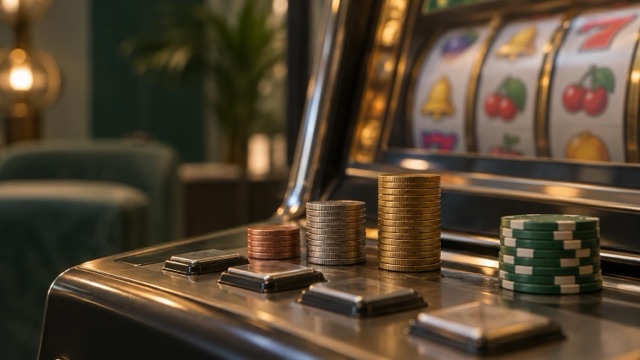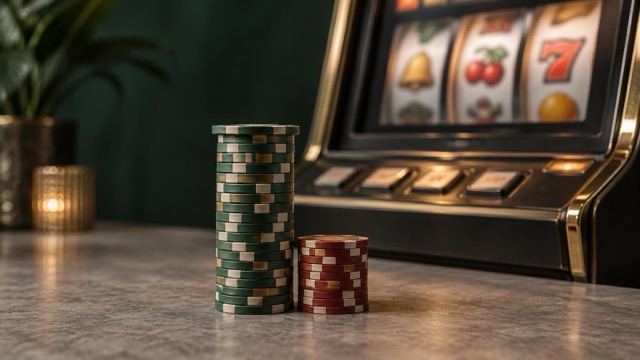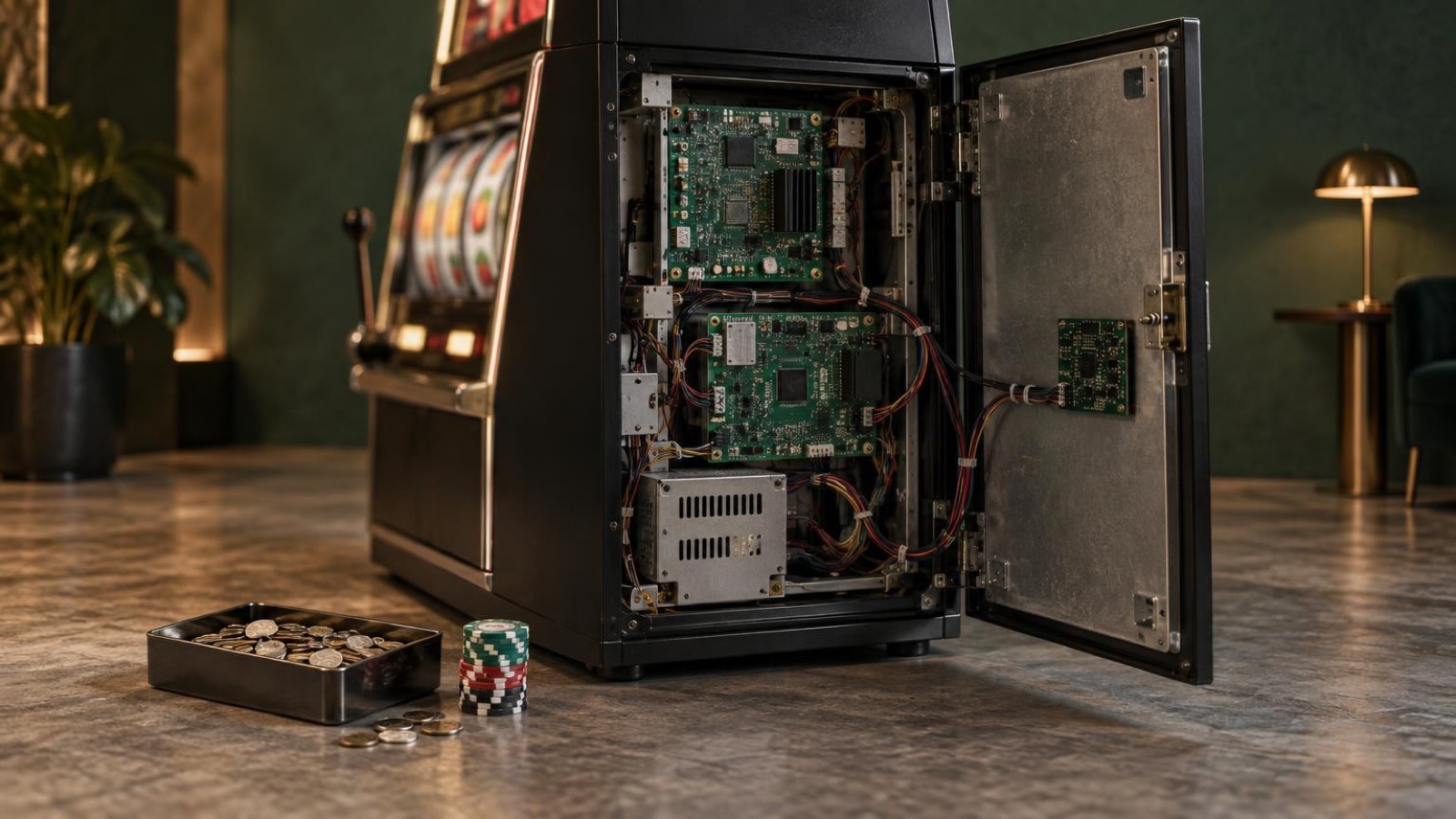
Modern slot machines look mechanical, with spinning reels, flashing symbols and a lever or button, but none of that decides the outcome. Underneath, every machine is a computer running a random number generator, and the reels are just a display. This page walks through what actually happens when you spin, on both casino machines and online slots, and how the prizes, paylines and payout percentages fit together. If you want to know where you can play, see our slots in Asia overview.
How a spin works: from credits to reels
The first thing that happens is a change of currency. When you put money into a slot machine, it becomes credits. Credits increase when you win and decrease when you lose, and the machine tracks the balance for you1. On machines that accept different cash values, your cash is automatically converted into cash credits of equal value, so a bill inserted into a machine set for a different denomination still plays at its correct worth3.
Then you choose your bet and press the spin button. Slot machines generally have three or more reels, which are the vertical strips of symbols you see on the screen2. On older mechanical-style machines, such as the classic Japanese pachislo games, the digital reels rotate at a set ratio from the left, and after a certain slip following the stop signal they come to rest; matching odd numbers, for example, was the jackpot on one classic machine5. The spinning is theater. The computer has already decided the result.
That is also true of the stop button. On machines that let you stop the reels early, pressing the stop button may let you see the result faster, but it does not change the result at all, because the outcome is decided by randomly generated numbers before the reels stop6. You are not nudging the machine toward a win. You are just skipping the animation.
Online slots work the same way. The reels you see in an online game are graphics, and the outcome of each spin is determined by a random number generator, the same technology used in physical machines7.
In short, here is the sequence on every spin:
- You insert money, and the machine converts it to credits1.
- You choose your lines and bet, then press spin3.
- The RNG produces the number that decides the outcome at that exact instant1.
- The reels spin and stop to display what was already decided1.
- Any winning combinations on your selected lines add credits to your meter3.
Reels and paylines: how winning combinations are judged
A payline is a line across the reels, and winning symbols must land on the paylines you selected in order to count. The more paylines you select, the higher your chance of winning on any given spin, because more lines are eligible to be judged3.
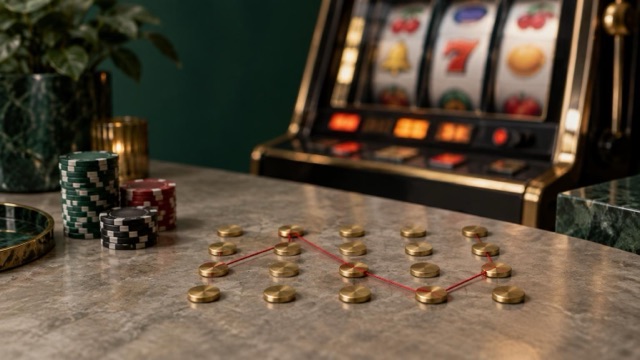
Paylines do not have to be straight. Depending on the game, they can run horizontally, zigzag, or take other shapes across the reels, and modern games offer many ways for symbols to connect. If you want the full picture of how lines and alternative win systems work, see our page on slot paylines and ways to win.
The key practical point is that a line only pays if you bet on it. If a winning combination lands on a line you did not select, it does not pay. This is why the number of lines you activate is one of the two main decisions you make on every spin, alongside the size of your bet.
Symbols: wilds, scatters and theme markers
Beyond the regular paying symbols, most machines carry a few special ones. Here is how they differ at a glance:
| Symbol | What it does | Where it counts | Typical effect |
|---|---|---|---|
| Wild | Substitutes for other symbols | On the paylines you bet | Completes winning combinations; some wild wins pay a multiple of the normal prize3 |
| Scatter / theme marker | Does not substitute | Usually anywhere on the reels | Three or more trigger free spins, bonus rounds or cash rewards3 |
Wilds. A wild substitutes for other symbols on a payline, helping you complete winning combinations. In some games a wild win pays a multiple of the normal prize, and most wilds appear in bonus games with higher payout multiples. The exact form and multiple depend on the machine3. Online, the wild is described the same way: a tool to help players form more winning combinations in the basic game7.
Scatters and theme markers. A scatter does not substitute for other symbols7. Instead, landing a specified number of them, usually three or more, anywhere on the reels triggers bonus features such as free spins, bonus rounds, or direct cash rewards7. Casino machines describe the same idea as theme markers: in most machines, three or more theme markers award a bonus game, and theme markers usually do not need to be on the same payline. Most theme marker wins multiply the bet credit3.
The distinction matters when you read the screen. A wild helps you win on lines you are already betting. A scatter or theme marker opens a separate feature, and it often counts wherever it lands. For a deeper look, see what wild and scatter symbols do in slot machines.
The Random Number Generator: why every spin is independent
The random number generator, or RNG, is the heart of every modern slot machine. Slot machines are computers that use the RNG to determine the outcome of each play. The generator produces hundreds or thousands of numbers every second, continuously, whether or not anyone is playing. The result of your spin depends on the number generated at the exact instant you activate the machine1.
Two consequences follow, and they answer most of the questions people have about slots.
First, each play is completely independent of the previous play. The RNG makes the outcome of each play nearly impossible to predict, and nothing that happened on earlier spins changes what will happen on the next one1. Each spin is independent, random and unrelated to previous or future spins2.
Second, the machine has no memory and no plan. Machines never "come due to win" and do not "freeze" after paying out. Payouts are determined by the machine's preset odds, and the internal mechanism cannot predict or steer the outcome1. A machine that just paid a jackpot has exactly the same odds on the next spin as it did before. A machine that has not paid in hours is not saving up for you.
Regulators draw a related distinction between two types of machine. As the UK Gambling Commission explains, random machines "rely purely on the statistical chance of an outcome occurring to meet their target return to player," while compensated machines "vary the chance of winning a prize depending on results from previous games played"8. If a compensated machine is below its target percentage, it may become more generous, or may pay out less, depending on its design8. Most machines you will meet are of the random type, but the distinction is worth knowing.
| Machine type | How odds behave | Effect of previous games |
|---|---|---|
| Random | Odds of a win stay constant | None; each game is unaffected8 |
| Compensated | Chance of a prize can vary | Machine may pay more or less depending on recent results8 |
Paytables, bet-per-line and how prizes are calculated
Every machine publishes a paytable, and it is the contract between you and the game. The prize table pays based on one bet credit. If you bet a higher number of credits, the prize is multiplied by the multiple of the bet you placed3. So a combination listed at 50 credits pays 50 if you bet one credit per line, 100 if you bet two, and so on.
Reading a paytable is straightforward once you know this rule. Find your combination, read the prize for one credit, and multiply by your bet per line. Our page on how to calculate winnings from a slot paytable walks through it with examples.
Linked machines, where several games feed a shared prize pool, often organize their jackpots into tiers. One common setup divides prizes into four levels3:
| Tier | How often it hits |
|---|---|
| Lightweight | Most often |
| Middleweight | Less often |
| Heavyweight | Rarely |
| Grand prize | Rarest; the one that grows on the overhead display3 |
One more thing the paytable will tell you, usually in fine print: the operator does not guarantee that you will win any prize at all. Rules vary by game, and the published information is for reference3.
House edge and RTP: what the machine keeps
Return to player, or RTP, is the share of all money wagered that a machine pays back out over its lifetime. The rest is the house edge, the built-in slice that stays with the casino over time. If a slot shows 96 percent RTP, the remaining 4 percent is the house edge9.
Typical numbers give you a sense of scale:
| Item | Figure |
|---|---|
| Average slot machine house edge | About 8 percent, meaning an average return to player of about 92 percent2 |
| Range across machines generally | About 3 to 15 percent house edge10 |
| Philippines, electronic slot-type games | RTP must be from 90.00 percent to less than 97.00 percent11 |
Two cautions make these numbers honest. First, a payout percentage is averaged over the machine's lifetime, not just one session, day or week. An 85 percent payout does not mean you win back 85 for every 100 you put in during your visit; those winnings are paid out over the course of the machine's life12. Second, the odds are fixed and do not change regardless of how you play13. There is no playing style that shifts them.
Compared with other games, slots are on the expensive side. That 8 percent average house edge makes slot machines less favorable than table games such as fortune pai gow poker, blackjack and roulette in terms of return to player2. For how these figures are calculated and how versions of the same game can differ, see slot return to player and house edge explained.
Jackpot odds: how often the big prize lands
The top prize is the rarest event on the machine. Jackpot odds can be as low as 1 in 17,000,000 spins4. You are far more likely to win a smaller prize on a slot machine than the top one1, and the general rule of thumb holds across gambling: the higher the payout odds, the less likely that outcome is to occur.
This is why machines can feel generous while draining your balance. Small and medium wins land regularly enough to keep the credit meter moving, but they are sized so that, over the machine's lifetime, the total paid out matches the programmed percentage. A long losing streak does not make the jackpot more likely, and a big win does not make the machine go cold. Each spin starts from scratch.
If you are chasing a specific top prize, the paytable or the machine's help screen usually states the odds or the conditions, such as a required bet level. Read them before you play, because they tell you exactly what you are competing against.
Denominations and settings: why payout rates differ
Not all slot machines are the same. Some have more frequent prizes and bonus games, while others pay less often but with bigger prizes1. Two machines with identical-looking games can sit side by side and return different amounts, for a couple of reasons.
The denomination. Higher-denomination machines are often set to return more than penny games, which is why players say higher-denomination machines pay better. The setting is a business decision by the operator within the regulated band, not a property of the game itself.
The machine's settings. Japanese pachislo machines make this visible in an unusual way: each machine has six selectable settings, and the payout rate differs by setting. The hall chooses the setting, which is why the same game can behave differently in different venues.
| Machine | Setting | Payout rate |
|---|---|---|
| GRADIUS THE SLOT | Setting 1 | 97.0 percent14 |
| GRADIUS THE SLOT | Higher settings | Rising through 98.6 and 104.6 percent14 |
| GRADIUS THE SLOT | Setting 6 | 110.8 percent14 |
| Junky Juggler | Lowest setting | 97.08 percent15 |
Japanese machines have also evolved in how they pay: Seven League was the first machine where coin wins differ between normal play and bonus play16.
Random versus compensated design. As covered above, compensated machines can vary their win chance based on recent results, while random machines hold constant odds8. Two machines with the same headline RTP can therefore feel very different in the short run.
For how the same online slot can ship in different RTP versions, see can the same slot have different RTP versions.
Cashing out: what happens to your credits
When you finish playing, the credits have to come back out as money, and the method depends on where you are.
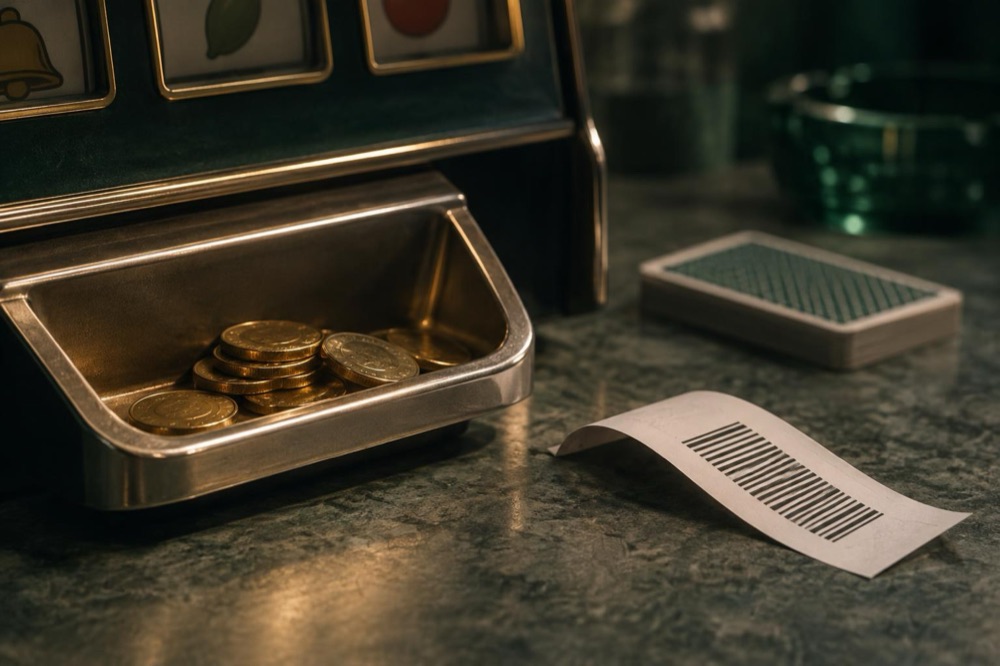
In many Asian halls, cashing out is a two-step process:
- Press the machine's cash out button and receive a ticket17.
- Take the ticket to an automatic machine, insert it and press the settlement button, and your winnings are paid out automatically17.
At Japanese racing venues, the same idea applies at the betting machines: you can cash out at any time by inserting your winning ticket and pushing the green settlement button19.
In casinos using ticket systems, hitting cash out prints a voucher you redeem at the counter, and wins above a threshold are handled specially. On one charity cabinet system, a jackpot voucher is printed for wins of $1,000 or more, which you present to the cashier for redemption20. Our pages on slot tickets and cashing out and slot jackpot payouts cover the casino process in detail.
Japan's pachislo halls have their own system, because cash prizes from these machines are not paid directly. With the Kin-Suro arrangement, you buy a gold-leaf card from a vending machine, the credits load into the connected pachislo, and you play as normal. Additional credits can be exchanged for more gold-leaf cards, which an attached secondhand dealer buys back; that buyback is the cash-out21.
Skill or luck: what players can and cannot influence
For the most part, slot play is purely luck. The RNG decides the outcome the instant you press the button, and the stop button, the timing of your press and the length of your session change nothing1.
The one partial exception is the bonus game. On some machines, a bonus game offers a chance to influence the outcome through arcade-style interaction, but the random number generator usually determines whether you get to play the bonus game at all, and how much money is available to win in it, so luck remains the dominant factor even there1.
This is what separates slots from games like blackjack, where skill can genuinely improve your odds23. On a slot machine, the odds are fixed no matter how you play13. What you can control is practical: which machine you sit at, what it pays back over its lifetime, how many lines you activate and how much you bet per spin. Those choices shape the price of your entertainment, not your odds of winning. For a longer discussion, see does skill matter when playing slot machines.
Common Questions
Do slot machines pay out more at certain times of day?
No. The random number generator runs constantly and each spin is independent, so the time of day makes no difference to the outcome. Machines also do not depend on where they sit in a hall or how often they have been played.
Can previous spins predict the next result?
No. Each spin is completely independent of the one before it, and the outcome is decided by a number generated the instant you activate the machine. Nothing about past spins changes the odds of the next one.
What is the difference between a wild and a scatter symbol?
A wild substitutes for other symbols to help complete winning combinations on a payline. A scatter does not substitute; instead, landing a set number of them anywhere on the reels usually triggers bonus features such as free spins or bonus rounds.
How do you cash out credits from a slot machine?
Press the cash out button and the machine prints a ticket or returns your credits. In many Asian halls you take the ticket to an automatic machine, insert it and press the settlement button, and the cash comes out. Large wins may need a cashier.
Do higher-denomination machines really pay better?
Payout rates vary between machines and settings, and some higher-denomination games are set to return more, but no machine is guaranteed. The payout percentage is averaged over the machine's lifetime, not over your session.
What are the jackpot odds on a slot machine?
Top prizes are rare. Jackpot odds can be as low as 1 in 17,000,000 spins, while smaller prizes land far more often. The higher the payout, the less likely that outcome is to occur.
Sources23 sources
- How Slots Work, GameSense, 2026
- How Do Slot Machines Work, GameSense, 2021
- Slot Machines, Mocha Clubs, 2026
- Gambling FAQs, Responsible Gambling Council, 2026
- サンスカーレット, Wikipedia (Japanese), 2026
- Gambling Myths, Responsible Gambling Council, 2026
- Slots, BingoPlus, 2026
- Return to Player: How Much Gaming Machines Pay Out, Gambling Commission, 2021
- Best Payout Slots in Hong Kong, Wizard of Odds, 2026
- 控除率, Wikipedia (Japanese), 2026
- Regulatory Framework for the Accreditation of Gaming Affiliates and Support Service Providers, PAGCOR, 2025
- Myths, GameSense, 2025
- Gambling FAQs, Responsible Gambling Council, 2026
- グラディウス・ザ・スロット, Wikipedia (Japanese), 2026
- ジャンキージャグラー, Wikipedia (Japanese), 2026
- セブンリーグ, Wikipedia (Japanese), 2026
- How to Bet, Sonoda Racecourse, 2026
- How to Bet, Sonoda Racecourse, 2026
- How to Bet, Tokyo City Keiba, 2026
- Tap 'n Play: How to Play, PlaySmart, 2026
- 金スロ, Wikipedia (Japanese), 2026
- 各台計数システム, Wikipedia (Japanese), 2026
- Table Games, PlaySmart, 2026