Skill required: none
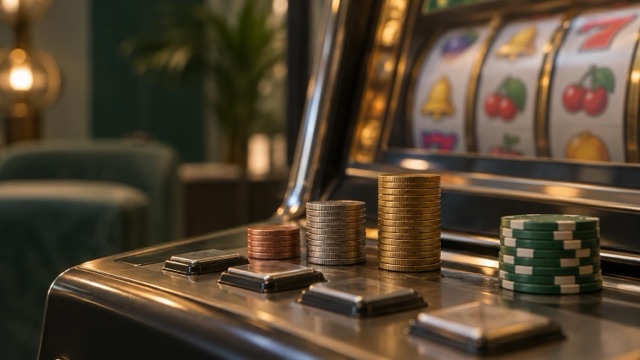
Slot machines sit at the simplest end of gambling. You pick a bet, you press the button, and the machine decides. There is no decision during the spin that changes anything, no moment where a better player would get a better result, and no way to read the machine and adjust.
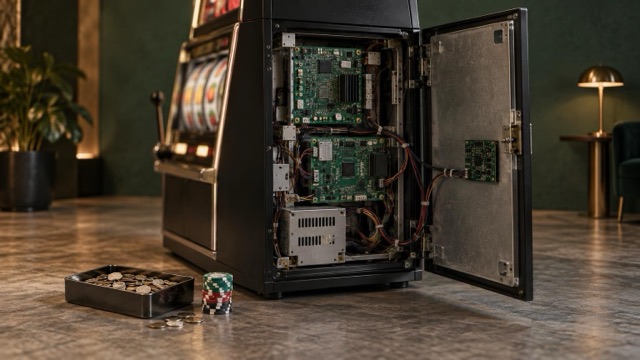
This is not a quirk of one manufacturer or one country. It is how the category is built. Independent guidance describes slot machines as computers that use a random number generator to determine the outcome of each play, producing hundreds or thousands of numbers per second, with the result depending on the number generated the instant the machine is activated1. Your input is the trigger, not the decision.
The same logic runs through other pure chance games, which is a useful comparison. Craps is described in official game rules as a game of chance that requires no skill or strategy to play7. Sic Bo is called a game of pure chance with no strategy or skill involved8. Roulette is described the same way, with no skill involved9. Slots belong in that group.
Some machines make the point even more sharply. On certain Japanese pachislo machines, the design deliberately removes any technical intervention: one model has no replay-removal element during the big bonus, which was notable for its time10. Another requires no reel aiming at all for the small symbols, with aiming needed only to line up a bonus11. A third is built so that if you stop the reels in order, no aiming is needed at all12. And one model removes right-side hitting entirely during the jackpot round13. These are machines designed so that the player cannot influence the outcome even if they want to.
Where a machine does allow a small interaction, it is usually cosmetic. On one model, the number of coins won during the big bonus is the same every time, and irregular play can only reduce it, never increase it14. That is the shape of "skill" on a slot: at best, you can avoid making things worse.
Why outcomes cannot be influenced by the player
The reason skill has nothing to grip onto is that the result exists before you see it. The random number generator makes the outcome of each play nearly impossible to predict, and each play is completely independent of the previous one1. By the time the reels are spinning, the answer is already fixed.
That is why the stop button does nothing. Pressing it may let you learn the result faster, but it does not affect the result at all4. The numbers were generated before the reels stopped. The same applies to how fast you spin, how long you sit, and which machine you choose.
Each spin is independent, random and unrelated to previous or future spins, which is why it is impossible to predict what will happen next3. There is no memory in the machine and no debt to be settled. A machine that has not paid for an hour is not closer to paying. A machine that just paid is not further away.
The same principle applies to the people running the game. In Sic Bo, official guidance notes that a dealer is not tied to any outcome and is unable to influence whether players win or lose15. Nobody on the floor is steering your result, in either direction.
Two persistent beliefs are worth naming because they cost people money. Machines never "come due to win," and they do not "freeze" after a win; payouts are determined by the machine's preset odds, and the internal mechanism cannot predict the outcome1. If you have ever moved machines because one felt "ready," that feeling had nothing behind it.
Games where skill does matter: how slots differ
Skill does exist in gambling, just not here. The clearest contrast is blackjack. Unlike other table games, skill can improve your odds of winning at blackjack6. That is a real, measurable difference, and it is why blackjack has a body of strategy while slots have none.
Poker is the other obvious example. Seven Card Stud is played by using a combination of skill, strategy and in some cases bluffing to make other players fold their hands16. The skill is not in the cards, which are dealt randomly, but in the decisions around them. Mississippi Stud sits in between: some skill is involved in deciding whether to bet or fold, but it remains a game of chance based on the random distribution of cards17.
Video poker is the closest thing to a skill game in a slot-shaped cabinet. It offers instant gameplay, instant payouts and the option to pay by coin, bill or card, like a slot machine, but with an element of skill5. That element is real: the decisions you make about which cards to hold change your expected return. It is still not a slot machine, and the skill lives in the draw decisions, not in the spinning.
Outside casinos, some betting products are explicitly built as skill games. Toto is described by its operator as a skill game in which participants analyze and predict match results, unlike lottery tickets which are heavily dependent on fortune18. South Korean regulators list horse racing, cycling, boat racing, poker and blackjack among games of chance and skill19. Note what is not on that list.
| Game | Skill involved? | Where the skill sits |
|---|---|---|
| Slot machines | No | Nowhere; the RNG decides1 |
| Roulette | No | Nowhere; pure chance9 |
| Craps | No | Nowhere; no skill or strategy required7 |
| Sic Bo | No | Nowhere; pure chance8 |
| Casino War | No | Nowhere; requires no skill to play21 |
| Video poker | Yes | Which cards you hold5 |
| Blackjack | Yes | Play decisions can improve your odds6 |
| Poker | Yes | Betting, folding and bluffing decisions16 |
| Mississippi Stud | Some | Whether to bet or fold17 |
| Toto | Yes | Analyzing and predicting match results18 |
One more distinction matters if you play with bonus money. In no-deposit bonus terms, slots are usually weighted at 100% toward the wagering requirement, while blackjack and video poker are typically weighted at 5% or 10%22. The same pattern shows up in individual offers, where a bonus might require you to wager the bonus amount 20 times on slots to cash out23. Operators weight slots highest precisely because there is no skill to reduce the house edge.
Is there any strategy for slot machines?
Not for the result. There is no play that improves your chances, and no play that protects them. The odds of winning stay the same no matter how you play2. That is the whole answer, and it holds whether you are on a machine in Macau, a pachislo parlor in Tokyo or an online slot at home.
What people call strategy usually falls into a few patterns, and none of them move the number:
- Chasing a machine that feels due. Machines never come due to win and do not freeze after a win1.
- Relying on lucky rituals. Independent guidance is direct on this: do not rely on lucky strategies, because they do not increase your chances of winning25.
- Believing a bigger payout is more likely because it is bigger. In Sic Bo, the higher the payout odds, the less likely the outcome is to occur, and lower payout odds mean greater chances of winning8. The same logic applies to slot paytables.
- Assuming a machine's position or popularity matters. Slot machines do not depend on arrangement or location, and how often a machine is played is not related to whether it will pay out on the next play1.
The honest framing is that over time you will lose more often than you win26. That is not a warning about slots specifically; it is how a house edge works. Skill games let a good player narrow that gap. Slots do not, because there is no lever to pull.
What you can actually choose is which game to play and how much to stake. Not all slot machines are the same: some have more frequent prizes and bonus games, while others pay less often but with bigger prizes1. That is a choice about the shape of the ride, not about your odds of coming out ahead. If you want to compare games on that basis, slot return to player and house edge and slot volatility and hit frequency cover it properly.
Do bonus rounds on slots involve skill?
Mostly no, and this surprises people. On some machines a bonus game offers a chance to influence the outcome through arcade-style interaction, but the random number generator usually determines whether you play the bonus game and how much money is available to win inside it, so luck remains the important factor1. You are choosing how to collect a prize that has already been sized.
The Japanese machine examples show how deliberately this is engineered. One model has no technical intervention during the big bonus at all10. Another pays the same number of coins every time during the big bonus, with irregular play only able to reduce it14. A third removes right-side hitting during the jackpot round13. These are not oversights. They are design choices that close off the small gaps where a player might otherwise gain an edge.
Where a bonus round does ask something of you, it is usually presentation. A pick-and-click screen, a wheel, a character animation: the outcome is set, and the interaction is how it is revealed. If you have ever wondered whether you picked the "wrong" box, you did not. There was no wrong box.
This is also why bonus terms treat slots differently from skill games. Slots count fully toward wagering requirements while blackjack and video poker count at a fraction22. If slots rewarded skill, operators would weight them the other way around.
What this means for players
The practical upshot is simple. You cannot play slots well or badly. You can only play them at a stake you are comfortable with, for as long as you are enjoying it, and stop when either of those stops being true.
That reframes a few everyday decisions:
- Machine choice is about variety, not edge. Some machines pay more often with smaller prizes, others pay rarely with bigger ones1. Pick the style you like.
- Bet size is your real control. It sets how fast your money moves and how long a session lasts. Nothing else you do changes the math.
- Streaks are noise. Each spin is independent and unrelated to the ones around it3. A run of losses tells you nothing about the next spin.
- Stop buttons, turbo spins and autoplay are conveniences. The stop button does not affect the outcome4. Use them for comfort, not for edge.
If you want to go deeper on the mechanics behind all of this, how slot machines work covers the reels, symbols and random number generator in detail, and are slot machines due to pay out after a losing streak deals with the most common version of the skill myth. For the wider picture of where machines are available and under what rules, see slots in Asia and where slots are legal in Asia.
If you prefer a game where your decisions count for something, the skill is elsewhere: blackjack, poker and video poker all reward attention5. Slots reward patience with the machine and nothing else.
Common Questions
Do slot machines require any skill to play?
No. A slot machine is a computer that uses a random number generator to decide each result. You choose your bet and press the button, and that is the whole of your involvement. Nothing you do during the spin changes what the machine pays.
Can you improve your odds at slots by playing better?
No. The odds on a slot machine are fixed, and they stay the same no matter how you play. There is no better or worse way to press the button, no hot machine and no cold machine. Your chances on each spin are what they are.
Are slot results random?
Yes. The machine generates hundreds or thousands of numbers every second, and the result depends on the number produced at the instant you activate it. Each spin is independent of the one before it and the one after it.
Is there any strategy for slot machines?
Not for the outcome. Machines never come due to win, and they do not freeze after a win. Payouts follow the machine's preset odds, and the internal mechanism cannot predict what is coming. The only real choices are which game and which bet size.
Do bonus rounds on slots involve skill?
On most machines, no. The random number generator usually decides whether you reach the bonus game and how much money is available to win inside it. A few machines add arcade-style interaction, but even there luck stays the main factor.
Are slots the same as games like poker or blackjack in terms of skill?
No. Blackjack is a table game where skill can improve your odds of winning, and poker involves strategy and bluffing. Slots sit at the other end of the scale, alongside roulette and craps, where no skill or strategy is required.
Why do some players believe slots take skill?
Because stopping the reels feels like a decision, and because streaks feel meaningful. In practice the stop button does not affect the result, which is already decided by randomly generated numbers before the reels come to rest.
Sources26 sources
- How Slots Work, GameSense
- Gambling FAQs, Responsible Gambling
- How Do Slot Machines Work?, GameSense
- Gambling Myths, Responsible Gambling
- Video Poker: How to Play, PlaySmart
- Table Games, PlaySmart
- Craps: How to Play, PlaySmart
- Sic Bo: How to Play, PlaySmart
- Table Games, GameSense
- Menso-re (pachislo)), Wikipedia
- Jiisama, Wikipedia
- Ganso Haneslo, Wikipedia
- CRA Burst Angel, Wikipedia
- Kelot (pachislo)), Wikipedia
- Sic Bo Etiquette, PlaySmart
- 7 Card Stud, PlaySmart
- Mississippi Stud, PlaySmart
- Toto, Sports Toto
- FAQ, KBOAT
- FAQ, KCycle
- Casino War: How to Play, PlaySmart
- No Deposit Codes: South Korea, Wizard of Odds
- No Deposit Codes: Thailand, Wizard of Odds
- Gambling FAQs, Responsible Gambling
- Safer Gambling Tips, Responsible Gambling
- Safer Gambling Tips, Responsible Gambling