What "due to pay out" means and why the idea persists
The idea is simple: a machine has been cold for an hour, so it must be warming up. Players call it being due, or overdue, or ready to hit. It feels like a physical law, the same way a coin that lands heads five times seems more likely to land tails on the sixth.
That instinct comes from watching games where outcomes really do balance out over a short run. In craps, payouts vary depending on what the point is, and the odds shift as the game moves7. In Casino War, a winning opening hand pays even money, a clean one-to-one result8. In bingo, the prize for each game is fixed, unaffected by the number of players, and listed on the session program9. Those games have visible structure. A slot machine has none. You cannot see the reels stop in a way that tells you anything about the next spin, so the mind fills the gap with a story about a machine that owes you.
The story survives because slot machines are built to reward persistence with near misses and small wins. Smaller prizes are more likely than the top prize on slot machines, so a session rarely feels completely dead1. That trickle of small payouts keeps the "it is about to turn" feeling alive, even though nothing about the machine has changed.
How modern slot machines decide results
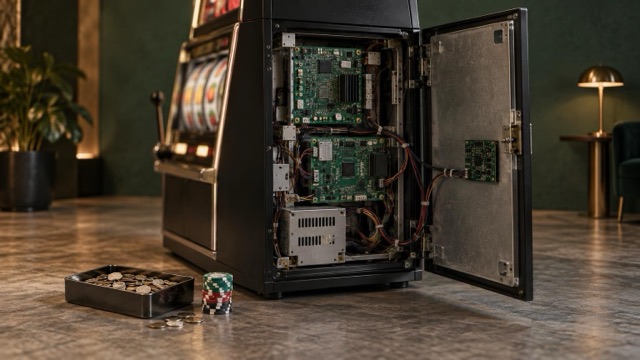
Every spin is decided before you see anything move. Slot machines work on the same principle: the result is generated internally, and the reels are just the display. On Japanese slot machines, six setting levels determine the medal payout10.
Not all slot machines are the same. Some have more frequent prizes and bonus games, while others pay less often but with bigger prizes1. That difference is designed into the machine, not earned by the player. On some machines with bonus games, a bonus round offers a chance to influence the outcome through arcade-style interaction, but the random number generator usually determines whether you play the bonus game and how much money is available to win, so luck remains the important part1.
This is why the arrangement of a casino floor tells you nothing. Slot machines do not depend on their arrangement or location, and how often a machine is played is not related to whether it will pay out on the next play1. The machine next to the aisle is not hotter than the one in the corner. The one by the cashier is not colder.
A losing streak does not change a machine's odds
This is the part that matters most. The odds on a slot machine are fixed. They do not change regardless of how you play, and the chance of winning stays the same spin after spin2. Length of play does not impact the odds of winning3. A hundred spins without a win leaves the next spin exactly where it started.
Machines never come due to win and do not freeze after a win. Payouts are determined by the machine's preset odds, and the internal mechanism cannot predict the outcome1. There is no counter inside that says "this player is owed." There is no memory of your last session, your last hour, or your last spin.
It helps to separate two numbers that get mixed up. A slot machine's payout percentage is averaged over its lifetime, not just one session, day or week4. That lifetime average is a design figure. It describes what the machine returns across millions of spins, not what it will return to you tonight. And even that average points one way: over time, you will lose more often than you win12. The house edge is not a debt the machine owes you. It is the reason the machine exists.
If you want to go deeper on the numbers behind this, our pages on slot return to player and house edge and slot volatility and hit frequency explain how RTP and variance work in plain terms. The short version: a high RTP machine still loses for most players in most sessions, and a low volatility machine still has cold streaks.
Machine faults and voided wins: what casinos have done
Sometimes the screen shows a win that the casino will not pay. This is not a myth, and it is worth knowing how it works before you sit down.
In the Philippines, any system or machine malfunction voids all plays and pays. If a ticket credit is not dispensed, it is cashed in and paid only after management verifies the correct credit amount6. An operator must also declare a game void if there is any malfunction or fault in, or interruption in the operation of, any part of an electronic gaming machine or electronic gaming equipment that affects the outcome of that game, and all wagers on that game are refunded6.
Singapore takes a similar line. The casino operator must declare any casino gambling void if there is any malfunction or fault in, or interruption in the operation of, any part of the gaming machine or equipment that affects the outcome13. The regulator also lists the situations where a result can be treated as undeterminable, including a malfunction, fault or interruption in the operation of a gaming machine, gaming program or gaming equipment, a foreign or damaged playing card discovered during the round, or a patron refusing to make a required decision14.
What this means in practice: if a machine glitches mid-spin, the default outcome is usually a refund of your wager, not a payout of the win on screen. That is why the ticket matters. If you are playing a machine that pays by ticket, keep it until you have cashed out, because an undispensed credit is only paid after verification6. If you are at a machine that pays automatically, the winnings come out of the machine after you insert the ticket and press the settlement button15.
For a fuller walk through what happens when a machine errs, including how jackpots are handled, see our page on slot machine malfunctions.
Malfunction clauses: what the law does not cover
Malfunction rules cover the machine, not your expectations. They do not say a machine must pay you because you played a long time. They do not create a right to a jackpot that appeared on a faulty display. They exist so the operator can unwind a spin that did not happen properly.
The rules also do not cover the ordinary case: you played, you lost, and you feel the machine owes you. That is not a malfunction. It is the game working as designed. The odds are fixed, and the outcome of each spin is independent of the ones before it2.
There is one more thing worth knowing about how payouts are set in the region. In the Philippines, the RTP percentage of an electronic game of slot machine type must be from 90.00 percent to less than 97.00 percent5. That is a regulatory range, not a promise to you. A machine at the bottom of that range is still legal, and it will still have long losing runs. A machine at the top is not "due" after a bad hour either.
If you are playing online rather than in a casino, the same logic applies, but the terms are different. Bonus offers often carry wagering requirements, such as the following16.
| Wagering requirement |
|---|
| 35 times the bonus on slots |
| 35 times the bonus and deposit on slots |
| 40 times the bonus on slots |
Those requirements are about the bonus, not the machine's odds, and they do not make a slot more likely to pay. Most no deposit bonuses are offered strictly for slots play, but some allow other games17. If your last transaction was a free casino bonus, you may need to make a deposit before claiming the next one, or your winnings can be void and the bonus money cannot be cashed out17.
What you can check before you play
You cannot check whether a machine is due, because that is not a real thing. You can check a few practical things that actually affect your session.
- The game's published RTP, where it is available. In the Philippines, slot machine type electronic games must sit between 90.00 percent and less than 97.00 percent5. If a game publishes its RTP, that number describes the long-run average, not your next spin4.
- The machine's volatility profile. Some machines have more frequent prizes and bonus games, others pay less often with bigger prizes1. Pick the profile you actually want to play, rather than chasing a machine because it looks cold.
- Whether the machine pays by ticket or by hand. Ticket-in, ticket-out machines let you cash out at a kiosk or cage, and an undispensed credit is paid after management verifies the amount6. Machines that pay automatically dispense winnings after you insert the ticket and press the settlement button15.
- The house rules on malfunctions. In the Philippines, a malfunction voids all plays and pays6. In Singapore, the operator must declare the gambling void if a fault affects the outcome13. Knowing this in advance saves an argument at the cage.
- Your own limits. Over time, you will lose more often than you win12. Set a spending limit before you sit down, and treat a losing streak as information about the game, not a signal to keep going.
One more practical note on timing. Casinos are not running a different math late at night. MGM casino properties typically operate 24 hours a day, every day of the year, with the exception of Empire City18. The floor is open, but the odds are the same at every hour. If you are collecting a payout rather than playing, note that payout hours differ by store for some lottery and toto products, so check locally before you travel to collect19.
If you want to understand the machinery behind all of this, our guide to how slot machines work covers reels, symbols and the random number generator, and our page on whether slots pay more the longer you play tackles the persistence question directly. For the regional picture on where machines are legal and how the rules differ for citizens, residents and visitors, start with where slots are legal in Asia.
Common Questions
Do slot machines get looser or tighter at different times of day?
No. A machine's odds are fixed and do not change based on the hour, how busy the floor is, or how long it has been since the last win. Length of play does not impact the odds of winning. A casino floor may feel different at 3 a.m., but the math behind each spin is the same.
Can a casino change the payout on a slot machine while you are playing?
Not mid-spin. The result of a spin is decided by the machine's internal random process, and the payout percentage is averaged over the machine's lifetime, not adjusted to your session. Different machines on the same floor can have different profiles, but that is set before you sit down, not changed while you play.
What happens if a slot machine malfunctions during a win?
It depends on where you are. In the Philippines, any system or machine malfunction voids all plays and pays, and a game is declared void if a fault affects the outcome, with wagers refunded. In Singapore, the casino operator must declare the gambling void if a malfunction affects the outcome. Always keep your ticket and ask staff to log the issue.
Do slot machines have to pay out a minimum percentage?
In some jurisdictions, yes. In the Philippines, the RTP of an electronic game of slot machine type must be from 90.00 percent to less than 97.00 percent. That is a long-run average across the machine's life, not a promise about your session, and it does not mean a machine owes you anything after a losing run.
Is it better to play a slot machine that has not paid in a while?
No. Machines never come due to win and do not freeze after a win. Payouts are determined by the machine's preset odds, and the internal mechanism cannot predict the outcome. How often a machine is played is not related to whether it will pay out on the next play, so a cold machine is not a better bet.
Can past spins on a slot machine predict future results?
No. Each spin is independent of the ones before it. The odds of winning stay the same no matter how you play, and a run of losses does not shift the odds in your favor. Past results on a machine tell you nothing about the next spin.
Sources19 sources
- How Slots Work, GameSense
- Gambling FAQs (Simplified Chinese), Responsible Gambling Council
- Play On Demand Etiquette, PlaySmart
- Myths, GameSense
- Regulatory Framework for the Accreditation of Gaming Affiliates and Support Service Providers, PAGCOR
- Regulatory Framework for Gaming Venue Operations, PAGCOR
- How to Play Craps: Details, PlaySmart
- Casino War: How to Play, PlaySmart
- Bingo: How to Play, PlaySmart
- Reach (Pachinko)), Wikipedia
- Gambling FAQs (Traditional Chinese), Responsible Gambling Council
- Safer Gambling Tips, Responsible Gambling Council
- Casino Control (Casino Gambling) Regulations 2009, Singapore Statutes Online
- Casino Patron Dispute, Gambling Regulatory Authority of Singapore
- Betting Guide, Sonoda Himeji
- Best Online Casinos for Players from Cambodia, Wizard of Odds
- No Deposit Codes: Thailand, Wizard of Odds
- MGM Resorts International Annual Report, U.S. Securities and Exchange Commission
- Refund Information, Toto Dream