What a near miss is on a slot machine
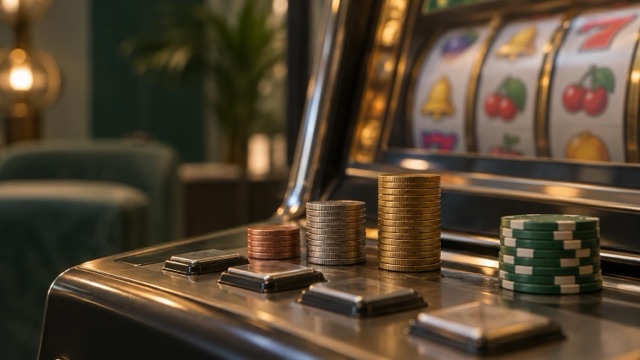
A near miss is the spin that looks like it almost paid. Two jackpot symbols land on the first two reels and the third stops one position short. Three scatters appear with one just off the visible area. The screen feels like it was a hair away from something big.
In pachislo and pachinko, players have a name for a related idea. A chance目 is an outcome that appears when a small role with a high chance of overlapping a bonus is missed, often a one-coin role4. On some machines it means an outcome that is neither a definite miss nor a reach symbol, or one with a high expectation of a bonus win4. On later machines it describes outcomes that do not appear during normal play and show up mainly when a bonus or AT lottery has been drawn, because of how the reels are controlled4.
That last point matters, and it is specific to those Japanese machines. On a standard slot, a near miss is not a signal. It is simply what the reels look like when the random result lands one symbol away from a paying combination. Nothing was drawn, nothing was triggered, and nothing is being saved for later.
How modern slots decide results: RNG at every spin
A slot machine is a computer. It uses a random number generator to determine the outcome of each play, generating hundreds or thousands of numbers per second, and the result depends on the number generated the instant the machine is activated1. That is the whole mechanism. There is no deck to shuffle, no wheel to slow down, and no memory of the last spin.
Online slots work the same way. One operator describes its slots as using RNG outcomes, so every spin is random within the rules of the game5. Another states that its online slots use a random number generator to determine the outcome, and that this ensures each spin is independent and random6. The same principle applies to instant games, where RNG software is used to ensure random outcomes for each hand7.
The practical consequence is simple. When you press spin, the machine picks a number. That number maps to a set of reel positions. The reels then stop on those positions, and the paytable is checked. The animation you watch is a display of a result that was already decided.
Are near misses programmed? What the RNG means for reel stops
This is the heart of the question, and the answer is no. A near miss is not programmed as a near miss. It is programmed as a result, and the result happens to sit one symbol away from a win.
Think about how many combinations a modern slot can produce. Each reel has a set of positions, and the RNG selects one position per reel. Most of those combinations are losses. Some are small wins. A tiny number are large wins. A near miss is just one of the many losing combinations that happens to look dramatic on screen.
There is a real mechanical reason some machines produce more of these moments than others. On certain Japanese machines, the reel layout itself makes it impossible to fully cover every small role, so some outcomes appear more often than the design would ideally allow8. That is a structural quirk of the reel strip, not a psychological trick aimed at the player.
What the RNG does mean is that the reels cannot be nudged. The machine cannot decide to stop one symbol short because you have been losing, or because it wants you to keep playing. It stops where the number tells it to stop. The near miss is a coincidence of layout and result, and it carries no message.
Near misses vs the paytable: how wins are actually evaluated
Once the reels stop, the machine does not judge how close you came. It checks the paytable. A win exists only if the symbols that landed match a paying combination.
Wilds are part of that check. A wild substitutes for other symbols on paylines to win prizes, and in some games a wild win pays a multiple9. Most wilds appear in bonus games with higher payout multiples, and their form and multiple depend on the machine type9. A wild sitting one position off a payline does nothing, because the paytable only reads what is on the line.
Scatters are the common exception. They often pay regardless of position, which is why they can trigger free spins or bonus rounds without landing on a line. That is also why a scatter that lands just outside the visible area feels worse than a normal loss. It was never going to count, because it was never on the reels in a paying position.
The paytable is the only thing that decides whether you won. A near miss is not a partial win, a pending win, or a win held in reserve. It is a loss that looked close.
House edge and RTP: what the machine pays back over time
Every slot is built to pay back a certain percentage over a very long time. That figure is the Return to Player, or RTP, and it is a percentage showing how much a slot is built to pay back over a very long time10. If a slot shows 96 percent RTP, the remaining 4 percent is the house edge, the built-in slice that stays with the casino10.
Across slot machines generally, the house edge runs about 3 to 15 percent2. The average is around 8 percent with optimal play3. That range is wide because machines are not all built the same. Some have more frequent prizes and bonus games, while others pay less often but with bigger prizes1.
Machine settings can shift the number further. One Japanese machine lists payout rates of 98.4 percent on setting 2, 101.7 percent on setting 3, and 114.0 percent on setting 611. Another lists a 97.5 percent machine payout on setting 212. These are specific machines with published settings, but they show the principle: the payout percentage is a design choice, not a fixed law of slots.
Here is the part that matters for near misses. The house edge is built into the paytable and the reel layout. It does not change because a spin looked close. A near miss pays back exactly the same as any other loss, which is nothing.
| Type of result | Where it happens | What it pays |
|---|---|---|
| Paying combination | On the payline or anywhere for scatters | The paytable amount |
| Near miss | Any spin | Nothing |
| Wild completing a line | On the payline | The line win, sometimes a multiple |
| Scatter off the reels | Any spin | Nothing |
Legal?: Yes
What near misses do not change: odds, independence and jackpot chances
A near miss does not change the odds of the next spin. Each spin is independent, and the RNG produces a fresh number every time. The machine has no memory of the near miss, no memory of your losing streak, and no plan to reward you for staying.
This is where the "due to win" idea falls apart. Machines never "come due to win" and do not "freeze" after a win; payouts are determined by the machine's preset odds, and the internal mechanism cannot predict the outcome1. Slot machines also do not depend on arrangement or location, and how often a machine is played is not related to whether it will pay out on the next play1.
Jackpot chances are fixed by the machine's design, not by how close you came. Smaller prizes are more likely than the top prize on slot machines1.
- On one machine, the jackpot odds are listed at 1 in 22013.
- On another, the base jackpot odds are 1 in 354.2, tightening to 1 in 35.4 during a probability continuation state14.
- Across slots generally, jackpot odds can be as low as 1 in 17,000,000 spins15.
Some machines also lock certain odds in place. One machine's small jackpot odds stay at 26/29 whether it is in normal play or in the shortened-time state16. Another enters a probability continuation state 100 percent of the time, limited to 54 spins17. These are design features of specific machines, and none of them respond to how a previous spin looked.
The practical takeaway is that a near miss is entertainment, not information. It tells you nothing about the next spin, nothing about the machine's mood, and nothing about your chances. The odds were set before you sat down, and they stay the same after every spin, close or not.
If you want to go deeper on the mechanics, how slot machines work covers reels, symbols and the RNG in more detail, and slot return to player explains how RTP and house edge are calculated. If you have ever wondered whether a machine is due to pay out after a losing streak, that page walks through the same independence principle. And if the near miss made you suspect the game is rigged, are online slot machines rigged addresses that directly.
Common Questions
Do slot machines pay out more after a losing streak?
No. Each spin is independent, and the machine has no memory of what came before. A long run of losses does not make a win more likely, and a win does not make the next spin less likely. The odds on the next spin are the same as they were on the first.
Can a near miss predict the next spin's result?
No. A near miss is just one outcome among many, and it carries no information about the next spin. The random number generator produces a fresh result for every spin, so past results, including near misses, cannot tell you what comes next.
Do higher-denomination slot machines have better payouts?
Not automatically. Higher denominations often mean bigger prizes, but the payout percentage is set by the machine's design, not its coin size. Two machines can look identical and still pay back different percentages, so check the paytable or the machine's information screen.
What is the average house edge on slot machines?
Slot machines generally carry a house edge of about 3 to 15 percent, with an average around 8 percent. That means the machine is built to keep a slice of everything wagered over time. The exact figure depends on the specific machine and its settings.
Do wild and scatter symbols need to be on a payline to count?
Wilds usually substitute for other symbols on a payline to complete a win, and some pay a multiple when they land in a winning combination. Scatters often pay anywhere on the reels, which is why they can trigger free spins or bonus rounds without sitting on a line.
Is there any skill that can improve slot machine results?
Most slot play is purely luck. On some machines a bonus game offers arcade-style interaction, but the random number generator usually decides whether you reach the bonus and how much is available to win. Skill does not change the underlying odds.
Sources17 sources
- How Slots Work, GameSense
- 控除率, Wikipedia
- Baccarat, GameSense, 2025
- チャンス目, Wikipedia
- How to Play Slots Online: The Complete Beginner's Guide, Shuffle, 2026-05-15
- Slots, BingoPlus, 2026-09-26
- Blackjack, Natural8, 2026-09-26
- 小役回収打法, Wikipedia
- Slot Machines, Mocha Clubs, 2026-09-26
- Best Payout Slots Hong Kong, Wizard of Odds, 2026-09-26
- タイムパーク, Wikipedia
- ゲゲゲの鬼太郎SP, Wikipedia
- CR球界王, Wikipedia
- 飯島直子のカジノビスティ, Wikipedia
- Gambling FAQs, Responsible Gambling, 2026-09-25
- フィーバーパンチアウト, Wikipedia
- CR中森明菜・歌姫伝説, Wikipedia