What Satta Matka is
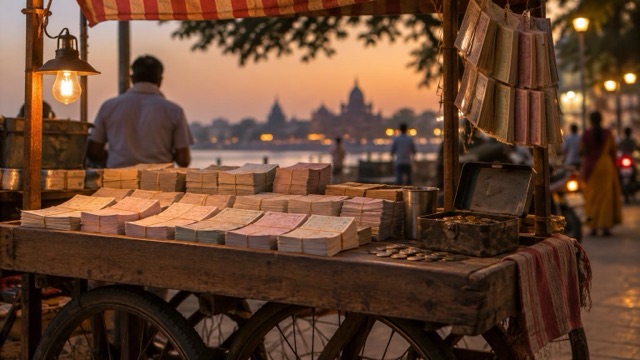
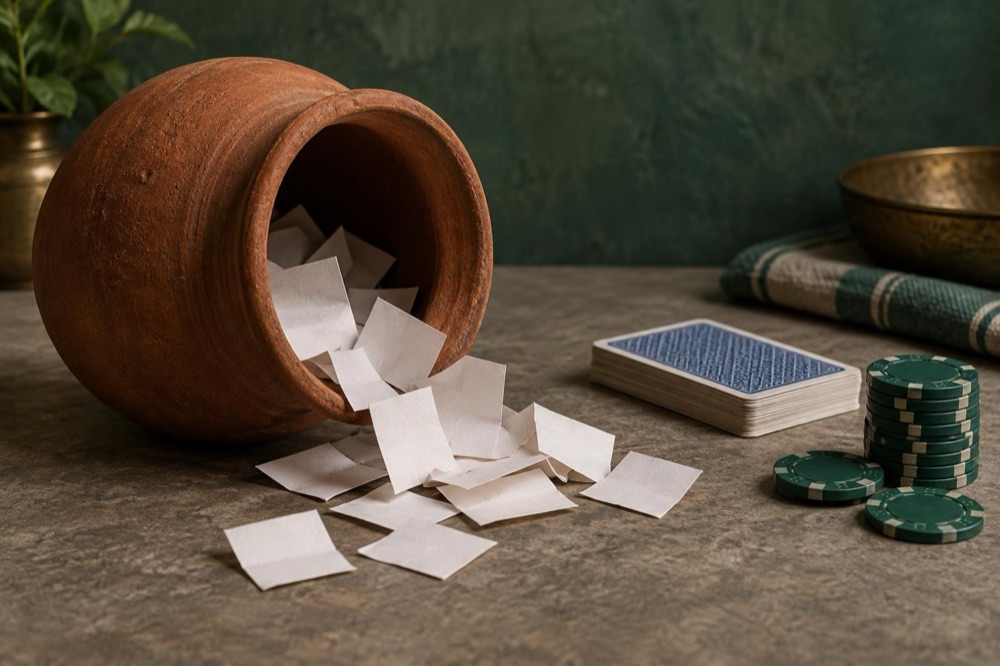
Satta Matka is a game of pure chance built around numbers. The name comes from the Hindi word "matka," an earthen pitcher, because that is how the game was originally played: slips of paper with numbers written on them went into a large clay pitcher, and one person drew a chit and declared the winning numbers1.
The modern version, often called Satta King, is based on random number selection and betting1. It is not a casino game or a card game in the usual sense. It is closer to a street lottery: you pick numbers, you place a stake with a bookmaker, and you wait for the draw. What makes it different from a state lottery is that it runs outside the law, twice a day, six days a week, with results that spread by word of mouth, printed sheets and now websites3.
The game is deeply tied to Mumbai. It grew out of the city's textile-mill districts, and its most famous figure, Ratan Khatri, was known across India as the Matka King9. Even people who have never placed a bet know the words "satta" and "matka," and the game has been dramatized in books, films and, most recently, a streaming series about Khatri's rise2.
How the game works: from the matka pitcher to playing cards
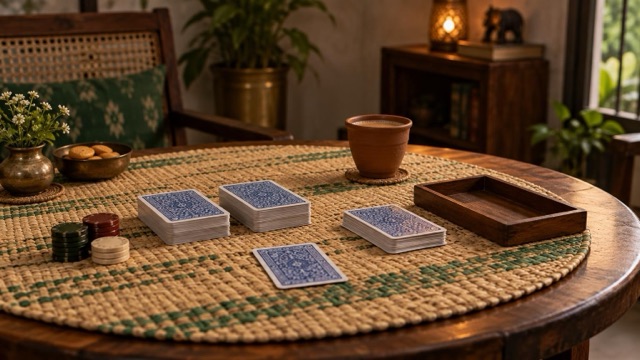
The original method was simple. Numbers from 0 to 9 were written on pieces of paper, the slips went into the matka, and a drawn chit decided the winners1. Over the years the practice changed, and today three numbers are drawn from a pack of playing cards instead10. The pitcher is gone, but the name stuck.
The rhythm of the game is still built around a nightly reveal. In the classic Khatri-era setup, the opening card was revealed every night at 9 PM, with the operator himself unveiling the opening numbers at that hour2. That twice-daily cadence, an opening draw and a closing draw, remains the structure of the game today3.
Because the game is unregulated, there is no official venue, no licensed operator and no ticket. Bets are placed with a bookmaker, historically a neighborhood figure who took stakes in person and paid out in cash. The minimum bet was famously tiny: one could wager a bet of even Re. 1, which is a large part of why the game spread so far among mill workers and daily-wage earners4.
Choosing numbers and the two draws
The mechanics of choosing numbers follow a fixed pattern. Players choose three numbers between 0 and 9. The final digit of the sum of those three numbers becomes part of the recorded choice. A second set of three numbers is then chosen the same way, giving the full result its two-part structure5.
In practice, a player's selection looks like a string of digits with two sums attached, one for the opening draw and one for the closing draw. The bets you can place vary in difficulty5:
| Bet | Difficulty |
|---|---|
| A single digit | The simplest bet, with a one in ten chance |
| A pair of two digits | Harder than a single digit |
| A three-digit outcome | Much harder to hit |
The harder the bet, the bigger the payout, and the payouts are set by the bookmaker rather than by any published odds table. Draws run six days a week, virtually like a lottery, with lucky numbers generated twice every day3. That frequency is the game's hook: unlike a weekly lottery, you never wait long to know whether you have won or lost.
A short history
The game's cultural footprint keeps growing. The 2025 streaming series "Matka King" dramatized Khatri's story for a national audience, and reviews note the nightly 9 PM opening-card reveal as the drama's centerpiece2. For a wider look at how games of chance took root in the subcontinent, see gambling in Indian history and culture.
Legal status in India
Satta Matka is illegal in India. The game falls under the Public Gambling Act 1867, the colonial-era law that restricted most forms of gambling and made games of pure chance such as satta illegal11. That federal gambling ban still frames the whole picture, though states are given the power to decide whether it applies across their territory12.
The Act prohibits all forms of gambling and the keeping of common gaming houses, while making an exception for games of skill, especially horserace betting13. That skill-versus-chance distinction matters, because it is why rummy and Teen Patti sit on the legal side of the line while matka does not. The Supreme Court declared playing rummy and other card games online to be legal and beyond the ambit of gambling8, and Teen Patti has likewise been treated as a game of skill rather than chance14. Satta Matka, a pure guessing game on random numbers, gets no such protection.
The practical risk for a player is short: being found in a gaming house can bring a fine of up to INR 100 or imprisonment for a term not exceeding one month15. For more detail on how the rules differ from state to state, see gambling laws by state in India.
The shift to online platforms
Satta Matka has become far more accessible in the digital age by moving to online platforms, which carry the game far beyond the old in-person bookmakers5. Websites and apps now publish results, take stakes through digital payments and reach players far beyond the neighborhoods where the game was born.
Online satta is illegal, not merely ambiguous. The colonial-era Public Gambling Act 1867 outlaws gambling throughout the country, and the Online Gaming Act 2025 goes further by banning online money games outright, whether they turn on skill or chance1. Individual states have acted on their own: Karnataka's Police (Amendment) Act 2021 makes gambling a cognisable and non-bailable offense and explicitly curbs gaming through the Internet and mobile apps16. And the baseline national position is unchanged: the Public Gambling Act 1867 prohibits gambling across India, with an exception only for games of skill17. In short, this is not a game with a legal home anywhere in the country.
The result is a strange situation: the game is easier to reach than ever, and the law against it is clearer and broader than ever. For the wider picture of legal online play, see online gambling in India.
Risks for players
Because the game runs outside any regulator, the ordinary protections of a licensed lottery or casino do not exist. Participants are exposed to fraudulent schemes, manipulated games, and delayed or rejected payments due to the unregulated nature of the market5. A bookmaker can simply refuse to pay, and there is nowhere to complain.
The risks go beyond being cheated. Players face significant financial losses, addiction, interpersonal problems and psychological anguish, and operators and players alike may be subject to fines and jail time as legal consequences5. The tiny minimum bet, the same feature that made the game popular, is what makes losses easy to accumulate: a Re. 1 stake twice a day, doubled and doubled again after losses, is a classic pattern in unregulated betting4.
If you or someone you know is struggling with betting losses, gambling help in India lists where to turn, and betting scams in India covers the common frauds that circulate around games like this one.
Legal number games you can play instead
If you like the appeal of a small stake and a daily draw, India has legal options that scratch the same itch. State lotteries are the closest match. The Maharashtra State Lottery runs daily draws every day from 4:00 PM to 5:30 PM at its office in Vashi, Navi Mumbai7, and its festival draws are generous with winning numbers: the Diwali Bhavyatam lottery draws 480 separate winning numbers on the last four digits, chosen randomly by computer and valid for all series6. See the India lottery for how tickets work, or Maharashtra monthly lotteries and Maharashtra bumper lotteries for that state's full range.
For card players, the skill games the courts have protected are legal to play for stakes. Online rummy is fully legal following the Supreme Court ruling8, and you can read more at online rummy in India. Teen Patti, treated as a game of skill, is covered at Teen Patti. Horse racing, the other big exception under the 1867 law, is covered at betting on horse races in India.
None of these carry the twice-a-day, any-stake rhythm of matka, and that is the point: they are slower, smaller and, above all, games where the draw is honest and the payout is enforceable.
Common Questions
What does 'matka' mean?
Matka is the Hindi word for an earthen pitcher. In the original form of the game, slips of paper with numbers written on them were placed inside a large clay pitcher, and one slip was drawn out to decide the winning numbers.
How are the winning numbers drawn today?
The old chit-and-pitcher method is gone. Today three numbers are drawn from a pack of playing cards, with the opening card typically revealed at 9 PM. Draws happen twice a day, six days a week.
What is the difference between Satta Matka and Satta King?
They are essentially the same thing. Satta King is the modern name for the same random-number betting game, run online rather than through the old neighborhood matka dens.
What happens if you are caught playing Satta Matka?
Under the Public Gambling Act 1867, being found in a gaming house can bring a fine of up to INR 100 or imprisonment of up to one month. Operators face heavier penalties than players.
Is playing Satta Matka online legal in India?
No. Online satta is illegal in every state and union territory, and the Online Gaming Act 2025 bans online money games outright across India, whether they involve skill or chance.
What are the odds of winning a single bet?
A bet on a single digit has a 1 in 10 chance, since only the digits 0 to 9 are in play. Longer bets, such as picking a full three-digit outcome, are far harder to hit.
Why is Satta Matka still popular despite being illegal?
Bets start from as little as one rupee, results come twice a day, and the game is woven into Mumbai's popular culture through figures like Ratan Khatri, the original Matka King.
Sources17 sources
- What is Satta Matka? Origin of Matka Gambling or Satta, India Today, October 9, 2023
- Matka King Series Review: A Gambling Drama That Takes No Risks, Hollywood Reporter India, April 17, 2026
- Goa BJP MLA Wants Matka Gambling Legalized, New Indian Express, August 11, 2015
- How Matka Business Started, DNA India, November 19, 2013
- Satta Matka: Examining India's Covert Gambling Industry, Betcorn, September 26, 2026
- Maharashtra Diwali Bhavyatam Lottery Rules, Maharashtra State Lottery, September 20, 2024
- Maharashtra State Lottery Draw Conditions, Maharashtra State Lottery, October 2024
- Playing Rummy Online Is Not Gambling: Supreme Court, LiveLaw, August 15, 2015
- Mumbai: Ratan Khatri, the Matka King, Dies at 88, Indian Express, May 12, 2020
- What is Satta Matka? How It Is Played, India Today, September 26, 2018
- Gambling in India, University of Bath, 2017
- Visa Debit in India, Wizard of Odds, September 26, 2026
- Gambling Comparative Guide, Mondaq, June 24, 2024
- What's the History Behind Teen Patti's Top Popularity in Indian Gaming?, ENV Media, September 29, 2020
- India Gambling Law Overview, Khaitan & Co, July 2026
- Online Gaming Act 2025: Game Over for RMG?, Mondaq, April 22, 2026
- MeitY Notifies Online Gaming Rules in Effect from May 1, 2026, The Hindu, 2026