Gambling in ancient Indian texts: what the earliest records show
If you want to know how far back gambling goes in India, the answer is: about as far back as written records go. Perhaps the earliest account of gambling anywhere in the world appears in a hymn from the Rig Veda, an ancient Indian text written between 1700 and 1100 BC1. The hymn is striking because it is not a dry description of a game. It is a gambler's own voice, a man who has lost everything at the dice and pleads with the dice not to forsake him. It reads as a confession and a lament at once, which tells you two things: that dice games were already fully formed and familiar enough to be worth poetry, and that the cycle of winning, losing and chasing losses was as recognizable in 1100 BC as it is today.
The dice in question were not the six-sided cubes most people picture now. Ancient Indian dice games used throwing sticks and marked nuts, and the games they fed were woven into everyday life and ritual. Gambling scenes and references also appear in the great epics. Records of gambling in India are traced back to between 2000 BC and 1500 BC through descriptions in the Ramayana and the Mahabharata5. The Mahabharata in particular turns on a game of dice: the fateful match in which Yudhishthira stakes and loses his kingdom, his brothers and his wife, setting up the entire war that follows. When a culture's central epic hinges on a dice game, gambling is not a fringe activity in that culture. It is part of the story the culture tells about itself.
That early record matters for a second reason. The ancient texts do not just describe gambling; they argue about it. The Rig Veda hymn treats the dice as a seductive, destructive force, while other passages treat gaming as an ordinary pastime. That ambivalence, the sense that gambling is both irresistible and dangerous, has run through Indian attitudes to betting for roughly three thousand years, and you can still see it in modern debates about online gaming.
Dayakattai: the ancient Tamil board game
Move from the epics to the south of India and you find a game that has survived from those ancient times into living rooms today. Dayakattai is a board game played from ancient times in Tamil Nadu, in the south of India2. It belongs to the same broad family as other race games, where players move pieces around a board toward a goal, and it shares DNA with games across Asia and beyond. It is a game of dice, movement and capture, and it is traditionally played by 2 to 4 persons at a time2.
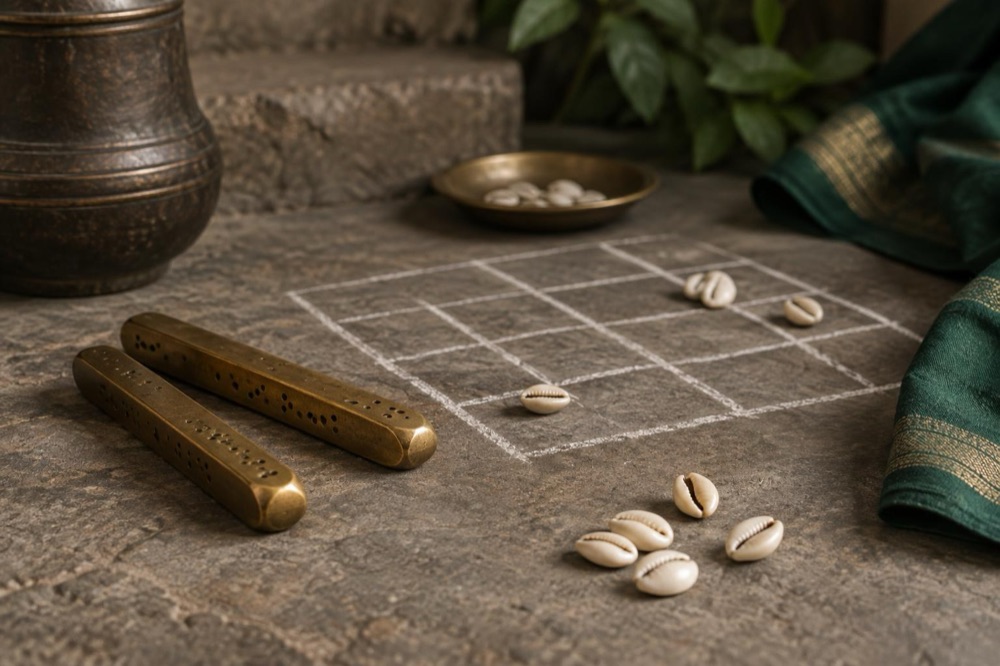
What makes Dayakattai special is not just its age but its persistence. This is not a game preserved in a museum or reconstructed by historians. It is a game that families in Tamil Nadu have kept playing, generation after generation, often with improvised equipment. The coins can be anything you have on hand, and the rules are passed down orally rather than from a rulebook. In a country that has produced some of the world's oldest written accounts of gambling, Dayakattai is the living, playable end of that tradition: a game of chance and tactics that children still learn at home.
The game also carries a small piece of language with it. The roll of 1 is called thayam, a word that has become shorthand for the game itself in some households, and the dice used are often called thayam dice. When a game's special roll has its own name, you know the game has been loved for a long time.
How Dayakattai is played: board, coins and rules
The basics of the game come down to three things.
| Element | Detail |
|---|---|
| Board | A grid of 7 x 7 square boxes2 |
| Coins | Each player gets 6 coins or chips, and traditionally anything works: beans, beads or whatever is at hand, mostly taken from the kitchen2 |
| Goal | Whoever moves all six of their coins to the center of the board first is the winner2 |
The movement rules give the game its character:
- Entry: a player can only place a first coin onto the board after rolling a 1, the thayam. A coin that has been cut returns to the game the same way, on a roll of 1 or 52.
- Extra turns: if the dice show 1, 5, 6 or 12, you move a coin and then roll again2.
- Occupancy: only one coin can stand on a plain box, even a coin of the same player, so the board fills up and blocks matter2.
- Capture: a player can cut an opponent's coin that is not in a safe zone, meaning not on a cross box. The cut coin is out of the game2.
- Progression: to move from the first layer of the board to the next, a player must cut an opponent's coin at least once2.
That last rule is what turns Dayakattai from a simple race into a tactical game. You cannot quietly work your way inward; you are forced into conflict. Safe squares, the cross boxes, become the places you rest and wait, and the timing of a capture becomes the heart of the game. A typical match between two or three players runs long enough to swing back and forth several times, with coins cut and re-entered on later rolls of 1 or 5.
If you want to try it, you do not need to buy anything. Draw a 7 x 7 grid, find six small objects per player, and use two long dice or marked sticks if you want the traditional feel. The rules above are enough for a full game.
The British era and the line between skill and chance
The colonial period gave Indian gambling the framework it still lives inside. The Public Gambling Act was passed in 1867, with a view to regulating and discouraging gambling on games of chance1. It applied to the United Provinces, East Punjab, Delhi and the Central Provinces, and its aim was the punishment of public gambling and the keeping of common gaming houses1. The Act introduced a distinction between games of skill and games of chance6, and that single distinction has done more to shape Indian gambling than anything since.
The skill-versus-chance line meant that games depending mainly on luck were treated as tantamount to gambling, while games of skill were treated differently6. The Act criminalized the keeping of common gaming houses and public gambling, but it carried an exemption for games of mere skill7. Betting on horse racing, for example, came to be deemed a game of skill, and so it survived1.
The courts then spent more than a century testing that line. A landmark Supreme Court ruling from 1959 noted that India's gambling statutes do not prohibit gaming in their entirety, but aim at suppressing gaming carried on for profit in private houses and gaming in public; gaming that does not contravene them is legal, and there is no law declaring wagering illegal in general8. In 1996, the Supreme Court defined gambling as betting and wagering on games of chance only, excluding games of skill whether played for money or not9. That definition is why rummy, a game the courts have treated as skill-based, sits on the legal side of the line in most of the country, and it is why the debate over card games and online gaming keeps returning to the same question the British asked in 1867: is this a game of skill, or a game of chance?
Matka and Ratan Khatri, the Matka King
The most colorful chapter in the history of Indian gambling is a 20th-century one. Satta Matka, often just called matka or satta, was a full-fledged lottery-style game that started in the 1950s, just after India's Independence3. It is a form of betting and lottery3, and the modern version is based on random number selection and betting3.
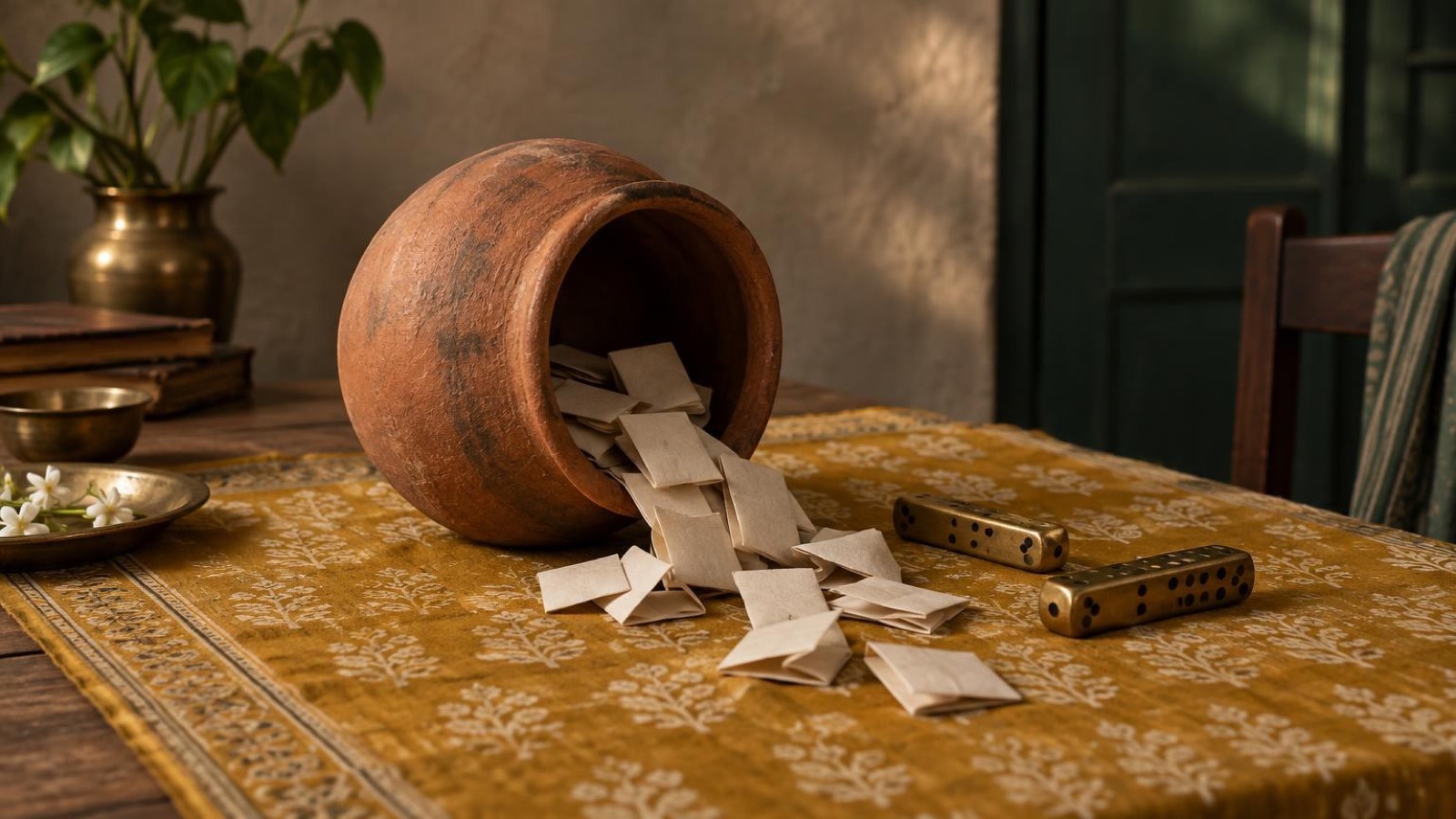
The man who turned it into an institution was Ratan Khatri, a Sindhi cotton trader widely known as the Matka King10. Khatri is credited with transforming matka, a form of gambling that originated in Mumbai in 1962, into India's biggest betting racket, and with establishing a nationwide gambling network that lasted for decades under his control11. He introduced organized gambling in the form of matka to Bombay in the 1960s12, and he refined the format with a simple, memorable device: drawing numbered chits from a matka, an earthen pot, which gave the game its name13. He also introduced the idea of declaring the opening and closing rates of imaginary products, a format that made the draws feel transparent and gave players better odds and returns than they had known before14.
Khatri did not start from nothing. Early in his career he worked under Kalyanji Bhagat, another major figure in matka gambling, known for the Worli Matka10. But it was under Khatri that the game evolved into a large-scale, nationwide gambling network10. By the 1970s he was the gambling kingpin of Bombay, raking in lakhs of rupees each day12, and there were days when the daily turnover touched as high as Rs one crore4. The player base spread from mill and factory workers to the biggest movie stars, producers, music composers and politicians of the time15. He remained a dominant figure in the gambling scene until his retirement in the early 1990s10, and he died in Mumbai in May 2020, remembered by many as among the pioneers of betting in India16.
Matka itself remains illegal under the Public Gambling Act of 1867, which restricted most forms of gambling and made games of pure chance such as satta illegal1. You can read more about how the game works today on our page about Satta Matka.
Gambling themes in Indian film and popular culture
A story this good was always going to reach the screen, and it has, twice over. A streaming series tells the story of a character named Brij Bhatti, played by Vijay Varma, a Karachi-born hustler who revolutionizes gambling with a game called matka; the series is loosely inspired by the life of Ratan Khatri19. The actor and director have described how the show traces the birth of the Matka King in 1960s Bombay, when the game spread from the city's mill workers to its film industry and politicians15.

There is also a Telugu film, Matka, directed by Karuna Kumar, which is based on the life of Ratan Khetri, as the film renders the name, who was called the Matka King because of the betting system he pioneered20. The story has been fictionalized, and the director has taken cinematic liberties to present it in an engaging way20, so viewers should treat it as inspired by history rather than a documentary.
Beyond matka, gambling runs all through Indian popular culture. The dice game in the Mahabharata is one of the most famous scenes in Indian storytelling, retold in countless television serials and films. Card games like Teen Patti appear in Bollywood films as shorthand for festival nights and family gatherings, and the older tradition shows up in unexpected places too: in Bishnupur, West Bengal, a card game called Dashabatar tash, played with a special deck, started 400 years ago in the court of King Bir Hambir and is still preserved as part of the town's heritage21. From epics to streaming dramas, the gambler has been a stock character in Indian culture for a very long time.
From ancient dice to today's gaming debates
The thread connecting the Rig Veda's dice hymn to today's arguments about online rummy is a real one. The legal forms of gambling in India today are limited: state-run lotteries in some states, horse racing, rummy card games and casinos in two states22. Everything else, including satta matka, sits on the wrong side of the 1867 line, and games of chance are prohibited while games of skill are exempt in most of the country18.
That skill-versus-chance distinction, inherited from the British era, is still the battlefield. The Supreme Court has declared playing rummy and other card games online to be legal and beyond the ambit of gambling17, but a 2012 Madras High Court judgment ruled that playing rummy with stakes amounts to gambling in Tamil Nadu17, and that state has since passed legislation banning betting with cards and dice online18. So the same game can be a lawful pastime in one state and a prohibited wager in another, depending on how the local legislature reads a distinction drawn in 1867.
For a reader trying to understand Indian gambling, the history is not background decoration. It explains the shape of everything: why horse racing and rummy are treated differently from matka, why state lotteries exist alongside a ban on most betting, and why every new format, from fantasy sports to online card rooms, gets argued about in the same old terms. The dice the Rig Veda poet cursed, the board Dayakattai players still race across, and the earthen pot Khatri drew his chits from are all part of one continuous story, and it is still being written. For what you can legally play today, see our guide to gambling in India.
Common Questions
How many players can play Literature?
Literature is a team game for six to eight players, split into two equal teams. Each team tries to collect complete half-suits of cards by asking opponents for specific cards, so it works best with a full table.
Why are the four 8's removed from the deck in Literature?
Removing the four 8's leaves a 48-card deck, which divides neatly into eight half-suits of six cards each. That structure is what makes the asking and claiming mechanics of the game work.
Can players take notes during a game of Literature?
No. Literature is a memory game at heart, and taking notes is not allowed. Players are expected to track which cards have been asked for and by whom in their heads.
What does thayam mean in Dayakattai?
Thayam is the roll of 1 on the dice in Dayakattai. It is the special roll you need to place your first coin on the board, and it also grants an extra turn.
How do you win at Dayakattai?
You win by being the first player to move all six of your coins to the center of the board. Along the way you can cut opponent coins that are not on safe squares, sending them off the board.
Who was Ratan Khatri?
Ratan Khatri was a Sindhi cotton trader who became known as the Matka King. He transformed matka, a numbers game that originated in Mumbai in 1962, into India's biggest betting operation before retiring in the early 1990s. He died in May 2020.
Is the film Matka a true story?
It is based on the life of Ratan Khatri, the Matka King, but the story has been fictionalized. The director took cinematic liberties, and the central character is a composite figure rather than a strict biography.
Sources22 sources
- Gambling in India (accepted manuscript), University of Bath, 2017
- Dayakattai, Instructables, 2015
- What is Satta Matka? Origin of Matka gambling or Satta, India Today, 2023
- Ratan Khatri, Mumbai's Matka King of 60s-90s, dead at 88, Zee News, 2020
- What's the history behind Teen Patti's top popularity in Indian gaming?, ENV Media, 2020
- State of play: colonial history and present day law governing gambling, Bar and Bench, 2020
- The Promotion and Regulation of Online Gaming Act, 2025: dawn of a new era, Bar and Bench, 2025
- Supreme Court of India judgment, 1959, Supreme Court of India, 1959
- Rummy legality, RummyCircle, 1996
- Who is Ratan Khatri? All about the legendary Matka King, The Statesman, 2024
- Matka King Ratan Khatri dead, Economic Times, 2020
- Who is Ratan Khatri, from Chandu Champion: Matka King brought gambling to India, DNA India, 2024
- Matka King Ratan Khatri passes away in Mumbai, Indian Express, 2020
- What is Satta Matka? How it is played, India Today, 2018
- How a Matka King was born: Vijay Varma, Nagraj Manjule on their gambling series, Hollywood Reporter India, 2026
- Matka King Ratan Khatri dead, Business Standard, 2020
- Playing rummy online is not gambling: Supreme Court, LiveLaw, 2015
- Gambling comparative guide, Lexology, 2024
- Matka King series review: a gambling drama that takes no risks, Hollywood Reporter India, 2026
- Matka is a biopic on Ratan Khetri, Deccan Chronicle, 2024
- Preserving Bishnupur's heritage, The Hindu, 2015
- Gambling in India (Green AAM), LSHTM Research Online, 2017