
Who was Ratan Khatri, the Matka King of Bombay
Ratan Khatri was a Sindhi migrant from Karachi who became the best known name in Indian street gambling. He arrived in Mumbai as a teenager during the partition of 1947, and by the 1970s he was the gambling kingpin of the city, bringing in lakhs of rupees each day6. The nickname that stuck to him for the rest of his life was the Matka King of Bombay6.
He did not invent betting on numbers. He rebuilt it. Khatri took a habit that already existed in the city and gave it a format ordinary people could follow, with a draw anyone could watch and odds that were easier to understand. That is the achievement his reputation rests on, and it is why he is described as the founder and the king of Satta Matka4.
His run at the top lasted a long time. He reigned supreme from the early 1960s until the 1990s, close to three decades in which his name and the game were effectively the same thing in Mumbai and the areas around it5. In that stretch the matka business in Mumbai and neighboring areas was synonymous with him7.
He was not the only person given the title. Only three people hold the dubious honor of being called Matka kings4:
- Kalyanji Bhagat
- Suresh Bhagat
- Ratan Khatri
Khatri is the one most people mean when they use the phrase.
He died in Mumbai in May 2020, at his home in the Navjeevan Society in the Mumbai Central area, after a brief illness1. He was 888. Reports at the time gave the date as Sunday, May 108.
From Karachi to Bombay: how Khatri built the matka business
Khatri's start in the trade came through someone else. He began his career with Kalyanji Bhagat, the man who started the Worli Matka8. Bhagat was another significant figure in matka gambling, and for a while Khatri worked under him9.
The partnership did not last. Khatri parted ways with Bhagat and set up his own operation, Ratan Matka2. That break is the moment the business that made his name began. He was no longer running someone else's game; he was running his own, with his own draws, his own network of bookies and his own customers.
What he built from there was a network rather than a single operation. Khatri is credited with transforming matka into India's biggest betting game and establishing a nationwide gambling network that lasted for decades under his control3. That reach is the part that mattered. A numbers game only works if enough people are placing bets, and Khatri's version spread well beyond the neighborhood where it started.
By the 1970s the scale was clear. He was the gambling kingpin of the city, raking in lakhs of rupees each day6. The money did not come from a few large players. It came from a very large number of small bets, collected daily, across a city of millions.
How the matka game worked: from cotton rates to chits in a pot
The game Khatri inherited had nothing to do with pots. Matka started as a form of betting on the opening and closing rates of cotton from the New York Cotton Exchange9. Traders and brokers in the cotton trade watched those numbers arrive by telegraph, and betting on them was a natural sideline for people whose working lives already revolved around prices.
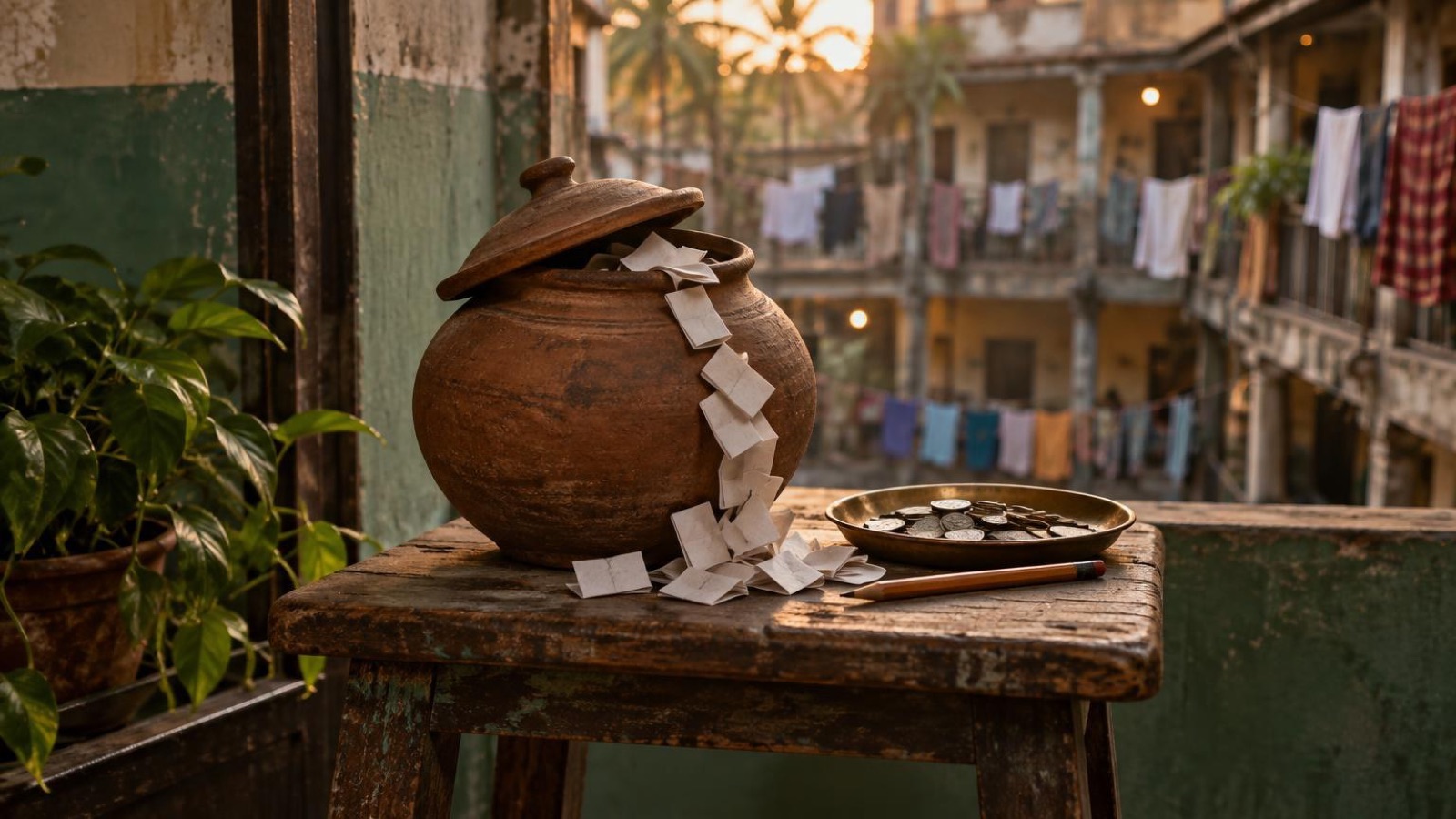
Khatri's change was to make the numbers local and the draw visible. He streamlined the format with the act of drawing numbered chits from a matka, an earthen pot10. Instead of waiting on a foreign exchange rate, players bet on numbers pulled out of a pot in front of them. The word matka is simply the Hindi and Marathi word for that pot, and it became the name of the game.
The mechanics were simple enough to explain in a minute. Numbers from 0 to 9 are written on pieces of paper and put into a matka, a large earthen pitcher, and one person draws a chit and declares the winning numbers11. Players put money on which numbers would come out. The draw produced a result that everyone could see, which is a large part of why people trusted it.
Khatri's contribution was not just the pot. He improved the odds, the transparency and the returns for players10. In a business where customers hand over money and wait for a result they cannot verify, those three things are the whole product. A game that pays slightly better and can be watched while it happens will beat one that cannot.
The result was a game that fit the city. It was cheap to play, quick to settle and easy to understand, and it ran on a daily cycle. That combination is what turned it from a cotton traders' sideline into a mass habit.
Scale of the empire: Rs one crore a day and Rs 500 crore a month
The numbers attached to Khatri's operation are the reason he is remembered. The matka, which involved drawing lots from chits in a pot, was a money spinner, with the daily turnover from gambling touching as high as Rs one crore1. Other accounts put the daily turnover at Rs 1 crore5.
Monthly figures were larger still. At the height of the matka business in the 1980s and 1990s, over Rs 500 crore would be laid as bet every month7. The 1980s and 1990s saw the matka business reach its peak with a turnover of around Rs 500 crore every month4.
To put that in perspective, this was not casino money or money moving through banks. It was cash collected daily from a very large number of small players, in a city where the game was illegal. The turnover figures describe the total amount bet, not anyone's profit, and they are the kind of numbers that explain why the business attracted both intense public interest and constant police attention.
The peak years were also the years when the game's reach was widest. The 1980s and 1990s were when matka became a genuinely mass activity across Mumbai and beyond, and when the names of the people running it became household references. Khatri's own daily earnings in the 1970s, lakhs of rupees a day, were already extraordinary by the standards of the time6.
Matka's legal status in India
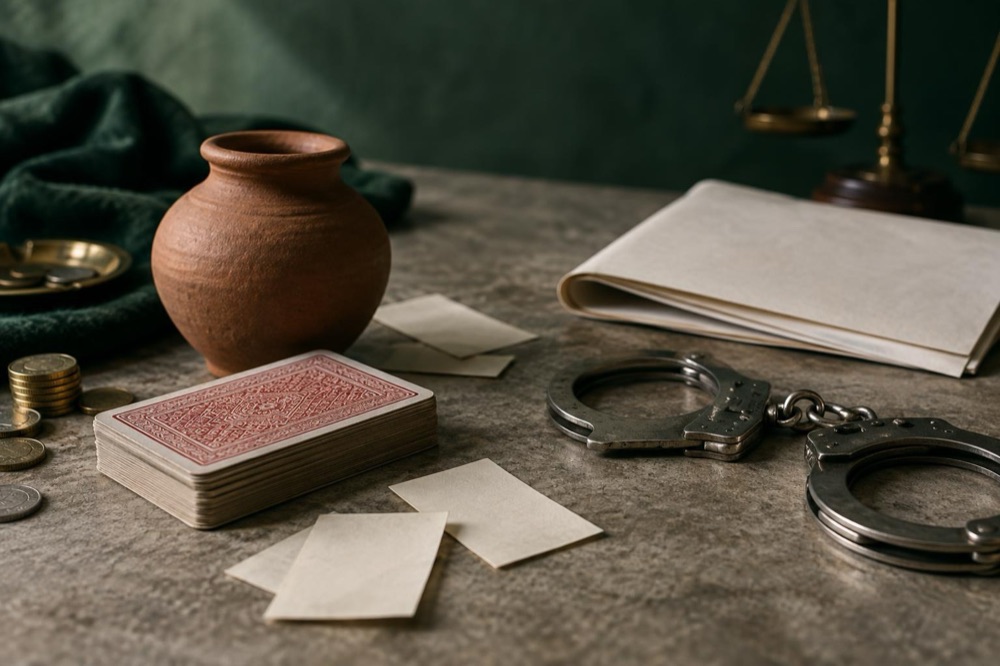
Matka is illegal in India. There were cases against Khatri during his career because matka was illegal5. Satta, the closely related form of numbers betting, was made illegal under the Public Gambling Act 1867, which restricted most forms of gambling and treated games of pure chance as illegal12. Satta Matka in particular is still prohibited in many areas13.
The practical consequence for Khatri was that his career ended well before his life did. He had over the last three decades kept away from the matka trade5. For a man whose name was the game, that is a long retirement, and it covers the entire period from the 1990s onward.
That is also why the story is told now as history rather than as a current business. The game he built still exists in various forms, but the era of the Matka King, with a single figure controlling a nationwide network, belongs to the 1960s through the 1990s.
Ratan Khatri in the Matka King series
The renewed interest in Khatri comes from a television series. Matka King is a Prime Video series, an eight-episode show directed by Nagraj Manjule10. It is loosely inspired by the life of Ratan Khatri, a Sindhi cotton trader who reinvented gambling with a popular new game in 1960s Bombay14.
The series is set in the India of the early 1960s14, and its subject is the origins of Ratan Khatri, widely considered India's unofficial architect of street gambling, or matka as it began to be called14. Vijay Varma plays the lead, and the show is a fictional retelling rather than a documentary14.
It is worth being clear about what the series is and is not. It is inspired by Khatri's life, not a record of it, and the eight episodes compress and dramatize events. If you want the facts of his career, the newspaper accounts from 2020, when he died, are the more reliable source.
For readers who want the wider context of how numbers games and betting traditions developed across the region, there is a companion page on when and where matka gambling originated, and a broader look at gambling culture and history in Asia. The series itself sits alongside other Asian gambling dramas covered in gambling in Asian films and TV.
Common Questions
When did Ratan Khatri die?
He died in Mumbai in May 2020, at his home in the Navjeevan Society in the Mumbai Central area, after a brief illness. Reports at the time gave the date as Sunday, May 10, 2020.
How old was Ratan Khatri when he died?
He was 88. He had come to Mumbai from Karachi as a teenager during the partition of 1947, so he had spent roughly seven decades of his life in the city where he built his business.
What does the word 'matka' mean?
Matka is the Hindi and Marathi word for an earthen pot or pitcher. In the game, numbered slips of paper were placed inside a large matka and one was drawn out to produce the winning number, which is how the betting system got its name.
When did matka gambling start in Mumbai?
It began in Mumbai in 1962. Ratan Khatri took an older habit of betting on New York cotton rates and rebuilt it as a draw from a pot, and the format spread across the city through the 1960s and 1970s.
Is matka legal in India?
No. Matka and satta are illegal in India and remain prohibited in many areas. Ratan Khatri faced cases during his career, and he stayed away from the matka trade for roughly the last three decades of his life.
Who directed the Matka King series?
Nagraj Manjule directed the eight-episode Hindi series Matka King for Prime Video, with Vijay Varma in the lead. It is loosely inspired by Ratan Khatri's life and is set in the Bombay of the early 1960s.
Sources14 sources
- Matka King Ratan Khatri passes away in Mumbai, Indian Express, May 2020
- Matka King Ratan Khatri dead, Economic Times, May 2020
- Matka is a biopic on Ratan Khetri, Deccan Chronicle, March 17, 2024
- What is Satta Matka and how it is played, India Today, September 26, 2018
- Mumbai: Ratan Khatri, the Matka King, dies at 88, Indian Express, May 2020
- Who is Ratan Khatri: From Chandu Champion to Matka King, brought gambling to India, DNA India, June 2024
- How the matka business started, DNA India, November 19, 2013
- Ratan Khatri, Mumbai's Matka King of 60s-90s, dead at 88, Zee News, May 2020
- Who is Ratan Khatri? All about the legendary Matka King, The Statesman, June 2024
- How a Matka King was born: Vijay Varma, Nagraj Manjule on their gambling series, The Hollywood Reporter India, April 2026
- What is Satta Matka: origin of matka gambling or satta, India Today, October 9, 2023
- Gambling in India, University of Bath research paper, 2017
- Satta Matka: Examining India's covert gambling industry, Betcorn, September 26, 2026
- Matka King: Nagraj Manjule's series repeats genre beats, The Wire, April 17, 2026















