Why numbers matter at the Asian gambling table
Numbers carry meaning in Asian gambling culture far beyond their face value. In Chinese, the sound of a number can echo a completely different word, and that echo decides whether players embrace the number or avoid it. The number 8 sounds close to the word for prosperity, so it is the most sought-after digit in the region. The number 4 sounds like the word for death in Chinese, and the same resemblance exists in Korean, Vietnamese and Japanese, which is why hotel rooms, license plates and lottery slips across Asia so often skip it. If you want the wider world of beliefs around the table, see our pages on gambling superstitions in Asia and casino feng shui.
Here is the short list of digits and what players make of them:
| Number | Reputation | Why |
|---|---|---|
| 4 | Unlucky | Sounds like the word for death in Chinese, Korean, Vietnamese and Japanese |
| 8 | Luckiest | Sounds like the word for prosperity in Chinese |
| 9 | Mixed | Lucky in some readings, avoided in others |
| 6 | Lucky | Reads as smooth or flowing in Chinese |
The habit of reading fortune into numbers is old. A 19th-century study of Chinese gambling games describes fortune telling with dominoes, in which combined tile values were ranked on a scale: 1 to 4 was the "lowest" tier, 5 to 7 "below the middle," 8 to 9 the "even middle," and 10 to 11 the "highest." Even in a divination game, 4 sat at the bottom of the ladder and the higher numbers near the top, a pattern that still fits how players feel about these digits today. The same study records games built for crowds, such as K'ap tái shap, described as "played by any number of persons from 2 to 20 and upward," and Ch'é mé, in which players "win 4 times the amount of their stakes if the one played on turns uppermost." Numbers were woven into the rules and the payouts from the start.1
What matters for a modern player is simple: these beliefs are real culture, and you will see them everywhere, from the numbers people pick on a Mark Six slip to the way a casino floor is laid out. But no belief changes a draw, a wheel or a shuffle. Every number in a fair game comes up with exactly the same frequency over time, lucky or not.
The number 4 in mahjong: four players, four rounds, four winds
Mahjong is the clearest example of a gambling game organized around the number 4, even in cultures where 4 is the unluckiest digit of all. The traditional game is played by exactly four people, and the winning hand is 14 tiles: four sets and one pair. The official Macau rules list the celebrated high-scoring hands, and several of the biggest are built on fours, including the "big four winds," a hand made with one pung or kong of each of the four winds.2
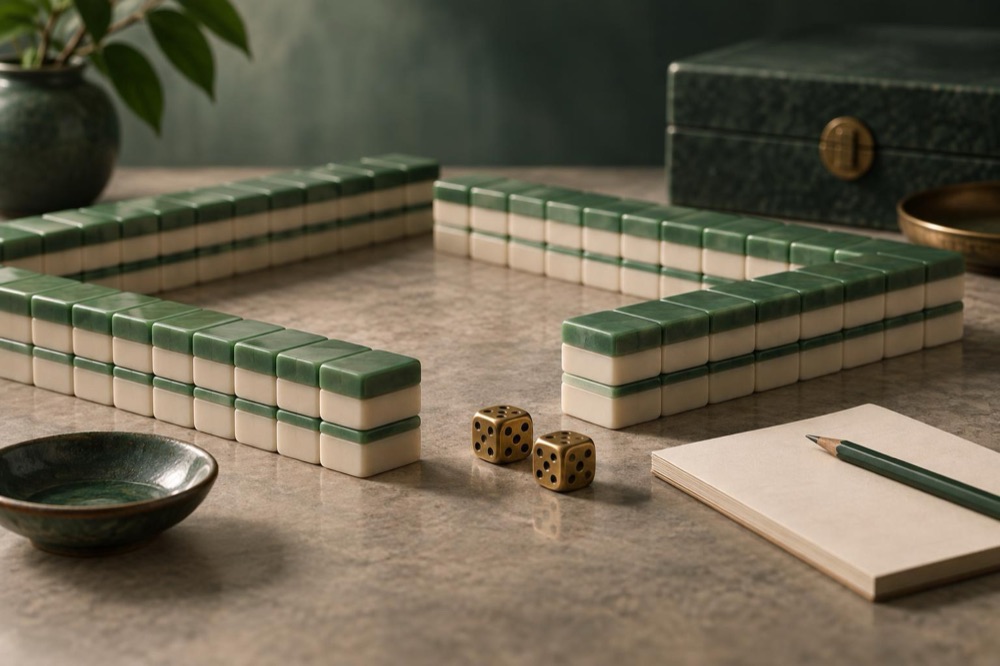
The structure of the game runs on fours from start to finish:
- Four players at the table
- Four rounds, so each player takes a turn as dealer in each wind position
- Four winds, East, South, West and North, which set the seating and the turn order
- Four sets and a pair in the winning 14-tile hand
So the game most associated with Chinese gambling culture is saturated with the very number many players avoid on a lottery ticket. The distinction players make is between a number that appears in the structure of a game, which nobody controls, and a number you choose yourself, where the superstition kicks in.
Not every version sticks to four. Macau's rules for the simpler betting version of mahjong allow two to four players. In Japan, three-player mahjong has grown into a format of its own, with dedicated three-player parlors west of the Chukyo area, a small number of free parlors in the capital region offering it, three-player tables on many online mahjong sites, and automatic tables that can usually be set for three players.3
108 and 144: what the tile counts are said to mean
Tile counts in mahjong are often said to carry meaning. The standard set used in the four-player game has 136 core tiles plus flowers and seasons, and players sometimes describe the full set as 144 tiles. The three-player Japanese variant uses a reduced set of 27 tile types and 108 tiles, made by excluding the 2 through 8 of the character suit.3
The numbers 108 and 144 get attached to Buddhist and cosmological ideas in popular telling, since 108 is a significant number in Buddhist tradition, and players who enjoy the symbolism say the tile counts echo it. The practical answer is more mundane: the set is built from three suits of number tiles running 1 to 9, plus honors, and the arithmetic of the suits produces the counts. But the symbolic reading is part of the game's culture, and you will hear it at tables across the region.
Other tile games have their own fixed counts. Pai Gow is played with 32 domino-like tiles, and its rankings and pairings are entirely traditional, with names that go back centuries.4 The counts are not lucky or unlucky in themselves; they are simply the size of the set each game evolved with.
Games built on the number 4: Numbers 4, PICK-4 and 4D
While some players avoid the digit 4 on their tickets, several of Asia's most popular number games are literally named after it. Japan's Numbers 4 lottery asks you to pick a four-digit number, and a straight win, matching all four digits in order, pays about JPY 1,000,000, with a theoretical value of JPY 900,000.5 The same game family includes Numbers 3, and the two are among the most played lotteries in Japan.
In North America's PICK-4, you play 4 numbers, and the odds of winning the top prize are 1 in 10,000, with prizes and odds varying depending on the number combination you choose.6
The 4D format, picking a four-digit number, is a staple across Malaysia, Singapore and the Philippines. In Curaçao's Wega di Number, a game in the same family, participants wager on one or more 2, 3 or 4-number combinations, and in every drawing three 4-digit numbers are drawn, determining the first, second and third prizes.8 China's 7星彩 (Seven Star Lottery) works on a similar principle with a seven-digit number: the fourth prize is won when any 5 digits of your number match the drawn number in the corresponding positions, and the sixth prize, for 2 consecutive digits matching in the same positions, pays a flat CNY 5.9
Here is how the digit-based games compare:
| Game | Where | What you pick | Top prize or odds |
|---|---|---|---|
| Numbers 4 | Japan | A 4-digit number | About JPY 1,000,000 for a straight win |
| PICK-4 | North America | 4 numbers | Top prize odds of 1 in 10,000 |
| Wega di Number | Curaçao | 2, 3 or 4-number combinations | Three 4-digit numbers drawn per drawing |
| 7星彩 | China | A 7-digit number | CNY 5 flat for the sixth prize |
The irony is worth savoring: the digit so many players refuse to pick is the foundation of some of the region's favorite games.
Mark Six: picking six numbers from 49
Hong Kong's Mark Six is a 6-out-of-49 lottery game, and it is where number beliefs are most visible in practice.11 In a single entry, you select six numbers from the 49; each single entry is one chance. In a multiple entry, you select at least seven numbers from the forty-nine, and the system groups your numbers into all possible combinations of six to calculate your chances. The drawn numbers and the Extra Number come from the range 1 to 49.12
Ask around a Hong Kong betting shop and you will see the culture at work: slips heavy with 8s and 18s, and 4s left on the shelf. Japan's equivalent, LOTO6, asks you to pick 6 different numbers from 1 to 43, and the Philippines' Super Lotto 6/49 uses the same 1 to 49 range, with a System Play option that covers multiple combinations.14 Vietnam's MEGA 6/45 has you pick from 1 to 45.16
A multiple entry is the practical way to cover more numbers, but note what it does and does not do: it buys more combinations, each with the same odds as any other. It does not make your lucky numbers luckier.
Odds of 1 in 13,983,816: what the numbers really say
Here is what the numbers actually say about a 6-from-49 draw. The odds of winning the jackpot, matching all six numbers, are 1 in 13,983,816. The odds of matching five out of six numbers are 1 in 55,492, and that prize is often only a few hundred dollars, compared with millions for the jackpot.17
Other games in the region show the same arithmetic at different scales:
- toto (Japan): first prize 1 in 1,594,323, second about 1 in 61,320, third about 1 in 5,110
- BIG, 14 matches: first prize 1 in 4,782,969
- BIG, 12 matches: first prize 1 in 16,777,216
- BIG, 9 matches: first prize 1 in 19,683
- MEGA BIG: first prize 1 in 16,777,216
- DUNK, 10 games: first prize 1 in 1,048,576
Notice what BIG reveals: the player does not need to predict anything, because the computer randomly selects each result. The odds are identical whether you choose your numbers with care, with a fortune teller, or with your eyes closed. That is the honest answer to every lucky number question, and it applies just as much to Mark Six.
What a winning number pays
When the numbers do come up, here is what they are worth. Mark Six dedicates 54% of turnover to dividends for winners, 15% goes to the Lotteries Fund for charitable purposes, and 6% is the HKJC's commission. Winning bets are valid for 60 days, so a winning ticket must be claimed within that window.24
Elsewhere in the region, prize structures are set out by the numbers too. China's Super Lotto caps first and second prize at CNY 5,000,000 per bet, and its third prize pays CNY 5,000 on a basic bet or CNY 6,666 with the additional bet. The eighth prize is a fixed CNY 15.26 The 9-match football game 胜彩选9场 costs CNY 2 per bet.28 China's football win-draw-loss game caps payouts per bet, from CNY 100,000 for singles and 2-in-1 parlays up to CNY 1,000,000 for parlays of 6 matches or more.29
None of these payouts depends on which numbers you picked. A jackpot made of 4s pays exactly what a jackpot made of 8s pays.
Lucky 8 on the casino floor
The number 8 shows up in the region's gambling economy in concrete ways. Macau's licensed operators report their table counts in official filings: City of Dreams operated 435 gaming tables and Studio City 259 at the end of 2024, and casino operators across the region are conscious of numbers, dates and layouts that read as auspicious when they open or expand properties.30
On the tables themselves, 8 appears in the payouts. In European roulette, the TOP line bet pays 8 to 1.31 The wheel itself is a study in number structure: an American roulette wheel has 38 numbered slots (1 to 36) plus two green slots with "0" and "00," while the European wheel carries a single zero. Outside bets let you bet on whether the winning number is high or low, odd or even, red or black, or part of the first, second or third dozen.32 None of these bets cares whether a number is lucky; the dozens pay what they pay because they cover 12 numbers, not because 8 is in one of them.
Even horse racing, the region's oldest licensed betting sport, is a numbers game: a horse numbered 4 in a race in Japan might carry decimal odds of 84.1, and the number on its saddlecloth has no effect on that price.34
Where number games meet the law: mahjong for money in Japan and China
For all the culture around the numbers, the practical question for players is where money games are allowed. In Hong Kong, the authorized gambling outlets are horse racing, football betting and the Mark Six Lottery as organized by the HKJC, along with certain gaming activities authorized under the Gambling Ordinance, such as licensed mahjong parlors.35 A long-standing enforcement notice adds a caution: it is a common misconception that playing mahjong for money does not contravene the law, and it is often the type of premises that determines legality. Playing for money in non-bona fide establishments, including unlicensed clubs, or on private premises where rental or commission is charged, is unlawful.36
In China, the line is drawn at profit. An official notice from Liaoning province states that the law strictly prohibits gambling in all forms, including mahjong, poker, dominoes, dice, underground "Mark Six" lotteries, electronic gaming machines, computer networks and WeChat red packets.37 At the same time, official guidance says recreational mahjong is not treated as gambling and is generally not punished when it is not for profit, stakes are small, or chess and card rooms only charge fixed venue and service fees.38 In Japan, mahjong among relatives and friends is treated as legal entertainment when it is not for profit, winnings are small, and it is only leisure.39
If you are traveling, our country guides, such as can I gamble in Hong Kong or can I gamble in Japan, cover the details.
Lucky numbers or lucky draws: what players can and cannot control
Strip away the symbolism and every one of these games comes down to the same thing: a random draw in which all outcomes are equal. The BIG lottery makes this explicit, with a computer randomly selecting each match result so the player does not need to predict anything.20 The roulette wheel does not remember that 4 is unlucky. The Mark Six balls do not know which numbers carry meaning in Cantonese.
Casinos, in fact, assume players cannot predict outcomes and set their rules accordingly. Macau's progressive jackpot poker rules prohibit using any device to record results, make predictions or set betting strategies, and even prohibit talking to other players while deciding whether to raise.40 The house is not worried that your lucky number works; it is worried about anything that actually could.
What players can control is real, but it is not luck:
- Coverage: a multiple entry lets you cover more combinations in one bet
- Game choice: matching five numbers comes in at 1 in 55,492, against 1 in 13,983,816 for matching six, with a much smaller prize attached17
- Timing: winnings are claimable within a 60-day window25
What no player can do is make one number more likely than another, no matter how it sounds in any language.
That is the honest pleasure of lucky numbers in Asian gambling: they are a shared language, a way of making a random draw feel personal, and a link to beliefs that go back to dominoes ranked on a scale where 1 to 4 was "lowest" and 8 to 9 the "even middle."1 Pick your 8s, avoid your 4s, enjoy the ritual, and know that the draw does not care. For more on how players try to find their numbers, see dream numbers and lottery number rituals.
Common Questions
Is the number 4 really considered unlucky in gambling?
Yes, in much of East and Southeast Asia the number 4 is avoided because its sound resembles the word for death in Chinese, Korean, Vietnamese and Japanese. Many players skip it when choosing lottery numbers, though it appears in games as often as any other number.
Why is 8 considered a lucky number for betting?
In Chinese, 8 sounds close to the word for prosperity or wealth, so it is widely treated as the luckiest number. Players favor it in lottery picks, license plates and betting amounts, and casinos lean on it in floor design and game payouts.
How many numbers do you pick in Mark Six?
In a single entry you pick six numbers from 1 to 49. A multiple entry lets you pick at least seven numbers, and the system groups them into every possible combination of six to count your chances.
What are the odds of winning the Mark Six jackpot?
Matching all six numbers in a 6-from-49 draw carries odds of 1 in 13,983,816. Matching five of the six is far easier at 1 in 55,492, but that prize is often only a few hundred dollars.
How long is a Mark Six winning ticket valid?
Winning bets are valid for 60 days, so you should claim within that window. After the period ends, an unclaimed prize can no longer be paid out.
Is playing mahjong for money legal in Japan?
Small games among relatives and friends, played not for profit and with only small amounts changing hands, are treated as legal leisure. Organized gambling for profit is a different matter and is prohibited.
Why does mahjong have 108 tiles in some versions?
Three-player mahjong uses a reduced set of 27 tile types and 108 tiles, dropping the 2 through 8 of the character suit. The standard four-player game uses the full 136-tile set plus flowers and seasons.
How many people play mahjong in Asia?
Traditional mahjong is played by four people, simple versions by two to four, and three-player mahjong has dedicated parlors in parts of Japan plus tables on many online sites. Automatic tables can usually be set for three players.
Sources40 sources
- Chinese Games with Dice and Dominoes, Smithsonian Institution, 1893
- Mahjong Rules, Gaming Inspection and Coordination Bureau of Macau, August 5, 1991
- 三人麻雀, Wikipedia, 2026
- How to Play Pai Gow Poker, PlaySmart, 2026
- Numbers 4, Takarakuji Official, 2026
- How to Play Lottery Daily Games, PlaySmart, 2026
- How to Play Lottery Daily Games: Details, PlaySmart, 2026
- Numbers Lottery Regulation, Curaçao Gaming Authority, 2026
- 7星彩, Zhongcai Wang, 2026
- 7星彩 Rules, China Sports Lottery, 2019
- Responsible Gambling, Hong Kong Jockey Club, 2026
- Mark Six Lotteries Rules (Chinese), Hong Kong Jockey Club, 2020
- Mark Six Lotteries Rules (English), Hong Kong Jockey Club, 2020
- LOTO6, Takarakuji Official, 2026
- Can I Buy PCSO Lotto Ticket Online, Lotto PCSO, 2026
- MEGA 6/45, Vietlott, 2026
- Lottery, GameSense, 2024
- toto, Toto Dream, 2026
- toto Odds, Japan Sports Promotion Center, 2026
- BIG, Toto Dream, 2026
- BIG (12-match), Toto Dream, 2026
- BIG and MEGA BIG Odds, Japan Sports Promotion Center, 2026
- DUNK, Toto Dream, 2026
- LegCo Brief on Mark Six, Legislative Council of Hong Kong, June 2001
- Going Racing Guide, Japan Racing Association, 2026
- Super Lotto, Zhongcai Wang, 2026
- Super Lotto Prize Rules, China Sports Lottery, 2026
- 胜彩选9场, China Sports Lottery, 2026
- Win-Draw-Loss Game Payout Caps, China Sports Lottery, 2026
- Gaming Table Counts 2024, Gaming Inspection and Coordination Bureau of Macau, 2024
- European Roulette, PlaySmart, 2026
- How to Play Roulette, PlaySmart, 2026
- How to Play Roulette: Details, PlaySmart, 2026
- Race Odds, Hokkaido Keiba, 2026
- LegCo Brief on Simulcast and Authorized Gambling, Home and Youth Affairs Bureau, Hong Kong, June 2025
- Mahjong Gambling Legality Notice, Hong Kong Government, April 26, 1999
- Notice on Strictly Cracking Down on Gambling Crimes, Liaoning Provincial Public Security Department, January 20, 2023
- Mahjong Entertainment Not Treated as Gambling, China Peace, May 15, 2023
- Mahjong Among Relatives and Friends, Xixian Procuratorate, May 26, 2026
- Statutory Rules for Progressive Jackpot Poker, Gaming Inspection and Coordination Bureau of Macau, May 12, 2004