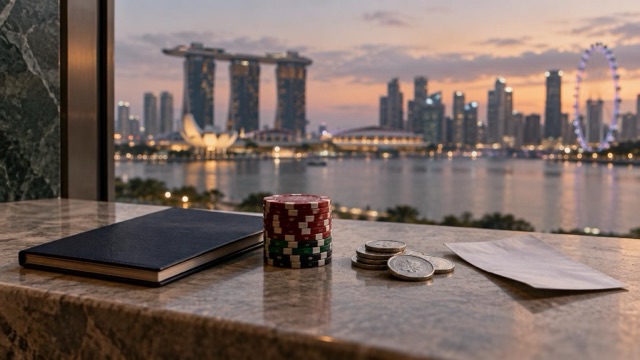
Walk through any casino floor in Macau or a lottery queue in Bangkok and you will see luck being worn, carried and invoked long before the first bet is placed. A player in a red shirt touches a small amulet on a cord around his neck. A woman chooses her lottery numbers after a visit to a shrine. None of this is incidental: in much of Asia, luck is a practical matter, prepared for in advance the way you would prepare cash or ID. This page covers the colors, charms, numbers and rituals Asian gamblers actually use, and, because so much of this play happens in places where gambling is restricted, it also explains where in Thailand and mainland China the law lets players act on their beliefs at all.
Lucky colors gamblers use in Asia
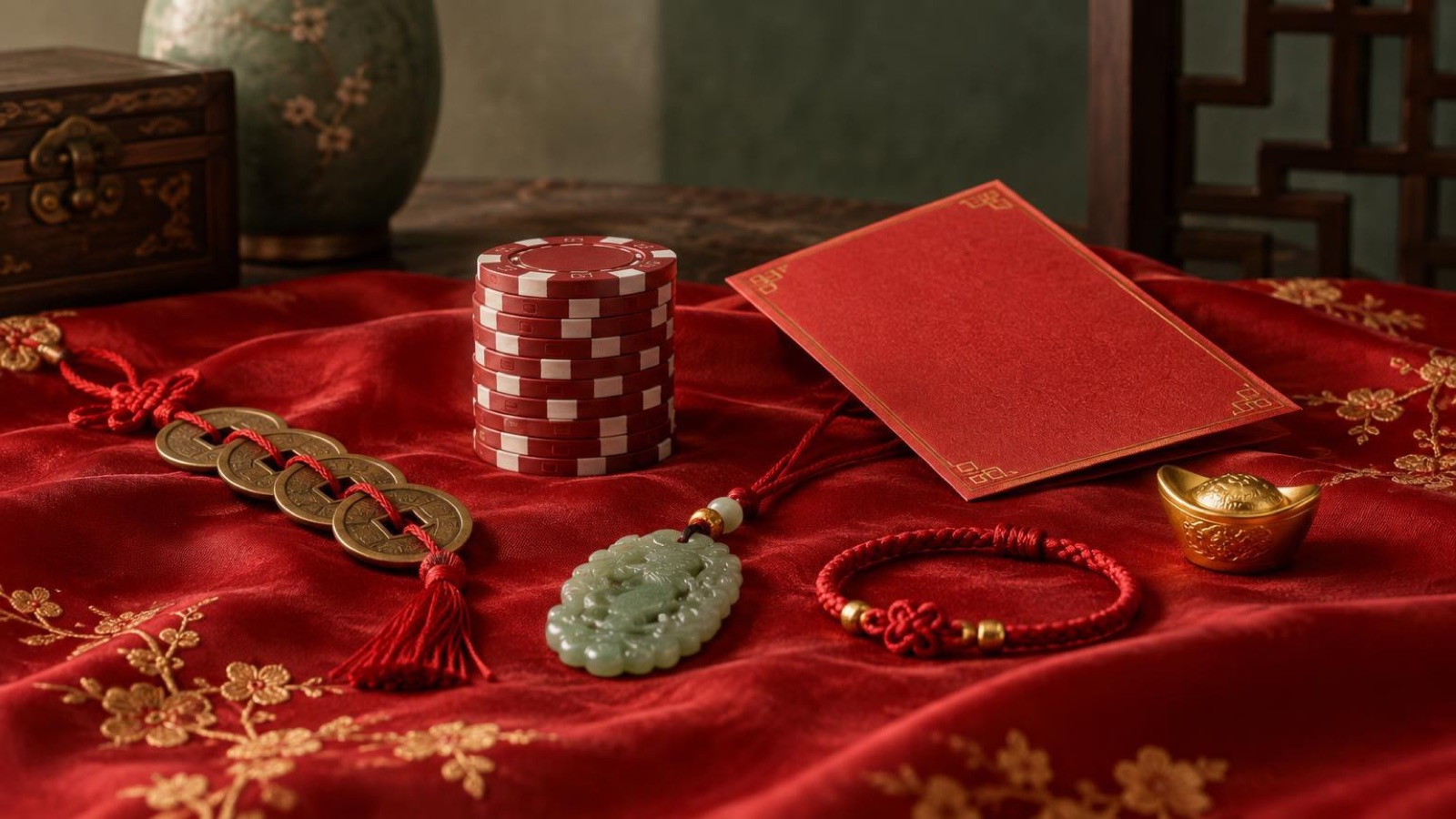
Red is the color that dominates. In Chinese culture, red is the color of celebration, weddings, New Year and good fortune, and gamblers carry that association straight to the table. You will see it in the clothing players choose for a casino visit, in the envelopes money is given in, and in the design of the gambling products themselves.
The clearest example comes from China's own lottery system. In 2023, the China Welfare Lottery released a 30-yuan scratch ticket called Hao Yun Lai, roughly "good luck arrives." Its designers chose "Chinese red" as the theme color, paired with gold lettering and gold patterns, precisely because that combination reads as auspicious to Chinese players1. The scratch coating itself was printed with classic luck symbols: the character fu (fortune), old copper coins, fortune bags and gold ingots1. In other words, the official state lottery sells luck in its most recognizable visual form: red and gold, covered in symbols of wealth.
Gold is red's constant companion. Where red signals fortune and joy, gold signals money itself, and the two together are the standard palette of anything in Asia that wants to promise prosperity. A related scratch ticket, Hao Yun Shi Bei ("luck times ten"), offered a top prize of CNY 400,000, and its marketing leaned on the same visual language of luck5.
Other colors matter in specific contexts:
- Red: the default choice for a big night at the tables; celebration, joy and fortune in Chinese culture.
- Gold: red's partner, signaling money and prosperity; the two appear together on tickets, charms and gifts.
- Jade tones: carry positive weight of their own, especially in pendants and charms.
- White: avoided in many Chinese settings because of its association with mourning, which is why you rarely see it chosen deliberately for a casino visit.
If you want a single rule of thumb for the region, it is this: when in doubt, wear red. For more on the beliefs that surround play, see our page on gambling superstitions in Asia.
Charms and amulets carried at the tables
Charms are the portable version of the same idea. A charm is anything small you carry or wear that you believe tilts luck your way. Common ones across the region include:
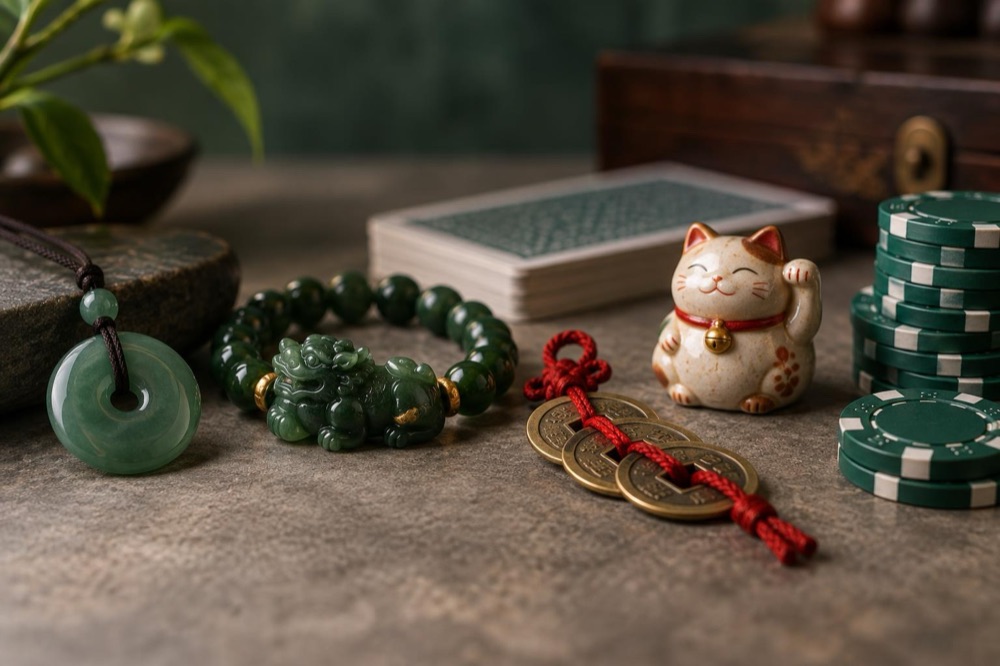
- a coin from a good year, or old coins with square holes strung on red cord
- a jade pendant
- a red string tied at a temple
- a photograph of a grandparent who always won
- a small Buddha figure in a pocket
- gold ingot replicas
- the fu character worn or displayed for fortune
In Chinese communities, the ingots, holed coins and fu character are the classics. These are the same symbols printed on the scratch tickets described above, which shows how deeply they are embedded: the state lottery and the grandmother's pendant draw on the identical vocabulary of luck1.
In Thailand, amulets are a culture of their own. Small blessed medallions and figures, often of monks or Buddhist imagery, are worn by millions of Thais for protection and good fortune in all parts of life, and gambling is no exception. A player heading to a card game or the lottery counter will often wear an amulet blessed at a temple, and some will make a small offering or a prayer before choosing numbers. Thai lottery players also follow rituals around where numbers come from, including interpreting dreams and asking spirits at shrines; our page on lottery number rituals covers those practices in detail.
Researchers who study the history of Chinese gambling note that games of chance there evolved into their documented forms through a long process of cultural selection, with practices that resonated surviving and spreading6. Charms and lucky colors are part of that same inheritance: they persist because, for generations of players, they have felt like they worked.
Casinos themselves do not discourage any of this. In Macau, the world's largest gambling market, the rules that govern who may enter a casino are about identity and employment, not about what you wear or carry. Casino employees, for example, may only enter gaming floors in narrow circumstances, such as the first three days of Chinese New Year, for documented training, or for approved research, and even then may not gamble7. Ordinary players in lucky red shirts with amulets around their necks walk in without a second glance. The 24 games licensed in Macau casinos, from baccarat and blackjack to fan tan, sic bo and pai gow8, are played daily by people dressed for luck.
Chinese lucky numbers and symbols
Numbers carry meaning across Chinese gambling culture, and players choose accordingly. The most famous is eight, whose pronunciation in Chinese echoes the word for prosperity, making it the single most sought-after number in the region. Nine suggests longevity. Four, by contrast, sounds like the word for death and is avoided wherever possible. Our page on lucky and unlucky numbers in Asian gambling goes through the full list.
You can see the number culture reflected in how China's legal lotteries are structured. The China Sports Lottery's Super Lotto draws three times a week, on Mondays, Wednesdays and Saturdays9, and the Welfare Lottery's Seven Star Lottery draws on Tuesdays, Fridays and Sundays9, giving players regular occasions on which to deploy their chosen numbers. Super Lotto's top prize is capped at CNY 5,000,000 per bet for the first and second prizes10, and players can buy into consecutive draws in advance, anywhere from 2 to 99 draws at a time10, so a set of lucky numbers can be locked in for months.
Sports betting through the official lottery follows the same pattern. The basketball big/small game caps prizes at CNY 1,000,000 for parlays of six selections or more11. Whether a player is picking lottery numbers or building a parlay, the instinct is the same: work the lucky numbers in where you can.
Here is how the main official games stack up:
| Game | Type | Draw days | Price and top prize |
|---|---|---|---|
| Super Lotto | Lottery draw | Mondays, Wednesdays, Saturdays | Top prize capped at CNY 5,000,000 per bet; multi-draw entry of 2 to 99 draws10 |
| Seven Star Lottery | Lottery draw | Tuesdays, Fridays, Sundays | Regular draws for chosen numbers9 |
| Basketball big/small | Sports parlay | Match days | Prizes capped at CNY 1,000,000 for parlays of six or more selections11 |
| Hao Yun Lai | Scratch ticket | Instant | CNY 30 per ticket, "Chinese red" and gold design1 |
| Hao Yun Shi Bei | Scratch ticket | Instant | Top prize CNY 400,0005 |
Symbols matter as much as numbers. The fu character, copper coins, fortune bags and gold ingots printed on scratch tickets1 are the everyday icons of luck, and they appear on charms, clothing and gifts around gambling throughout the Chinese-speaking world.
Thai beliefs at the card table and lottery counter
Thai gambling culture is saturated with belief. The Government Lottery Office's twice-monthly draws are a national ritual, and the weeks before a draw are filled with practices for finding numbers: dreams interpreted by published guides, numbers read from car license plates, tree spirits asked at shrines, and amulets consulted. Players then carry those numbers, and often their amulets, to the counter.
The lottery is one of the only legal outlets, so it absorbs an enormous amount of this belief energy. But Thai players also bet on lotteries beyond the country's borders. Research on Thai gambling found that Thais place bets on foreign lotteries run from Laos, Cambodia, Malaysia and Singapore, and even from countries where acquaintances work, such as Singapore, with the bets placed by telephone through intermediaries2. The charms and rituals travel with the practice, not the venue.
At the card table, where most play in Thailand happens outside the law, amulets are just as common. A blessed medallion worn during a session of pok deng or a night of underground poker is standard practice for many players. Some forms of betting sit closer to the legal line: betting on boxing and horse racing is allowed in Thailand12, and these are occasions where luck rituals appear openly, in the stands rather than behind closed doors.
Where Thai gamblers bring their charms: from underground rooms to Cambodian casinos
Because most casino play is illegal inside Thailand, the charms travel. The practical map of Thai gambling has three layers:
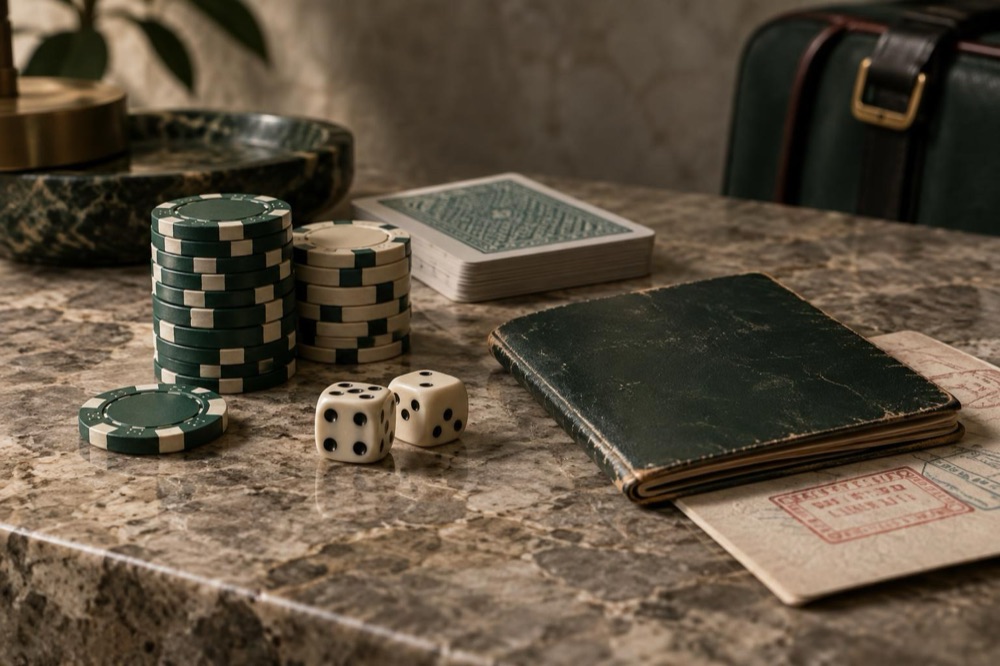
- Domestic and informal: card games in private homes, back rooms and underground venues, where amulets are as common as cards.
- Legal: the government lottery, horse racing and boxing betting, plus tournament poker, which was legalized in 2025 (more on that below).
- Cross-border: Thais travel to gamble in neighboring countries, above all Cambodia, where casinos are open and cater heavily to Thai visitors. Our Gambling in Thailand page covers the practical details.
There is also an online layer. Thailand's gambling landscape sits in what observers describe as a gray zone: no online casinos are approved or regulated by the Thai government, but offshore sites are accessible in practice, and they typically let Thai players deposit and withdraw in their native baht13. Players who would not carry an amulet to an underground room still keep one nearby when playing online at home.
For foreign visitors, the region's rules differ sharply by country. Vietnam, for example, took the opposite approach to Thailand: under Decree 03/2017, foreigners and overseas Vietnamese holding a valid foreign passport may gamble at Vietnam's casinos14, and Vietnamese authorities later confirmed that foreigners and overseas Vietnamese with foreign-issued passports may bet at licensed casinos, with banks allowed to provide services to casino businesses15. A Thai player's amulet is welcome at a Phnom Penh casino table; whether the player is welcome depends entirely on which side of which border they are standing.
Gambling in Thailand: what is legal and what is not
The short version: horse racing, the government lottery, boxing betting and, since August 2025, tournament poker. Everything else is illegal.
The foundation is the Gambling Act of 1935, under which all forms of gambling are illegal except horse racing and the lottery3. Betting on boxing and horse racing is allowed12. In a significant change, tournament poker was made officially legal in Thailand in August 2025, when the acting prime minister overturned a long-standing ban, though a full legal framework for the new law has yet to be implemented16.
The law applies to everyone, including foreigners. The authorities have been known to jail foreigners to await deportation, and fines and deportation are often the response3. The minimum age for legal gambling in Thailand is 1813.
Online gambling occupies uncertain ground. The Gambling Act does not cover online gambling directly, but it bans nearly all wagering activities, and no online casinos are approved or regulated by the Thai government13. In practice, offshore sites are reachable, and there has not yet been a reported case of a poker player getting into trouble playing online3, but that is a description of what has happened, not a permission.
Change may be coming. Thailand's cabinet approved a draft law to legalize casinos and gambling in early 202517. If that happens, the underground rooms where amulets are worn today would give way to licensed floors.
Why many Thais travel to Cambodia to gamble
The answer is arithmetic: Thailand bans casino gambling, and Cambodia does not. Casinos cluster on the Cambodian side of the border and in Phnom Penh and Sihanoukville, marketing directly to Thai players, who cross for a weekend of baccarat and slots. Thai players already bet on foreign lotteries by phone through Laos, Cambodia, Malaysia and Singapore2, and physical casino trips are the same impulse at full scale. Our Gambling in Cambodia page covers what those venues offer.
For Thai players, the trip is also a chance to gamble openly, with the amulet around the neck and the red shirt on, in a way that is impossible at home. The charms do not change; the setting does.
Mainland China: a gambling culture under prohibition
Mainland China presents the sharpest contrast in the region: a gambling culture with thousands of years of history, expressed today almost entirely through two state lotteries, because nearly everything else is prohibited.
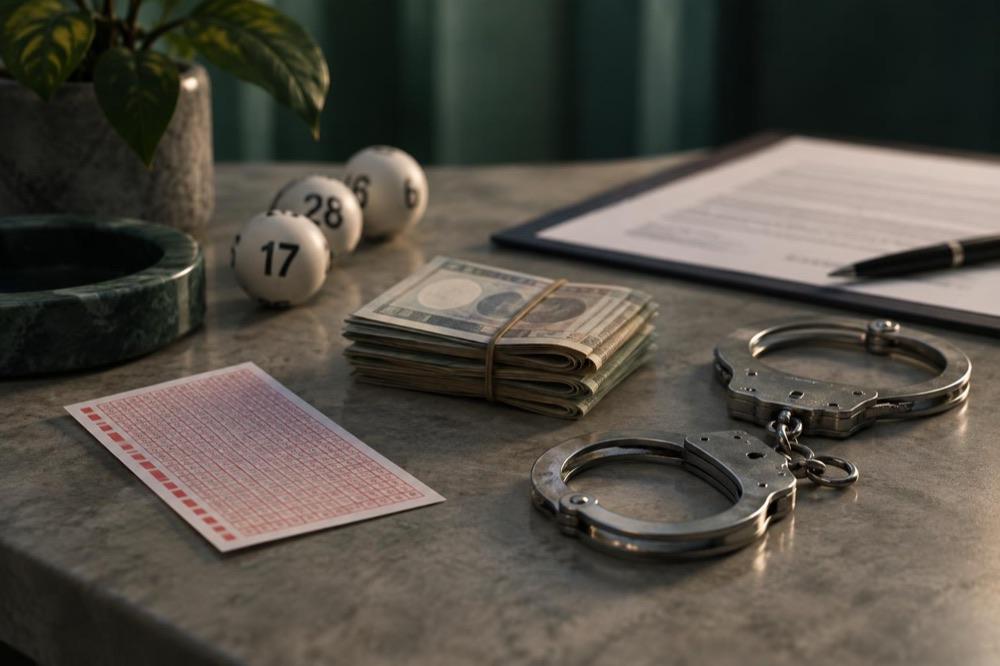
What is legal are the China Welfare Lottery and the China Sports Lottery, described above, with their scratch tickets in Chinese red and gold1, Super Lotto draws on Mondays, Wednesdays and Saturdays9, and prize caps in the millions of yuan10. What is illegal is essentially everything else. Gambling devices that automatically decide results, such as slot machines, are prohibited18. Enforcement notices across provinces spell out the breadth: gambling for profit using electronic game machines, chess and cards, mahjong, dominoes, dice, underground "Mark Six" lotteries, the internet, WeChat red packets and Texas Hold'em is prohibited19, and Liaoning province's 2023 notice states flatly that national law strictly forbids gambling in all its forms20.
The prohibition reaches beyond the border. Chinese authorities state that gambling abroad, online gambling, and providing funds or technical support for gambling all violate the Criminal Law and the Public Security Administration Punishment Law21, and Chinese law treats any form of gambling by Chinese citizens, including online gambling and gambling overseas, as illegal, as well as opening casinos overseas to attract Chinese citizens as primary customers22. Even the debts are treated differently: obligations arising from gambling are not protected by law, and crimes committed to collect gambling debts are punished severely4.
There are narrow exceptions. Ordinary mahjong and card games played for leisure in chess and card rooms, without a profit motive, are lawful entertainment protected by law23. And Hong Kong, a special administrative region, runs its own system: all gambling is illegal there except regulated horse racing, football betting and the Mark Six lottery, licensed activities such as mahjong parlors, and exempt social gambling24.
The prohibition shapes travel too. From 2008 through 2010, China readjusted its visa policy toward Macau and limited the number of visits some mainland citizens could make in a given period25, and in October 2013 China banned "zero-fare" tour groups with compulsory shopping25. There has even been official-level discussion of change: a proposal to allow gambling on Hainan Island was noted in corporate filings26. For now, though, the mainland's lucky colors and charms are mostly carried to lottery counters, not casino floors. Our Gambling in China page has the full picture.
What charms cannot do: a note on luck and losses
The beliefs are real, the culture is real, and the rituals are genuinely comforting to millions of players. But luck, as a force you can dress for, does not exist.
That matters because the rituals can quietly encourage players to bet more than they planned. Problem-gambling counselors list the warning signs27:
- betting with more money than planned
- repeatedly trying to win back losses
- lying about gambling
- missing work and family commitments
- thinking about gambling all the time
- being unable to cut down
- accumulating debt or unpaid bills because of gambling
The practical takeaway is simple. Enjoy the red, carry the amulet, pick your lucky numbers if it makes the evening better. Then set a budget before you start, keep to it, and treat the charms as tradition rather than strategy. Luck is the story players tell afterward; the budget is what protects you beforehand.
Common Questions
What color is considered luckiest for gambling in Asia?
Red is the standout lucky color, especially in Chinese communities. China's own lottery products lean on it: a 30-yuan scratch ticket called Hao Yun Lai uses "Chinese red" as its theme color, paired with gold names and designs, because red and gold together signal fortune and prosperity.
Are lucky charms allowed inside casinos?
Yes. Casinos in Asia do not ban personal charms, amulets or red clothing, and many players openly carry them. The only entry rules that matter are the official ones, such as Macau's restrictions on when casino employees may enter gaming floors, which have nothing to do with charms.
What is a good lucky number in Chinese culture?
Numbers that sound like lucky words are the favorites, and eight is the most famous because its pronunciation echoes the word for prosperity. Players often build bets and ticket choices around such numbers, and lottery games in China are designed with these preferences in mind.
Do Thai lottery players use amulets?
Yes, amulets and charms are a strong part of Thai lottery culture. Many players also bet on foreign lotteries run from Laos, Cambodia, Malaysia and Singapore, placing their bets by telephone, and charms and rituals often accompany the numbers they choose.
Is gambling legal in Thailand for foreigners?
No, not in general. Under the Gambling Act of 1935, all forms of gambling are illegal except horse racing and the lottery, and the law applies to foreigners too. Authorities have been known to jail foreigners pending deportation, and fines and deportation are common responses.
Can expats in Thailand be deported for gambling?
Yes. Thailand's gambling laws apply to foreigners as well as citizens, and the authorities have been known to hold foreigners in jail to await deportation. Fines and deportation are often the practical outcome for expats caught gambling illegally.
What gambling is legal on the Chinese mainland?
Only the state lotteries. The China Sports Lottery and China Welfare Lottery are legal, including Super Lotto, which draws on Mondays, Wednesdays and Saturdays. Casino gambling, slot machines and almost all other forms are prohibited, and even gambling debts carry no legal protection.
Sources27 sources
- 30元好运来 scratch ticket announcement, Zhongcai Wang, July 24, 2023
- Thai gambling research paper, Gambling Study, August 2011
- Thailand poker guide, SoMuchPoker, February 20, 2026
- Notice on Cracking Down on Gambling Crimes, Xinxing County government, January 17, 2019
- 好运十倍 scratch ticket announcement, Zhongcai Wang, April 6, 2023
- The Cultural Evolution of Games of Chance: A Historical Investigation of Chinese Gambling, PubMed, 2024
- Casino entry Q&A, DICJ Macau, 2026
- Law 16/2001 attachment: permitted games, Macau Official Gazette, October 2016
- China Sports Lottery draw schedule, Zhongcai Wang, September 26, 2026
- Super Lotto game rules, China Sports Lottery, September 26, 2026
- Basketball big/small game rules, China Sports Lottery, September 26, 2026
- Thailand gambling laws overview, Bangkok Views, September 25, 2026
- Online casinos for players from Thailand, Wizard of Odds, August 27, 2026
- Vietnamese to be permitted to gamble in casinos, Vietnam News, January 26, 2017
- Casino business, commercial banks allowed to provide services, Vietnam News, September 6, 2017
- Tournament poker now legal in Thailand, Asia Gaming Brief, August 6, 2025
- Cabinet approves draft law to legalise casinos and gambling, Bangkok Post, January 13, 2025
- State Council regulation on gaming machines, gov.cn, November 22, 2019
- Dingcheng District gambling crackdown notice, Dingcheng District Public Security Bureau, February 25, 2020
- Notice on Strictly Cracking Down on Gambling Crimes (Liaoning), Liaoning Public Security, January 20, 2023
- Cross-border gambling press release, National Immigration Administration, February 5, 2021
- Chinese embassy statement on gambling by citizens, Chinese Embassy in the Philippines, August 8, 2019
- Chess and card room guidance, Beijing government, June 29, 2020
- Gambling policy page, Home and Youth Affairs Bureau Hong Kong, 2026
- MGM annual report 2014, SEC filing, 2014
- MGM annual report 2017, SEC filing, February 23, 2018
- When does gambling become a problem, NCPG Singapore, September 25, 2026