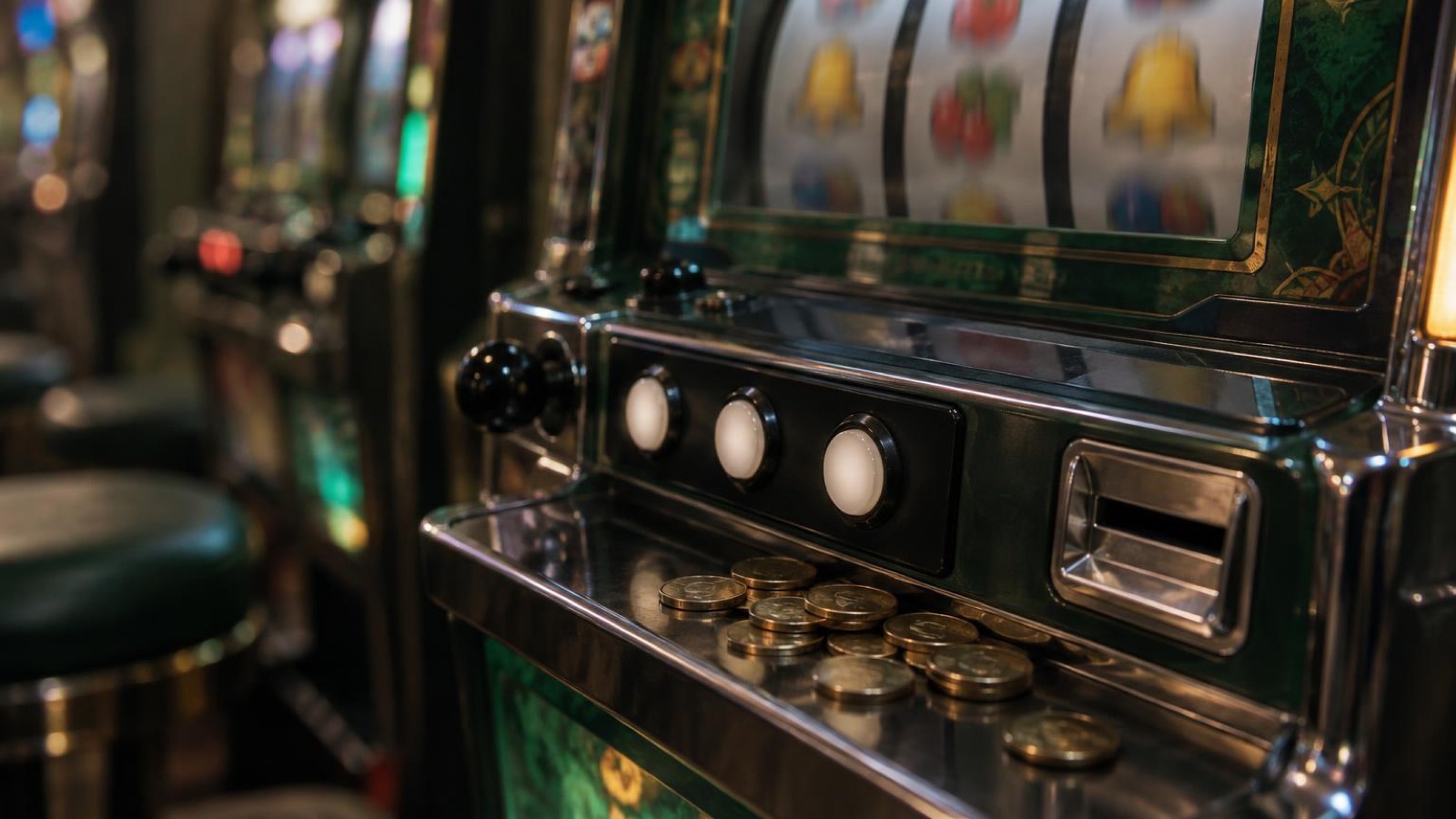
Pachislot, sometimes written pachislo or pachi-slot, is the slot-machine half of Japan's huge pachinko hall industry. Where pachinko is a vertical pinball game with steel balls, pachislot gives you three reels, a lever or buttons, and the job of stopping each reel yourself. The two games share the same buildings, the same medal economy and the same culture, so if you have read about pachinko parlors, you already know most of what a pachislot hall looks and sounds like.
How a pachislot machine works
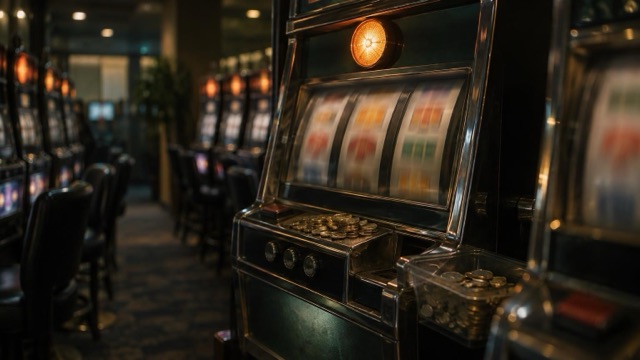
The first surprise for anyone who has played slots in Las Vegas or Macau is that you do not just press spin and watch. On a pachislot machine, the outcome of each game is decided before the reels even settle: the winning combination is already fixed by an internal computer lottery, using pseudo random numbers and reel control, at the exact moment the lever is pressed. Everything the reels do afterward is the machine carrying out that already-determined result. This is why experienced players sit at machines they know well: knowing a machine's rhythms and presentation tells you what is happening, even though the draw itself is out of your hands.
The lottery itself is simple. Whether a game will be a win is decided by an internal computer draw at the point the lever is pressed, before the reels even start moving. Everything after that, the flashing lights, the music, the "reach" buildup, is presentation built around a result that is already fixed. Once you understand this, the whole hall makes more sense: the noise and the screens are theater, and the money question was settled the instant you pulled the lever.
A few other mechanics you will meet quickly:
- Chance symbols (チャンス目). Outcomes that are neither a definite miss nor a reach symbol, some of them with high bonus expectation. Their names are usually wordplays tied to the machine's theme2.
- Bounce stop. Some machines, like Pachislot Kelot 2, stop the reels while they bounce, a Yamasa effect that signals a bonus or bonus-overlapping small role may be coming1.
Tokens and payment: how play is paid for
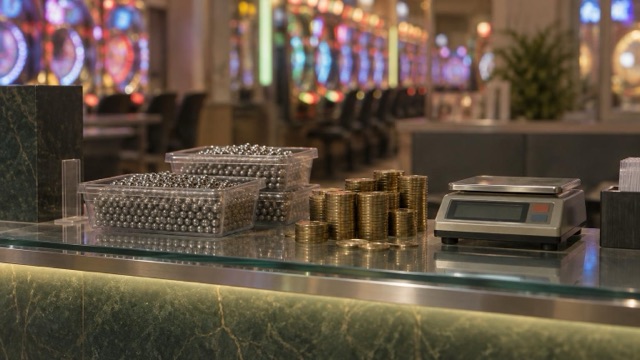
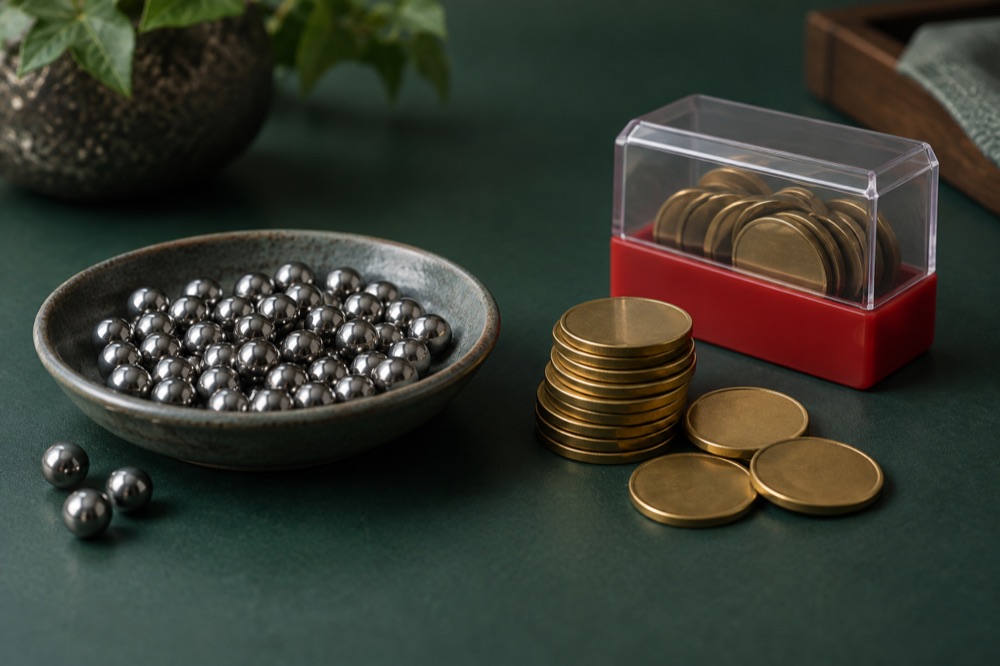
Pachislot is paid for with medals (メダル), brass tokens you buy at the hall. The legal maximum game fee in the pachinko and pachislot business is JPY 4 per ball plus the consumption tax equivalent, which is the ceiling the medal price works back from3. Machines do not pay cash: winnings come out as more medals, and the hall settles them through its exchange system rather than at the machine. Today the mainstream business model lets you play unlimited until closing without exchanging winnings, where the older one-exchange method, common in the 1号機 and 2号機 era, required settling up each time4.
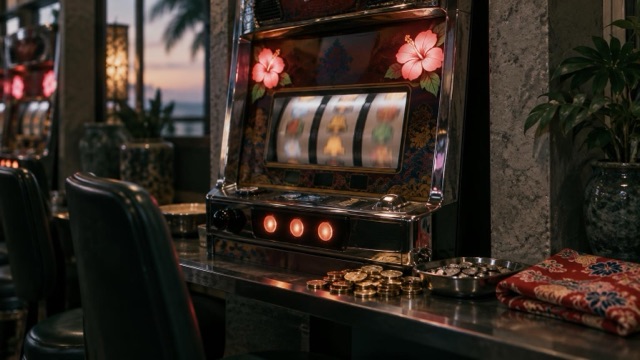
Bet sizes vary by machine, and many machines are 2-coin or 3-coin only. Whatever the bet, payouts per game are capped at 15 coins: a cherry paying 8 coins that lands on both the top and bottom rows pays 15, not 16, because the cap applies to the game as a whole.
Bonus sizes give you a feel for the stakes. On Pachislot Kelot 3, the Big Bonus pays a fixed 312 coins5. On Kelot 2, coins are increased only through the Big Bonus and Regular Bonus, with no ceiling (tenjō), and a skilled player can take up to 335 coins from a Big Bonus by aligning the 14-coin role once and the rest at 15 coins, since pushing in reverse always aligns at 151. Jack and the Beanstalk can pay out about 3,000 coins in a single hit if you complete its full RT. At the small end, Jan-kyu, a mahjong-themed machine using three JPY 20 medals, has a theoretical maximum of 420 medals, at 30 medals per game across 14 rounds6.
One hybrid worth knowing is Parrot, a ball-type pachislo that plays with pachinko balls at 60 yen per play (15 balls), treating 5 balls as the equivalent of 1 medal. It sits in the slot corner but handles money like the pachinko floor, so check the hall's ball and medal rates before you settle in at one.
Machine generations: from 4号機 to 6号機
Pachislot machines are grouped into generations (号機) by the regulation standard they were built to, and the generation tells you a lot about how a machine plays.
- 3号機 and earlier. Simple machines; Continental 2 is an example of a third-generation machine7.
- 4号機. The classic era of big payouts and A-400 type machines. Tango Brother8 and Sekkou no Tsurugi9 are both 4号機 A-400 types, and Eightman is a 4号機 as well. Kaiji is classed as a 4.7号機, a late transitional machine.
- 5号機. The standard from the mid-2000s to 2018, with tighter payout rules and setting-based probability differences. Most machines in halls today are 5号機: Pachi-Slot Sengoku Musou by Yamasa (2007)10, Pachislot Tekken-den Taf by Oizumi and Olympia (2007)11, Pachi-Slot Martian Successor Nadesico by SANKYO (announced November 2009)12, Kagaku Ninja-tai Gatchaman, Aka-Don13, Pachislo Souten no Ken14, and Pachi-Slo Kinnikuman by Yamasa15, among many others.
- 6号機. The current standard. Pachislot Kelot 4, released in March 2020 by YAMASA and developed by its subsidiary Seven League, is the first Kelot on the 6号機 standard, and its bonus coin counts are lower than 5号機 models as a direct result16.
The practical difference for you: 4号機-era games could pay enormous amounts, 5号機 games rely more on small roles, replays and setting differences, and 6号機 games pay smaller bonuses more often.
Okinawa-style slots (沖スロ) and full-notification machines
A whole family of machines, most of them made by Pioneer, uses the larger 30-pai (30 mm) medal and is known as Okinawa-style slots, or 沖スロ; the 25-pai coin is the standard size used in most of the country17. They are beloved for one feature above all: they are full-notification (完全告知型) machines. When you win a bonus, the machine tells you outright, no reading of subtle reel patterns needed. On Shimaso-dachi, the rotating patrol light on top of the machine lights up and spins with a sound effect, and that alone confirms the bonus.
The 沖スロ lineup includes Nangoku Monogatari18, Special Oasis (a 5号機 using 25-pai coins)19, Sansan Oasis Queen Ver.20, Uminchu, Hanaroman N-30 (successor to the 4号機 ST machine Hanaroman)21, Shiosai-30, New Oasis by Pioneer22, and Aqua Venus, an 沖スロ with a different coin size23. If you want a machine where you never have to guess whether you won, this family is where you look.
Popular machines and themes
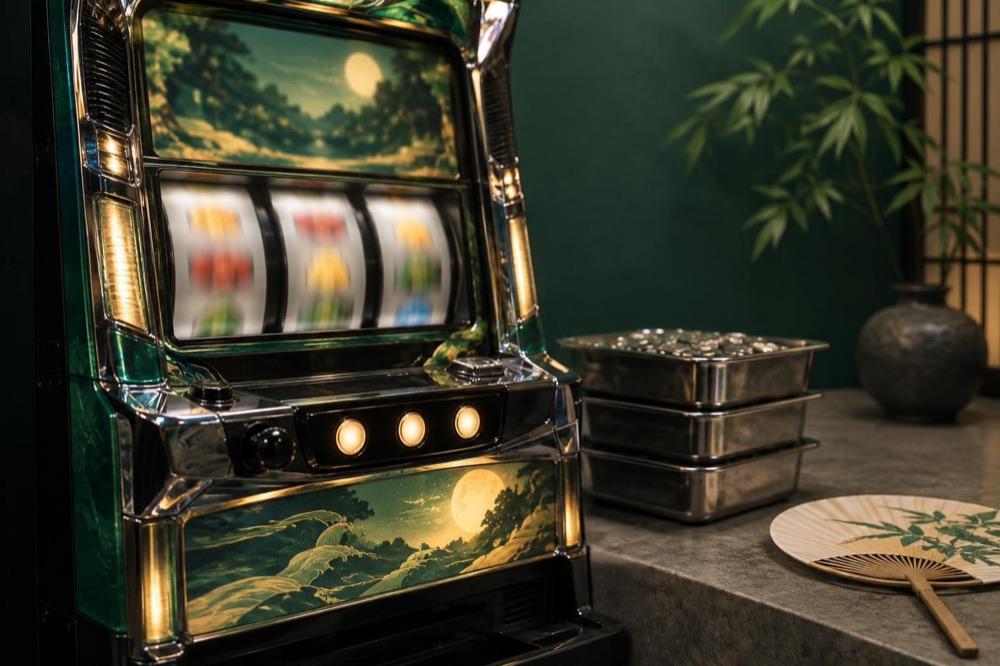
Pachislot is a tie-up industry. Machines are built around manga, anime, video games and celebrities, and the theme shapes everything from the reel symbols to the chance-symbol names2.
Some of the best-known titles:
| Machine | Theme or basis | Maker | Generation |
|---|---|---|---|
| Kaiji | The manga Tobaku Mokushiroku Kaiji | Rodeo, 2004 | 4.7号機 |
| Pachi-Slot Sengoku Musou | Koei's Sengoku Musou games | Yamasa, 2007 | 5号機10 |
| Pachi-Slot Tetsuya | The mahjong manga Tetsuya | Aristocrat Technologies, 2007 | 5号機24 |
| Pachislot Tekken-den Taf | Original (Oizumi NEO brand) | Oizumi and Olympia, 2007 | 5号機11 |
| Pachislo Hokuto no Ken: Seikimatsu Kyuuseishu Densetsu | Fist of the North Star | Sammy, December 2011 | 5号機25 |
| Kelot series | Yamasa's frog mascot | YAMASA, 2009 onward | 5号機 to 6号機16 |
Kaiji is a tie-up machine based on the manga Tobaku Mokushiroku Kaiji and its sequel Tobaku Hakairoku Kaiji. The Kelot series is Yamasa's flagship: Kelot 2 arrived in 2011, Kelot 3 in June 2014 (which added a special replay triggering Kelot Time and a setting-guessing character that appears when you aim at a specific spot)5, and Kelot 4 in March 202016. PachiPachi BANK, a prize-type machine by Sansei (now S&D), even uses an all-mighty key symbol26.
Where to play: halls and notable venues
Pachislot machines live in pachinko halls, the bright, loud buildings found in every Japanese city. See pachinko parlors in Japan for what the halls are like, how to find them, and what to expect at the door, and the major chains, from Maruhan to DYNAM, each have their own guide on this site. Halls are open to visitors and residents alike with no special entry rules; you must be 18 or older. For the wider picture of legal gambling in the country, see gambling in Japan.
A first visit is straightforward: buy medals at the counter or a medal machine, pick a cabinet, and sit down. Most halls have a rack or a binder of machine manuals, and staff will explain a machine's basics if you ask. Smoking is common on hall floors, and the noise level is high; earplugs are a normal accessory for regulars.
Juggler machines
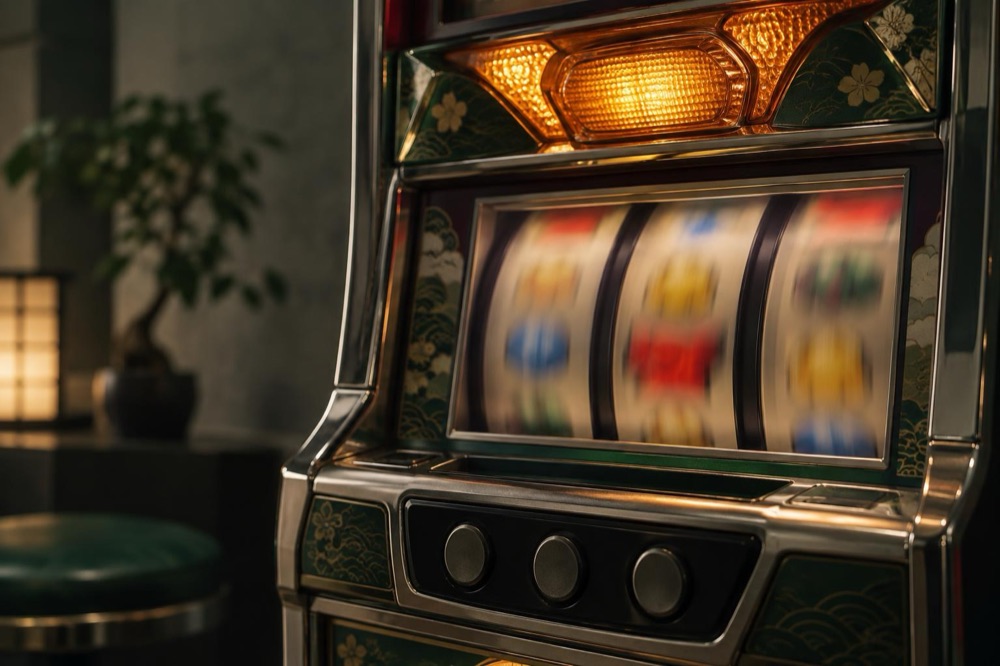
The Juggler series is the most famous name in pachislot, a line of simple, no-frills machines by Yamasa that has run for decades. Its appeal is exactly what it sounds like: plain reels, plain bonuses, and none of the complicated LCD productions of modern machines. Kangoku JACK, a 5号機 in the extended Juggler family, shows how the line keeps its identity across generations27. For the full history, the models, and how the machines play, see our dedicated guide to Juggler slot machines.
Machine guides on this site
Two families of pachislot machines have their own in-depth pages here:
- Juggler slot machines: the classic Yamasa line, the simplest and most played pachislot machines in Japan, with a guide to each model and how their bonuses work.
- Okinawa pachislot machines: the 沖スロ family, from Nangoku Monogatari to the Oasis series and Uminchu, with their full-notification style and 30-pai coins explained machine by machine.
Common Questions
What does 5号機 (Type 5) mean on a pachislot machine?
It means the machine was built under the fifth generation of Japan's pachislot regulations, which ran from roughly 2004 to 2018. Type 5 machines introduced tighter payout limits and setting-based probability differences, and most machines you see in halls today are Type 5 or the newer Type 6.
Do pachislot machines pay real money?
No. Machines pay out medals, not cash, and exchanging medals directly for money is not allowed. Halls use a two-step process where medals are exchanged for prizes or vouchers and then settled elsewhere. You play for entertainment, not cash at the machine.
What is the difference between pachislot and pachinko?
Pachinko is a vertical pinball-style game where you launch steel balls, while pachislot is a three-reel slot machine you stop by hand. Both are played in the same halls with the same medal-and-prize system, and some machines, like Parrot, even mix the two.
What is a full-notification (完全告知型) pachislot?
It is a machine that tells you immediately and unmistakably when you have won a bonus, usually with a spinning patrol light and a sound effect, instead of making you read subtle reel patterns. Most Okinawa-style slots work this way.
Who makes pachislot machines?
The big names are YAMASA, SANKYO, Sammy, Aristocrat Technologies, IGT, Rodeo, Olympia, Oizumi and Sansei (now S&D). YAMASA alone is behind the Kelot series, Sengoku Musou and the Juggler line.
What is a digipachi?
Digipachi is a pachinko term for machines with a digital display in the center that shows the jackpot draw, as opposed to mechanical-only machines. The word is sometimes loosely applied to any digital-display gambling machine in a hall.
When was Pachislot Kelot 4 released?
March 2020, sold by YAMASA and developed by its subsidiary Seven League. It was the first machine in the Kelot series built to the sixth-generation (6号機) standard, which lowered bonus payouts compared with Type 5 machines.
Sources27 sources
- パチスロケロット2, Wikipedia
- チャンス目, Wikipedia
- 風俗営業等の規制及び業務の適正化等に関する法律施行規則, e-Gov
- パチスロ用語の一覧, Wikipedia
- パチスロケロット3, Wikipedia
- 雀球, Wikipedia
- コンチネンタル2, Wikipedia
- タンゴブラザー, Wikipedia
- 赤光の剣, Wikipedia
- パチスロ戦国無双, Wikipedia
- パチスロ鉄拳伝タフ, Wikipedia
- パチスロ機動戦艦ナデシコ, Wikipedia
- 赤ドン, Wikipedia
- パチスロ蒼天の拳, Wikipedia
- パチスロキン肉マン, Wikipedia
- パチスロケロット4, Wikipedia
- 沖スロ, Wikipedia
- 南国物語, Wikipedia
- スペシャルオアシス, Wikipedia
- サンサンオアシスキュイーンVer., Wikipedia
- 花の浪漫N-30, Wikipedia
- ニューオアシス, Wikipedia
- アクアビーナス, Wikipedia
- パチスロ哲也〜雀聖と呼ばれた男〜, Wikipedia
- パチスロ北斗の拳 世紀末救世主伝説, Wikipedia
- パチパチBANK, Wikipedia
- 監獄JACK, Wikipedia