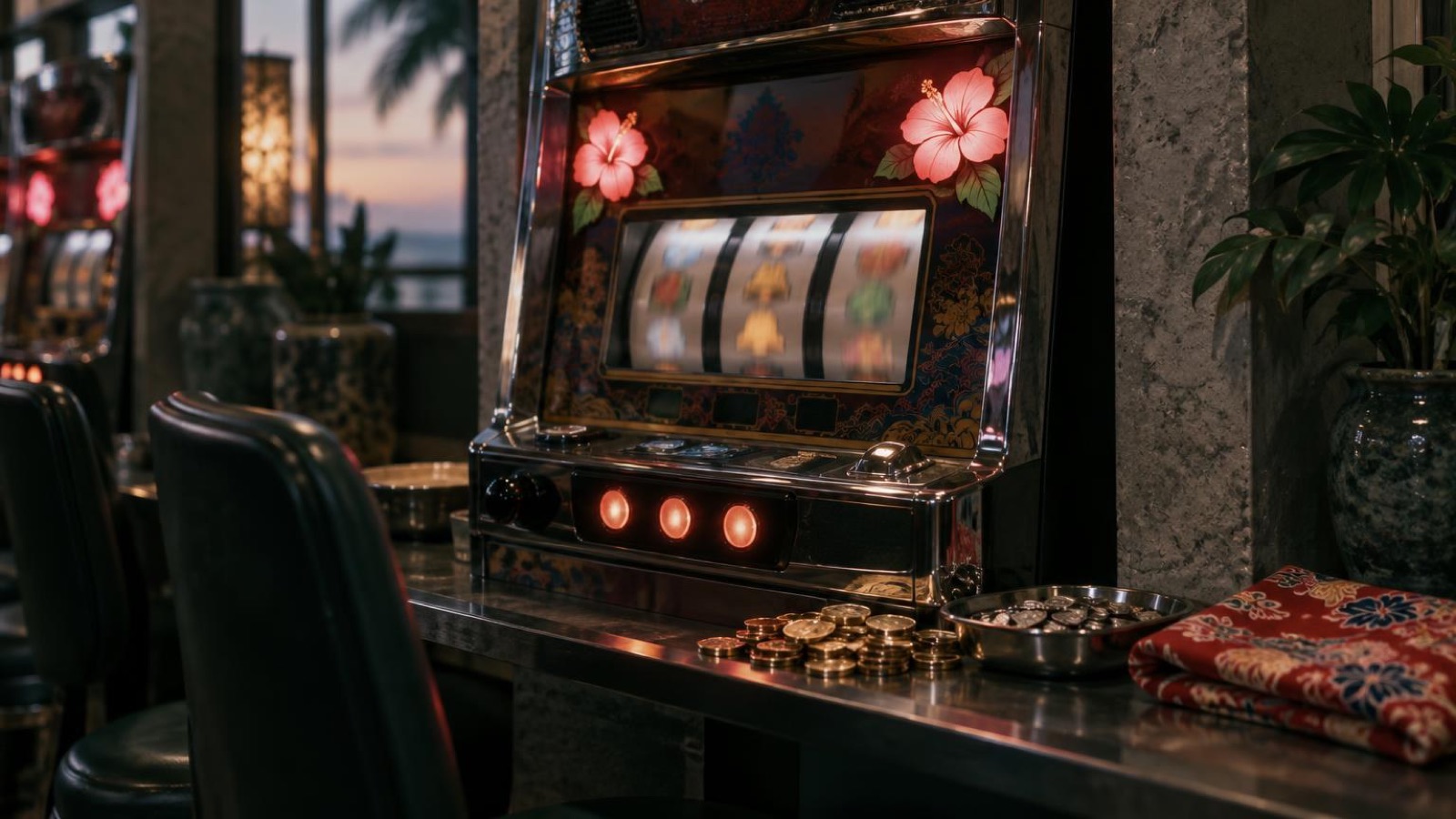
If you walk into a pachinko parlor anywhere in Japan, you will notice a corner of the slot floor that looks and sounds a little different from the rest. The cabinets are decorated with hibiscus flowers, the soundtracks have an island feel, and the machines are simpler than the big licensed titles around them. These are Okinawa pachislot machines, and they have a loyal following that goes well beyond Okinawa itself. This page explains what they are, how the main models work, what the bonuses pay, and what the odds look like.
What Okinawa pachislot machines are
Okinawa pachislot, usually shortened to oki-slo, is a family of pachislot machines built for the Okinawan market. Most of them share a few traits that set them apart from mainstream pachislo.
The first trait is simplicity. Machines like Pachislot Kelot 3 increase your coins only through a Big Bonus and a Regular Bonus, with no complicated assist or game modes layered on top5. The second is full notification, called kanzen kokuji in Japanese. When you win a bonus, the machine tells you outright, usually with a lamp, rather than making you guess from reel patterns. The third is the look: hibiscus flowers, island imagery, and names drawn from Okinawan culture, such as Uminchu, which means a person of the sea.
Most oki-slo machines are fifth-generation (5-gouki) machines, the regulation era that ran from the mid-2000s, and many use a 30-pai coin, a slightly larger medal than the 25-pai coin used in most of the country. Special Oasis is one example of the other kind, an oki-slo that uses a 25-pai coin instead6. Tiida 2-30 is a dedicated 30-pai machine7.
The makers behind the family are mostly Pioneer and Taiyo. Pioneer built the Hanahana series, the Oasis line, Big High-Bi-30 and Shiosai-301. Taiyo built the Hanaroman line, including Hanaroman N-30, a successor to the fourth-generation Hanaroman8. Other makers have produced Okinawa-styled versions of their own machines: Wanbaa 1-30 is an Okinawa-spec version of Golden Bell 7, and Speed 30 exists as an oki-slo version of a mainstream title9.
A few machines sit at the edges of the family. Nangoku Monogatari, meaning "tale of the southern country," is a full-notification oki-slo that confirms a bonus with a butterfly-shaped lamp above the reels, and flashes the reels blue when they all stop10. Shimauta RXH-30, named after the famous Okinawan song Shimauta, is another 30-pai entry. Epsilon R, while not an oki-slo itself, is worth knowing because at its release it had the largest bonus confirmation lamp in pachislo, a top panel backlight that lights with a notice sound11.
The Hanahana series: from New Hanahana 30 to Sansan Hanahana-30
The Hanahana series is the heart of oki-slo, and it is where most players meet the family for the first time.
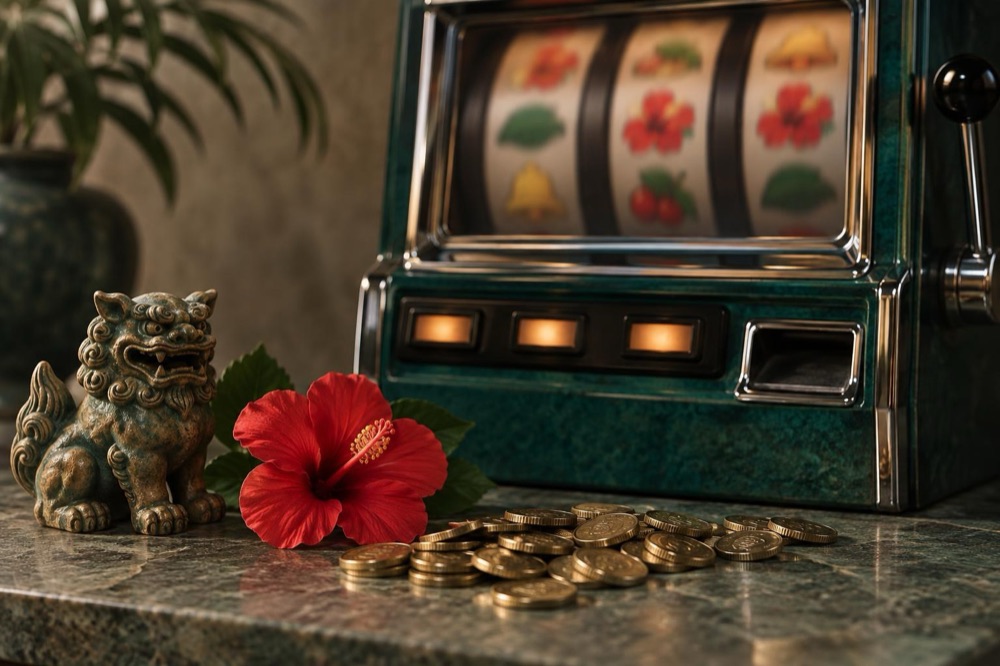
The line goes back to fourth-generation machines Hanahana 30 and Dondon Hanahana 30. New Hanahana 30, released by Pioneer in 2007, succeeded them and moved the series to fifth-generation rules3. It shares its reel layout with New Oasis, released slightly earlier, making the two of them sister machines with the same reels but different specifications3.
Special Hanahana-30 followed in 2008 as an upgraded version of New Hanahana 30, with the same reel layout, symbols and reach patterns as its predecessor2. Sansan Hanahana-30, released by Pioneer in 2009, succeeded Special Hanahana-30 and is the sixth machine in the series1.
The series also spun off related lines. Gold Shio 30, from 2006, has an Okinawa-specification panel in the Super Hanahana style12. Hanaroman N-30 by Taiyo was sold alongside an Okinawa-limited version registered as Hanaroman R-308. And the Oasis line, covered below, is a parallel Pioneer series that borrows the same design language.
What makes the Hanahana machines so enduring is the combination of plain rules and a clear bonus signal. You bet, you spin, and when the hibiscus lamps light, you know exactly where you stand. That is the whole appeal, and it has kept the series alive through multiple generations.
Special Hanahana-30
Special Hanahana-30 is the 2008 entry in the series and the one that refined the formula the most.
It is a full-notification oki-slo fifth-generation machine, sold by Pioneer2. The hibiscus lamps at the upper left and right of the reel panel are the signal: if they light or flash, a bonus is confirmed, no ambiguity2. Notification happens at the lever-on of the winning game 90% of the time, and at the lever-on of the next game the remaining 10%2.
The machine moved to a new cabinet, first used on Hana Ichiban, and upgraded its presentation in two ways. The lamps went full LED, using four high-brightness 7-color LEDs in place of the old wedge bulbs, and a 4.1ch speaker system was added for a big jump in sound presence2. A reel backlight was also adopted to make the reels easier to read2.
The reels themselves are unchanged from New Hanahana 30, with identical symbols and reach patterns2. Two panel designs were offered, including an Oki-slo Road panel2.
The payouts are the classic Hanahana shape. The Big Bonus ends after payouts exceed 345 coins, for a net gain of about 312, and the Regular Bonus ends after payouts exceed 135 coins, for a net gain of about 1302. Both bonuses are played with a 2-coin bet2. One detail worth knowing: any flash pattern other than the normal one confirms a Big Bonus, so if the hibiscus lamps blink in a way you have not seen before, it is good news2.
Big High-Bi-30
Big High-Bi-30 is a 2007 Pioneer machine and the third full-notification oki-slo of the fifth generation. It succeeds the fourth-generation High-Bi-30, and its registered model name is P5BHA-304.
It has one Big Bonus symbol and one Regular Bonus symbol, which keeps the reel reading simple4. The Big Bonus is played with a 2-coin bet and ends with a payout exceeding 336 coins, a net gain of about 300. The Regular Bonus is played with a 3-coin bet and ends with a payout exceeding 135 coins, a net gain of about 1204.
Notification works the same way as the Hanahana machines: if the hibiscus lamps light or flash, a bonus is certain4. The timing splits 50/50 between the lever-on of the winning game and other moments, and on some wins the lamps do not light unless a 7 is about to line up, which adds a small layer of suspense4.
There is one extra treat. If you win a bonus within 32 games after a previous bonus, a premium notification can occur, a rarer and more elaborate version of the usual signal4.
Shiosai-30
Shiosai-30, announced by Pioneer in November 2008, is a fully announced type oki-slo fifth-generation machine, registered as Shiosai V-30.
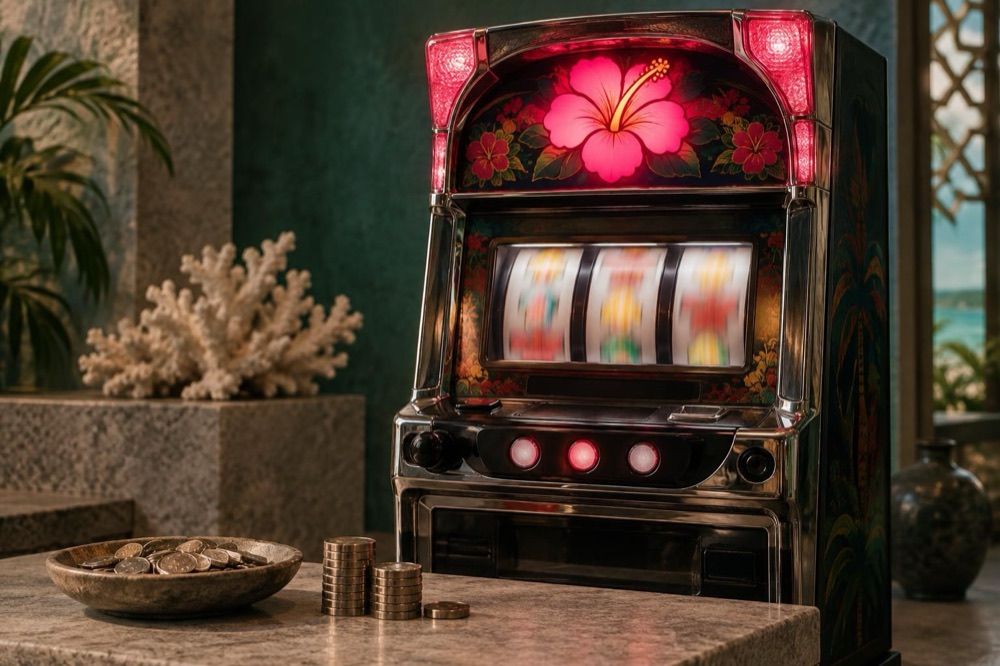
It plays on 5 active lines with a 3-coin bet in normal play. The maximum payout in a single game is 8 coins normally, rising to 15 coins during bonus games. It has three Big Bonus symbols and one Regular Bonus symbol, so there are more ways to line up a Big than on the single-symbol machines.
The Big Bonus ends with a payout exceeding 330 coins, for a maximum net gain of 322, and is played with a 1-coin bet. The Regular Bonus ends with a payout exceeding 224 coins, for a maximum net gain of 207.
Shiosai-30 also has a ceiling feature. After 1300 games between bonuses, the machine enters a replay time mode in which you can play while barely losing coins, and it stays there until the next bonus hits. This is the machine's safety net for long dry spells, and it is one reason players who dislike long losing runs gravitate to it.
Notification splits differently here: the hibiscus lamps lighting on their own accounts for 60% of notifications, and the other 40% come with additional effects.
Bonus payouts and bet patterns
Across the oki-slo family, the bonus structure is broadly the same: line up the bonus symbols, play out a short bonus game at a fixed bet, and collect until the payout passes a set limit. The details vary by machine, and the table below gathers the main ones.
| Machine | Big Bonus end | Big net gain | Regular Bonus end | Regular net gain | Bet during bonus |
|---|---|---|---|---|---|
| New Hanahana 30 | over 348 coins | about 300 | over 168 coins | about 150 | 2 coins (Big and Regular) |
| Special Hanahana-30 | over 345 coins | about 312 | over 135 coins | about 130 | 2 coins |
| Sansan Hanahana-30 | over 345 coins | about 312 | over 135 coins | about 130 | 2 coins |
| Big High-Bi-30 | over 336 coins | about 300 | over 135 coins | about 120 | 2 coins Big, 3 coins Regular |
| Shiosai-30 | over 330 coins | up to 322 | over 224 coins | up to 207 | 1 coin Big |
Sources:3
A few machines outside the core five show how the pattern bends. Aka JACK has one Big and one Regular, both at 2-coin bets, with the Big ending over 345 medals (net about 312) and the Regular ending at 95 or more medals (net about 104) or after 8 games, whichever comes first13. Jack and the Beanstalk has only a Big Bonus, ending at a payout exceeding 465 coins for a net gain of about 350. Kamitama plays 3 coins in normal games and 2 coins in bonus games14. Nago-Slo Kinshachi Dagane's Regular Bonus ends at a payout over 105 coins, a net gain of about 104, and the machine has an unusual ceiling: 758 games after a bonus ends, it enters an infinite replay time that lasts until the next bonus15.
The bet you use during a bonus matters because it changes how quickly the payout limit is reached. A 1-coin bet, as on Shiosai-30, stretches the bonus into a longer run of games; a 2- or 3-coin bet burns through the limit faster. Either way, the net gain is what ends up in your tray, and the figures above are the ones to expect.
Bonus probabilities and RTP by setting
Every pachislo machine has six settings, chosen by the parlor, and the setting changes both how often bonuses hit and the return to player. Oki-slo machines publish their full tables, so you can see exactly what each setting offers. Here are the three machines with complete tables.
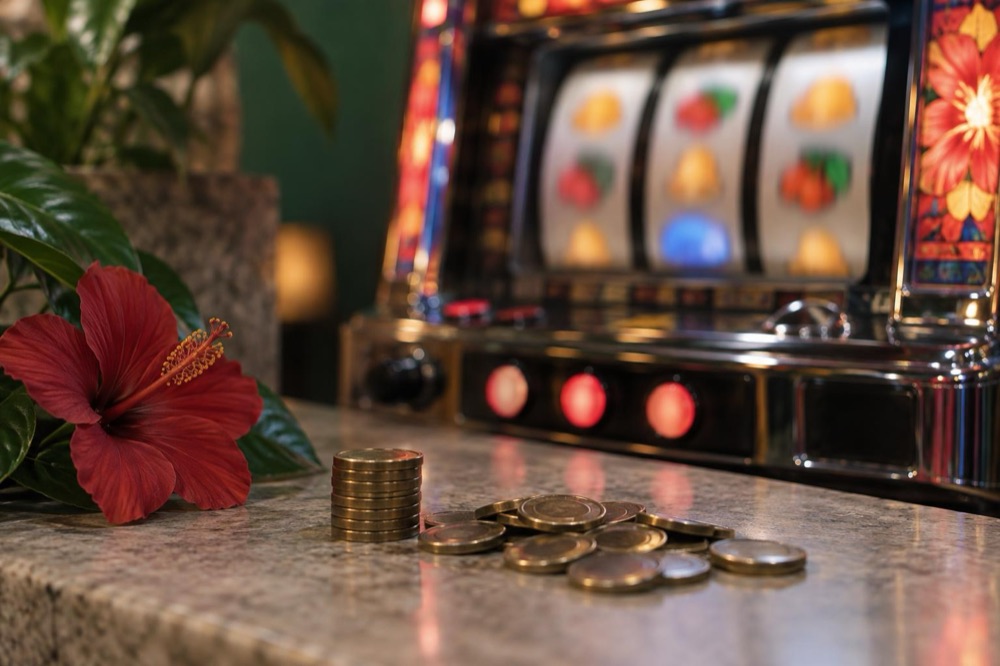
Special Hanahana-302
| Setting | Big Bonus | Regular Bonus | Combined | RTP |
|---|---|---|---|---|
| 1 | 1/327 | 1/546 | 1/204 | 95% |
| 2 | 1/312 | 1/504 | 1/192 | 98% |
| 3 | 1/297 | 1/468 | 1/182 | 100% |
| 4 | 1/286 | 1/436 | 1/172 | 103% |
| 5 | 1/276 | 1/409 | 1/165 | 106% |
| 6 | 1/268 | 1/385 | 1/158 | 109% |
Big High-Bi-304
| Setting | Big Bonus | Regular Bonus | Combined | RTP |
|---|---|---|---|---|
| 1 | 1/321 | 1/431 | 1/184 | 96% |
| 2 | 1/312 | 1/399 | 1/175 | 98% |
| 3 | 1/303 | 1/368 | 1/166 | 100% |
| 4 | 1/292 | 1/348 | 1/159 | 102% |
| 5 | 1/284 | 1/327 | 1/152 | 104% |
| 6 | 1/277 | 1/318 | 1/148 | 106% |
Shiosai-3016
| Setting | Big Bonus | Regular Bonus | Combined | RTP |
|---|---|---|---|---|
| 1 | 1/318 | 1/655 | 1/214 | 94.0% |
| 2 | 1/303 | 1/630 | 1/204 | 96.7% |
| 3 | 1/289 | 1/618 | 1/197 | 99.1% |
| 4 | 1/275 | 1/574 | 1/186 | 102.8% |
| 5 | 1/266 | 1/528 | 1/177 | 105.5% |
| 6 | 1/256 | 1/496 | 1/168 | 108.2% |
Shiosai-30 also lists coin duration, how many games a coin lasts on average, from 35.0 games at setting 1 to 36.5 games at setting 6.
For comparison, New Hanahana 30 at setting 1 is listed at 1/327 Big and 1/555 Regular3. Sansan Hanahana-30 at setting 1 is listed at 1/306 Big, 1/496 Regular and 1/189 combined, with 95% RTP1.
One quirk of the Hanahana design: the machines do draw bonuses and small roles simultaneously, but the probability is extremely low, and when it happens it is always a Big Bonus1.
Notification timing and hibiscus lamps
The hibiscus lamp is the signature of oki-slo, and it is worth understanding how it works before you sit down, because it replaces the guesswork that defines most pachislo play.
On the core machines, the rule is the same as on Special Hanahana-30: if the lamps light or flash, a bonus is confirmed. This holds for Special Oasis, Big High-Bi-30 and Sansan Oasis Queen Ver. alike6. On Sansan Oasis Queen Ver., any flashing pattern other than the normal one confirms a Big Bonus, with a notification sound described as "Kuikyuikyuin"17.
When the notification fires varies by machine:
- New Hanahana 30: 90% at the lever-on of the winning game, 10% at the lever-on of the next game. It has 12 flash patterns, and the 11 patterns other than normal flashing all confirm a Big Bonus3.
- Special Hanahana-30: the same 90/10 split2.
- Sansan Hanahana-30: 7/8 at the lever-on of the winning game, 1/8 at the next game's lever-on1.
- Big High-Bi-30: 50% at the lever-on of the winning game, 50% at other timing, and sometimes the lamps stay dark unless a 7 is about to line up4.
- Shiosai-30: hibiscus lighting alone 60% of the time, other effects 40%.
Other machines in the family use their own lamps on the same principle. Hanaroman N-30 and Ryuukyuu Roman light a flower lamp at the lower left of the reel panel with a "Kyukyukyuin" notification sound to confirm a bonus, and the hibiscus lamp at the top of the cabinet blinks afterward; both also have a pre-notification effect in which the panel goes fully dark with a "Gofu" sound before the flower lamp lights8. Hanadensetsu 30 uses a flower lamp on the left of the reel window, which during notification confirms a Big Bonus. BON JOVI, not an oki-slo but built in the same spirit, has a BON JOVI lamp at the lower left of the reels that confirms a bonus when it lights.
The practical upshot for a first-time player is simple. You do not need to memorize reach patterns or decode reel speeds. Pull the lever, watch the lamps, and when they light, you are in a bonus. That clarity, more than any single model, is what defines the Okinawa pachislot experience.
Common Questions
Who makes Okinawa pachislot machines?
Pioneer is the main maker, responsible for the Hanahana series, the Oasis line, Big High-Bi-30 and Shiosai-30. Taiyo built the Hanaroman line, including Hanaroman N-30.
What does 'oki-slo' mean?
It is short for Okinawa slot, a family of pachislo machines made for the Okinawan market. They are known for simple rules, full notification of bonuses and hibiscus flower lamps.
What is the Shiosai-30 model name at the security communications association?
It is registered as Shiosai V-30. The security communications association, or hotsukyo, is the body that certifies pachislo machine types in Japan.
How many coins do you bet during a Big Bonus?
It depends on the machine. Shiosai-30 and Gold Shio 30 use a 1-coin bet during the Big Bonus, while Sansan Hanahana-30, Big High-Bi-30 and Aka JACK use 2 coins.
What is the ceiling RT trigger on Shiosai-30?
After 1300 games between bonuses, Shiosai-30 enters a replay time mode that lets you play while barely losing coins, and it lasts until the next bonus.
Which machine revived the white 7 symbol?
Pachislot Kelot 2 brought back the white 7, adding red7-red7-white7 and white7-white7-red7 Big Bonus patterns on top of the plain three-of-a-kind sevens.
What is the successor to Special Oasis?
Sansan Oasis Queen Ver., also made by Pioneer. Special Oasis itself was an upgraded version of New Oasis, released in 2009.
When was Shiosai-30 announced?
Pioneer announced Shiosai-30 in November 2008. It is a fully announced type Okinawa slot built under the fifth-generation pachislo rules.
Sources18 sources
- サンサンハナハナ-30, Wikipedia
- スペシャルハナハナ-30, Wikipedia
- ニューハナハナ30, Wikipedia
- ビッグハイビ-30, Wikipedia
- パチスロケロット3, Wikipedia
- スペシャルオアシス, Wikipedia
- ティーダ2-30, Wikipedia
- 花浪漫N-30, Wikipedia
- ワンバー1-30, Wikipedia
- 南国物語, Wikipedia
- イプシロンR, Wikipedia
- ゴールドシオ30, Wikipedia
- 赤JACK, Wikipedia
- 神たま, Wikipedia
- ナゴスロ金鯱だがね, Wikipedia
- シオサイ-30), Wikipedia
- サンサンオアシスキュイーンVer., Wikipedia
- 琉球浪漫, Wikipedia