What a pachinko parlor is, and why it is allowed
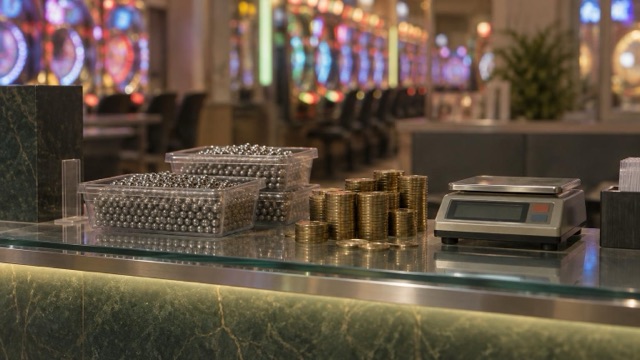
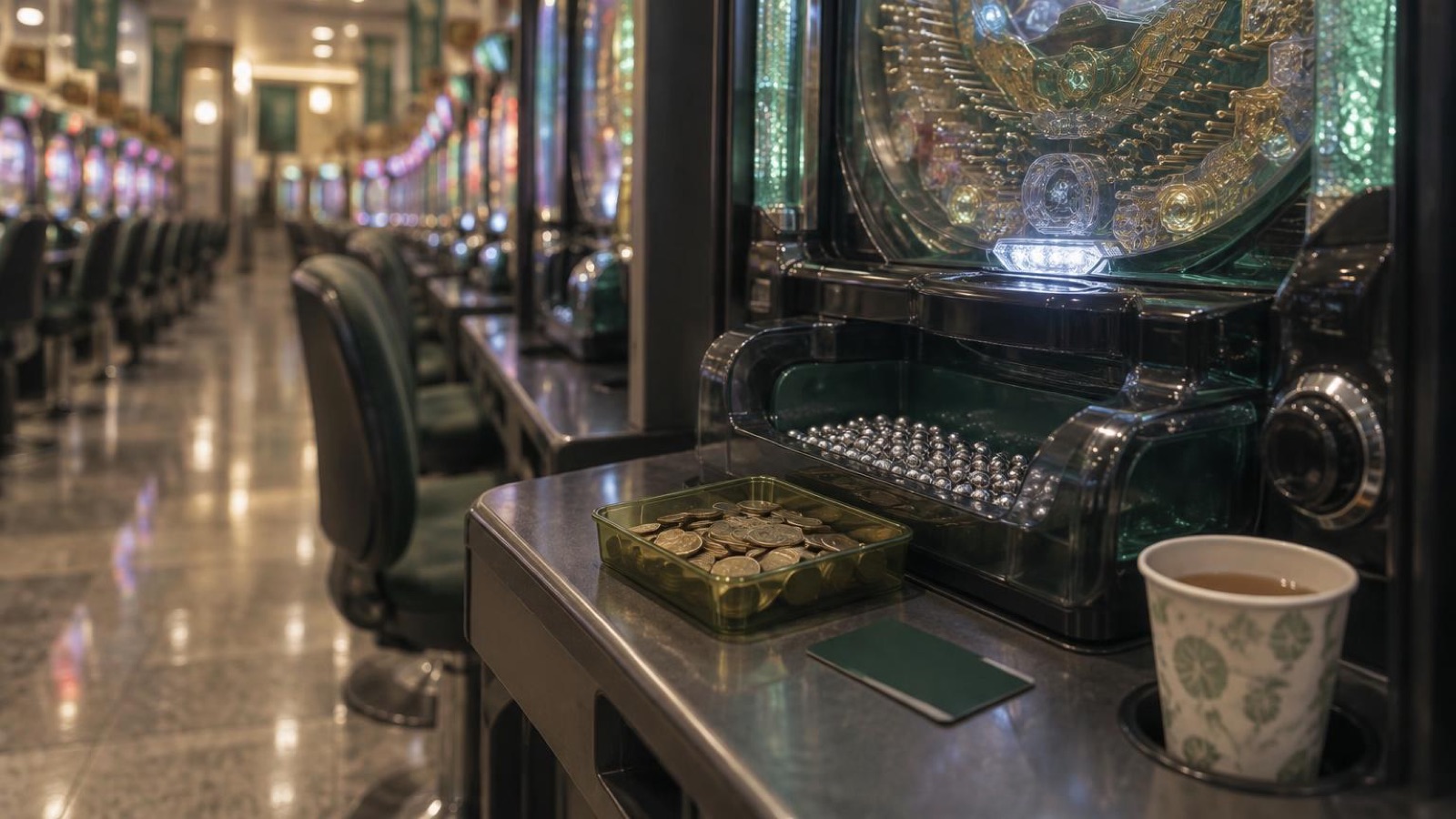
A pachinko parlor (pachinko-ten) is a Japanese amusement hall filled with rows of pachinko machines and, in most halls, pachislot machines as well. Pachinko itself is a mechanical ball game that resembles pinball, but played on a vertical machine with small steel balls that you rent from the parlor rather than own7. The halls are unmistakable: bright signage, flashing machine displays, and a wall of noise that carries into the street. Inside, the atmosphere is fairly smoky and the sound of excitement is in the air, as one longtime observer put it8.
These halls are everywhere. By the outbreak of World War Two there were already 380 such venues in Nagoya alone, and today punters will find thousands of pachinko parlors across Japan1. They range from small local shops to enormous chain megastores run by operators such as Maruhan and DYNAM.
Why is this allowed in a country where gambling is generally prohibited? Japanese rules draw a clear distinction between pachinko and gambling: you pay to rent balls, you play a game of skill and chance with them, and any winnings are paid in prizes, not money7. Pachinko is treated as an amusement business, regulated under the entertainment business rules rather than the gambling rules, and it has effectively been granted a cultural carve-out alongside workarounds on how transactions are handled1. The practical result is that playing pachinko in a parlor is a normal, legal pastime for adults in Japan, while online pachinko, where you play for money over the internet, is illegal9.
If you want the wider picture of what you can and cannot play in Japan, see gambling in Japan.
How the games work: pachinko and pachislot
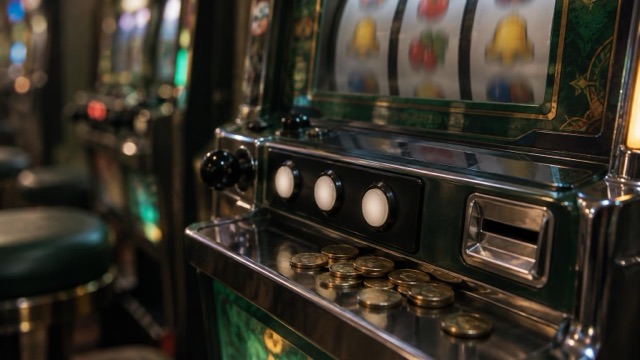
Most parlors offer two kinds of machines side by side. Pachinko is the ball game: you launch steel balls into the top of a vertical playfield, they cascade down through pins and obstacles, and if enough fall into certain holes you trigger a jackpot, a bonus round that pays out a stream of extra balls. Pachislot, short for "pachinko slot," is essentially a slot machine that uses tokens or medals instead of cash, played at what operators call a Pachislot Hall, which is usually the same building10.
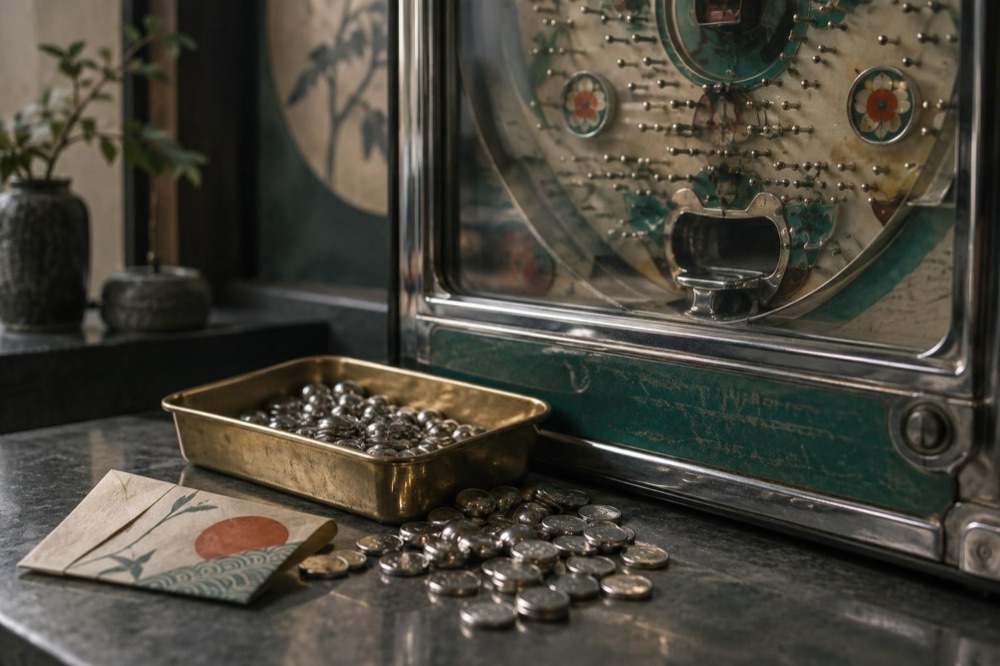
Modern pachinko comes in at least three or four variations: hanemono, machines with a physical "wing" that opens to guide balls into the jackpot hole; deji-pachi (digital type), where the playfield is dominated by a large video screen; kenrimono, machines with more complex rule systems favored by experienced players; and pachi-suro, the slot variant4.
The basic procedure, as described in operator guides for beginners, runs in eight steps: choose a machine, rent balls, launch the balls, match numbers or symbols for a jackpot, put your balls in the counter, finish the game, exchange for prizes, and settle your card balance11. In practice:
- Choose a machine. Halls group machines by type and stake. A parlor's listing page, such as those on the P-WORLD site, shows how many machines of each type it runs.
- Rent balls. You insert cash into the machine or load a prepaid card, and balls or medals are dispensed at the hall's posted rate.
- Play. On pachinko machines you turn a dial to control how hard the balls launch; on pachislot you press buttons to stop the reels.
- Count and exchange. When you finish, you pour your remaining balls into a counting machine, receive a card or slip showing the total, and take it to the prize counter.
If you are new, the big chains are the easiest place to start. Maruhan offers how-to-play guidance for both pachinko and pachislot in English, Chinese and Korean, and staff will show you the basics at the counter12. For more detail on the two game types, see pachinko and pachislot.
What it costs: ball and medal rates
You do not pay per game or per hour. You pay for the balls or medals themselves, at a rate each hall posts for each machine type, and everything you win or lose happens within that rented stock. Rates vary by machine and by hall, so it is worth checking the posted rate card before you sit down.
Some real examples from hall listings:
| Parlor | Machine type | Rate |
|---|---|---|
| DYNAM (Dynam Sakura, Sano, Tochigi) | Pachinko | JPY 100 for 90 balls13 |
| Maruhan Kanuma (Tochigi) | Pachinko | JPY 200 for 175 balls, or JPY 100 for 450 balls depending on machine3 |
| Kicona Mikage (Hyogo) | Pachinko | JPY 1,000 for 250 balls, or JPY 1,000 for 1,000 balls depending on machine14 |
| Saotome (Kanuma, Tochigi) | Pachinko | JPY 200 for 175 balls, or JPY 100 for 450 balls depending on machine15 |
| Saotome (Kanuma, Tochigi) | Pachislot | JPY 1,000 for 90 medals, or JPY 500 for 225 medals depending on machine15 |
The differences are not random. Low-ball-count rates are used on high-volatility machines where jackpots pay large numbers of balls, while high-count rates (1,000 yen for 1,000 balls) are used on low-stakes machines aimed at casual players. A 4-yen or 1-yen "corner" in a hall, like the ones at Maruhan Kanuma, refers to the value per ball of the machines in that section3. At Saotome, the 200-yen pachinko machines pay out at 320 medals per exchange15.
As a rough sense of scale, a casual session of a few hours on a low-rate machine might involve a few thousand yen; on high-rate machines the same session costs several times more. There is no minimum spend beyond the first ball rental, and no time limit.
Who can play
You must be 18 or older to enter a pachinko parlor or play pachinko or pachislot in Japan5. This is set out in the entertainment business rules, which prohibit parlors from letting anyone under 18 enter as a customer, and the industry has responded by placing notices about the under-18 ban at halls and training registered advisors across all pachinko premises16. Note the contrast with Japan's public gambling: horse racing, keirin, boat racing and auto racing all require you to be 20 or older5.
In practice, halls verify age by identity document for customers who enter and may look young, and staff may ask for ID, such as a passport, from anyone who looks younger than 1816. There is no entry registration or card system of the kind used at Japan's new casino resorts, so for most adult visitors the process is simply walking in.
Visitors and foreign residents can play on the same terms as Japanese customers. There is no nationality check at the door. The main practical barrier is language, which the larger chains have addressed with multilingual guides12. One hall in Sasebo, the Paradise pachinko hall inside the Paradise Garden Sasebo resort hotel, went further: it opened in February 2017 specifically targeting foreign hotel guests, with machine guides in English, Chinese, Korean and Taiwanese, operating from 16:00 to 22:40 to match hotel check-in times18.
Prizes, and how winnings turn into cash
Parlors cannot pay you cash directly. When you finish playing, you exchange your counted balls for prizes at the parlor's prize counter, choosing from items such as snacks, daily goods, toys, food, groceries and home appliances, with the selection scaled to your ball total19.
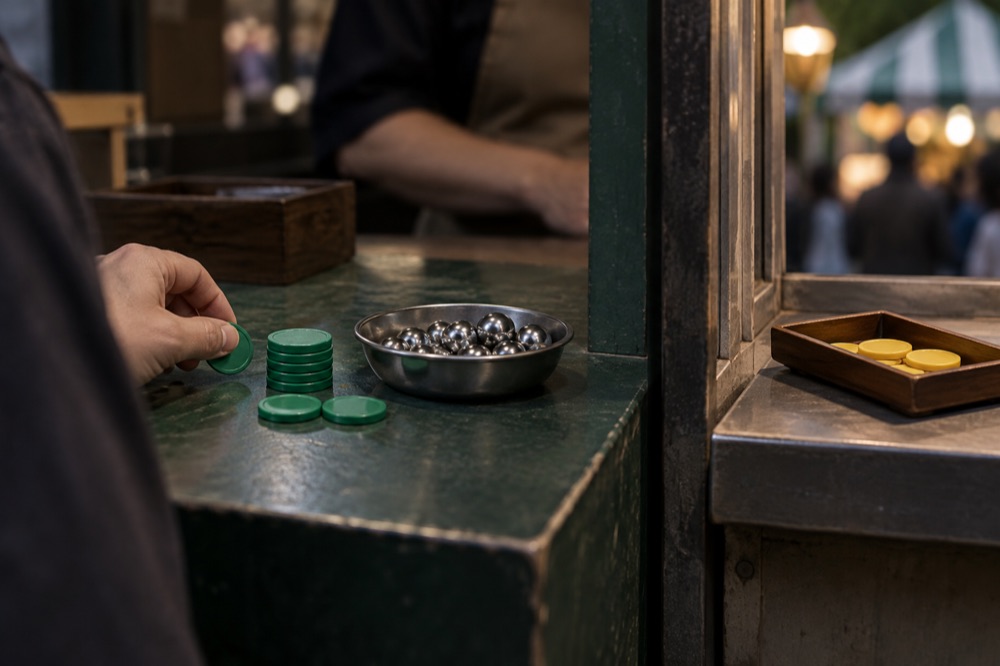
The well-known workaround is the "three-store method" (santen hoshiki). Alongside certain small prizes, halls offer "special prizes," typically small items like mechanical pencils or gold-colored trinkets. These are exchanged for cash not inside the parlor but at a separate prize exchange window or kiosk outside, with the transaction passing through three businesses: the pachinko parlor, the prize exchange office, and the prize wholesaler, plus the player. This structure is what allows ball winnings to be turned into cash in a form that avoids illegality6. One visiting player described the experience plainly: a woman at the window took his two mechanical pencils and handed him 5,000 yen20.
So the practical routine for a first-timer is:
- Finish playing and pour your balls into the counting machine.
- Take the card or slip to the prize counter and choose your prizes.
- If you have won a special prize, take it to the exchange window outside the parlor to convert it to cash.
Nothing about this is hidden; the exchange windows are usually within sight of the parlor entrance, and regular players treat the cash value as the real measure of their session.
A first visit: what to expect on the day
Halls typically open in the morning, often around 9:00 or 10:00, and close around 22:503. Aficionados can be seen lining up in front of pachinko parlors for the 10 a.m. opening, hoping to grab machines that other players have "marked" as likely to pay out4. If you arrive at opening at a popular hall, expect a small crowd at the door.
What to expect inside:
- Noise and smoke. Parlors are loud by design, with every machine playing its own soundtrack, and smoking is permitted on the floor in most halls, so the air is fairly smoky8.
- Machine layout. Pachinko machines and pachislot machines are usually in separate sections, each with its own rate card. A big hall like Dynam Sakura in Sano runs 240 pachinko machines and 327 slot machines13.
- Payment. You can feed cash directly into machines, but most halls also use prepaid card systems: you buy or recharge a card at a terminal, play on it, and settle the balance when you leave, which is the final step of the standard eight-step procedure11.
- Staff. Floor staff (called "hall ladies" or attendants) patrol the aisles and will help with machine errors, calling a jackpot attendant, or explaining the dial and buttons. At chain halls you can ask for the English how-to-play guide12.
- Dress and entry. There is no dress code. You walk in off the street, and there is no entry fee.
A sensible first session: pick a low-rate machine (the 100-yen-for-90-balls type), budget a fixed amount you are comfortable spending, play until that amount is used or until you hit a jackpot, then count your balls and try the prize counter once so you know how the system works.
Parlors in Kanuma, Tochigi
Kanuma, a small city in Tochigi Prefecture north of Tokyo, illustrates what a mid-sized Japanese pachinko town looks like, with several halls competing within a short drive of each other.
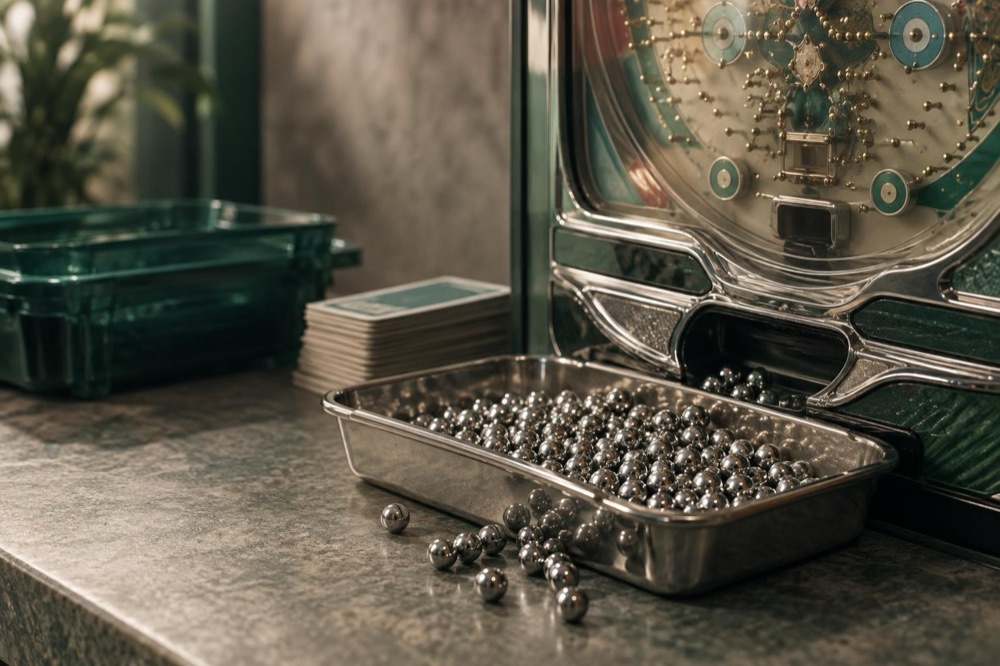
Saotome is listed at 1051-5, Tochigi Prefecture, Kanuma, with the phone number 0289-76-0717 and opening hours of 9:00 to 22:50. Its operator website is http://www.saotomesp.co.jp. The hall runs pachinko machines at JPY 200 for 175 balls and JPY 100 for 450 balls, and slot machines at JPY 1,000 for 90 medals and JPY 500 for 225 medals, with the 200-yen pachinko machines paying 320 medals per exchange15.
Maruhan Kanuma is listed at 923-2, Tochigi Prefecture, Kanuma, with the phone number 0289-72-1888 and the same opening hours of 9:00 to 22:50. It runs a 4-yen pachinko corner and a 1-yen pachinko corner, with the hall running pachinko machines at JPY 200 for 175 balls and JPY 100 for 450 balls, and a payout structure of 320 balls3.
Both halls' listings are carried on P-WORLD, the hall information site that covers parlors across Japan and is the standard place to check a hall's current machine lineup, rates and hours before you go15.
Other parlors around Japan
Wherever you are in Japan, a parlor is rarely far away. Some pointers by type and place:
- Tokyo. Akihabara's Pachinko and Slot Island is a well-known multi-floor hall aimed at the district's game and electronics crowd21. Historic halls have long been part of Tokyo's landscape; the long-established Pachinko Tengoku operated in Nishisugamo, Toshima Ward22.
- Chain megastores. Maruhan, one of the largest operators, runs halls across the country with multilingual how-to-play support12. DYNAM, another major chain, runs large-format halls such as Dynam Sakura in Sano, Tochigi (240 pachinko and 327 slot machines) and branches in Nishinasuno and Ashikaga13.
- Regional halls. Smaller operators fill in the map, such as Pearl Shop Tomoe in Inage, Chiba, running both pachinko and pachislo machines25, Kicona Mikage in Hyogo14, and Kyoichi Yamashina-Higashi, which runs pachinko and slot machines as part of an amusement business26. The Hirakawa Corporation operates halls in Hiratsuka, Kanagawa and Yamato-Koriyama, Nara27.
- For foreign visitors. The Paradise hall in Sasebo, inside a resort hotel, is the one hall in Japan set up specifically for foreign guests, with multilingual machine guides18.
To find a hall near you, the P-WORLD site lists parlors by prefecture with current rates and hours, and the big chains (Maruhan, DYNAM) have branch finders on their own sites. For the game types themselves, see our pages on pachinko, pachislot and Juggler slot machines.
Common Questions
What is the minimum age for pachinko in Japan?
You must be 18 or older to enter a pachinko parlor or play pachinko or pachislot. This is lower than Japan's public gambling, such as horse racing and boat racing, which requires you to be 20 or older.
Do I need ID to enter a pachinko parlor?
Usually not. Staff may ask for ID, such as a passport, if you look younger than 18, so it is worth carrying some form of identification just in case. There is no entry registration system like the one used at Japan's casino resorts.
Can tourists play pachinko in Japan?
Yes. There is no rule against visitors playing, and the big chains such as Maruhan offer how-to-play guidance in English, Chinese and Korean. You rent balls with cash and exchange winnings for prizes at the counter.
What is the phone number of the Saotome pachinko parlor in Kanuma?
The Saotome parlor in Kanuma, Tochigi lists its phone number as 0289-76-0717. It is open from 9:00 to 22:50 and offers both pachinko and slot machines.
What is the address of the pachinko parlor in Kanuma, Tochigi?
Saotome is listed at 1051-5, Kanuma, Tochigi Prefecture. Another parlor in the same city, Maruhan Kanuma, is at 923-2, Kanuma, Tochigi Prefecture, with the phone number 0289-72-1888.
What is the Saotome pachinko parlor's website?
Saotome's operator website is http://www.saotomesp.co.jp. The parlor's listing page, which shows its current machine lineup and rates, is also carried on the P-WORLD hall information site.
How do you claim prizes at a pachinko parlor?
You count your remaining balls at a counter, receive a card or slip showing the total, and choose prizes such as snacks, daily goods, toys or small electrical items. Special prizes can then be exchanged for cash at a separate window outside the parlor.
Sources27 sources
- Best for Players from Japan, Wizard of Odds, 2026-05-06
- DYNAM machines listing, DYNAM, 2026-09-25
- Maruhan Kanuma, P-WORLD, 2026-09-25
- Gambling in Japan, Oxford Brookes University research paper, 2007-09
- Pachinko and pachislo age guidance, SCGA, 2026-09-26
- Three-store cash-out system, Excite News (archived), 2022-03-22
- Maruhan English business page: pachinko, Maruhan, 2023
- Pachinko game description, D. Reed, Community College of Philadelphia, 2008
- RSN Sakura: online pachinko illegality, RSN Sakura, 2026-09-25
- How to play Pachislot, Slot Pioneer, 2023
- Pachinko play procedure (eight steps), FACE Group, 2026-09-26
- How to play pachinko/pachislot, Maruhan, 2023
- Dynam Sakura machines, P-WORLD, 2026-09-18
- Kicona Mikage, P-WORLD, 2026-09-25
- Saotome, Kanuma, P-WORLD, 2026-09-26
- Basic Plan on gambling countermeasures, Cabinet Office, 2025-03-21
- Pachinko parlor entry rules, Wikipedia (Japanese), 2026
- Pachinko (Wikipedia, Japanese), Wikipedia (Japanese), 2026
- Prize exchange at the counter, Maruhan, 2024-06-24
- Pachinko winnings redemption account, D. Reed, Community College of Philadelphia, 1994
- Pachinko and Slot Island Akihabara, Akiba Island, 2026-09-26
- Pachinko Tengoku, Wikipedia (Japanese), 2026
- Dynam Nishinasuno, P-WORLD, 2026-09-25
- Dynam Ashikaga, P-WORLD, 2026-09-18
- Pearl Shop Tomoe Inage, P-WORLD, 2026-09-26
- Kyoichi Yamashina-Higashi, Matsubara Kosan, 2026-09-26
- Hirakawa Corporation pachinko business, Hirakawa Corporation, 2026-09-26