What boat racing (kyotei) is
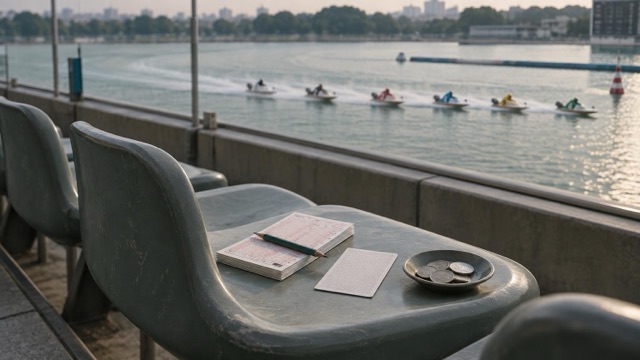
Boat racing, known in Japan as kyotei or BOAT RACE, is a competition in which six boats race to the finish line. It is one of Japan's publicly managed sports betting events, alongside horse racing, keirin cycling and auto racing, and it has been run this way for decades6.
Each boat carries a fixed number and color, which makes the sport unusually easy to follow for a first-timer.
- Boat 1 is white
- Boat 2 is black
- Boat 3 is red
- Boat 4 is blue
- Boat 5 is yellow
- Boat 6 is green2
You can simply pick your favorite color and place a bet with just 100 yen3.
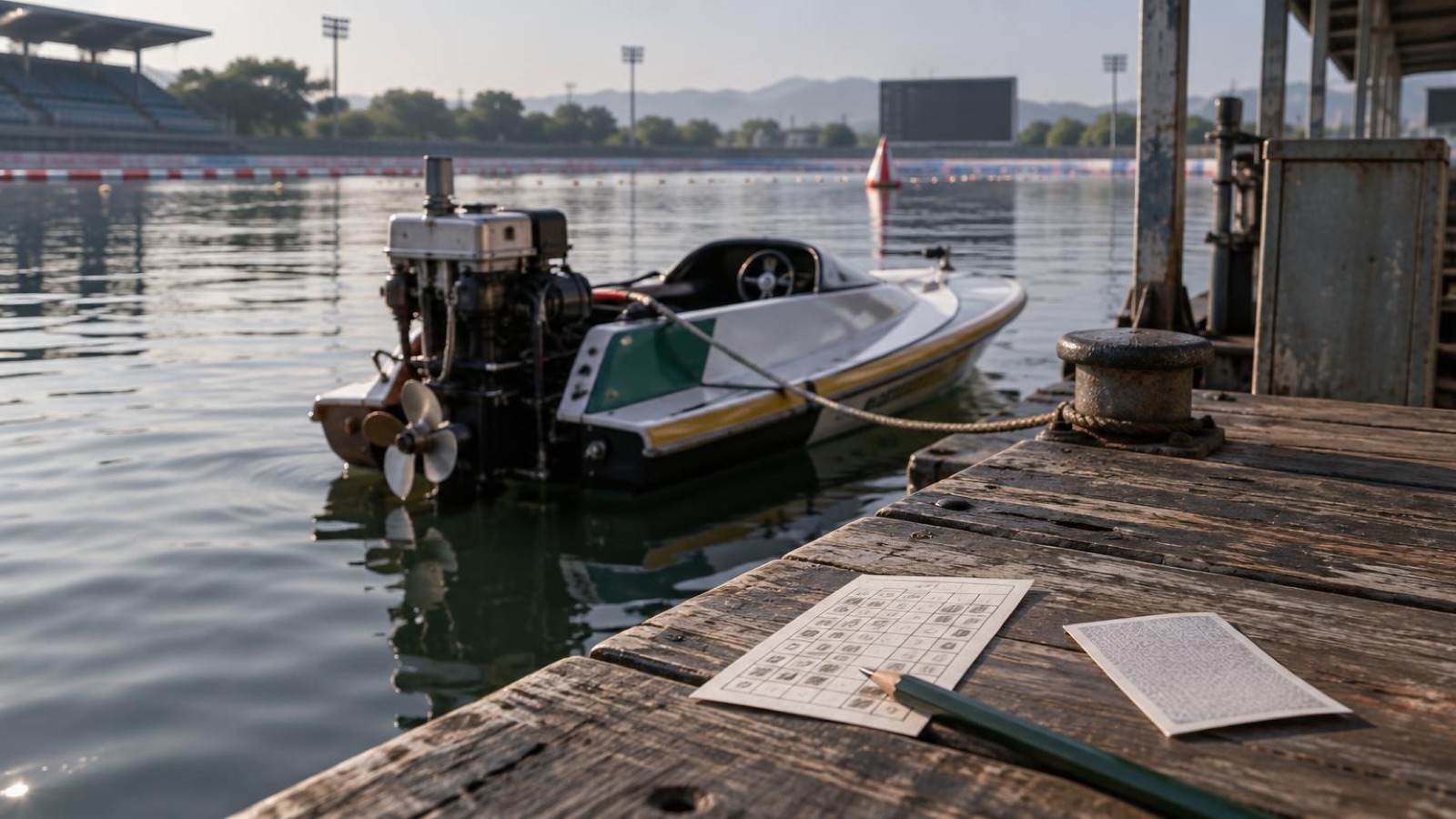
The boats are small, powerful hydroplanes driven by professional racers, and the races are short and loud. Because the whole thing is decided in about three minutes, a day at a boat race stadium moves quickly: 12 races, each with betting windows, odds boards and commentary in between.
How a race works: 6 boats, 3 laps, flying start
A race is run on a dedicated circular course. After passing the start line, the boats turn the 1st and 2nd marks in order and complete 3 laps of the course, one lap being 600 meters, so the full race is 1,800 meters, and the finishing order decides the result7. The boats race counterclockwise, turning left around the course2.
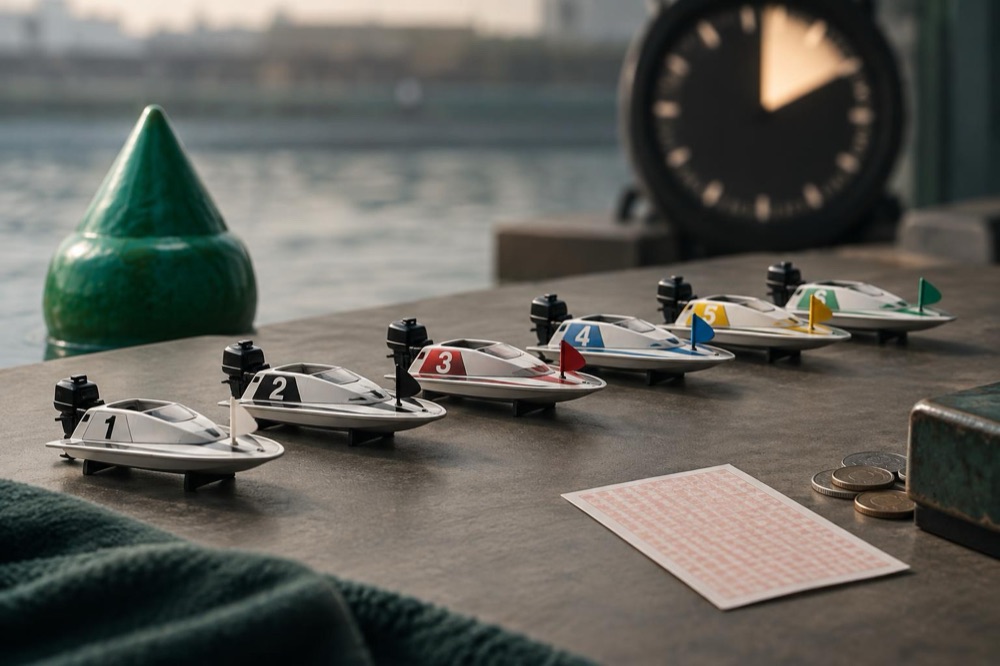
The most distinctive part of the sport is the start. Unlike athletics, boat racing uses a "flying start": the boats must cross the start line within a designated time frame, not from a standing start4. Passing the start line earlier than the other boats is an advantage, so the start is where races are often won or lost8.
Before the start, there is a preliminary phase. From the moment all six boats pit out together until they cross the start line, they circle left around the 2nd mark and the anti-small-circle buoy, jockeying for position and timing their run at the line2. A large clock counts down to zero, and every boat tries to hit the line at exactly that moment.
A big clock at the stadium shows the countdown, and if a boat crosses the line before the clock shows 0 seconds it is a Flying (F) start; if it crosses more than 1 second late it is a Late (L) start. We cover what happens to your money in that case further down this page.
The 24 venues and where to watch
There are 24 boat race venues across Japan, and a lot of them are close to popular tourist spots, so getting to one is surprisingly simple3. From north to south they are:
| Region | Venues |
|---|---|
| Kanto | Kiryu (Gunma), Toda (Saitama), Edogawa (Tokyo), Heiwajima (Tokyo), Tamagawa (Tokyo) |
| Chubu and Kansai | Hamanako (Shizuoka), Gamagori (Aichi), Tokoname (Aichi), Tsu (Mie), Mikuni (Fukui), Biwako (Shiga), Suminoe (Osaka), Amagasaki (Hyogo) |
| Chugoku, Shikoku, Kyushu | Naruto (Tokushima), Marugame (Kagawa), Kojima (Okayama), Miyajima (Hiroshima), Tokuyama (Yamaguchi), Shimonoseki (Yamaguchi), Wakamatsu (Fukuoka), Ashiya (Fukuoka), Fukuoka (Fukuoka), Karatsu (Saga), Omura (Nagasaki) |
You can come to any venue in Japan to watch the races, enjoy the food and check out the other attractions without placing a single bet9. The stadiums are set up as full day-out destinations, with restaurants, food stalls, souvenir shops and attractions such as VR experiences, karaoke boxes and arcades3. If you would rather watch a specific stadium in depth, we have separate pages on Boat Race Heiwajima, Boat Race Suminoe, Boat Race Marugame, Boat Race Kojima and Boat Race Miyajima.
A few venues are worth noting for visitors. Boat Race Miyajima sits near Miyajimaguchi Station, right where the ferries depart for Miyajima Island, so it pairs naturally with one of Japan's most famous sights10. Boat Race Suminoe in Osaka offers night races in comfortable seats11. Shimonoseki runs night racing all year round12. And Boat Race Kojima in Okayama has a quirk that regulars study: the race flow changes between high tide and low tide, and at high tide with a tailwind, come-from-behind passes succeed more often and payouts tend to be higher13.
Bet types: 7 tickets from 100 yen
There are 7 types of betting tickets in total, and any of them can be bought from 100 yen4. Tickets come in three stake units, 100 yen, 1,000 yen and 10,000 yen, so you set your own level2. The seven types, with their rough chances of hitting, are:
| Ticket | What you pick | Chance of hitting |
|---|---|---|
| Win | The boat that finishes first | 1/6 |
| Place-Show | A boat that finishes in the top two | varies |
| Exacta | First and second in exact order | 1/30 |
| Trio | First, second and third in any order | 1/20 |
| Trifecta | First, second and third in exact order | 1/120 |
The definitions are straightforward. Win means picking the boat that finishes in first place4. Place-Show means picking a boat that finishes within the first two places6. Exacta is the top two in order, Trio is the top three in any order, and Trifecta is the top three in exact order7. There is a fun variety of ways to place a bet, well beyond simply picking who is first7.
The simplest tickets are the cheapest to hit and pay the least; the Trifecta, at 1 in 120, is the hardest and can pay the most. Many first-timers start with a Win bet on a color and move up from there.
Odds and payouts: how they work
Odds are the expected payout rate for a betting ticket. If a 100-yen ticket is given a rate of 6.2, the payout is 620 yen7. All payouts are in yen14.
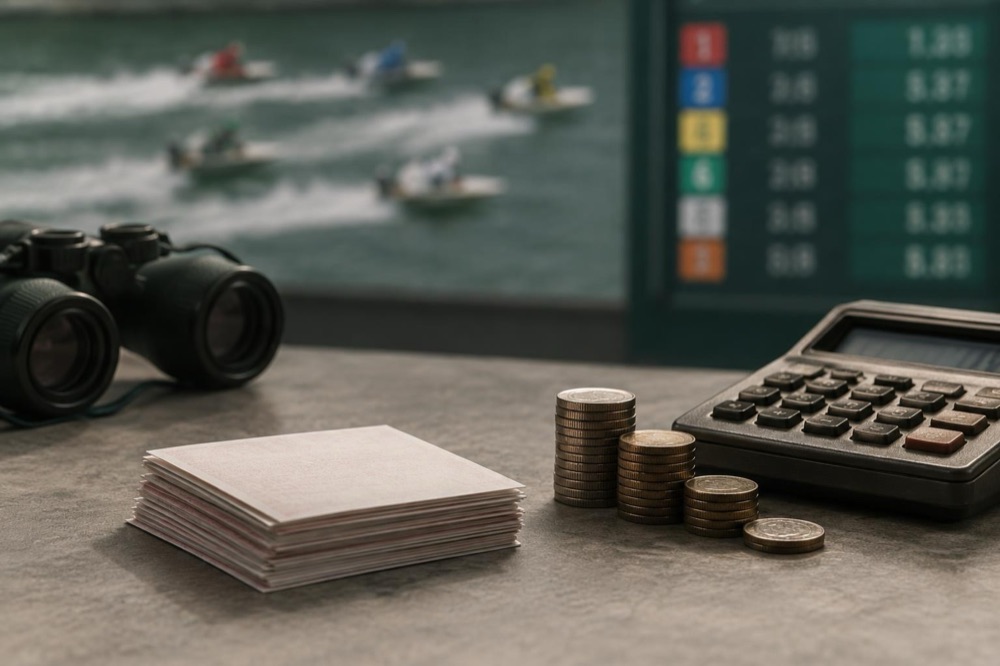
The odds for each race are displayed on monitors and large video screens inside the stadium and on the official website, so you can check them while you decide6. For example, if you predict the finishing order 1-3 in an Exacta, the odds might be 8.4 times your bet6. The numbers move as betting progresses, because the payout depends on how much money is on each combination, so the odds change from moment to moment and are calculated and displayed continuously.
A worked example from the official guide: a Trio bet on the 6th race at Boat Race Suminoe in Osaka, picking boats 1, 2 and 4 to finish in the top three in any order, for 1,500 yen. The chance of winning is 1 in 20, and the odds are 15.3, so your 1,500 yen bet is multiplied by 15.3 and an accurate prediction pays 22,950 yen9.
When you win, you do not have to queue at a window. There are machines all over the venue that you can use to collect your prize money on the spot9.
Start fouls and ticket refunds
The flying start produces the sport's most dramatic fouls. If a boat crosses the start line before the big clock shows 0 seconds, it is a Flying (F) start; if it crosses more than 1 second late, it is a Late (L) start8. In either case the boat is scratched from the race and the bets on that boat are refunded6.
The refund rule is simple and generous: all tickets involving a scratched or disqualified boat are refunded in full2. That includes every ticket type, so a Trifecta that included the fouling boat also gets your money back.
Betting tickets are kept for a reason: tickets for a boat that does not start, including one scratched for a flying start (F) or late start (L) foul, are refunded in full7. If a refund is made due to a false start or other problem, the ticket is inserted into the betting machine to get the money back14.
Midnight Boat Race and TELEBOAT betting channels
If you cannot get to a stadium, there are two main ways to bet remotely.
TELEBOAT is the official internet and telephone betting service, and through it you can buy tickets for races at all 24 venues nationwide, from 100 yen15. Odds and race information appear on the betting site and the BOATRACE app; next-day race information is published after betting closes on the final race of the day's meeting15.
Midnight Boat Race is a separate late-night program. It is internet voting only, and you need to complete member registration before you can bet on it5. The final race can run late: at Boat Race Wakamatsu, for example, the closing time for the final Midnight race was extended to 22:5416.
Away from the stadiums, there are also Boat Race Ticket Shops around the country, where you can bet while watching the races on monitors15. One example is Boat Race Ticket Shop Iwama, which mainly sells races held at Boat Race Hamanako, SG races, premium G1 races and venues in the Kanto region, and also sells night races nationwide every day, mainly from Boat Race Kiryu17. SG races are the sport's top-grade events, the ones every racer wants to win.
Boat Race Betting: where to go next
This page has covered the sport itself: the races, the venues and the tickets. For the betting side in detail, see our Boat Race Betting page, which goes deeper into how to place bets, how to read the odds boards and how to use the betting machines and mark cards at a stadium.
For the wider picture of legal gambling in the country, including the other public sports and the lottery, start with our gambling in Japan overview.
Common Questions
How many boats race and how many races are held per day?
Each race has 6 boats, and a day of racing has 12 races in total, with a roughly half-hour break between each one. Some venues also hold night races.
What are the colors of boats 1 to 6?
Boat 1 is white, boat 2 is black, boat 3 is red, boat 4 is blue, boat 5 is yellow and boat 6 is green. The colors are fixed, so you can bet simply by picking a color.
What is the minimum bet?
Every one of the seven ticket types can be bought from 100 yen. Tickets also come in 1,000 yen and 10,000 yen units, so you choose the stake that suits you.
What happens if a boat false starts?
A boat that crosses the start line before the clock shows 0 seconds commits a Flying (F) start, and one that crosses more than 1 second late commits a Late (L) start. In both cases the boat is scratched and all tickets on it are refunded.
What is a Trio bet and what are its odds?
A Trio means picking the boats that finish first, second and third in any order. The chance of hitting it is 1 in 20. In an example from Boat Race Suminoe, a 1,500 yen Trio at odds of 15.3 paid 22,950 yen.
Can I bet online?
Yes. Through the TELEBOAT service you can bet on races at all 24 venues over the internet. Midnight Boat Race, a late-night program, is internet voting only and requires member registration.
Do I need to keep my betting ticket?
Yes. Keep it until results are final. If your boat is scratched, for example after a false start, the ticket is refunded in full, and you need the ticket itself to collect the money.
Sources17 sources
- Boat race venues list, Boatrace.jp
- Kyotei rules (Chinese), Boatrace.jp
- Step-by-step guide, Boatrace.jp
- BOAT RACE guide (English), Boatrace.jp
- Midnight Boat Race, Boatrace.jp
- BOAT RACE extra (English), Boatrace.jp
- BOAT RACE English site (archived), Boatrace.jp, archived 2016
- Flying start rules, Boatrace.jp
- How to make predictions, Boatrace.jp
- Boat Race Miyajima (English), Boatrace.jp
- Boat Race Suminoe (English), Boatrace.jp
- Boat Race Shimonoseki stadium page, Boatrace.jp
- Boat Race Kojima stadium page, Boatrace.jp
- How to bet, Boatrace.jp
- TELEBOAT recruitment page, Boatrace.jp
- Boat Race Wakamatsu Midnight race notice, Boatrace.jp, May 2026
- Boat Race Ticket Shop Iwama notice, Boatrace.jp, March 2022