Trifecta, tierce and trio: the differences
Two bets sit at the top of the difficulty ladder in nearly every Asian racing pool, and they are easy to confuse because both are about the first three finishers.
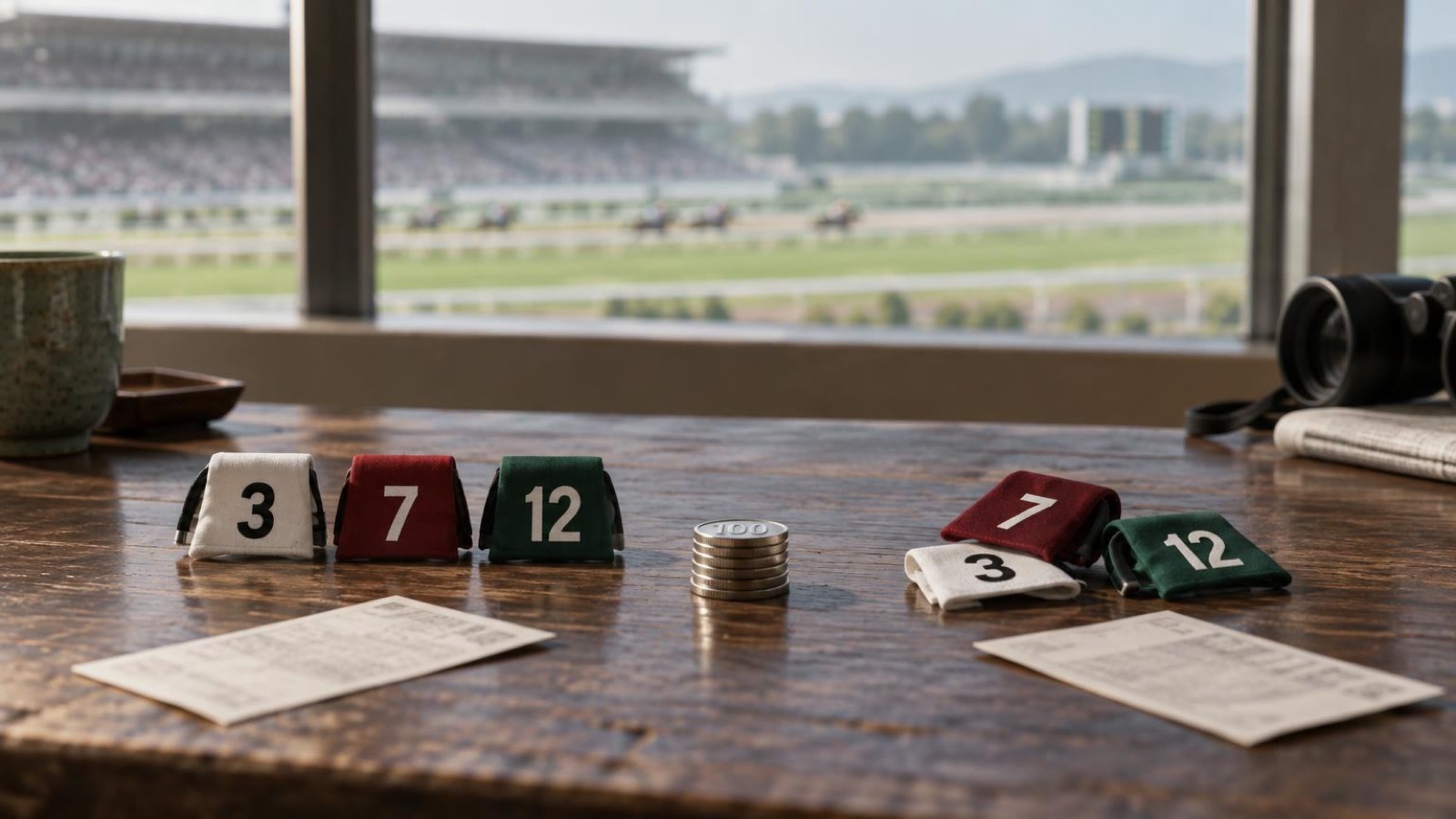
The trifecta is the ordered version. You pick the horse that finishes first, the horse that finishes second and the horse that finishes third, and all three must arrive in exactly that order. Japanese racecourses call it sanrentan (3連単), and a Sonoda-Himeji guide sums it up plainly: pick the horses you think will finish first, second and third in the correct order2. The Hong Kong Jockey Club uses the French-derived name Tierce, defined the same way: a bet in which you select the first, second and third horses in a nominated race in the correct finishing order1. Philippine tracks use the English name trifecta, with the same meaning: first, second and third place finishers in exact order of arrival3.
The trio is the unordered version. You pick the three horses that fill the first three places, and the order does not matter. The HKJC defines the Trio as selecting the first, second and third horses in a nominated race regardless of their finishing order1. In Japan it is sanrenpuku (3連複), and the Chinese-language HKJC rulebook writes the same distinction for Tierce: select the first, second and third horses in finishing order4.
The practical difference is huge. Because the trio covers every ordering of your three horses, it is several times easier to hit and pays correspondingly less. A later section gives the exact probabilities and some real payouts.
One naming trap worth knowing: in Japanese boat racing, the Korean-language and Chinese-language materials sometimes translate the local bet names in ways that shift the labels. The Korean boat racing site describes the 3연단 bet as picking the first, second and third boats in finishing order, and the 3연복 as picking the top three regardless of order5. So the ordered/unordered pair is the same everywhere; only the names move.
Where the bet is offered: horses, boats, autos and cycling
This pair of bets is not limited to horse racing. Across Asia it appears wherever pari-mutuel pools are run on races with three or more placings paid.

Horse racing is the biggest home. JRA, Japan's central racing authority, and the local-government (NAR) racecourses both offer it; the official guidebook lists nine standard bet types for local racing, and the trio and trifecta are the last two6. Sonoda Racecourse, a typical NAR venue, sells eight bet types with trifecta and trio at the end of the list7. In Hong Kong the HKJC offers Tierce and Trio on local and overseas races1. Philippine racing offers a long menu including Trifecta, Superfecta, Pentafecta and a Triple-Trifecta8, and Philracom's beginner guide lists the trifecta among its standard bets3. Singapore Pools takes tierce, trio and quartet bets on horse racing with a S$2 minimum9.
Boat racing (kyotei in Japan, KBOAT in Korea) offers the same pair. The English boat race guide describes the trifecta ticket as picking the exact three boats that finish first, second and third in order10, and the archived English site lists both the trifecta and the trio among the standard bet types11. The Korean site for Japanese boat racing gives the same two bets with their hit probabilities5, and KBOAT, the Korean operator, runs the equivalent pools with worked payout examples on its own site12.
Auto racing (auto race) in Japan offers the same pari-mutuel structure, and keirin cycling does too. The Japanese keirin site explains the trifecta as predicting which cyclists finish first, second and third in the correct order13, and the Korean cycling site (Kcycle) lists the three-place bets with their hit probabilities, noting that the ordered version is the hardest bet type with the highest expected dividends14.
So wherever you find a pari-mutuel window in Asia, the three-place pair is almost certainly on the menu. For the wider picture of bet types, see horse racing bet types.
How often a three-place bet hits
The probabilities depend on the field size, and the operators publish them.
With 12 horses running, a single trifecta combination has a 1 in 1,320 chance of winning, while a place bet in the same race is 3 in 122. That 1/1320 figure is the one to keep in mind for Japanese horse racing, where 12-horse fields are common.
In boat racing, with six boats on the water, the numbers are much friendlier. The trifecta hits 1 time in 120, and the trio 1 time in 2011. The Korean-language boat racing site gives the identical figures for the two Japanese boat racing bets5, and the Chinese-language site repeats the 1/120 and 1/20 pair15.
In keirin, the field is usually seven or nine riders. The Japanese site gives a 1 in 504 probability for the trifecta in nine-rider races13. The Korean cycling site gives three figures worth comparing: the ordered trifecta at 1/210, the trio at 1/35, and a hybrid bet (picking first in order plus second and third in any order) at 1/10514. You can see the pattern: ordering the whole trio is roughly six times harder than leaving it unordered.
The reason is simple arithmetic. Three horses can cross the line in six different orders, so every trio combination covers six trifecta combinations. That is why the trio hits about six times as often and pays roughly a sixth as much when the market is balanced.
Minimum bets and field-size rules
Ticket minimums vary by operator, and they are low everywhere.
| Operator | Bet | Minimum |
|---|---|---|
| JRA and Japanese local racecourses | Trifecta and trio | 100 yen2 |
| Singapore Pools | Tierce and Trio | S$29 |
| Philracom (Philippines) | Trifecta | P23 |
Field-size rules decide when the bet is sold at all. At JRA, the trifecta is available only when nine or more horses are in a race16. Local racecourses are more generous: Kanazawa, a NAR venue, sells the 3連勝単式 whenever four or more horses start17. The reason for minimums is the same everywhere: with too few runners, the number of possible combinations collapses and the pool stops making sense.
If you want to cover more than one combination, you can. The standard way is a box or wheel, where you mark several horses and buy every combination they produce. The JRA how-to-bet guide explains marking a single banker in the "軸" section and counterparts in the "相手" section, with wheels available for the trio (one banker or two bankers) and the trifecta18. Iwate racecourse's mark card guide describes the same flow bets for trifecta and trio: a one-horse axis flow and a two-horse axis flow19. See banker, box and flexi bets for how combination betting works in detail.
What a trifecta pays: examples and odds
Three-place bets are pari-mutuel: the pool is divided among the winners, so the payout depends on how much money was on the winning combination.
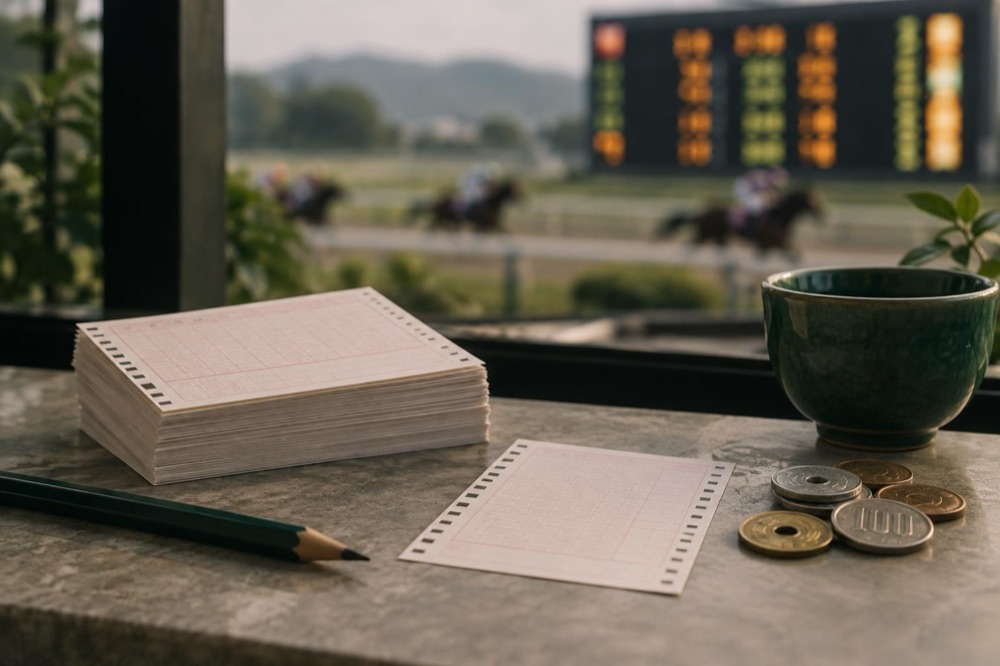
A JRA guide shows a trio bet of 100 yen on the combination 1-3-9, the first three in any order, paying 3,680 yen20. The gap between the ordered and unordered versions widens sharply when the finishing order is unexpected.
The share of the pool returned to winners is fixed by rule. JRA sets the trifecta payout rate at 70 percent for races from June 7, 202621. Hokkaido keiba set the trio rate at 70 percent and the exacta rate at 75 percent from the 2014 season22.
Korean boat racing gives the clearest arithmetic. KBOAT's guide shows a 5,000 won trifecta bet on players 1-2-5 finishing in that exact order at odds of 9.1 returning 45,500 won, and a 5,000 won trio on players 2-5-6 finishing in any order at odds of 3.1 returning 15,500 won12. Real results confirm the range: a September 2026 KBOAT race paid a trifecta dividend rate of 3.6 on the combination 4-2-123, and another meeting's result shows the trio at 3.6 percent24. Japanese boat racing publishes live trifecta odds for every race, such as the closing 3連単 odds for race 12 at a September 2026 meeting25.
The ceiling is very high. The record payout to date came at Funabashi Racecourse on February 10, 2026, when a 10 yen Triple Umatan ticket returned 48,069,554 yen after a 17th-ranked longshot won a Nakayama maiden race. That is the appeal of the ordered bet: ordinary finishes pay modestly, but chaos pays life-changing money.
How to buy a three-place ticket
At Japanese racecourses, buying a trifecta or trio is a mark-card routine that takes one practice run to learn.
You take a mark sheet, shade in the bet type (三連単 for trifecta, 三連複 for trio), the race number, your horse numbers and the amount. The JRA how-to-bet guide walks through the whole process, including the banker and counterpart sections for wheel bets18. Sonoda's beginner writing guide shows the same card for the sanrentan, marking the first, second and third place numbers in order26. At the machine you insert cash or hold up a UMACA card, and the ticket prints out27.
The SMAPPY app adds a shortcut: after inserting money or holding up UMACA at the machine, you can purchase tickets by showing a QR code generated in the app27. The app supports all nine standard bet types including the trifecta and trio, and its "Multi Ways" option lets you buy bets with the placings of your banker and counterparts reversed, so a single entry can cover the banker finishing first, second or third27.
JRA's beginner book suggests combining the trifecta with the trio (3連複) or the quinella (馬連) for double enjoyment, which is a common approach: the trio as the safety net, the trifecta as the big swing28.
Triple Trio and other multi-race versions
The three-place idea also powers the biggest jackpot bets in Asia, where you must land the first three finishers in several races in a row.
The HKJC's Triple Trio (三T) asks you to select the first, second and third horses, regardless of order, in each of three designated races1. There is a consolation dividend for selecting the first, second and third in the first two legs only29. The bet carries a jackpot structure with carryovers when nobody hits all three legs, which is covered in detail on the Triple Trio jackpot page.
Japan's local racecourses have their own three-race version, the Triple Umatan, sold at NAR venues such as Funabashi. It is the ordered trifecta extended across three races, which is why its payouts reach the record figures mentioned above. The same logic scales up further to JRA's WIN5, a five-race jackpot bet.
Philippine racing lists a Triple-Trifecta among its principal bet types8, the same idea of linking trifecta legs across races. For the full family of linked bets, see multi-race bets.
Refunds and canceled races
Three-place bets are the first to be affected when races lose runners, because they need three finishers to have a result at all.
In Korean boat racing, the refund rules are explicit: when only two boats cross the finish line, the three-place bets (trio and the two combination bets) are refunded, and when only one boat finishes, essentially the whole menu is refunded30.
At the HKJC, the multi-leg rules are detailed. If all legs of a Triple Trio have fewer than four runners each, betting is terminated and all bets are refunded31. If fewer than three horses finish a leg, the allocated jackpot returns to the jackpot pool, and if one leg has fewer than three finishers, bets selecting the top three in the other two legs receive 100 percent of the net pool31. For single-race bets, all bets on the trio and the single T are refunded if fewer than three horses finish31. A scratched horse does not trigger a refund in multi-leg bets: each scratched horse is replaced by the favorite, with the second or third favorite substituted in specified cases31.
For overseas races, the HKJC refunds all bets in full if a race is declared void, even if the stewards order a rerun32. The same principle applies everywhere in Asia: if the race cannot produce three finishers, or is wiped from the result, the pool comes back to you. See scratched horses and refunds for the single-race rules.
Quick first-timer checklist
If it is your first time playing a three-place bet, here is the whole visit in a few steps.
- Check the field size. At JRA you need nine or more runners for a trifecta16; at local Japanese tracks four is enough17.
- Pick your bet. Trio if you want the easier hit, trifecta if you want the big payout. With 12 horses, one trifecta combination is a 1 in 1,320 shot2.
- Fill in the mark sheet. Bet type, race number, horse numbers, amount. Banker and counterpart sections if you are playing a wheel18.
- Pay at the machine. Cash or UMACA card in Japan; the minimum is 100 yen2, S$2 in Singapore9, P2 in the Philippines3.
- Keep the ticket. The payout is pari-mutuel, so you will not know your dividend until the race is run; check the result board after the race.
- Expect modest payouts most days. KBOAT trifectas often pay single-digit multiples23. The record days, like the 48 million yen Funabashi ticket, are the exception that makes the bet worth playing.
Common Questions
What is the minimum trifecta bet?
It depends on the operator. JRA and local Japanese racecourses sell trifecta tickets from 100 yen, Singapore Pools sets the minimum at S$2 for tierce and trio, and Philracom tracks in the Philippines take trifecta bets from P2.
How many horses must run for a trifecta to be offered?
At JRA races the trifecta is sold only when nine or more horses run. Local Japanese racecourses are more generous and sell it from four starters, because with too few runners the number of combinations collapses.
What does a ¥100 trifecta pay?
It varies completely with the result, because the pool is divided among winners. One JRA guide shows a 100 yen trio paying 3,680 yen, and in Korean boat racing a 5,000 won trifecta at odds of 9.1 returned 45,500 won. Longshot finishes can pay many times more.
What is the difference between a trifecta and a trio bet?
A trifecta (tierce in Hong Kong, sanrentan in Japan) requires the first, second and third finishers in the exact order. A trio (sanrenpuku) only requires the right three horses, in any order, so it is much easier to hit and pays less.
What happens if a Triple Umatan race is canceled?
If a race is declared void or too few runners finish, the pool is usually refunded. At KBOAT, three-place bets are refunded when only one or two boats finish, and the HKJC refunds all bets in full on a void race even if a rerun is ordered.
How do you buy a Triple Umatan ticket?
At Japanese racecourses and off-track betting windows you fill in a mark sheet with the horse numbers for first, second and third in order, insert cash or a UMACA card into the betting machine, and take your printed ticket.
What is the biggest Triple Umatan payout ever?
The record payout to date came at Funabashi Racecourse on February 10, 2026, when a 10 yen Triple Umatan ticket returned 48,069,554 yen after a 17th-ranked longshot won a Nakayama maiden race.
What is the hit rate for a trifecta in boat racing?
With six boats on the water, a trifecta, which requires the top three in exact order, has a hit probability of 1 in 120. The trio, which covers the top three in any order, hits about 1 time in 20.
Sources32 sources
- HKJC Betting Rules: Horse Race Rule 1 (English), Hong Kong Jockey Club, May 2025
- Sonoda-Himeji Racecourse betting guide (English), Sonoda-Himeji Racecourse, 2026
- Getting started with betting, Philracom, 2026
- HKJC Betting Rules: Horse Race Rule 1 (Chinese), Hong Kong Jockey Club, May 2025
- Boat Race Korean-language guide, BOAT RACE, 2026
- JRI Guidebook 2026, Japan Racing International, 2026
- Sonoda Racecourse bet types, Sonoda-Himeji Racecourse, 2026
- Philippines racing profile, Asian Racing Federation, archived 2016
- Bet placement horse racing guide, Singapore Pools, January 2026
- BOAT RACE English guide, BOAT RACE, 2026
- BOAT RACE bet types (English, archived), BOAT RACE, archived 2016
- KBOAT dividend rate board guide, KBOAT, 2026
- Keirin betting basics (English), Keirin, 2022
- Kcycle basic guide, Kcycle, 2026
- BOAT RACE Chinese (simplified) guide, BOAT RACE, 2026
- How to bet at local racecourses, Japan Racing Association, 2026
- Kanazawa Racecourse ticket guide, Kanazawa Racecourse, 2026
- How to bet (English), Japan Racing Association, 2026
- Iwate keiba mark card guide, Iwate Horse Racing, 2026
- Go Racing guide page 4 (English), Japan Racing Association, 2014
- JRA payout rates FAQ, Japan Racing Association, June 2026
- Hokkaido keiba payout rates, Hokkaido Horse Racing, April 2014
- KBOAT race result, meeting 39 day 1, KBOAT, September 2026
- KBOAT dividend rate decision, KBOAT, 2026
- BOAT RACE race 12 trifecta odds, BOAT RACE, September 2026
- Sonoda beginner writing guide 6, Sonoda-Himeji Racecourse, 2026
- How to use SMAPPY, Japan Racing Association, 2026
- JRA beginner's book, Japan Racing Association, 2024
- HKJC Horse Race Rule 3 (Chinese), Hong Kong Jockey Club, January 2023
- KBOAT ticket refund guide, KBOAT, 2026
- HKJC Horse Race Rule 4 (Chinese), Hong Kong Jockey Club, January 2023
- HKJC Horse Race Illustration (Chinese), Hong Kong Jockey Club, January 2023