
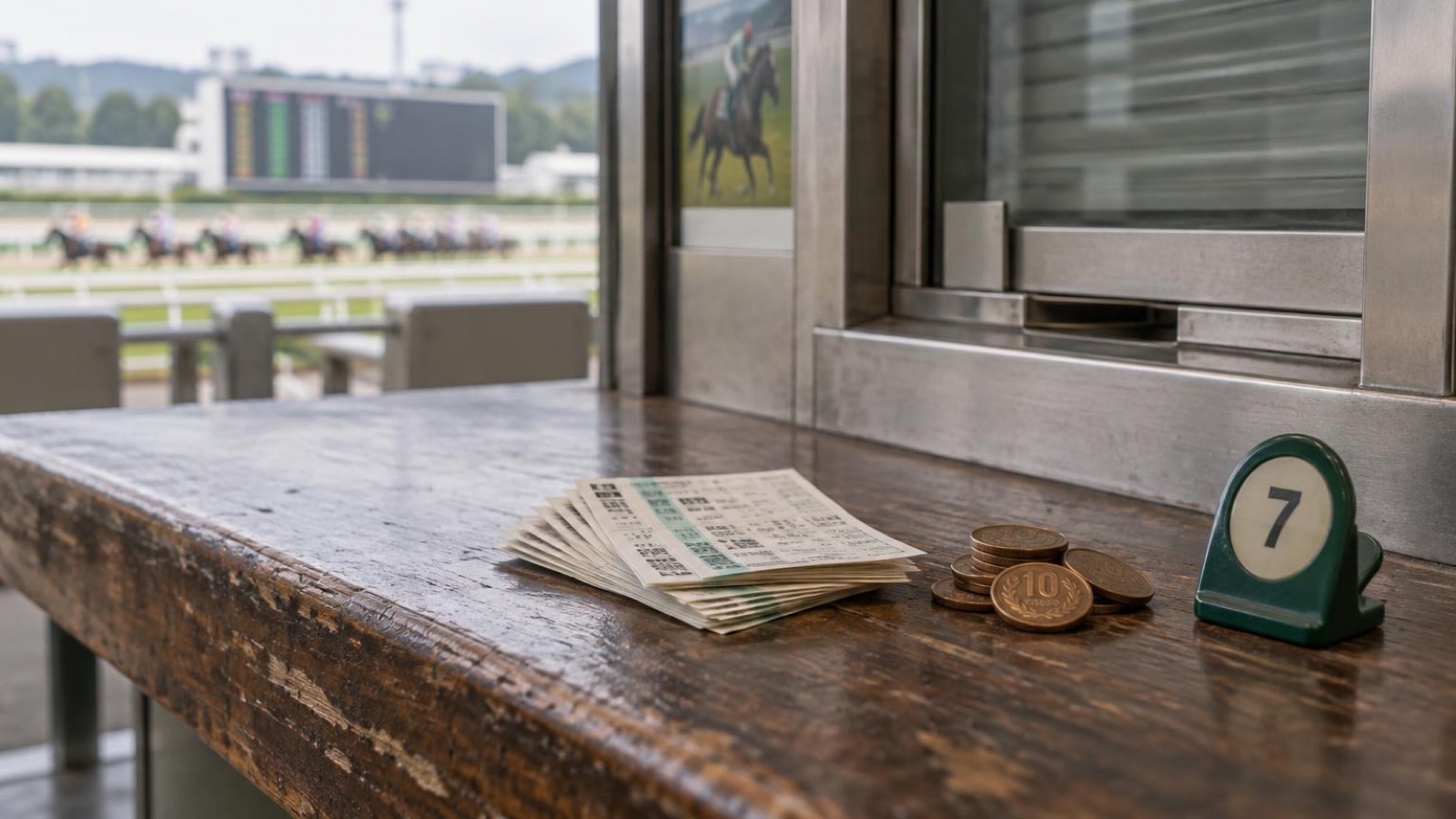
How the payout is calculated from the pool
Pari-mutuel betting works the opposite way to fixed odds. Nobody posts a price in advance. All the money on a given bet type goes into one pool, the operator takes its deduction, and the remainder is divided among the winning tickets. Your dividend depends on how much was in the pool and how much of it was on the right combination.
The Hong Kong Jockey Club sets this out plainly in its pool guide. For a single pool other than place betting, the dividend per unit bet is the net pool divided by the number of unit bets on the winning combination, plus an amount equivalent to the unit bet stake and its share of any applicable jackpot amount6. Place betting works differently: the net pool is split into two or three parts according to how many places pay6.
Two pools carry a separate deduction on top. In the Six Up pool, 2 percent of the pool is deducted as an Operator Reserve Deduction, taken from the Club's revenue rather than from bettors' stakes, and the remainder is paid as dividend. The Double Trio pool carries a 0.5 percent deduction on the same basis2.
For Six Up Betting specifically, 50 percent of the net pool is divided by the number of unit bets selecting the winning combination, and the other 50 percent goes to the Six Win Bonus7.
The same arithmetic applies to football. Dividends are declared to the unit bet or partial unit bet for each pari-mutuel football bet type4. Where the total winning investment on the winning combination is less than the unit bet amount, the dividend is declared to the minimum partial unit bet and paid by reference to the multiplicand8.
If you want the full mechanics of deductions, rounding and jackpot transfers, how pari-mutuel dividends are calculated walks through it step by step.
Japan's payout rate: 70 to 80% set by the Minister
Japan's racing law fixes a floor and leaves the operator to set the exact rate inside a band. Winning horse betting tickets are paid at least 70 percent of ticket sales revenue, at a rate the Japan Racing Association sets within a rate the Minister for Agriculture, Forestry and Fisheries determines9. The Act itself says payouts must be not less than 70 percent of net turnover, paid pro rata to holders of winning tickets1.
The band was widened by amendment. Payout rates were set at not less than 70/100 and not more than the rate set by the Minister, which is 80/100, with each race organizer choosing its rate inside that range10. That is why different Japanese race meetings can show slightly different numbers on the same bet type.
The practical effect is a takeout of 20 to 30 percent. One official research paper puts it bluntly: a 20 to 30 percent loss arises at the point of ticket purchase11. The same paper records the payout rates in force from June 7, 2014:
- Win and place at 80.0 percent11
- Frame number box, quinella and wide at 77.5 percent11
- Exacta and 3-renpuku at 75.0 percent11
- 3-rentan at 72.5 percent11
- WIN5 at 70.0 percent11
Local organizers publish their own versions. Kasamatsu lists win at 80.0 percent and place at 75.0 percent13. Nagoya Racecourse describes the range as 70 percent to 80 percent, within which each organizer sets its rates under the amended law10.
One detail worth knowing before you tear up a ticket: if there are no winning tickets, Nagoya's rules say bet types in the 70 percent payout band pay JPY 70 per JPY 100 and bet types in the 80 percent band pay JPY 80 per JPY 100 to everyone who bet on that bet type12. You get something back rather than nothing.
Who cannot buy betting tickets under the Horse Racing Act
Age is the first gate. Pari-mutuel betting tickets must not be purchased by or transferred to individuals under the age of 201. Kanazawa Racecourse states the same rule in its own words: persons under 20 may not buy betting tickets3. The national gambling policy plan lists the prohibition on purchase by under-20s at racecourses, boat race venues, and keirin and autorace tracks14.
The second gate is employment. People engaged in horse racing affairs may not buy betting tickets3. That covers staff working in the racing operation, not the general public, but it means an adult who happens to work at the track is barred even though they meet the age rule.
The minimum stake is small. The Japan Racing Association may sell pari-mutuel betting tickets with a face value of 10 yen for races in race meetings it runs9. Ten yen is the floor, not the price of a typical bet, but it tells you the system is built for small stakes.
If a race falls apart, your bet can be voided rather than lost. Betting is null and void when none or only one of the horses due to run remains, or the race does not take place, for pari-mutuel methods other than the multiple ones9. And if the calculated payout comes out below the face value of the ticket, the Act provides for payment of an amount equivalent to one tenth of that face value9.
Bet types the operator can offer
Neither Japan nor Hong Kong guarantees you a fixed menu. The operator decides.
In Japan, there are five methods of pari-mutuel betting: win, place, correct-order forecast, either-order forecast, and multiple pari-mutuel betting1. That is the statutory list, and the individual bet types you see on a tote board sit inside it.
In Hong Kong, the operator may decide from time to time which types of pari-mutuel bets to offer in relation to any race or races7. The same discretion applies to outbound commingled bets: the operator may decide the types offered, the unit bet or partial unit bet or minimum Flexi Bet unit stake, and which pari-mutuel bet types Flexi Bet is available for6. For overseas race commingled pools, the operator may decide which commingled pool bet types to offer, including a bet type called 串拖投注, or multiple selection betting6.
Football follows the same pattern. The operator may decide from time to time to offer which types of pari-mutuel football bets on a nominated match or matches4. It may also offer multi-match HaFu, where a backer bets on both the half time result and the full time result in all matches the operator nominates8.
The Hong Kong Jockey Club runs pari-mutuel and fixed odds betting on races, and pari-mutuel and fixed odds betting on selected overseas football matches15. So the same operator can offer you two completely different pricing models depending on the product.
Hong Kong Jockey Club pools and dividends
Hong Kong publishes its payout percentages pool by pool, which makes the takeout easy to see.
| Pool | Payout rate |
|---|---|
| Win, Place, Quinella | 80.5% |
| Forecast | 80.5% |
| Trio | 77% |
| Tierce, First 4, Quartet, Treble | 75% |
| Outbound Commingling Pools (designated France races) | 84.95%, subject to the rate announced by France PMU |
Those figures come from the Club's own pool guide2. The outbound commingling figure is the outlier: it is set by the French operator and can change, so the number you see is the rate announced by France PMU at the time2.
Dividends are declared to the unit bet or partial unit bet for each pari-mutuel bet type7. A partial unit bet is paid the part of the dividend it bears to the unit bet, and the unpaid balance is credited to the jackpot pool8. The jackpot pool accumulates: an amount decided as jackpot is deducted from the jackpot pool and transferred to the net pool of the same type of football betting that the operator designates17.
Rounding is handled at the small end. Where a Flexi Bet or partial unit bet in a single race pool is refunded or paid, it is done in multiples of 10 cents, rounded up or down to the nearest 10 cents16.
For separate pools conducted under the outbound commingling rules, dividends of winning bets are calculated on the total value of valid bets in the separate pool using the same formulae the foreign operator uses for the overseas pool, except that any overseas jackpot reserve deduction and any jackpot amount are disregarded6.
When odds go wrong: the operator's rules on honoring bets
Fixed odds bets have a clear rule. The fixed odds recorded in the operator's official records for each bet are the odds used to calculate the payout, and neither the operator nor the bettor may change the recorded fixed odds for a valid bet regardless of later changes5. The operator states the fixed odds at which your stake will be multiplied if the selection wins, and it may change the fixed odds for a bet type at any time5.

That rule was tested in public. During the FA Cup match between Leyton Orient and Manchester City on February 8, 2025, the Hong Kong Jockey Club briefly offered Manchester City at 80 to 1 in play because of human error, and confirmed that bets placed in that period would be paid according to the final result.
Results can also be revised after the fact, and the operator draws a line. Once it has started paying out dividends or refunds based on a referee's declaration, any subsequent amendment to that declaration, or any decision by the official body of the match or tournament that could affect the qualification of those dividends or refunds, is ignored for payment purposes4. The same rule appears in the fixed odds football rules: once payouts and refunds have been made based on the referee's announcement, a later revision will not be accepted even if it affects payout or refund eligibility19.
Cash-out has its own trap. At the moment the operator accepts a cash-out proposal, the football bet is deemed immediately abandoned by the bettor, and subsequent revisions to the result are treated as invalid for that bet18. If you take the cash-out, you have closed the position.
The operator also keeps a withholding right. It may withhold payments after a match to allow for clarification with the official body, and may refund all relevant bets if clarification is not obtained19.
Handicap bets have a refund case of their own: if the handicap-adjusted score is a draw, the handicap bet is refunded after deduction of any handling fee the operator sets20.
Where to verify current payout rates and rebates
Payout rates are published, but they are published in different places in each market, and they change.
In Hong Kong, the pool guide is the reference for the percentages themselves, and it is updated as rates move2. The betting rules chapters carry the dividend formulae and the rounding rules6. The operator's responsible gambling pages sit alongside the betting information and set out the account-level tools available15.
In Japan, the operator's own site is the place to check what a specific meeting is paying, because the rate is set within the statutory band rather than fixed nationally10. Local racecourses publish their own payout tables, which is why Kasamatsu can list win at 80.0 percent and place at 75.0 percent while another meeting shows a different mix13. Nagoya's ticket rules page is the clearest example of a track spelling out what happens to your money when nobody wins12.
For boat racing, the payout rate is defined as total payout, including refunds and special payouts, as a percentage of total purchase amount, rounded to one decimal place21. That definition is worth keeping in mind whenever you compare a published payout rate with what you actually received: refunds and special payouts count toward the figure.
If you are comparing a tote pool with a fixed odds price, the two are not the same product. Fixed odds at state betting operators covers how those payout rates, rounding and caps work, and how betting payouts and dividends are rounded explains why a dividend rarely lands on a round number.
Common Questions
What is a good takeout rate in horse racing?
A lower takeout means more of the pool comes back to bettors. In Japan, payout rates run from 70% to 80% depending on the bet type, so the takeout is 20% to 30%. Hong Kong's pools pay between 75% and 80.5%, so the takeout there is 19.5% to 25%.
How is a pari-mutuel dividend worked out for football bets?
Dividends are declared to a unit bet. If you hold a partial unit bet, you receive the share of the dividend that your stake bears to a full unit, and the unpaid balance goes into the jackpot pool. Where the total winning investment is below one unit, the dividend is declared to the minimum partial unit.
What is the minimum age to bet on horse racing in Japan?
You must be 20 or older. Under the Horse Racing Act, pari-mutuel betting tickets must not be purchased by or transferred to anyone under 20. The same age floor applies at boat race, keirin and autorace venues.
Can horse racing staff place bets?
No. People engaged in horse racing affairs may not buy betting tickets. That restriction sits alongside the age rule, so even an adult who works in the racing operation is barred from buying a ticket.
What happens if a bookmaker posts the wrong odds?
For fixed odds bets, the odds recorded in the operator's official records are the ones used to calculate your payout, and neither side can change them for a valid bet. In February 2025 the Hong Kong Jockey Club briefly offered Manchester City at 80 to 1 in play because of human error and said bets placed in that window would be paid on the final result.
What was the coldest quinella payout in Hong Kong?
The quinella of 天合 and 中游新星 in Race 9 at Sha Tin on March 5, 2017 paid HK$23,863 per HK$10, breaking the previous record of HK$18,948 set on February 17, 2013.
Sources21 sources
- Horse Racing Act, Japan Racing Association
- Hong Kong Jockey Club Horse Racing Betting Guide, Hong Kong Jockey Club
- Kanazawa Keiba Betting Tickets, Kanazawa Racecourse
- Football Rule 4, Hong Kong Jockey Club, March 30, 2026
- Horse Race Rule 5 (Chinese), Hong Kong Jockey Club, September 2022
- Horse Race Rule 6, Hong Kong Jockey Club, May 2025
- Horse Race Rule 3, Hong Kong Jockey Club, January 2023
- Football Rule 4, Hong Kong Jockey Club, December 15, 2023
- Horse Racing Act (PDF), Japan Racing Association
- Payout rate enhancement press release, Nagoya Racecourse, February 28, 2014
- Study on pari-mutuel horse racing and taxation, National Tax Agency, June 2025
- Nagoya Keiba Ticket Rules, Nagoya Racecourse
- Kasamatsu Keiba Betting Guide, Kasamatsu Racecourse
- Basic Plan on Gambling Addiction Countermeasures, Cabinet Secretariat, March 21, 2025
- Responsible Gambling, Hong Kong Jockey Club
- Horse Race Rule 2, Hong Kong Jockey Club, January 2023
- Football Rule 4 (Chinese), Hong Kong Jockey Club, May 13, 2022
- Football Rule 3 (Chinese), Hong Kong Jockey Club, January 17, 2026
- Football Rule 3, Hong Kong Jockey Club, January 17, 2026
- Football Rule 3 (Chinese), Hong Kong Jockey Club
- Teleboat Payout Rate Definition, Boat Race Official Site















