
What odds formats are: decimal, fractional and the payout formula
Odds are simply a multiplier showing what you get back if your ticket wins. At a Japanese regional track like Kasamatsu, the word "odds" (オッズ) is defined exactly that way: an approximate multiplier showing the payout if the ticket you bought wins5.
Three formats dominate worldwide, and you will meet all of them in Asia depending on where you bet:
- Decimal odds (for example 3.0) are the standard across Asia. The number is the money you win for every 1 unit staked, and it represents the complete payout, not just the profit6. To work out your total return, multiply your stake by the odds: all that is needed is to multiply the stake by the odds1.
- Fractional odds (for example 1/1) are the British style, shown as profit relative to stake. The equivalent of 1/1 in decimal is 2.001.
- American odds (for example +100) are the US style. A 50 percent probability is shown as decimal 2.0 in Europe, 1/1 (even money) in the United Kingdom, and +100 in the United States, so all three are the same price in different clothes6.
The payout formula for decimal odds is the one to remember:
Total payout = stake x decimal odds
Because the stake is inside the number, decimal odds of 2.00 on a 100 stake return 200: your 100 back plus 100 profit. This is the single biggest difference between decimal and fractional odds, and it matters everywhere on this page, from football fixed odds in Hong Kong to horse racing dividends in Japan. If you want the full breakdown of which formats include your stake, see stake, profit and return.
Which format you will meet in each jurisdiction
The format you see depends less on the country and more on what kind of betting you are doing. Sports betting at state operators is quoted in decimal odds. Racing is pari-mutuel, where the "odds" are really a projected dividend that moves with the crowd's money. Here is the practical picture, jurisdiction by jurisdiction.

| Jurisdiction | Sports betting format | Racing format |
|---|---|---|
| Hong Kong | Decimal fixed odds on football (HKJC), for example 9.00x on a correct score2 | Pari-mutuel dividends on horse racing, plus cross-pool betting into overseas pools7 |
| Singapore | Decimal fixed odds on football (Singapore Pools), for example 1.80 on an Asian Handicap8 | Pari-mutuel dividends on horse racing, declared per unit bet9 |
| Macau | Decimal odds on football bet types including Asian handicap, over/under and next goal10 | No local racing pool of note |
| South Korea | Decimal fixed odds on Proto, applied to two decimal places for single-match purchases11 | Pari-mutuel tote on horse racing, on and off course12 |
| Japan | No legal sports bookmakers | Pari-mutuel on horse, boat and keirin racing, with odds shown as multipliers13 |
| Philippines | Limited bookmaker presence, off-course betting limited14 | Pari-mutuel on horse racing14 |
A few notes on the table. In Hong Kong, the HKJC's football products quote prices like "9.00x" on a correct score, and a 100 bet on a 1:2 away win at those odds pays 900 including stake2. In Singapore, Singapore Pools quotes Asian Handicap prices like 1.80, and a 100 stake at 1.80 pays 1808. In South Korea, Sports Toto's Proto product applies winning odds to two decimal places when you buy a single match11, and Korean horse racing runs a totalizator both on course and off course, with no bookmakers12. In Japan, there are no bookmakers at all: all racing betting is pari-mutuel under the Horse Racing Act13.
For the other jurisdictions in our coverage, Cambodia, China, India, Malaysia, Thailand and Vietnam, there is no licensed local sports book quoting odds to residents. Players in those countries who bet online generally use offshore sites, and those sites almost always default to decimal odds with a settings menu that lets you switch to fractional, American, Hong Kong, Malay or Indonesian formats. If you are curious how those Asian-local formats work, see decimal odds explained and convert decimal odds to Malay odds.
Decimal odds in the Philippines: total payout, not profit
The Philippines is a useful case study because its racing scene shows what happens when there is no bookmaker to set prices. Philippine horse racing has no bookmakers and only limited off-course betting14, which means the odds you see are pari-mutuel, not fixed.
But the headline point for this section is the one that catches out most first-timers anywhere in Asia: decimal odds show the total payout, not the profit. The number is the money you win for every 1 unit bet, and it usually signifies the complete payout instead of the profit6.
So when you see a price like 2.00:
- Your total return is stake x 2.00.
- Your profit is stake x 2.00 minus your stake.
- On a 100 stake at 2.00, you get 200 back and 100 of that is profit.
This is different from fractional odds, where the quoted number is profit only. It also differs from American odds, where a positive number is profit on a 100 stake and a negative number is the stake needed to win 100. If you mix the systems up, you will misjudge your payout, so it is worth being sure which format your ticket or screen is using before you commit money. For a fuller comparison, see European odds vs Asian handicap odds.
Why decimal odds suit parlay betting
Parlays, also called accumulators or multiples, are bets that chain several selections together, and decimal odds make them easy to calculate. Because the stake is already inside each price, you simply multiply the prices together and then multiply by your stake.
The HKJC gives a worked example in its official rules. A 100 bet on a home win in a Handicap Home Draw Away accumulator, chained across six legs at odds of 1.55, 2.00, 2.50, 2.40, 2.00 and 1.50, returns 5,580 including stake15. Multiply the six prices together, multiply by 100, and that is your payout. No adding the stake back leg by leg, no working out profit separately for each selection.
This is also why Asian operators that offer parlay products, such as the HKJC's football multiples, quote everything in decimal. South Korea's Proto applies its odds to two decimal places for single-match purchases11, which keeps the multiplication clean when you build up a ticket.
One caution: because each leg's price includes the stake, a single losing leg kills the whole parlay, and the combined price can look enormous while the true chance of winning shrinks with every leg you add. The math is easy, which is exactly why it can be misleading. For how margins stack across multiple selections, see fair odds: how to remove the margin.
How pari-mutuel odds work at Japanese racecourses
Japan is the biggest pari-mutuel market in the region, and its racing odds work on a completely different principle from fixed odds. There are no bookmakers. Instead, everyone's money goes into a pool, the operator takes a cut, and the rest is divided among the winning tickets.

The numbers behind this are straightforward. In Japanese horse racing, 70 to 80 percent of sales proceeds is distributed as the refund total to winning tickets4. Looked at from the other side, a bettor buying tickets faces a 20 to 30 percent loss at the point of purchase, taken as a whole4. That is the price of the pool system: your odds are not set against a bookmaker's margin on your individual bet, but against everyone else in the pool.
The Horse Racing Act sets the framework. The Japan Racing Association may sell pari-mutuel betting tickets with a face value of ten yen16, and there are five methods of pari-mutuel betting: win, place, correct-order forecast, either-order forecast, and multiple pari-mutuel betting17. In practice at the track you will see these as the familiar bet types: Tan-sho (win), Fuku-sho (place), Waku-ren, Uma-ren, Wide, Uma-tan, 3-ren-fuku, 3-ren-tan and WIN518. Regional tracks like Hokkaido Racing sell win, place, bracket quinella, quinella, wide, 3-ren-fuku and 3-ren-tan19, and Kanazawa Racecourse decides which bet types to offer based on the number of starters at the start of sales, offering them in all races20.
The key mental shift is this: the odds board does not show a price someone is offering you. It shows what the dividend would be if the race closed right now. The payout changes depending on how many people buy a given horse or bracket and how much they put on, so the odds change from moment to moment, calculated by computer and displayed on the large in-venue TVs and odds boards5. For the full mechanics of pools, deductions and rounding, see how pari-mutuel dividends are calculated.
The same system runs Japan's other legal racing products. Boat Race (kyotei) shows the payout multiplier for each race on display screens, large video screens in the venue or the website: if you predict the finish order 1-3, the odds would be 8.4 times your bet21. Keirin works the same way at velodromes and off-track betting sites, where you fill in a mark sheet, insert your money and the sheet into the ticket machine, and take the issued betting ticket22.
Why odds move: popularity, betting volume and update timing
Whether you are looking at a pari-mutuel board or a sports bookmaker's screen, odds move. The reasons differ, and it is worth knowing which system you are watching.
At the races, the crowd moves the price. Tote board odds are continuously updated according to how much bettors wager on each horse, right up until the race starts23. Before betting even opens, the track handicapper sets morning line odds for individual horses23, but those are only projections. Once the windows open, the money talks: odds change from moment to moment because the payout rises and falls depending on how many people buy a horse or bracket and how much they spend5. Lower odds mean the horse is favored by many people and your return is lower; higher odds bring higher payouts3.
In sports betting, the operator moves the line. Singapore Pools states plainly that handicap lines and odds will change during betting24. The HKJC says the same for live handicap betting: the handicap line and odds change according to how the match develops25. If you bet live, your payout is based on the full-time result adjusted by the handicap line at the moment you bet, not the score at that moment25.
Update timing at the track. Odds change constantly until the cutoff time for placing bets, which is 2 minutes before post time3. Some venues and race days close earlier: special off-course sales events have closed betting 4 minutes before the scheduled post time26. The lesson is simple: the number on the board when you queue up is not guaranteed to be the number you are paid at. For a deeper look at line movement, see why odds change before a match or race.
Where and when to check odds at the track
Walking into a Japanese racecourse, a velodrome or a boat race venue for the first time, the odds are impossible to miss, but it helps to know where to look and when to trust what you see.
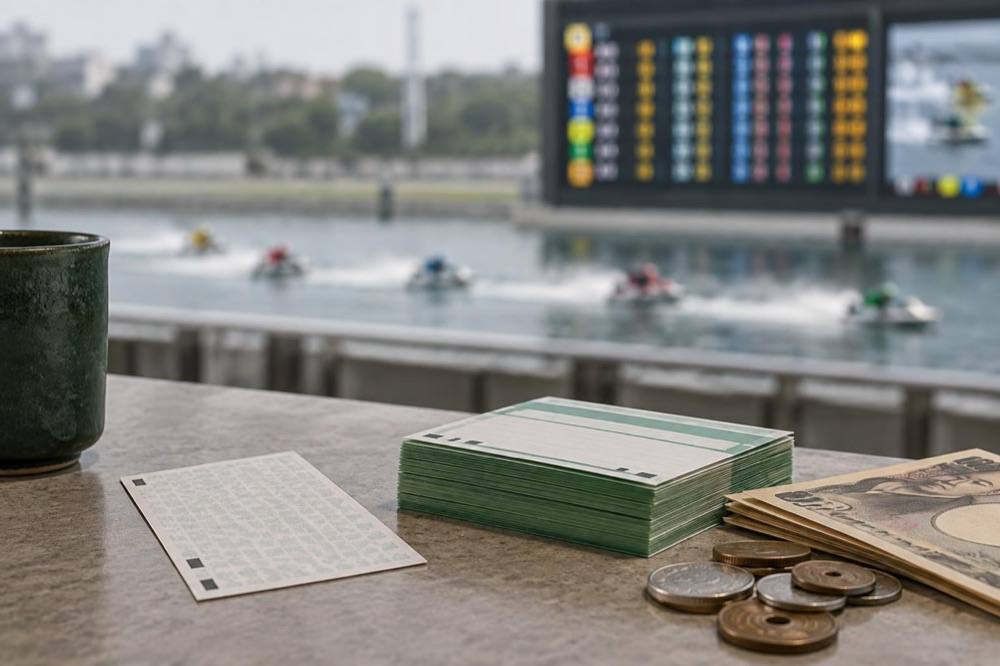
Inside the venue. Odds can be checked on monitors inside the racecourse3. At boat race stadiums, odds are displayed on monitors inside the stadium, on the jumbo screen, and on the website21. Keirin's live odds screen shows live video and odds for each betting format, and you can search odds by specifying a race number combination, switching the display between standard order and popularity order27.
On the website. Every major operator publishes live odds online alongside the in-venue boards, so you can compare or bet from your phone while watching the screens.
Timing. The practical rhythm of a race day: check the morning line or early odds when you arrive, watch the board move as the crowd bets, and make your move before the cutoff. Betting closes 2 minutes before the scheduled post time at venues like the off-course stations at Tatebayashi and Nakagou28, and ticket sales at Hokkaido Racing venues also close 2 minutes before race start19. After betting closes, the actual race starts at least a few minutes later, which gives you time to grab a seat and watch29.
Placing the bet. At a keirin velodrome or off-track site, you fill in a mark sheet provided by the venue, marking the venue, bet type, race number, your prediction and the amount30, then insert your wager money and the completed sheet into the ticket machine and take the issued betting ticket22. Boat race mark cards list all 24 venues across Japan, and you fill in which venue's races you are betting on31.
Reading odds on our fixtures and results pages
The odds you see on fixtures and results pages, including ours, follow the same rules described above, and a couple of worked examples show how to read them.
Asian Handicap. Singapore Pools offers Asian Handicap on selected matches only32. A worked example from their rules: England (0) at odds of 1.80 with a 100 stake wins a payout of 180. With a split handicap like (-0.75), half your stake settles at each line, so a 100 bet becomes 50 x 1.80 plus 50 returned, a payout of 1408. For quarter-line handicaps, a win or loss by a margin of 0.25 pays or loses on half the stake with the other half refunded8. If the result is level after the handicap is applied, the bet is refunded8.
Live betting. You are allowed to place bets after kickoff, in the midst of the match8. Live Asian Handicap bets are settled according to the scoreline for the remainder of the game after your bet is placed, with the scoreline refreshed to 0-0 at the point of placement32. The handicap line and odds at the moment you bet are what you are paid on25.
Correct score. The HKJC's correct score product quotes prices like 9.00x: a 100 bet on a 1:2 away win pays 900 including stake2.
Racing dividends. When a results page shows a dividend like 129.7 for a longshot and 18.9 for a favorite, those are decimal multipliers per unit stake, exactly as described above33. A place bet (Fuku-sho) pays out on second place and above when 7 or fewer horses start20.
The one habit worth building: before you read any price, check which format the page is using. If it is decimal, the stake is included; multiply and you have your total return. If it is a pari-mutuel dividend, remember it is a snapshot that was still moving until the pool closed. For how final dividends are rounded and declared, see how betting payouts and dividends are rounded.
Common Questions
What do decimal odds of 2.00 pay?
Decimal odds of 2.00 pay your stake multiplied by 2.00, and that figure includes your stake. So a bet of 100 at odds of 2.00 returns 200 in total: your 100 stake back plus 100 profit. It is the same as even money, or fractional odds of 1/1.
How do I convert fractional odds to decimal?
Divide the first number by the second and add 1. Fractional odds of 1/1 become 1 divided by 1 plus 1, which is 2.00 in decimal. A 50 percent chance is shown as decimal 2.0, UK fractions of 1/1, or American +100, so all three formats describe the same price.
Why do horse racing odds change before the race starts?
At pari-mutuel tracks the payout depends on how many people bet each horse and how much. As money comes in, the pool shifts and the odds are recalculated by computer moment to moment until betting closes, usually two minutes before post time.
When is the last chance to bet before a race starts?
At Japanese racecourses betting usually closes two minutes before the scheduled post time. Some off-course venues and special race days close earlier, around four minutes before, so check the posted deadline at the venue you are betting at.
Where can I see current odds at a Japanese racecourse?
On the odds monitors and large screens inside the racecourse, and on the operator's website. Odds change constantly until the betting cutoff, two minutes before post time, so the number you see is only current until the next update.
Do lower odds mean a horse is more likely to win?
Broadly yes. Lower odds mean many bettors favor that horse and your return is smaller, while higher odds bring a bigger payout but a less popular pick. Odds reflect where the crowd's money is going, which is usually, but not always, a guide to the race.
Are decimal odds good for accumulators?
Yes. Because decimal odds already include your stake, you can multiply the prices of each leg together and then by your stake to get the total payout. An example six-leg bet at odds of 1.55, 2.00, 2.50, 2.40, 2.00 and 1.50 returns 5,580 for a 100 stake.
Sources33 sources
- Decimal odds explained, Betway Blog, February 25, 2025
- Correct Score betting info, HKJC, September 25, 2026
- Going racing guide, Japan Racing Association, 2014
- Research paper on horse racing payouts, National Tax Agency, June 2025
- Odds explained, Kasamatsu Keiba, September 25, 2026
- Glossary of betting terms, 888sport, April 12, 2024
- Horse race betting rules, HKJC, May 2025
- Football betting game rules, Singapore Pools, May 29, 2026
- Horse race betting game rules, Singapore Pools, July 6, 2026
- Regulation of Sports Lotteries, Football Betting, Macau Official Gazette, April 20, 2018
- Proto introduction, Sports Toto, September 25, 2026
- Korean racing overview, Asian Racing Federation, September 27, 2026
- Horse Racing Act, Japan Racing Association, September 25, 2026
- Philippine racing overview, Asian Racing Federation, September 27, 2026
- Handicap Home Draw Away betting info, HKJC, September 25, 2026
- Horse Racing Act, Article 6, Japan Racing Association, September 25, 2026
- Horse Racing Act, Article 7, Japan Racing Association, 2023
- Racing glossary, JRA, September 27, 2026
- Hokkaido Racing betting guide, Hokkaido Keiba, September 25, 2026
- Kanazawa Racecourse betting, Kanazawa Keiba, 2026
- BOAT RACE English guide, BOAT RACE, September 25, 2026
- Keirin velodrome betting guide, KEIRIN.JP, 2022
- Understanding odds, Ontario Racing, September 26, 2026
- Sports betting FAQ, Singapore Pools, 2026
- Live handicap betting info, HKJC, September 25, 2026
- Off-course betting sales news, JRA, January 17, 2013
- KEIRIN.JP odds screen help, KEIRIN.JP, 2022
- Off-track betting station Tatebayashi, Tokyo City Keiba, September 26, 2026
- How to make predictions, BOAT RACE, September 26, 2026
- Keirin mark card guide, KEIRIN.JP, 2022
- BOAT RACE Chinese guide, BOAT RACE, September 25, 2026
- Sports betting FAQ, Singapore Pools, 2026
- Hokkaido Racing odds page, Hokkaido Keiba, September 25, 2026