
What odds mean: the payout multiplier behind every bet
Odds are, at heart, a multiplier. At Japanese horse racing venues, odds are defined as an approximate multiple showing the payout you would receive if the ticket you bought wins3. The same idea applies elsewhere: in fixed odds football betting, the stake amount is multiplied by the fixed odds displayed when the bet was placed4.
How that multiplier is applied depends on the type of bet. In fixed-odds betting, the operator states the odds in advance, and if your selection wins, your stake is multiplied by that fixed odds figure to give the payout6. In pari-mutuel (tote) betting, there is no fixed price at all: the dividend is the amount declared per winning selection after the pool is settled, and the odds you see beforehand are only an estimate of what that dividend will be7.
The fixed-odds arithmetic is straightforward. Singapore Pools gives a worked example: a S$100 bet on "Over 2.5" at odds of 1.80 wins a payout of S$100 × 1.80 = S$1808. The Hong Kong Jockey Club's Home/Away/Draw bet works the same way: a bet of $1,000 on the home side at odds of 2.10 pays $2,100, stake included1.
Multiples and combination bets chain the multipliers together. The prize payout is the stake multiplied by the odds of each individual selection, so a S$30 treble on three picks at 1.50, 1.67 and 1.20 pays S$30 × 1.50 × 1.67 × 1.20 = S$90.18 if all three win8. If one leg is abandoned, that leg counts as odds of 1 and the rest still multiply through, which in the same example gives S$75.158.
Two small print details are worth knowing. Payouts on fixed-odds football bets in Hong Kong are calculated to the nearest 10 cents, up or down1. And if a match in a combination is void or refunded, the odds for all its possible outcomes are treated as "1", meaning that leg simply returns your stake portion and drops out of the multiplication9.
Odds-on, evens and odds-against: where the line sits
These three terms describe one thing: how your profit compares to your stake. The line sits at evens, also called even money, where profit equals stake.

- Evens (1/1, or 2.00 in decimals): you win exactly the amount you staked, plus your stake back. The classic example is the pass line bet in craps, which pays out at even money, 1 to 1, if you win10.
- Odds-on: the price is below evens, so your profit is smaller than your stake. A price of 4/11 earns £4 profit for every £11 staked11. You still come out ahead, because your stake comes back on top, but you risk more than you stand to win.
- Odds-against: the price is above evens, so your profit is bigger than your stake. A price of 10/1 earns £10 profit for every £1 staked11.
The same three zones exist in decimal form. Since 1/1 is the equivalent of 2.00 in decimals11, anything below 2.00 is odds-on, 2.00 is evens, and anything above 2.00 is odds-against.
Casino games use the same language. In craps, the odds bet behind your pass line bet pays out at true odds, meaning there is no house edge on it, and the payouts vary depending on the point: 1 to 1.5 on 5 or 9, and 1 to 1.2 on 6 or 813. Those prices pay at evens or better, and the bet is considered one of the best on the table precisely because it carries no house edge.
Fractional odds: reading profit against stake
Fractional odds are the traditional racing format, still used on British and Irish racecourses and by several Asian operators. The rule is simple: the number on the left is the profit you make if you stake the number on the right11.
Some worked examples:
| Fraction | What it means | Profit on a £10 stake |
|---|---|---|
| 4/11 | £4 profit for every £11 staked11 | about £3.64 |
| 1/1 (evens) | profit equals stake | £10 |
| 5/2 | £5 profit for every £2 staked11 | £25 |
| 2/1 | £2 profit for every £1 staked | £20 |
| 10/1 | £10 profit for every £1 staked11 | £100 |
Note that the profit is separate from the stake, which always comes back on a win. A £1 bet at 2/1 returns £3 in total: £2 of profit plus the original £111. If you want a fuller walkthrough of the format, see fractional odds.
Anything where the left number is smaller than the right (4/11, 1/2, 8/15) is odds-on. Anything where it is bigger (5/2, 10/1) is odds-against. Equal numbers are evens.
Fractional prices also appear inside settlement rules. Hong Kong's football rules describe split handicap bets, where the stake is divided equally into two portions invested on two different handicap lines4, and each portion settles at its own price. Dividends on racing bets are declared per betting unit and paid on multiples of that unit, so if you bet a half unit, the declared dividend is calculated on the lowest partial unit14.
Decimal, American and percentage formats
The four formats you will meet are fractional odds, decimal odds, American or moneyline odds, and percentage probability11. They are all the same information in different clothes.
Decimal odds quote the total return including stake, which is why they are the easiest to use: multiply your stake by the number and that is your payout. The equivalent of 1/1 in decimals is 2.0011, so the evens line in decimals is 2.00, odds-on is anything below it, and odds-against is anything above. The S$100 bet at 1.80 paying S$180 is decimal odds in action8. For a deeper look, see decimal odds.
American odds use plus and minus signs: a minus number shows how much you must stake to win 100 units, a plus number shows how much you win on a 100-unit stake. A price of -250 is odds-on, +250 is odds-against, and +100 is evens. See American odds for the full mechanics.
Percentage probability turns a price into a chance. Roulette makes the idea concrete: a corner bet in American roulette wins 10.53% of the time, and a dozen bet wins 31.58% of the time15. The lower the percentage, the higher the payout has to be for the bet to make sense. Craps place bets show the same logic from the other side: the true odds on a point of 4 or 10 are 1/3, about 33.33%; on 5 or 9 they are 2/5, about 40%; and on 6 or 8 they are 5/11, about 45.46%13. The likelier the outcome, the shorter the price.
If you are converting between formats by hand, the one fact to hold onto is that fractional odds quote profit only, while decimal odds quote profit plus stake. A coin-toss example makes the point: a 50% probability is shown as decimal 2.0 in Europe, 1/1 (even money) in the United Kingdom, and +100 in the United States11. The difference between the two conventions is unpacked in stake, profit and return.
Why favorites carry lower odds and longshots pay more
A favorite is simply the selection the crowd believes in most, and the market shows that belief as a short price. In horse racing, the favorite is the horse with the most money bet on it, which is why it carries the lowest odds; a longshot is the opposite, a horse with the least money on it and therefore the highest odds2.
Japanese keirin (cycle racing) uses the same idea with its own vocabulary. The lower the odds, the more popular the pick, called the honmei or favorite; the higher the odds, the less popular the pick, called the hole or outsider16. Odds in keirin show the payout amount and are treated as key information when deciding how much to bet16.
The logic behind it is a simple trade-off, and it holds in every game. In Sic Bo, the higher the payout odds, the less likely the outcome is to occur, and lower payout odds mean a greater chance of winning18. A single win bet in keirin, where you pick one first-place rider out of seven, has a hit probability of 1/7, which is why it is the most basic bet type and can produce dividends even from small stakes19.
Popularity and price are two sides of the same coin in pari-mutuel pools: the more money that lands on a selection, the more winners share the pool, and the smaller each share becomes. That is why the tote board doubles as a popularity ranking, a relationship covered in detail in reading a tote odds board.
Why odds move while betting is open
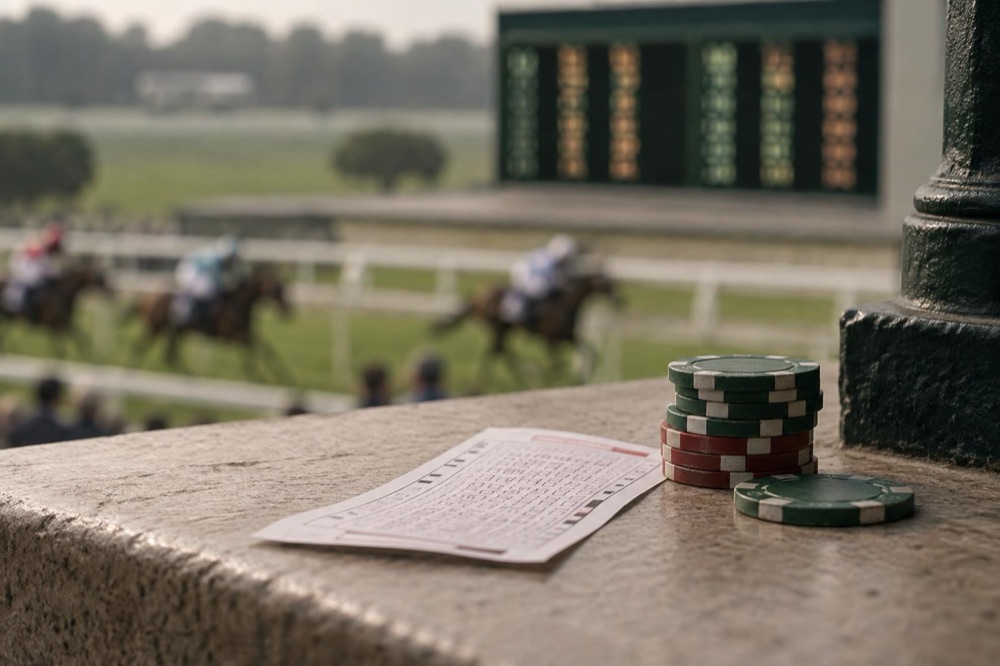
If you have watched an odds board during a race meeting, you have seen prices flickering constantly. In pari-mutuel betting there is a mechanical reason: the payout rises and falls depending on how many people buy each horse and how much they put on, so the odds change from moment to moment3. The figures are calculated by computer and pushed out one after another to the large in-venue TVs and odds boards3.
Fixed-odds betting moves for a different reason. The operator may change the fixed odds for a bet type at any time before you place your bet4. But once your bet is valid, the odds recorded in the operator's official record at the moment of placement are the odds used for the payout, and they cannot be changed afterwards by either side4. Korea's Proto football pools work the same way: odds can be adjusted based on team records, past results, injuries, recent form, media coverage and popularity, but anyone who bought before the change is settled at the odds at the time of purchase20.
Some products are explicitly pool-priced. Japan's WINNER football lottery states that its odds, the payout multiplier, fluctuate according to betting volume until sales close and are not fixed until sales end21.
In football betting, line movement is constant. Asian Handicap lines and odds change during the betting period23, and in live in-play handicap betting the line and odds change according to how the match develops24. If the handicap selections in your bet change after placement, cash out may be offered when your selections become available again23.
Before betting opens at a race meeting, a track handicapper sets morning line odds for each horse, an estimate of where the market will land2. From that opening figure to the final one, the price belongs to the crowd. The mechanics of this are covered in why odds change.
Where to check odds before the cutoff
Odds are only useful if you are looking at current ones, so knowing where to look and when betting closes matters.
At the venue. Racecourses display odds on large screens and odds boards that update continuously as money arrives3. Boat race stadiums in Japan show odds on monitors inside the stadium and on the jumbo screen, with the same figures on the official website; predicting the finishing order 1-3, for example, might pay 8.4 times your bet26. On official websites, the odds shown are as of the moment you accessed the page, so refresh to see the latest27.
On betting screens. Keirin's bet confirmation screen shows your selections, the odds and the estimated payout amount before you confirm28. Korean boat racing (KBOAT) publishes confirmed dividend rates, where the number in parentheses is the winner's number and the figure after it is the payout29.
Cutoff times. These vary by product, and they are strict:
| Product | Betting closes |
|---|---|
| JRA racecourses, Japan | 2 minutes before post time5 |
| NAR races via JRA Net Voting | 2 minutes before scheduled post time31 |
| J-PLACE Yokawa, Japan | 2 minutes before each race's start time32 |
| WINNER football lottery at counters | 60 minutes before the designated match starts33 |
| Boat Race tickets | at the stated deadline, with the race starting at least a few minutes later34 |
At JRA racecourses, odds change constantly until that two-minute cutoff5, so the price you saw when you queued may not be the price at the close. One caveat on final figures: the final odds are an estimated payout rate assuming a single winner, and actual payouts can differ if the race ends in a dead heat27.
Two last practical points. First, know which kind of product you are betting into: pari-mutuel odds are estimates until the pool closes, while fixed odds are locked at placement4. Second, remember that a short price means the crowd agrees with you, and a long price means it does not; neither is right or wrong, they are just information about what everyone else is doing2.
Common Questions
What does 2/1 pay on a £1 bet?
A £1 bet at 2/1 returns £3 in total if it wins: £2 of profit plus your original £1 stake back. The left-hand number of a fraction is the profit you earn for every unit on the right-hand side.
What does a 5/1 payout look like on a GBP 10 stake?
At 5/1, a £10 stake earns £50 of profit, and you get your £10 back, for a total return of £60. Fractional odds quote profit against stake, so 5/1 means five units of profit for every one unit staked.
What is the difference between fractional and decimal odds?
Fractional odds such as 2/1 show profit against stake, so your stake is added on top. Decimal odds such as 3.00 show the total return including your stake, so you simply multiply stake by the number. 2/1 and 3.00 are the same price.
Why do odds change from moment to moment?
In pari-mutuel pools, the payout depends on how much money lands on each selection, so the price moves with every bet placed. Fixed-odds operators can also change prices at any time before you bet, though the odds recorded when you place a bet are locked in.
When is the latest I can place a bet before a race starts?
At JRA racecourses in Japan, betting closes two minutes before post time, and the same two-minute cutoff applies at NAR off-course betting and J-PLACE venues. WINNER football lottery tickets at counters stop selling 60 minutes before kickoff.
Where can I see the current odds at a racecourse?
Racecourses display odds on large screens and odds boards that update continuously as money comes in. Boat race stadiums show them on monitors and the jumbo screen, and the same figures appear on the official websites, though you may need to refresh the page.
Which odds formats do sportsbooks use?
The four common formats are fractional odds, decimal odds, American or moneyline odds, and percentage probability. Decimal odds dominate in Asia, fractional odds are traditional in racing, and American odds are used mainly by US-facing sportsbooks.
Sources34 sources
- Home/Away/Draw (HAD) betting guide, Hong Kong Jockey Club, September 25, 2026
- Understanding odds, Ontario Racing, September 26, 2026
- Kasamatsu Keiba beginner's guide to odds, Kasamatsu Keiba, 2026
- HKJC Football Betting Rules, Rule 3 (English), Hong Kong Jockey Club, January 17, 2026
- Go Racing guide, Japan Racing Association, September 26, 2026
- HKJC Football Betting Rules, Rule 1, Hong Kong Jockey Club, January 17, 2026
- HKJC Football Betting Rules, Rule 3 (Chinese), Hong Kong Jockey Club, January 17, 2026
- Football betting game rules, Singapore Pools, May 29, 2026
- HKJC Football Betting Rules, Rule 2 (English), Hong Kong Jockey Club, January 17, 2026
- How to play craps: details, PlaySmart, September 25, 2026
- Decimal odds explained, Betway Blog, February 25, 2025
- HKJC Football Betting Rules, Rule 3 (English), Hong Kong Jockey Club, April 29, 2026
- Craps odds, PlaySmart, September 27, 2026
- HKJC Betting Rules Chapter 6, Hong Kong Jockey Club, May 2025
- Roulette basics, Wizard of Odds, August 3, 2026
- Keirin odds basics, Keirin, 2022
- Keirin odds basics (Traditional Chinese), Keirin, 2022
- Sic Bo: how to play, PlaySmart, September 25, 2026
- Kcycle betting basics, Korea Cycling Federation, September 25, 2026
- Sports Toto FAQ, Sports Toto, September 25, 2026
- WINNER: about the game, Toto-Dream, September 25, 2026
- WINNER: how the game works, Toto-Dream, September 25, 2026
- Sports betting FAQ, Singapore Pools, 2026
- Handicap (HDC) bet types, Hong Kong Jockey Club, September 25, 2026
- In-play (即場) bet types, Hong Kong Jockey Club, September 25, 2026
- BOAT RACE official site (English), Boat Race, September 25, 2026
- NAR betting questions and answers, National Association of Racing, 2026
- Keirin bet confirmation screen help, Keirin, 2022
- KBOAT confirmed dividend rates, Korea Boat Racing, September 25, 2026
- How to bet at JRA racecourses, Japan Racing Association, September 26, 2026
- IPAT questions and answers, National Association of Racing, September 27, 2026
- DASH Yokawa (J-PLACE Yokawa), Sonoda Racecourse, September 25, 2026
- WINNER: how to buy, Toto-Dream, September 25, 2026
- How to make predictions, Boat Race, September 26, 2026