
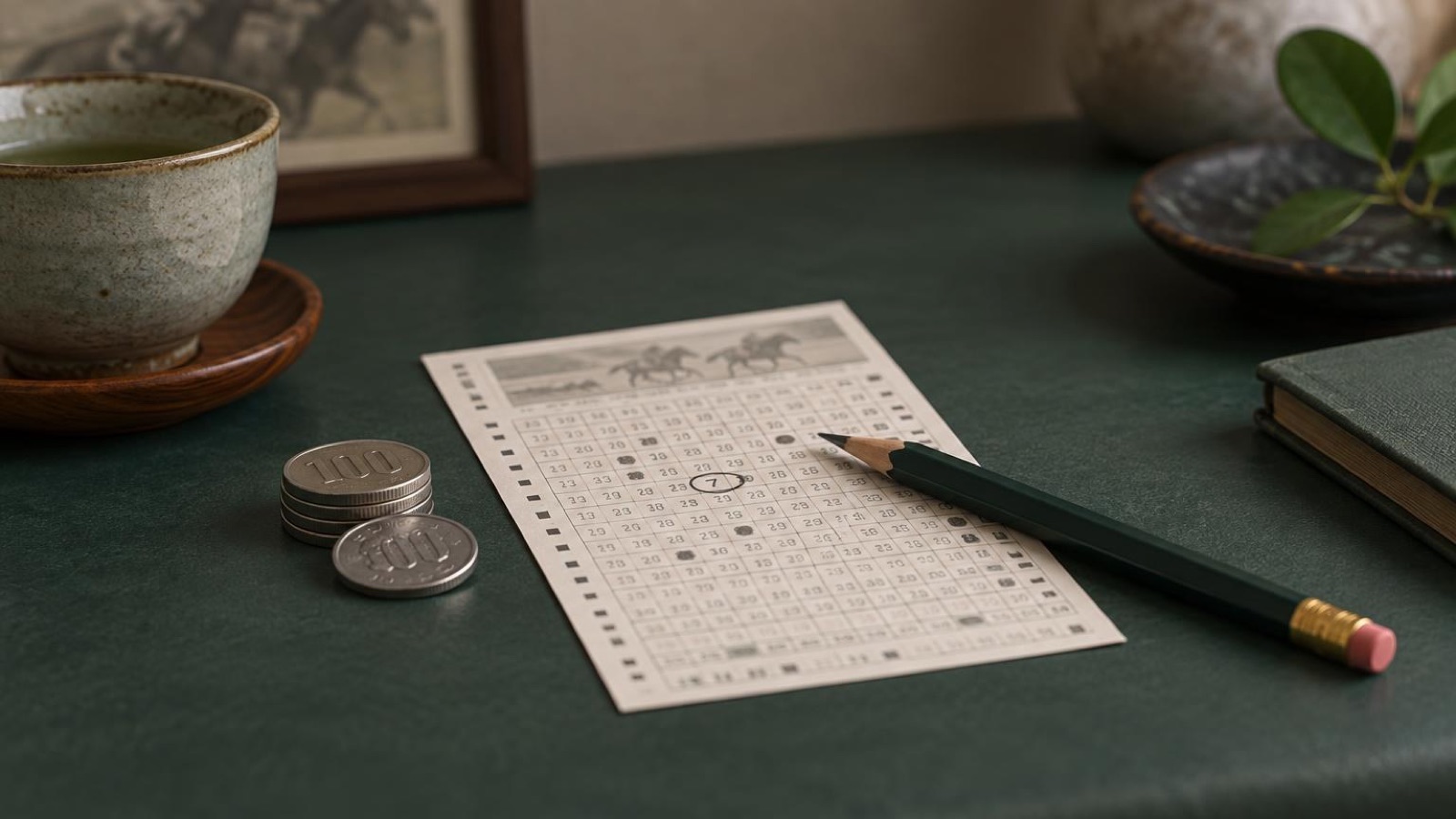
What a banker bet is in horse racing
A banker bet is a way of covering several permutations of horses in one ticket while insisting that one horse, the banker, appears in every combination. Singapore Pools defines it plainly: banker betting is a method where various permutations of horses are placed into selected bet combinations, and each of those combinations includes a horse or horses nominated as the banker or bankers8.
The practical point is cost control. If you like three horses for the first three positions but are sure one of them will win, naming that horse as the banker cuts the number of combinations you have to buy. You are trading coverage for price: fewer combinations means a cheaper ticket, but the banker must do its job or the whole bet is dead.
The idea travels well. In Japan the same structure is called a wheel bet: you mark one horse number as your banker in the "軸" (Banker) section and your other selections in the "相手" (Counterpart) section9. Trio wheels there allow one or two bankers, and on Trifecta and Exacta wheels you can select "Multi Ways" to also buy versions with the placings reversed, so the banker can run second or third instead of first9. If you are new to the underlying bets, our page on trifecta, tierce and trio bets explains what each one asks you to pick.
The main ways to combine selections
Across Asian racecourses you will meet four broad ways to cover several outcomes at once.
Banker. One horse is pinned to a finishing position, usually first, and the remaining selections fill the other spots in any order. Cheapest of the three-horse structures, but the banker must win.
Box. The opposite extreme: you pick your horses and buy every possible order they can finish in. A boxed Tierce of three horses is all six orderings of those three. Most expensive per selection, but any order wins.
Wheel. The Japanese version of the banker, with the banker in the 軸 section and counterparts in the 相手 section; you can add reversed placings with Multi Ways9.
Multiple. Bets linked across two or more races, where the dividend from one leg rolls into the next. Hong Kong's All Up and Singapore's Roll bets work this way, and we cover them in detail below.
Singapore Pools offers banker betting for Forecast, Place Forecast, Tierce, Trio and Quartet1, so the banker structure reaches from two-horse bets up to four-horse bets. Japan's JRA lists nine bet types in total across its menu, including WIN510, and the wheel structure applies to several of them.
Banker bets with Forecast, Place Forecast, Tierce, Trio and Quartet
First, what each of these bets asks for. A Forecast needs the first and second horses in the correct finishing order11. A Tierce needs the first, second and third in order11. A Trio needs the first three in any order, and a Quartet needs the first four in order11. Place Forecast pays on placed horses rather than the exact first two. If you want the full breakdown of the four-horse version, see first four and quartet bets.
Now add the banker. The rule is the same for each type: your selected banker must finish first, and the remaining selected horses must fill the other positions in any order. For a Tierce with a single banker, the banker must finish first and your other selections must take second and third in either order1. Singapore Pools gives a worked example: where horse number 2 is selected as the banker for first place, every combination on the ticket starts with the 2, and the other horses shuffle behind it1. For a Quartet with a single banker, the banker wins and the remaining selected horses take second, third and fourth in any order1.
The cost is the number of combinations times your stake. With one banker and three other horses in a Trio, you buy three combinations: banker with each pair of the others. Add more horses and the count grows fast, which is why flexi betting, where you take a percentage share of combinations rather than whole units, exists in some markets.
On the Singapore bet slip, these bets share one form: the Forecast/Place Forecast/Tierce/Trio/Quartet slip, which also has a Computer Pick option where you mark the number of horses to be selected at random12. That random option is the ultimate box: the machine picks the horses, you just say how many.
How tote pool betting works and what a dividend pays
Almost all of these combination bets are tote, or pari-mutuel, bets. The Hong Kong Jockey Club offers pari-mutuel and fixed odds betting on races13, and its betting guide walks you through the pari-mutuel pools, the fixed odds types, and the betting formulas14. The word tote matters because it explains your payout: you are not betting against the operator at quoted odds, you are betting into a pool alongside everyone else.
Here is the arithmetic. All the money staked on a bet type goes into a pool. The operator takes its commission off the top: Singapore Pools lists a 25% commission on Tierce, Trio, Quartet, Quadro, Double Trio and Triple Trio bets where it receives pools collected by overseas totalisators2. What is left is the net pool.
For a single pool, the dividend per unit bet is the net pool divided by the number of unit bets on the winning combination, plus an amount equal to the unit stake and any share of an applicable jackpot3. In Chinese-language form the same rule reads: the net pool is divided by the total units on the winning combination, plus the stake and any jackpot share15. So if you hold the only winning unit in a Tierce pool, you get the whole net pool; if a thousand people hold it, you split it a thousand ways.
Place betting is slightly different because several horses pay. The net pool is divided into two or three parts according to whether two or three place positions pay, and each part is divided by the units on the relevant horse3. If none of the placed horses was backed at all, all bets in that pool are refunded15. Jackpot carryovers, which can swell these pools dramatically, are covered on our racing jackpots and carryovers page.
Fixed tote odds versus variable tote odds
Because a tote dividend depends on how much everyone else bets, the odds you see on the board are provisional. The board updates continuously according to how much bettors wager on each horse, right up until the race starts16. A horse showing a big dividend at noon can pay far less by post time if money floods in behind it.
Fixed odds work the other way. The operator states the odds at which your stake will be multiplied if your selection wins, and that is the number you are paid at17. The operator decides which fixed odds bet types to offer for a race or race day, and may change the fixed odds of a bet type at any time before your bet is placed17. Once accepted, though, a fixed odds bet is locked: HKJC's Jockey Challenge, for example, pays a dividend calculated on the fixed odds at the time the bet is accepted, unaffected by any later odds change18.
The practical difference for a combination bettor: your Forecast or Trio dividend is variable and unknown until the pool closes, while a fixed odds product, where offered, tells you the price in advance. Most exotic combination bets in Asia sit in the variable pool world.
Multi-race combinations: All Up and Roll
Combination betting does not stop at one race. Hong Kong's All Up and Cross Pool All Up betting lets you place bets in the same or different pools across 2 races up to a maximum of 6 races, and any dividend from a winning leg is automatically carried forward and reinvested in the next leg you specified18. The bet types you can link depend on how many races you take: Forecast and Trio are available for 2 to 3 races, while Win, Place, Quinella, Quinella Place, Forecast and Trio run from 2 to 6 races18.
Singapore's equivalent is Roll betting, and the Roll-Win version's bet value depends on the number of horse selections you make for each race19. The more horses you cover per leg, the more combinations the ticket contains and the more it costs, exactly the same arithmetic as the single-race banker and box bets above.
The most ambitious structure of this kind is the Super Heinz: seven selections combined into 120 individual bets, with no singles, covering every double, treble and upward combination among the seven. Because there are no singles, you need at least two winners to see any return, and the stake is the unit stake times 120. It is a bet for bettors who want many small chances rather than one big one, and it shows up mostly in markets with fixed-odds multiple betting rather than on Asian tote menus.
How to place a tote bet and what to tell the window
At a teller, keep it simple and say things in the order the operator expects. Philracom in the Philippines tells bettors to give four things in sequence4:
- The race number
- The type of bet you are placing
- The amount of your bet
- The horse's number
Japan works the same way: to buy a ticket you decide the racecourse and race, the bet type, the horse number (bracket number), and the purchase amount20.
At Japanese local tracks the betting slip does the talking. At Sonoda and Himeji, for example, you mark the location block "Sonoda, Himeji", then the race number, the type of wager, the first finisher, and the amount and unit blocks: a 100 yen Win ticket on horse number 3 in the tenth race is marked exactly that way21. The Chinese-language version of the same track's instructions describes the same fields22.
For combination bets specifically, you will usually mark the banker separately from the other selections, as on the Japanese wheel slips where the banker goes in the 軸 section9, or use a dedicated combination slip like the Singapore Forecast/Place Forecast/Tierce/Trio/Quartet form12. If you want the random option, mark the number of horses for Computer Pick and the system selects them for you12.
A word on stakes before you reach the window: Korean cycling guidance, which reflects the same pool-betting culture, suggests buying around 3 to 5 tickets per race at a level you can afford, and only on races you feel confident about23. That is sensible pacing for any combination bettor, because combination tickets multiply fast.
Each way bets and what they cost
An each way bet is really two bets in one: a win bet and a place bet on the same horse or combination. The cost rule is blunt: the marked amount will be doubled, because you are buying win and place together9.
For combination structures this matters a lot. An each way Super Heinz is 240 bets, not 120. An each way boxed Trio buys the win combinations and the place combinations separately. The consolation is that place dividends pay more often, since a place bet only needs your horse to finish in the first three, or in the top two when five to seven runners go9. At Japanese local tracks, the place bet pays the top three, or the top two when seven or fewer horses run24, and the odds are simple to picture: with 12 horses running, a place bet has 3/12 chances and a win bet 1/1224.
Costs, minimums and who can bet
The unit stakes are small everywhere, which is what makes combination betting affordable in slices.
| Where | Minimum stake | Notes |
|---|---|---|
| Japan (JRA) | JPY 100 | All bet types, except at several WINS off-track facilities5 |
| Japan (toto/DUNK lottery) | JPY 100 per bet | 7 |
| Japan (Boat Race) | JPY 100 | Bets start at 100 yen at any racetrack25 |
| Japan (law) | JPY 10 face value | The Japan Racing Association may sell pari-mutuel tickets with a face value of ten yen26 |
| Korea (cycling race tickets) | KRW 100 | Up to KRW 100,000 maximum6 |
| Vietnam (draft decree) | VND 10,000 per bet | 23 |
Age limits: in Japan you must be at least 20 years old to bet, on horse racing5 and on Boat Race25. Vietnam's draft betting decree requires players to be 21 or older with full civil act capacity23. These rules apply to everyone at the window, resident or visitor alike.
Where you can bet: in Hong Kong, betting locations mean Sha Tin and Happy Valley racecourses, the off-course betting centers, and any other approved premises, including the official website and approved internet sites11. In Japan, you can buy tickets at the 10 JRA racecourses and the off-track betting facilities around the country5. Our page on official online horse racing betting accounts covers who can open one.
Questions first-timers ask
Do I have to bet whole units on a big combination? The cost of a combination ticket is combinations times stake, and minimums are per bet, so a large structure adds up quickly. Start with smaller structures, like a single banker with two counterparts, until the arithmetic feels natural.
What if my banker finishes second? On a standard banker bet the banker must finish first, so the ticket loses. In Japan, though, the Multi Ways option on Trifecta and Exacta wheels buys versions with the placings reversed, covering the banker running second or third9.
Why did the dividend differ from the board? Because tote odds are variable: the board updates as money comes in until the race starts16, and the final dividend is the net pool split among winning units3. The number you saw when you placed the bet was an estimate.
What is the difference between a box and a banker? A box buys every order; a banker fixes one horse to first and lets the rest shuffle. The box costs more and wins more often; the banker costs less but dies with the banker.
Can I combine bets across different racecourses? Yes, in the All Up family: Cross Pool All Up lets you link bets in different pools across up to 6 races, with winnings rolling forward leg by leg18.
Where do the place rules differ? Place payouts depend on field size: in Japan, a place bet pays the top three, or top two with seven or fewer starters24, and with five to seven runners you select one horse to finish first or second9. Our win and place bets page has the full breakdown.
Common Questions
How many bets are in a Super Heinz?
A Super Heinz contains 120 individual bets built from seven selections: 21 doubles, 35 trebles, 35 four-folds, 21 five-folds, 7 six-folds and 1 seven-fold, with no singles. Your stake is multiplied by 120, so small unit stakes add up quickly.
What information do I need to give at a tote window?
Four things, in order: the race number, the type of bet you are placing, the amount of your bet, and the horse's number. In Japan the same logic applies: racecourse and race, bet type, horse number, and purchase amount.
How old do you have to be to bet at the tote?
In Japan you must be at least 20 years old to buy betting tickets, whether for horse racing or Boat Race. In Vietnam the draft betting decree sets the minimum at 21. Check the local rule before you queue at the window.
What happens if only two of my seven Super Heinz selections win?
You still collect. Every combination that uses only those two winning selections, meaning the single double between them, is a winning bet. All the combinations that involve your five losers lose, but that one double pays a dividend.
How does an each way Super Heinz change the cost?
It doubles it. An each way bet buys a win version and a place version of every combination, so the marked amount is multiplied by two. A 120-bet Super Heinz becomes 240 bets, and place dividends are usually smaller than win dividends.
Where is tote betting available?
At the racecourses themselves and at off-course betting centers. In Hong Kong that means Sha Tin and Happy Valley plus off-course branches and approved internet sites; in Japan, the 10 JRA racecourses plus off-track WINS facilities around the country.
Sources26 sources
- Ways of Betting: Banker Bet, Singapore Pools, 2026
- Horse Race Betting Game Rules, Singapore Pools, July 6, 2026
- HKJC Betting Rule 6, Hong Kong Jockey Club, May 2025
- Getting Started with Betting, Philracom, September 25, 2026
- Go Racing FAQ, Japan Racing Association, September 25, 2026
- Ticket Purchase, K-Cycle, September 25, 2026
- DUNK, Toto Dream, September 25, 2026
- Bet Placement Horse Racing Guide, Singapore Pools, 2026
- How to Bet, Japan Racing Association, September 26, 2026
- JRA Beginner's Book, Japan Racing Association
- HKJC Betting Rule 1, Hong Kong Jockey Club, May 2025
- Placing Horse Racing Bets Using Bet Slips, Singapore Pools, 2026
- Responsible Gambling Introduction, Hong Kong Jockey Club, September 26, 2026
- Beginner's Guide to Racing Betting, Hong Kong Jockey Club, September 25, 2026
- HKJC Betting Rule 6 (Chinese), Hong Kong Jockey Club, May 2025
- Understanding Odds, Ontario Racing, September 26, 2026
- HKJC Betting Rule 5 (Chinese), Hong Kong Jockey Club
- Racing Betting Guide, Hong Kong Jockey Club, 2024
- Bet Types: Roll-Win, Singapore Pools, 2026
- Beginner's Book 2026, Japan Racing Association, 2026
- How to Bet at Sonoda and Himeji, Sonoda and Himeji racecourses, September 25, 2026
- How to Bet at Sonoda and Himeji (Chinese), Sonoda and Himeji racecourses, September 25, 2026
- Draft Betting Decree (Vietnam), 2025
- Betting at Kanazawa Racecourse, Kanazawa Racecourse, 2026
- Boat Race How To, Boat Race Promotion Association, September 25, 2026
- Racing Law in Japan, Japan Racing Association, September 25, 2026















