What a quinella bet is
A quinella asks you to pick the first two horses home in a race, and the order does not matter. If you bet horses 3 and 6, you win whether the result is 3 first and 6 second, or 6 first and 3 second. The Hong Kong Jockey Club defines it exactly that way: the backer selects the first and second horses in a nominated race regardless of the finishing order1. Japan's local racing bodies describe the same bet: mark two horse numbers, and you win if they finish first and second in either order9.
Because order does not matter, the quinella is one of the friendliest of the combination bets. A two-horse quinella is a single bet, not two. The odds board shows one dividend per pairing: at Kasamatsu Keiba, a board reading 3-6 = 21.4 means the 3-6 quinella pays 21.4 times your stake, so JPY 100 returns JPY 2,14010.
The chance of hitting any one pairing depends on field size. Sonoda and Himeji, in their Chinese-language guide, give the figures for a full field: with 12 horses running, a single quinella combination has a 1 in 66 chance, while the same two horses in exact order is 1 in 1327. Japanese keirin (cycle racing) sells the same bet on nine riders, where a quinella combination has a 1 in 36 chance11.
A close cousin is the bracket quinella, sold in Japan. Instead of horse numbers, you pick the bracket (gate group) numbers of the first two finishers, again in any order. Horses coupled in the same bracket count as one bracket, so the field of possible combinations is smaller and the dividends usually lower7.
Quinella vs quinella place (wide): the difference
The quinella place, called wide in Japan and quinella place in Hong Kong, relaxes the requirement further: you pick two horses and win if both finish in the top three, in any order. Your pairing wins if the horses run first and second, first and third, or second and third. The Hong Kong Jockey Club defines it as selecting any two of the first three placed horses regardless of order1, and Japan's guide says the same: you win if your horses finish in the top three9.
Japanese boat racing spells out the three winning pairings plainly: your two selected boats must finish first and second, second and third, or first and third12. Keirin gives the probability for a nine-rider field: 3 in 36 for a quinella place, against 1 in 36 for a quinella11.
The trade-off is simple. A quinella has one winning pairing per race, so dividends are higher. A quinella place has three winning pairings, so the pool is split three ways and each dividend is smaller. In a Hong Kong result from Sha Tin on April 26, 2026, the quinella on the first two horses paid HK$35 for HK$10, while the three quinella place dividends for the same race paid HK$18.00, HK$52.50 and HK$164.50 depending on the pairing13. The wide bet suits fields where you like two horses but are not sure either will beat the rest of the field into the first two.
Where quinella betting is offered
Quinella pools run across most of Asia's pari-mutuel operators.
- South Korea. The Korea Racing Authority Act lists eight bet types, and the quinella and quinella place are two of them, alongside win, place, exacta, tierce and trifecta3.
- Japan (JRA). The Japan Racing Association currently sells nine bet types, including the quinella (umaren) and wide, alongside win, place, bracket quinella, exacta, trio, trifecta and WIN52.
- Japan (local NAR racing). Hokkaido Racing sells win, place, bracket quinella, quinella, wide, trio and trifecta at its racecourses14. Sonoda and Himeji sell the same range off-track, in JPY 100 units15. Tokyo City Keiba's English how-to-bet guide walks through marking a quinella slip, and its race program lists quinella as available for any race with three or more runners6.
- Philippines. Philracom's betting guide lists the daily quinella at a minimum of P 2.00, defined as the first and second place winners in any order in both races of the daily double4.
- Singapore. Singapore Pools' horse racing bet placement guide covers quinella-type bets on Singapore and Hong Kong races, with a $2 minimum for forecast-type bets and $5 for win and place17.
- Hong Kong. The HKJC runs quinella and quinella place pools on every race, with dividends declared to 50 cents8.
Japan's boat race and keirin pools sell the same bets on boats and riders rather than horses, so the quinella family is one of the few bet types you can find in almost every pari-mutuel product in the region12.
Minimum bets and field-size rules
Minimum stakes vary by operator:
| Operator | Minimum unit | Notes |
|---|---|---|
| Hong Kong Jockey Club | HK$10 | Unit bet for quinella and quinella place5 |
| Japan (JRA and local) | JPY 100 | Standard unit at racecourses and off-track windows6 |
| Philippines (Philracom) | P 2.00 | Daily quinella4 |
| Singapore Pools | $2 | Quinella-type bets; win and place are $517 |
Field-size rules decide whether the pool is sold at all. At HKJC, the quinella pool is closed and all bets refunded if fewer than three horses start, and the quinella place pool needs at least seven starters13. In Japan, the quinella by horse number is sold when three or more horses start, while the bracket quinella is only sold with nine or more starters, though it stays on sale if a late withdrawal drops the field below nine provided two horses still share a bracket18. JRA's English guide notes that quinella, quinella place and trifecta betting on its races is available when there are nine or more horses in a race9.
Korea's boat racing shows how the same logic works elsewhere: quinella-type bets are void if only two or three starters remain, and if just one boat finishes the race, quinella and exacta bets are all voided19.
How quinella payouts are calculated
Quinella pools are pari-mutuel: all money wagered on the bet type goes into one pool, the operator takes its share, and the rest is divided among the winning tickets. At HKJC, the win, place, quinella, quinella place and double pools pay out 82.5% of the pool as dividends8. At Kasamatsu Keiba, the quinella payout rate is 70.0%20.
Because the pool is shared, the dividend depends entirely on how much other money backed the winning pairing. A pairing nobody fancied can pay many times a heavily backed one. Kasamatsu's worked example: the 3-6 quinella at 21.4 returns JPY 2,140 on a JPY 100 ticket10. JRA's guide gives a bracket quinella example where the 1-2 combination pays JPY 1,600 for JPY 10021. Korea's boat racing shows the same arithmetic in won: a KRW 5,000 quinella on boats 3 and 4 at odds of 2.4 returns KRW 12,00022.
HKJC rounds dividends to the nearest 50 cents, and no quinella or quinella place dividend is declared below the unit bet plus 50 cents, so a HK$10 bet always returns at least HK$10.5013.
Cost formula: quinella vs exacta box
An exacta box and a quinella cover the same horses, but they are priced differently. An exacta (called forecast in Singapore, and exacta in Korea and Japan) requires the finishing order, so a two-horse exacta box buys two bets: 3 then 6, and 6 then 3. A quinella buys the pair once, in either order. The two-horse exacta box therefore costs exactly twice the quinella for the same coverage, and the gap widens as you add horses: a three-horse quinella is three bets, a three-horse exacta box is six.
The odds reflect the difference. Japanese boat racing lists the quinella at 1 in 15 and the exacta at 1 in 30 for a single combination23. Sonoda's guide gives the horse-racing version: 1 in 66 for a quinella pairing in a 12-horse field, 1 in 132 for the same pair in order7.
The bracket quinella sits on the other side of the scale, cheaper still. Because coupled horses share a bracket, the number of possible combinations is smaller: Kanazawa's betting guide lists 60 bracket combinations for a 12-horse field, falling to 59, 58 and 57 as the field shrinks, with no sales at eight or fewer starters18. Fewer combinations means lower dividends, but a better chance per ticket.
Bet options: flexi, multiple and standout betting
Most operators let you build quinella tickets beyond a single pairing.
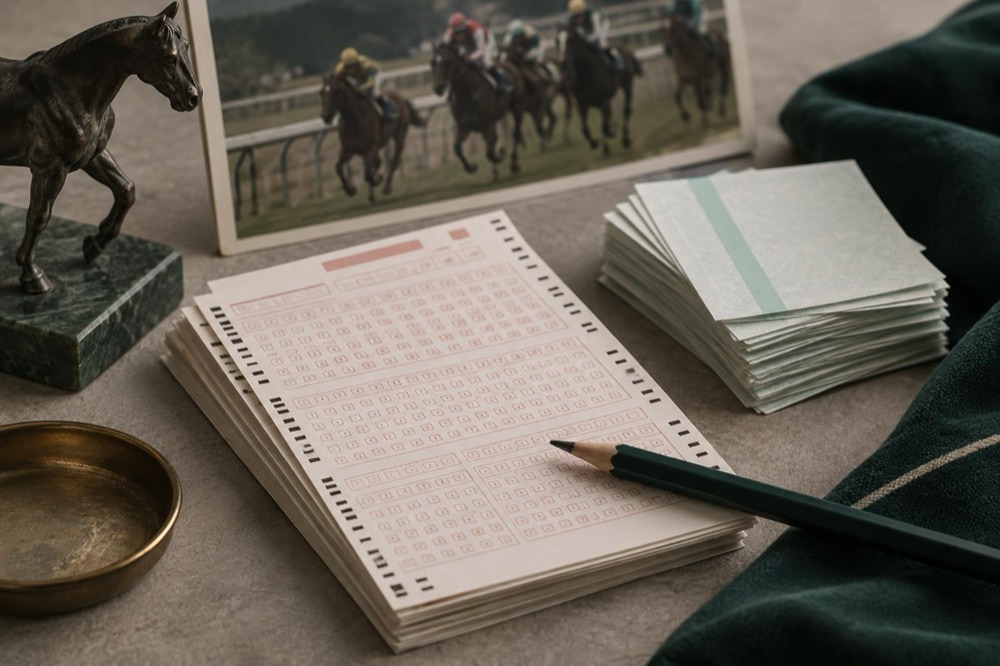
- Multiple formation. JRA's SMAPPY app and betting cards let you combine several horses in each leg of a bracket quinella, quinella, exacta, quinella place, trio or trifecta, buying every pairing your selections produce24.
- Wheel. The same JRA materials offer a wheel on bracket quinella, quinella and quinella place: one horse paired with several others, covering every pairing that includes your key horse24.
- Box. All selected horses paired with each other, in every combination24.
- Standout. A single horse paired with your other selections, a narrower and cheaper version of the wheel.
- Flexi-style units. At HKJC, the minimum unit bet drops as your total outlay rises: HK$10 units for small bets, HK$1 units once your total reaches the higher brackets, so you can spread a fixed budget across many combinations and still collect a share of the dividend per unit8.
JRA's A-PAT internet betting sells the full range, win, place, bracket quinella, quinella, wide, exacta, trio, trifecta and WIN5, and its instructions cover formation and box tickets across all of them25. Local racing cards work the same way: the regular voting card at NAR racecourses covers all eight bet types, and the formation card covers the six combination bets26.
Dead heats and pool refunds
Dead heats split the pool. At HKJC, when two or more horses dead heat, the net pool is divided equally among the winning combinations backed, and each combination's share is divided by the units bet on it27. The same rule applies to the place pool: the net pool is divided equally among the winning combinations bet, and each combination's share is divided by the units bet on it27.
Japan has a specific rule for the wide bet: if third place is a dead heat, the pairing of the two third-place horses is not a winning combination18.
Refunds work differently by operator. If a race is canceled after sales start, JRA's A-PAT refunds all bets on that race in full, and for win, place, wide, exacta, trio, trifecta and WIN5, any combination that includes a scratched horse is refunded in full25. JRA's glossary adds that refunds are paid at rates tied to each bet type's payout rate, JPY 70 per JPY 100 for bet types with a 70% payout rate and JPY 80 per JPY 100 for those at 80%2. At Kasamatsu, if a scratch leaves a bracket with no horses, all bets on that bracket are refunded20. For HKJC's merged pools, bets on a void race are refunded in full13.
Common Questions
What happens if fewer than the required number of horses start the race?
The pool is usually closed and all bets refunded. At HKJC the quinella pool needs at least three starters and the quinella place pool needs seven. In Japan, quinella betting is offered when three or more horses start, and in Korea quinella-type bets are void with two or three starters.
What is the minimum bet on a quinella pool?
It depends where you bet. In Hong Kong the unit is HK$10, in Japan JPY 100, in the Philippines P 2.00 for the daily quinella, and at Singapore Pools the minimum is $2 for quinella-type bets and $5 for win and place.
What are the odds of hitting a quinella?
In a 12-horse field a single quinella combination has a 1 in 66 chance, against 1 in 132 for the same two horses in exact order. In Japanese boat racing, with six boats, a quinella combination has a 1 in 15 chance.
How is a quinella different from an exacta box?
They cover the same combinations, but an exacta box buys each finishing order as a separate bet, while a quinella is one bet on the pair in either order. A two-horse exacta box costs twice as much as the quinella for the same coverage.
What is a quinella place (wide) bet?
You pick two horses and win if both finish in the top three, in any order: first and second, first and third, or second and third. Japan calls this bet wide, Hong Kong calls it quinella place, and it pays smaller dividends than a quinella because it has three winning pairings instead of one.
What was the coldest quinella payout in Hong Kong racing history?
On April 13, 2025, the quinella of two outsiders in race 9 paid HK$25,905 for every HK$10 bet, breaking the previous record of HK$23,863 set at Sha Tin on March 5, 2017.
Sources27 sources
- HKJC Betting Rules Chapter 1, Hong Kong Jockey Club, May 2025
- JRA glossary, Japan Racing Association, 2026
- Korea Racing Authority Act, Korea Law Translation Center, 2026
- Getting started with betting, Philracom, 2026
- Betting illustration, Hong Kong Jockey Club, 2022
- How to bet, Tokyo City Keiba, 2026
- How to bet, Sonoda and Himeji Racecourses, 2026
- Betting guide, Hong Kong Jockey Club, 2024
- How to bet local races, Japan Racing Association, 2026
- Odds explained, Kasamatsu Keiba, 2026
- Betting basics, JKA, 2022
- How to make predictions, BOAT RACE, 2026
- HKJC Betting Rules Chapter 3, Hong Kong Jockey Club, 2023
- Bet types and payouts, Hokkaido Racing, 2026
- Off-track betting sales, Sonoda and Himeji Racecourses, 2026
- Race program December 29, 2024, Tokyo City Keiba, 2024
- Bet placement horse racing guide, Singapore Pools, 2026
- Betting ticket guide, Kanazawa Keiba, 2026
- FAQ, Korea Boat Racing, 2026
- Bet guide, Kasamatsu Keiba, 2026
- Go Racing guide, Japan Racing Association, 2026
- Dividend rate board, Korea Boat Racing, 2026
- BOAT RACE English guide, BOAT RACE, 2026
- How to use SMAPPY, Japan Racing Association, 2026
- A-PAT instructions, Japan Racing Association, 2026
- A-PAT instructions, Japan Racing Association, 2025
- HKJC Betting Rules Chapter 6, Hong Kong Jockey Club, 2025