
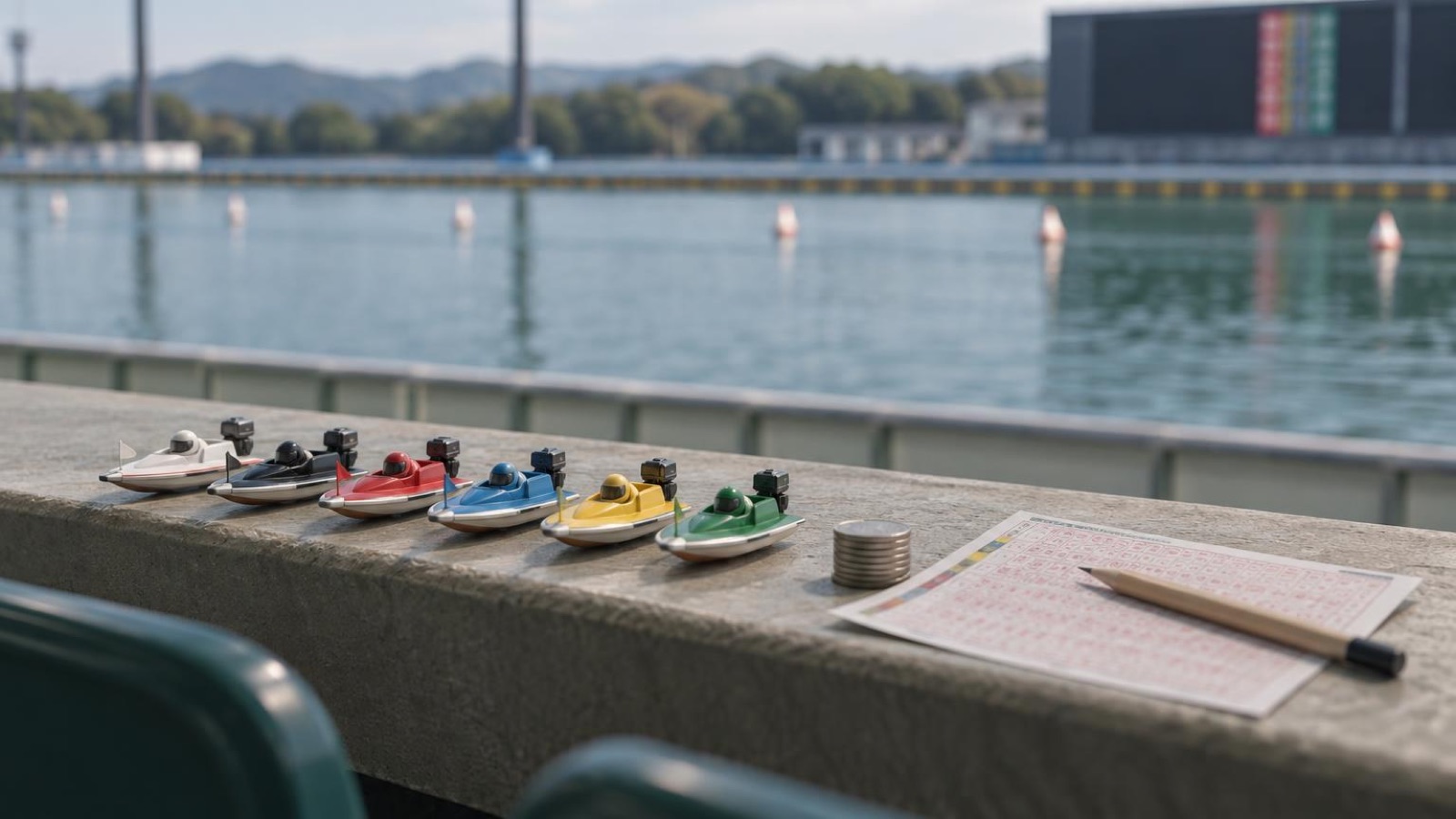
What kyotei is and how a race works
Kyotei, usually written as BOAT RACE in English, is a six-boat race on a circular water course. The boats run counterclockwise for three laps of 600 meters each, so the race distance is 1,800 meters2. Six boats line up for each race, and a day of racing at a venue has 12 races6.
The race is not a straight sprint. After the boats cross the start line they turn at marker 1 and then marker 2, and the ranking is decided over the full three laps7. Because the course is a loop, the lane you draw matters: the smaller the boat number, the better the race position6. Boat 1 has the inside line, boat 6 the widest.
Each boat has a fixed color that matches its number, and the colors are the same at every venue: 1 white, 2 black, 3 red, 4 blue, 5 yellow and 6 green8. If you cannot read the numbers from where you are sitting, you can follow the race by color alone.
Racers are ranked in four categories, A1, A2, B1 and B2, according to their winning levels6. That ranking is printed in the race program and is one of the things regulars look at before picking a boat.
The flying start: how the race begins
Boat race does not use a standing start. It uses a flying start, where the boats must cross the start line within a set time rather than waiting for a gun7. The six boats leave the pit area together, then warm up by sprinting clockwise around marker 2 and the shortcut prevention buoy before turning to approach the line9.

The timing is judged against a large clock at the venue. Boats must start between 12 and 1 on that clock, crossing the line within the prescribed start time3. Crossing the line before the clock reaches zero is a flying start, marked F, and starting one second or more late is a late start, marked L3.
Either way the boat is scratched from the race, and bets on that boat are refunded10. Because passing the line earlier than the other boats is an advantage, racers push right up to the limit, and the F and L calls are a normal part of the sport rather than a rare accident3.
One more rule worth knowing if you watch the warm-up: following in a position directly behind another boat during standby warm-up is not allowed and is judged as a violation2.
The 7 bet types explained
There are seven types of betting ticket in Japanese boat race, and any of them can be bought from 100 yen1. They range from simply picking the winner to naming the first three boats in exact order.
| Ticket type | What you predict | Boats to pick |
|---|---|---|
| Win | The boat that finishes first | 1 |
| Place | One boat finishing first or second | 1 |
| Quinella | The top two, in any order | 2 |
| Exacta | The top two, in exact order | 2 |
| Trio | The top three, in any order | 3 |
| Quinella place | Two of the top three, in any order | 2 |
| Trifecta | The top three, in exact order | 3 |
The two-win types ask you to fill in up to second place on the mark sheet, and the three-win types up to third place11. For the quinella place bet, you are betting on two of the top three winners in any order, and when two or more boats tie for third, the combination of third-place boats does not apply2.
There is also a shortcut that saves filling in every line. A box bet buys all the combinations related to the boats you selected12. A multiple combination works the same way for three boats: you pick three and bet on all their permutations13. A rotation combination fixes the first or second boat and fills all the remaining boats as third8.
Odds and payouts: how they are calculated
Odds in boat race are the expected payout rate on a ticket. If a 100-yen ticket is given a rate of 6.2, the payout is 620 yen2. As a simple example, if you predict the order 1-3, the odds would be 8.4 times the amount of your bet14.
Odds are shown on monitors inside the stadium, on the large video screens, and on the official website, so you can check them before you commit7. They move as money comes in on each combination, which is why the number you see early in the day is not the number you get at the off.
A worked example from the official guide: a trio bet on the 6th race at Suminoe in Osaka, with boats 1, 2 and 4 in the top three, for 1,500 yen. If it lands, the 1,500 yen is multiplied by 15.3, so the prize is 22,950 yen6. All payouts are in yen15.
In Korea, the confirmed payout is printed in the results with the boat number in brackets. A notation of (1)2.7 means the confirmed payout for that bet type on boat 1 is 2.716. In a real result from meeting 37, day 1, race 2, the win bet paid 1.3 on boat 1 and 2.1 on boat 317.
Stakes, tickets and how to place a bet
The minimum bet in Japan is 100 yen, and you can place bets for as little as that6. Stakes are written on a mark card in three units: hundreds of yen, thousands of yen and ten-thousands of yen. Writing 10 in the hundreds column and 2 in the thousands column means 3,000 yen1.
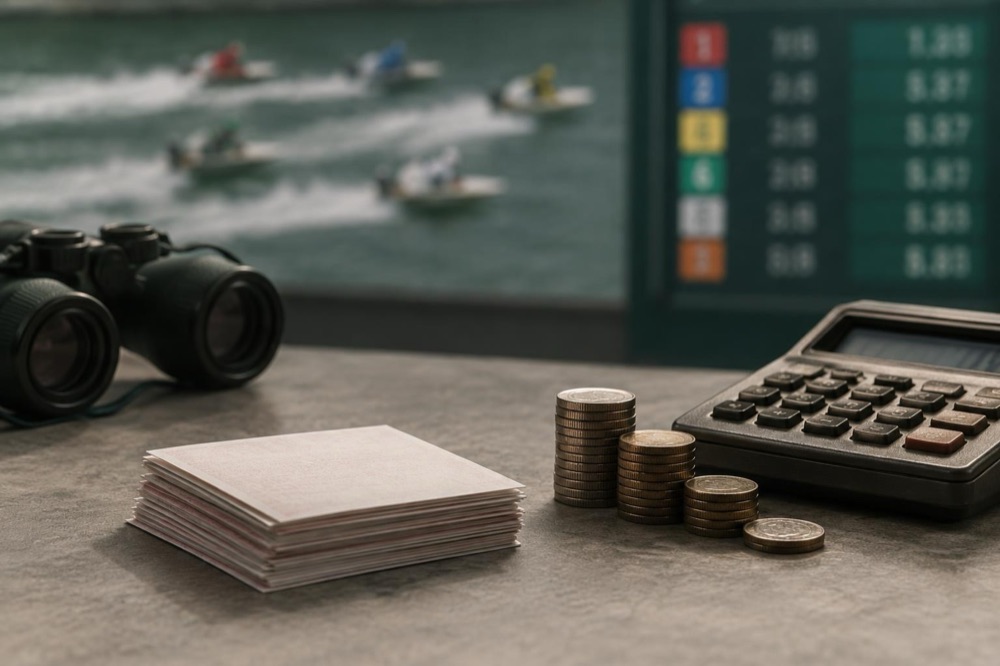
A mark card asks for the venue, the race number, the ticket type, the boat numbers for first, second and third, the stake amount and the stake unit12. Mark cards list all 24 venues across Japan, so you fill in which stadium's race you are betting on1. You can only use pencil, and the marks need to be thick and clear. Pencils are available at every betting venue6.
At the venue you will find stacks of OMR betting cards and pencils, and you buy at betting machines5. You can also buy at the counter using mark sheets and similar forms15. Tickets can be purchased up until the deadline for each race, and the race itself starts at least a few minutes later, which gives you time to find a seat6.
If you would rather not handle paper at all, TELEBOAT is a membership service that lets members bet on boat races held across the country from a smartphone, anytime and anywhere18. The bet is established when your accepted vote is added to the race's sales money, and the ticket is delivered immediately and held by the association on your behalf19. The maximum for a single bet through the service is 9,999,900 yen19.
Disqualification rules and ticket refunds
The refund rule is the one piece of boat race betting that surprises first-timers most, and it is generous. If a boat is scratched before the race, all tickets for that boat are refunded20. That covers a boat that crosses the line too early or too late, and in both cases the boat is withdrawn and the bets on it are refunded10.
The same applies if a race is ruled invalid. Tickets in a race judged invalid can be fully refunded, and you need to keep the ticket to claim21. If a boat does not start at all, tickets on it are refunded in full22.
The practical point is simple: do not throw your ticket away. The official guidance is blunt about it, telling bettors not to lose or dispose of the betting ticket10. A refund is not automatic to your account at a stadium, you present the ticket.
Korea draws the line differently. If a motorboat passes the start line normally and then fails to finish because it capsized, fell overboard, sank or for another reason, the race tickets related to that boat are not refunded. The player is disqualified under the race rules and may face sanctions such as suspension22. Korean rules do refund all bet types when only one or no player starts, when the race is not established, or when there was no winner22.
Where and when you can watch and bet
There are 24 boat race stadiums around Japan, and you must fill in the stadium number on your card according to where the race you are betting on is being held2. Each stadium runs 12 races a day during a meeting2.
You do not need to bet to go in. You can come to any boat race venue in Japan to watch the races, enjoy the food and check out the other attractions without placing a bet6. There is no need to book in advance or fuss with online tickets, and instead of a ticket you put a 100-yen coin in the gate5. No reservation is needed and no ticket has to be bought beforehand23.
If you want a seat rather than a spot by the rail, paid reserved seats usually cost 1,000 to 2,000 yen depending on the type5. On days when the stadium you visit is not holding a race of its own, it sells betting tickets for races at other stadiums, and admission is free on those days23.
The crowd is mixed. Boat race is a hit with adults and children, visitors and locals alike, and English commentary and subtitles are available on race replays and videos14. If you are new to Japanese racing, the keirin betting guide covers the track cycling version, which uses a similar mark card system.
Ticket shops are a smaller alternative to a full stadium. At a Boat Race Ticket Shop you watch the races on monitors and buy tickets at the counter using mark sheets15.
Korean race tickets (gyeongjukwon): limits and payment methods
Korea runs its own motorboat betting under the gyeongjukwon, or race ticket, system, and the mechanics are close to Japan's but the money rules differ.
The minimum bet is 100 won and the maximum is 100,000 won per ticket4. Payment at the counter can be made in cash, with a purchase voucher, or with a Green Card, which is an electronic account4. The following bet types are on offer4:
- Single win
- Place
- Quinella
- Exacta
- Trio
- Quinella place
- Trifecta
Winning and refund tickets are valid for one year4. That is a long window, but the ticket has to survive it: payment may be refused if part of the ticket is damaged or cannot be visually verified, especially the serial number and the barcode in the center4. Keep it flat and dry.
Refunds and cancellations are shown on a display with the date, counter number, a type code (CSH for a refund, CAN for a cancellation) and the amount4. If you are collecting a refund rather than a win, that is the record to check.
Korean results are published with the confirmed payout for each bet type, so you can look up what a race actually paid after the fact16. The notation puts the boat number in brackets before the figure, so (1)2.7 means boat 1 paid 2.7 for that bet type16.
Common Questions
How much does a boat race bet cost in Japan?
The minimum is 100 yen per ticket, and every one of the seven ticket types can be bought from that amount. Stakes are written on a mark card in units of hundreds, thousands or ten-thousands of yen, so a 1,500 yen bet is written as 15 in the hundreds column.
What happens if my boat is disqualified?
If a boat is scratched before the race, for example for a flying start or a late start, every ticket involving that boat is refunded in full. Keep the ticket, because you need it to claim the refund. In Korea, a boat that starts normally but then capsizes or sinks does not trigger a refund.
How old do you have to be to bet on boat race?
In Japan you must be 20 or older to buy boat race tickets, whether at a stadium or through the online TELEBOAT service. There is no separate lower age for visitors, so foreign visitors follow the same rule. Younger visitors can still enter the venue and watch the races.
Can I visit a boat race venue without betting?
Yes. You can walk into any of the 24 stadiums to watch the races, eat and look around without placing a bet. There is no advance booking and no ticket bought beforehand, you just put a 100-yen coin in the gate. Admission is free on days when the stadium only sells bets on races held elsewhere.
How do I collect my winnings?
At a stadium, machines around the venue pay out on the spot. Keep your ticket until you have collected, because it is the only proof of the bet. In Korea, winning and refund tickets are valid for one year, and a damaged ticket can be refused if the serial number or barcode cannot be read.
What do the boat colors mean?
Each of the six boats has a fixed color that matches its lane number: 1 white, 2 black, 3 red, 4 blue, 5 yellow and 6 green. The colors are the same at every venue, so you can follow a race by color even if you cannot read the numbers.
Can I bet on boat race online?
Yes, in Japan through TELEBOAT, a membership service that lets you bet on races nationwide from a smartphone. You must be 20 or older to join. In Korea, race tickets are bought at the counter with cash, a purchase voucher or a Green Card electronic account.
Sources23 sources
- BOAT RACE Chinese Guide, BOAT RACE
- How to Make Predictions, BOAT RACE
- BOAT RACE Guide, BOAT RACE
- Ticket Purchase, KBOAT
- Step by Step Guide, BOAT RACE
- BOAT RACE Enjoy Guide, BOAT RACE
- BOAT RACE Korean Guide, BOAT RACE
- BOAT RACE Chinese Guide, BOAT RACE
- BOAT RACE English, BOAT RACE
- BOAT RACE Official English Site, BOAT RACE
- BOAT RACE Guide, BOAT RACE
- BOAT RACE Korean Guide, BOAT RACE
- BOAT RACE Chinese Guide, BOAT RACE
- BOAT RACE Official English Site, BOAT RACE
- BOAT RACE Guide, BOAT RACE
- Race Results, KBOAT
- Race Results, KBOAT
- TELEBOAT, BOAT RACE
- TELEBOAT Terms, BOAT RACE
- BOAT RACE Korean Guide, BOAT RACE
- BOAT RACE Chinese Guide, BOAT RACE
- Ticket Refund, KBOAT
- BOAT RACE Plan, BOAT RACE















