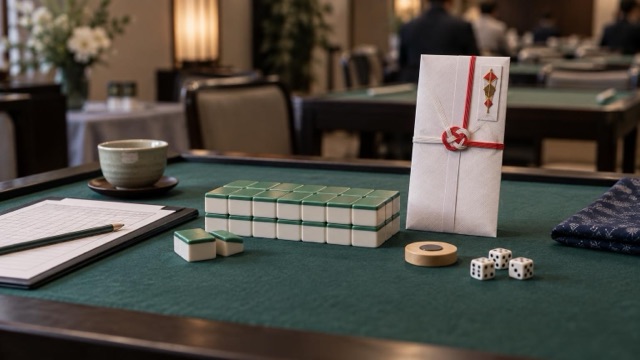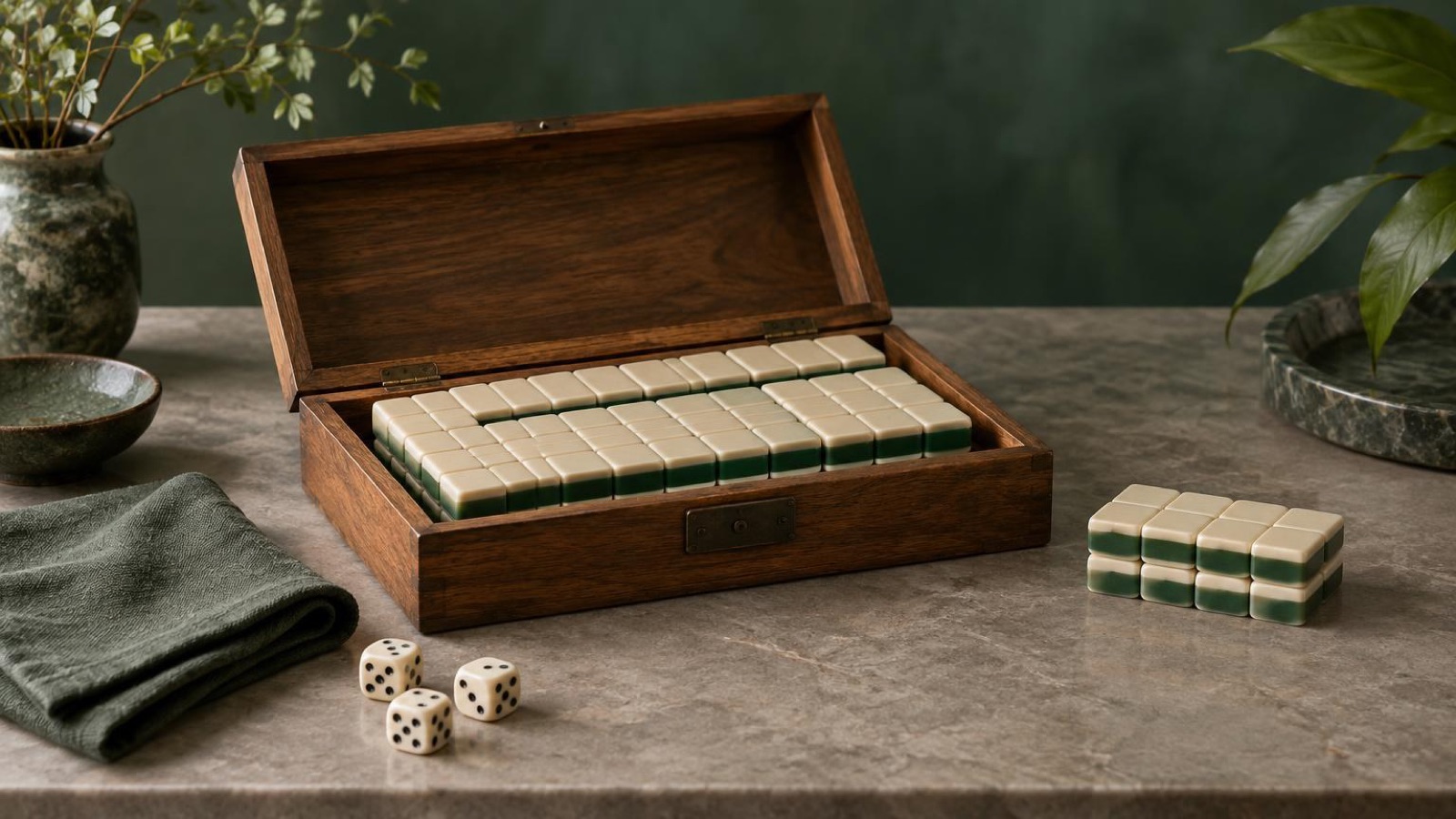
How many tiles are in a mahjong set: 136 or 144
The answer depends on where you are playing, but two numbers cover most of the mahjong played across Asia: 136 and 144.
The 144-tile set is the "full" set. It contains the three suits, the four winds, the three dragons, and eight bonus tiles: four flowers and four seasons. Hong Kong Old Style lists its set at either 136 or 144 tiles depending on the table, and a standard Hong Kong set is usually described as 144 tiles with four copies of every tile type1.
The 136-tile set is the same set with the eight flower and season tiles removed. That is the standard in Japanese mahjong, where flower and season tiles are omitted and the total comes to 136 instead of 1442. It is also the norm in northern China, where there are no flower and season tiles and players just use the 136 tiles7. The official riichi rules used in Europe state it plainly: with four of each tile, a mahjong set consists of 136 tiles8.
Beyond those two, regional variants shrink or stretch the set in every direction:
| Variant | Tiles in set | What is different |
|---|---|---|
| Japanese riichi | 136 | No flowers or seasons |
| Hong Kong | 144 | Full set with flowers and seasons |
| Beijing / northern China | 136 | No flowers or seasons |
| Western / British | 144 or more | Optional jokers, varying in number |
| Singapore | 148 | Basic set plus 4 animal flowers |
| Fujian | 124 | Three suits and 4 winds, no dragons |
| Korean | 104 | Dots, Craks, winds, dragons and 4 flowers only |
| Hunan, Sichuan, Tibetan | 108 | Suit tiles only, no winds or dragons |
So if you buy a set in a shop, you will most likely get 144 tiles, and if you sit down at a riichi table in Japan or a parlor in northern China, you will play with 136 of them. If you want to compare how these versions play, see mahjong variants.
The three suits: dots, bamboo and characters
Whatever the set size, the heart of mahjong is the three suits, and together they account for 108 tiles: 36 dots, 36 bamboo and 36 characters.
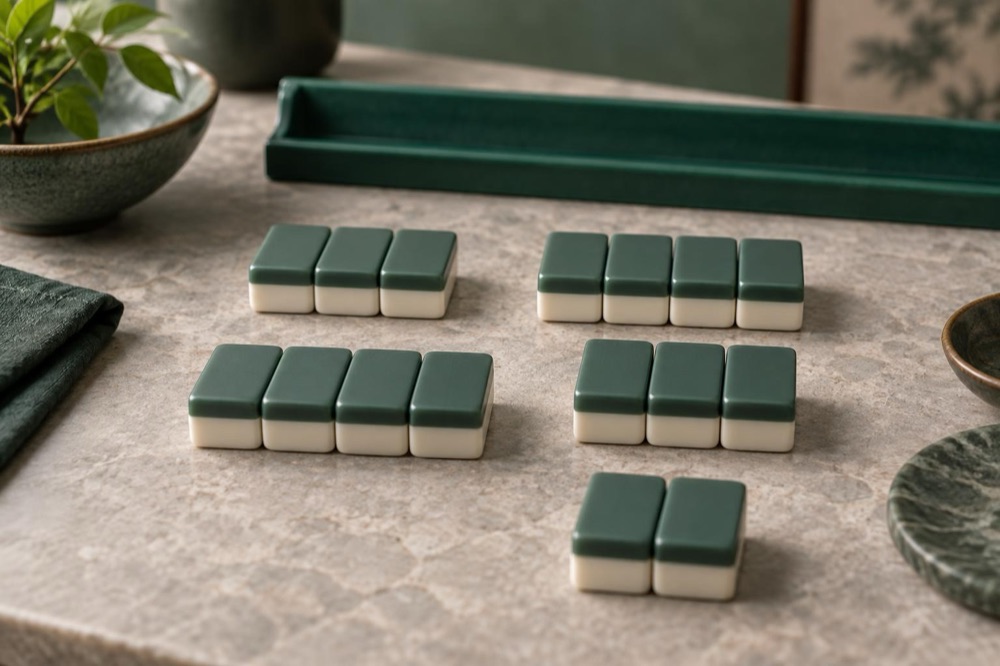
Each suit runs from 1 to 9, and each number appears four times. That gives nine unique tiles per suit, times three suits, times four copies, for 108 suited tiles in total. Filipino mahjong, which uses the standard 144-tile set, calls the suits sticks, dots and characters, and counts the same 108 suited tiles as the most important group in the game4.
- Dots (also called circles or balls) are shown as arrangements of circular symbols. The 1 of dots is a single large circle, and the count builds up to nine.
- Bamboo (also called sticks or bams) shows vertical bamboo stalks, except for the 1 of bamboo, which is traditionally a bird.
- Characters (also called cracks or myriads) show a Chinese numeral on top and the character for ten thousand, "wan," below. In Japan the suit is called manzu, and in the three-player game the 2 through 8 of characters are removed.
Macau's official rules for traditional mahjong describe the set the same way: four each of the 1 to 9 of bamboo, four each of the 1 to 9 of characters, and four each of the 1 to 9 of dots5. The suited tiles are the ones you will handle most, because runs, called chows, can only be made inside a single suit, and the biggest-scoring hands are made from a single suit alone.
Honors: winds and dragons
After the suits come the honor tiles: 16 winds and 12 dragons, again with four copies of each.
The four winds are East, South, West and North. They matter in two ways. Each player sits at a named seat, and a pung of your own seat wind is worth extra points; in Malaysian mahjong, a pung of North or East wind is worth 1 fan, and a pung of your own wind is worth 1 fan too, doubling to 2 fan if the dealer holds a pung of East10. Winds also name the rounds of a full game, which consists of four rounds named after each of the winds consecutively11.
The three dragons are usually called Red Dragon, Green Dragon and White Dragon. In Chinese sets the red dragon shows the character "zhong" (center), the green dragon shows "fa" (wealth), and the white dragon is a blank tile. Macau's rules list the three together as the dragons, four of each5, and a pung of a dragon is worth 1 fan in the Malaysian game10.
Not every variant keeps all the honors. Fujian mahjong uses three suits and the four winds but drops the dragons entirely, leaving a 124-tile set3. At the other extreme, the game of Pong uses 120 tiles: all the suited tiles plus the dragons, but no winds12. If you are learning the Japanese version, the honor tiles work the same way but feed into the yaku system, which is covered in riichi mahjong rules.
Flowers, seasons and bonus tiles
The eight tiles that decide whether your set has 136 or 144 tiles are the flowers and seasons: four of each, one each in a set.
They work differently from everything else in the game. You never keep a flower or season in your hand. When you draw one, you set it aside in front of you, show it, and immediately draw a replacement tile from the back end of the wall. The flower then simply adds points to your score if you win. In Malaysian mahjong the bonus tiles are unusually generous: one face, one animal, four flowers, four seasons, your own flower or season, or the number four flower or season are each worth 1 fan, and collecting all four flowers or all four seasons is another 1 fan each10.
Some sets go further. Singapore mahjong adds four animal flower tiles to the basic set, bringing it to 148 tiles3. Western and British sets can add jokers, in varying numbers, on top of the 1443. Malaysian mahjong is the most extravagant of all, with 24 flower tiles in the four-player game, including 16 numbered flowers and 8 unnumbered animal tiles13.
Japanese mahjong simply leaves all of these out, which is why the Japanese set stops at 136 tiles2. If you are used to playing with flowers and then sit down at a riichi table, do not be surprised that the bonus pile never appears.
Malaysian mahjong: 88, 84 and 164-tile sets
Malaysia plays mahjong with sets you will not find anywhere else, in both three-player and four-player versions.
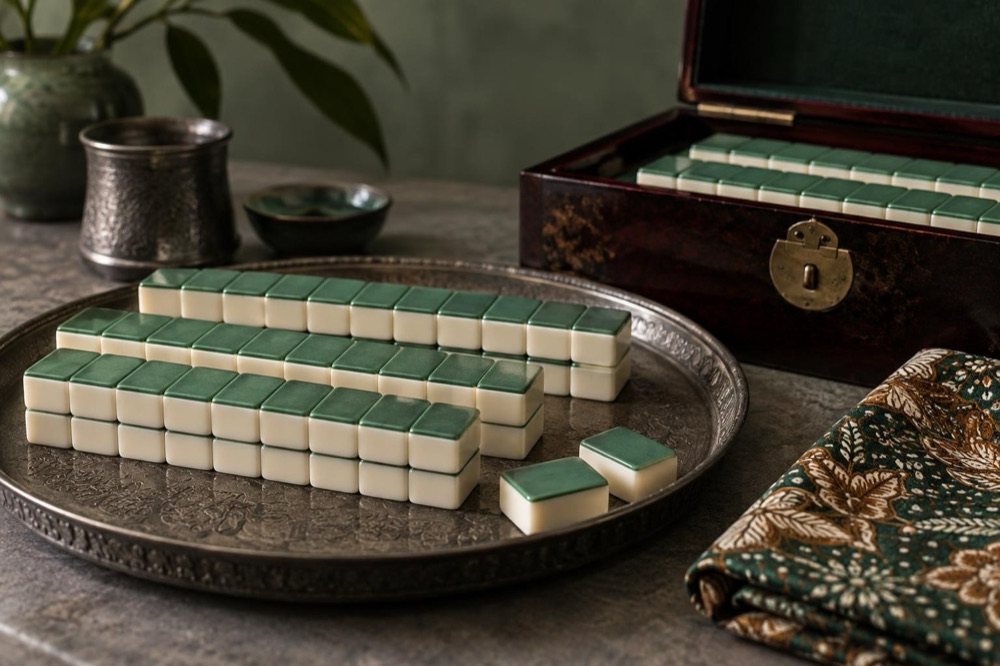
The three-player set contains 88 tiles, but only 84 are needed for play10. The breakdown is unusual: 36 dot tiles (only one suit is used), 16 wind tiles, 12 dragons, 8 flowers and seasons, 4 faces, 4 animals, and 4 Fly tiles, which are jokers10. A separate listing describes the same game as using 84 tiles made up of one suit, honors, 16 flowers and 4 jokers3. The four-player Malaysian game goes the other way entirely, with 164 tiles: the full 108 suited tiles, 28 honors, 24 flowers and 4 jokers13.
The Fly tiles are the distinctive part. A Fly can be used to represent any tile when you are making a three-tile set, so it is a true wildcard. There are limits: a Fly cannot be part of a Gong, and you cannot Pong with three Flies. You can use one Fly to Chow a discarded tile, and two Flies used to Chow count as a Pong instead. If two players Pong at the same time, the one without a Fly gets the tile13. A Fly can also act as a flower worth 1 fan if you find yourself short of the 5 fan minimum needed to win10.
Scoring is point-based. Winning is worth 100 points as a base, and each fan adds 20 points, so the minimum 5-fan winning hand is worth 100 points. A concealed Gong costs 100 points and a revealed Gong 50 points, with the discarder paying double. If you win by self-draw, each player loses double the winning points to you; if you win on a discard, the discarder pays double and the other player pays the base amount. Special hands called Max Fan double the score, and if a hand qualifies as more than one Max Fan type, the points multiply again, so a 200-point hand can become 600 or 1,000 by agreement between players10.
There are no round winds and no limit on the number of rounds. The game simply ends when two or more players agree to stop, and each round takes about 5 to 15 minutes10.
Three-player mahjong in Japan
Japan has its own three-player game, usually called sanma, and it is popular enough that dedicated three-player parlors exist west of the Chukyo area around Nagoya, a small number of free parlors in the Tokyo area offer it, most online mahjong sites have three-player tables, and current automatic tables can usually be set for three players14.
The tile set is the key difference. The standard version uses 108 tiles in 27 types, with the 2 through 8 of the manzu (character) suit removed14. Some regions, especially on the Seto Inland Sea side of western Japan, remove the 2 through 8 of bamboo instead of the characters14.
There is no North player. The seats are decided counterclockwise from the dealer as South and West14. This creates a payment quirk: when a non-dealer wins by self-draw, the dealer covers the missing North player's share entirely, and when the dealer wins by self-draw, the two other players split the payment. This is called "oya sanbai kaburi," or the dealer's triple burden14.
One rule disappears entirely: there is no Chi in the three-player game, so a player cannot claim a tile from the player to their left to complete a run15. A common game format is the east-south game, with three hands in each of the East and South rounds, for six hands in total, not counting drawn games14.
How the tiles are dealt: walls and starting hands
Every game of mahjong starts the same way: the tiles are shuffled face down in the middle of the table, and the players build them into a square wall.
In the standard 136-tile game, all the tiles are shuffled face down and four square walls are built with 34 tiles each7. Another way to picture it: each player builds a wall seventeen tiles long and two tiles high, and the four walls together form a square16. Macau's official rules describe the same thing, with four rows of stacks two tiles high, seventeen stacks in total, arranged in a square5. In the Malaysian three-player game, each player builds a 14-tile-long wall, two tiles high as in other forms of mahjong13.
Then the dice are thrown to decide where the wall is broken, and hands are dealt. In the 13-tile variations, tiles are dealt in groups until all players have 12 tiles, then one more is dealt to make a 13-tile hand17. Each player draws 13 tiles, with the dealer starting with an extra 14th tile so they can open the game with a discard7. The Malaysian game works the same way: the dealer starts with 14 tiles and the other players with 1313.
The dealer marker, a small token, sits in front of the dealer and passes on as the game progresses. A full set of equipment for the traditional game is a set of 136 tiles, one dealer marker, three dice and a standard mahjong table5.
What a winning hand looks like: four sets and a pair
The goal of all this dealing is the same everywhere: assemble a winning hand of 14 tiles made of four sets and a pair.
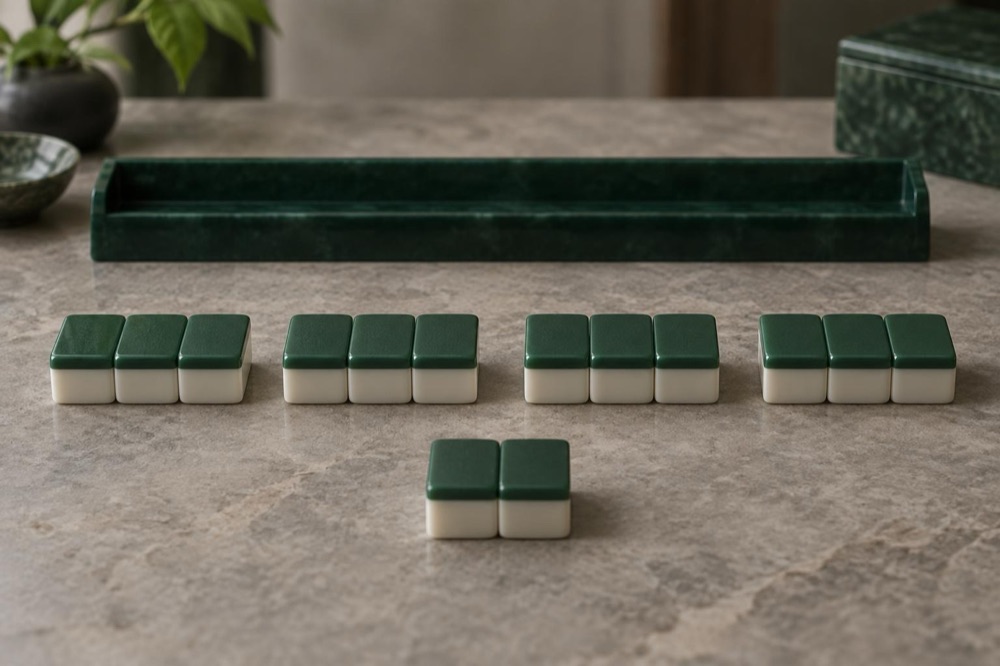
A standard winning hand uses 14 tiles: four sets of three tiles plus one pair6. The sets can be of three kinds:
- Chow: a run of three consecutive numbers in one suit, like 4-5-6 of bamboo. An exposed chow may only be declared off the discard of the player on your left, and in some parts of China the chow is not allowed at all7.
- Pung: three identical tiles, such as three red dragons.
- Kong: four identical tiles. Any player completing a kong immediately draws an extra tile from the end of the wall before discarding, to keep their hand at the right size7.
A winning hand is four sets of pungs, chows or kongs and a pair18, and in the 13-tile Hong Kong style, four sets of three tiles plus a pair wins you the round19. A player who only needs one more tile to win is said to be "fishing"11.
Not every game uses the 14-tile target. Filipino mahjong deals bigger hands: the goal is to arrange your tiles into five sets of three, called "bahay," plus one pair, called the "eye"4. And Macau's casino-style "Simple Mahjong" shrinks the game the other way, with hands of just five tiles, one set and one pair, and the same kong rule of drawing a replacement from the wall end5. Malaysian four-player mahjong keeps the standard shape: hold 13 tiles in the hand, go out on 1413.
If you want to go deeper into turns, melds and the flow of play, see how to play mahjong, and for how hands are valued, see mahjong scoring.
When two players want the same tile, or the wall runs out
Two situations come up in almost every game: two players call for the same discarded tile, and the wall runs down to its last tiles.
When a tile is discarded, any player can claim it, but the calls have a strict order of priority: Mahjong, before Kong, before Pung, before Chow11. Another way of saying it: "Pung" takes precedence over "Chow," and "Mah Jongg" takes precedence over all20. If two players call Mahjong on the same discard at the same time, the tie is settled in the order Kong, before Pung, before Pair, before Chow11. The Malaysian game adds its own twist: if two players Pong at once, the one without a Fly gets the Pong13.
The wall does not run all the way down. A game is drawn when the last 14 tiles, including any loose tiles created by kongs and flowers, remain in the wall, and no scores are taken for that hand11.
One practical note on money. In China, mahjong is usually treated as a recreational activity rather than gambling, but it can attract legal sanctions when gambling is involved, and stakes vary widely: a single base can be 200 to 1,000 yuan, with some games reaching 10,000, and a plain complete hand might cost 2 yuan while a top hand costs around 50 yuan per hand21. Playing for small stakes among friends is the norm; playing for money in Japan, for example, is treated as gambling regardless of the amount, though sponsored competitive tournaments with prize money are treated differently2. For where the game sits in each jurisdiction, see where Asian games are legal.
Common Questions
How many tiles does each player start with?
In the standard four-player game, each player starts with 13 tiles, and the dealer takes an extra 14th tile so they can make the first discard. In Malaysian three-player mahjong the dealer also starts with 14 tiles while the others take 13.
How many of each tile are there in a set?
Almost every tile comes in four identical copies. That means four of each numbered suit tile, four of each wind, four of each dragon, and four copies of each flower or season tile. A 136-tile set is simply the 144-tile set without the eight flower and season tiles.
What are Fly tiles used for in Malaysian mahjong?
A Fly is a joker that can stand in for any tile when you are making a three-tile set. You cannot put one in a Gong, and you cannot Pong with three Flies, but a Fly can also count as a flower worth 1 fan if your hand is short on points.
Is there a North player in three-player mahjong?
No. The three players are called East, South and West, and the seats are decided counterclockwise from the dealer. In the Japanese three-player game, payments that would have gone to the missing North player are covered by the dealer or split between the other two players.
How long does a round of Malaysian three-player mahjong take?
Each round takes about 5 to 15 minutes. There are no round winds and no fixed number of rounds, so the game simply ends when two or more players agree to stop.
What happens if the wall runs out of tiles?
The game is a draw. In the standard rules a game is drawn when the last 14 tiles, including any loose tiles, remain in the wall, and no scores are taken for that hand.
Which call wins if two players want the same tile?
A call of Mahjong beats everything. After that, Kong comes before Pung, and Pung comes before Chow. If two players call Mahjong on the same discard, the tie is settled Kong, then Pung, then Pair, then Chow.
Sources21 sources
- Hong Kong Old Style Mahjong, Mahjong Wikidot, 2026
- Gambling in Japan, Oxford Brookes University, 2007
- Mahjong FAQ: Variants, Sloperama, 2002
- Official Filipino Mahjong Rules, Mahjong Pros, 2026
- Legal Mahjong Gaming Rules, DICJ Macau, 1991
- Limit Hands in Hong Kong Mahjong, TileBuddy, 2026
- Chinese Mahjong Culture, China Educational Tours, 2026
- EMA Riichi Rules 2016, Mahjong Europe, 2016
- A Guide to Mahjong, Mahjong MIL, 2024
- Malaysian 3-Player Mah-Jongg, Sloperama, 2026
- How to Play Mahjong: Rules and Guidelines, NA Japan, 2007
- Pai Tong, Porg.es, 2025
- Malaysian Mah-Jongg, Sloperama, 2026
- Three-Player Mahjong, Japanese Wikipedia, 2026
- Three-Player Mahjong Introduction, Japanese-Mahjong.com, 2010
- NMB Spelregelboekje, Nederlandse Mahjong Bond, 2019
- Mahjong Dealing Chart, Righto, 2009
- Mahjong Game Rules, Mahjong Time, 2026
- Mahjong, the Board Game, Slate, 2024
- Mahjong, BoardGameGeek, 2026
- Mahjong Stakes in China, Zhihu, 2026