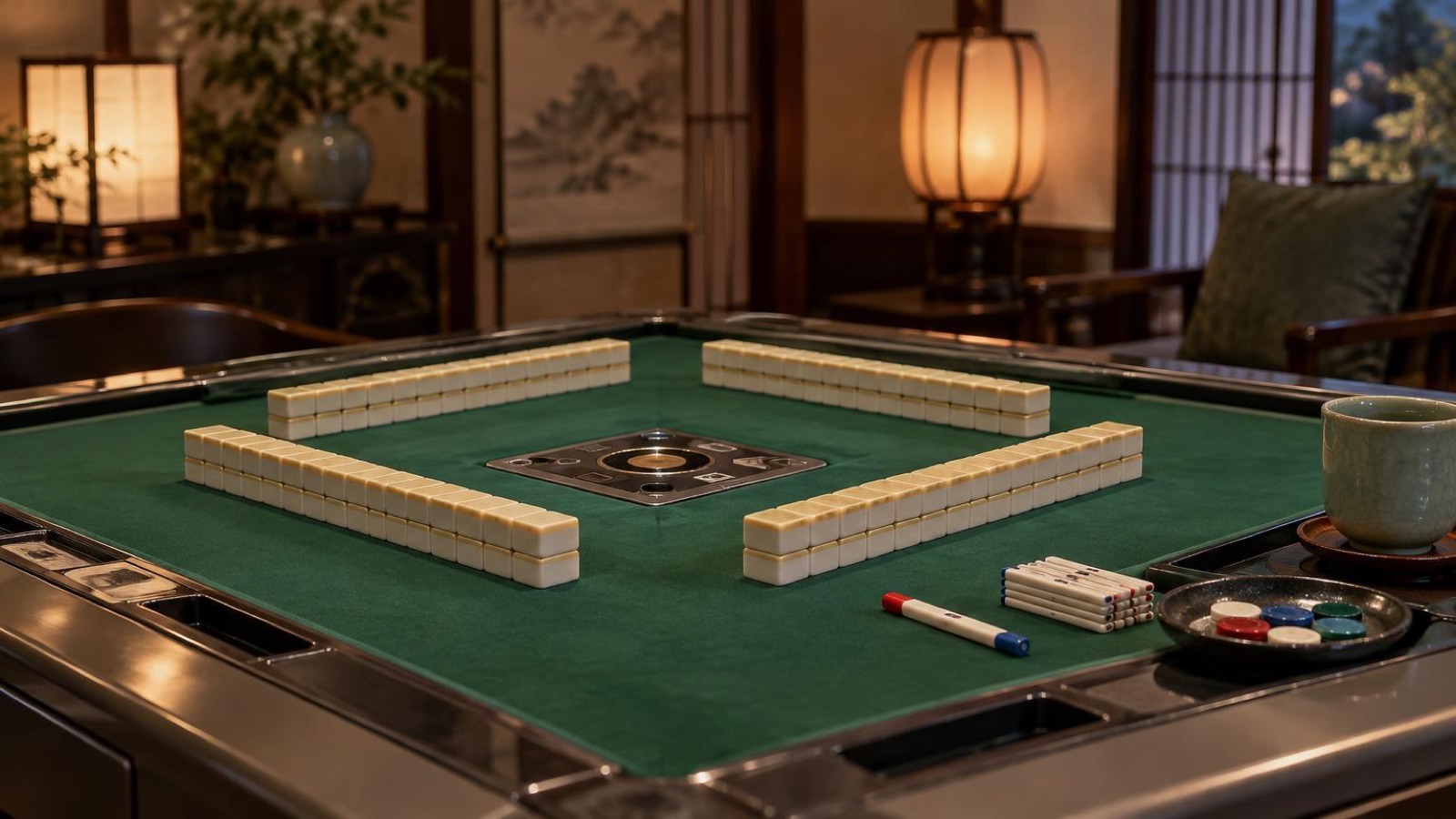
The tile set: 136 tiles and what was left out
Japanese mahjong uses 136 tiles instead of the 144 found in many other versions, because the flower and season tiles are omitted entirely1. That single change shapes the whole game: there are no bonus tiles to draw and set aside during play, no flower payments, and every tile in the wall belongs to the three suits or the honors.
The set breaks down like this:
- Three suits of 36 tiles each: characters (man), circles (pin) and bamboo (sou), numbered 1 through 9, with four copies of each tile.
- Four winds: East, South, West and North, four copies each.
- Three dragons: white, green and red, four copies each.
The tile names are largely borrowed directly from Chinese, so if you already know Chinese mahjong terminology you will recognize most of the vocabulary6. What you will not find are the eight flower and season tiles, nor the jokers that some other regional versions add. In rules that do keep flowers, collecting all four flowers or all four seasons is worth 1,000 points from each player, but in the Japanese game that bonus simply does not exist7.
How a hand works
Each player is dealt 13 tiles, and the dealer starts with 14. On your turn you draw a tile and discard one, aiming to build a complete hand. A winning hand is four sets of pungs (three identical tiles), chows (three consecutive tiles of one suit) or kongs (four identical tiles), plus one pair2.
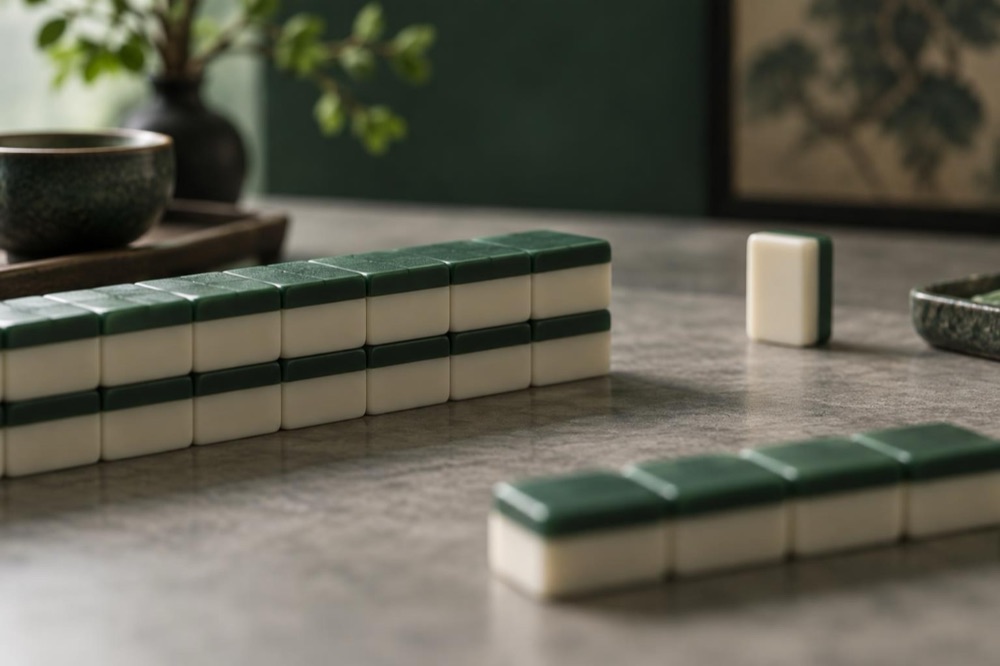
Players can also speed up their hands by claiming each other's discards: calling a pung or kong on a discarded tile, or a chow on the discard of the player to your left. One thing you may not do is call a chow and then discard a copy of the tile you just claimed in the same turn; this is called kuikae and it is disallowed under standard riichi rules8.
The dealer position matters throughout. When the dealer wins, or in most rules when the dealer is one tile from winning at a drawn hand, the dealer keeps the seat for another hand; this is called renchan9. When the dealer's hand ends without that, the deal rotates to the player on the dealer's right, called rinchan9. Some venues and rules use a stricter version, agari renchan, where the dealer only continues after actually winning, not merely being ready at a draw9.
Riichi: declaring ready and adding a han
Riichi is the rule that gives the game its name. When your hand is complete except for one tile, you may declare riichi: you bet 1,000 points, place it on the table, and lock your hand. From then on you can only draw and discard, waiting for your winning tile. If you win, the riichi declaration adds one han to your hand's value4.
Two conditions apply. You cannot declare riichi with fewer than 1,000 points10. And after declaring, your hand is fixed, with one exception: you may still form a concealed kong after riichi, provided the change does not alter which tiles you are waiting on11.
The 1,000-point riichi bet is not lost to the other players in the usual way. If you win, it comes back to you as part of your score; if the hand is drawn, it carries over to the next hand. In some rule sets, such as the Mangan variant, players do not have to bet 1,000 points to declare riichi, but in standard Japanese play the bet is required8.
How scoring works: base points and doubles
Riichi scoring starts from two ingredients: fu, the base points of the hand, and han, the doubles. Every winning hand is awarded 20 fu automatically, called the fuutei, before anything else is counted12. Han come from yaku, the patterns and situations that make a hand valid: riichi itself, a hand with no triplet and an open wait (pinfu), self-draw, and so on. Dora tiles add han too: a typical dealer win might combine riichi (1 han), pinfu (1 han), one dora and one hidden dora for a total of 4 han12.
The base points are then multiplied by the han, and the payment is rounded up, with any fraction under 100 points rounded up at the moment of payment12. A worked example from the standard score tables: a 40 fu, 2 han hand won by self-draw as a non-dealer means the dealer pays 1,300 points and each other non-dealer pays 700; won by discard, the discarder alone pays 2,60012. The same waiting shape can score differently depending on how you take it: a 30 fu, 3 han win taken as a closed wait scores as 40 fu, 3 han, paying 1,300 to 2,60012.
Two limits keep the tables manageable. The highest fu count that appears in a standard score table is 110, because any hand of 120 fu or more under 5 han always has at least 4 han and reaches the mangan tier anyway12. And under unlimited-fu rules, the theoretical maximum fu is 170, from four concealed kongs of terminals plus an honor pair wait12.
Some local rules reject the pinfu-plus-self-draw combination, scoring such a win as 20 fu base plus 2 fu for the draw, rounded up to 30 fu12. It is worth asking which convention a parlor uses before you sit down.
Payouts: what the winner collects and who pays extra
The payment multipliers are fixed and easy to remember12:
| Situation | Who pays | Multiplier |
|---|---|---|
| Non-dealer wins by discard | discarder | base points x 4 |
| Dealer wins by discard | discarder | base points x 6 |
| Dealer wins by self-draw | each non-dealer | base points x 2 |
| Non-dealer wins by self-draw | dealer | base points x 2 |
| Non-dealer wins by self-draw | each other non-dealer | base points x 1 |
The principle behind the table: East always pays and receives double3. The winner receives in full from the players according to these multipliers and pays nothing out to anyone else3.
In the three-player game, sanma, the same idea is adjusted because there are only two payers. Ron wins are scored exactly as in four-player mahjong, the dealer's self-draw is split between the two non-dealers, and a non-dealer's self-draw is paid by the dealer and the other non-dealer at a 5:3 ratio13. Because a self-draw collects from two players instead of three, a tsumo win is worth roughly one third less for the dealer and one quarter less for a non-dealer than the same hand won by discard; this is called tsumo-son13. Some rules compensate: in the baidori variant common in Kyoto and Tokyo, the winner receives the full ron-equivalent amount from both players, doubling the income13. Another adjustment, sen-ten kafu, adds 1,000 points to each of the other two players' payments on a self-draw13.
Special hands and bonuses
The top of the scoring ladder is the yakuman, a limit hand worth 32,000 points as a non-dealer or 48,000 as a dealer. In the three-player game the yakuman payouts under the common rulesets look like this13:
| Ruleset | Dealer tsumo | Non-dealer tsumo |
|---|---|---|
| Marudori 1 | 48,000 (24,000) | 32,000 (10,700 / 21,300) |
| Marudori 2 | 32,000 (12,000 / 20,000) | 32,000 (8,000 / 24,000) |
| Split payment | 32,000 (16,000 / 16,000) | 32,000 (8,000 / 24,000) |
Dealer ron: 48,000
Non-dealer ron: 32,000
An optional rule for the ambitious: if agreed beforehand, when the dealer wins eight hands in a row, paarenchan kicks in, letting the dealer finish with a win whether or not the hand contains a yaku, and scoring it as a yakuman if completed11.
Dead hands and penalties at the table
You must always hold exactly 13 tiles at one time, other than the dealer at the start of a hand. If by error you have more or fewer, your hand is considered dead3. A dead hand is a serious position: you may no longer win, you receive no points, but you must still pay the other players when someone else makes mahjong13.
Other table penalties are lighter. If the rules require announcing discards and you name the wrong tile, the penalty is 50 points7. When a hand ends with no winner, each player who was not ready pays 1,000 points to each player who was ready, which is the pressure that keeps everyone pushing for a complete hand11.
Where to play
Mahjong parlors (jansou) are found across Japan; a parlor in Osaka where people play mahjong is a typical example of the venue14. Play is usually settled in points converted to money at a rate: at the common "pin" rate, 1,000 points equals JPY 1005. A session's win or loss is the difference between your final points and your starting points, multiplied by the rate.
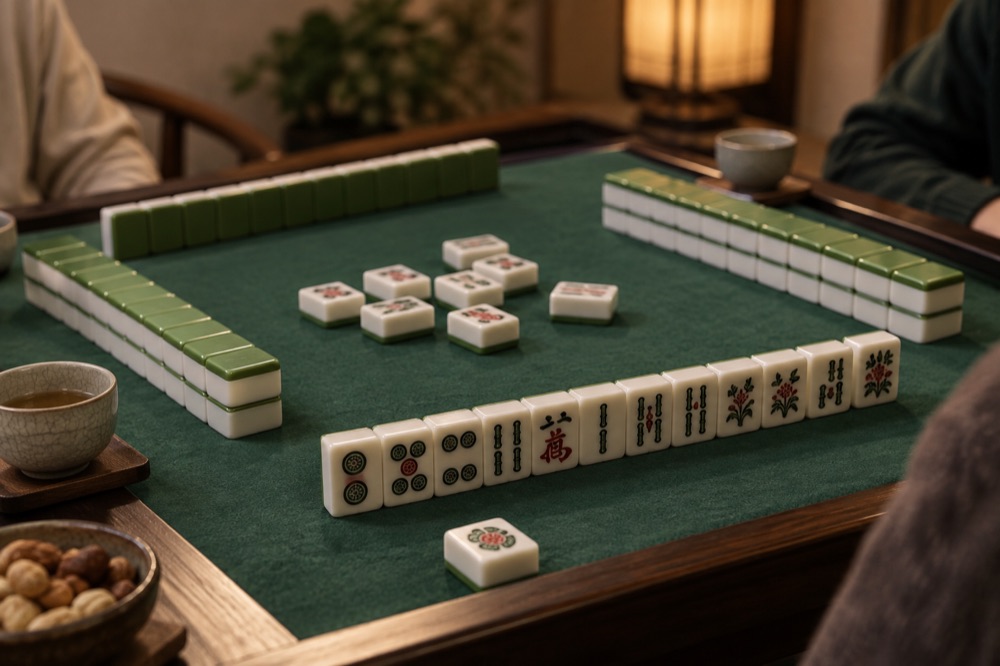
Three-player mahjong, sanma, is widely available too. Dedicated three-player parlors exist west of the Chukyo area around Nagoya, and a small number of set-free parlors in the Tokyo capital area now offer it; most online mahjong sites have three-player tables, and current automatic tables can usually be set for three players13. The standard sanma set uses 27 tile types and 108 tiles, excluding the 2 through 8 of characters13, though some regions, especially on the Seto Inland Sea side of western Japan, remove the 2 through 8 of bamboo instead13. In most sanma rules you cannot call a chow on another player's discard, only on tiles you draw yourself15, though some local versions such as Yokosuka mahjong do allow chow calls13.
Online, the biggest name is Mahjong Soul, a Chinese-made game that follows the Japanese riichi rules and has drawn a large international following16. It has been described as an online game that adopted the classic Japanese mahjong gameplay, and it became one of the most-played games on Steam. For a first taste of riichi without money at stake, it is a reasonable place to learn the flow of a hand.
If you are in Japan and want the broader gambling landscape, see gambling in Japan and the traditional Japanese gambling games page.
M.League: professional riichi in Japan
Riichi went professional in October 2018 with the founding of M.League, Japan's professional mahjong league. It selects and trains professional players from across Japan, and its high prize money has attracted many young players into the game6. Matches are team-based, played under standard riichi rules, and broadcast, which has done a great deal to move mahjong's image in Japan away from the smoky parlor stereotype.
For a sense of how seriously the rules are standardized at that level: tournament play such as the MSMC annual tournament uses standard Japanese riichi rules with no red fives in play8. The same rules you would learn in a parlor or on Mahjong Soul are the ones on television, which is part of why the game is so approachable for a visitor who puts in a little study first.
Common Questions
How many tiles does Japanese mahjong use?
Japanese riichi mahjong uses 136 tiles. The flower and season tiles found in some other versions are left out entirely, so there are no bonus tiles to draw during play. The set is three suits of 36 tiles plus 16 wind and dragon tiles, and the tile names are largely borrowed directly from Chinese.
What is riichi in mahjong?
Riichi is a bet you declare when your hand is complete except for one tile. You place 1,000 points on the table and lock your hand, and if you win the riichi adds one han to your score. You cannot declare it with fewer than 1,000 points, and after declaring you may only wait for your winning tile.
How much is a bouquet of four flowers or seasons worth?
Nothing in Japanese mahjong, because the flower and season tiles are not in the set at all. In rules that do use them, collecting all four flowers or all four seasons is worth 1,000 points, paid by each of the other players.
What happens if you discard the wrong tile name?
In rules that require you to announce each discard, naming the wrong tile costs you 50 points as a penalty. In practice most Japanese play does not require calling discards aloud, but if you are playing under rules that do, be careful with the names.
What is a dead hand in mahjong?
A dead hand is one with the wrong number of tiles. You must always hold exactly 13 tiles, other than the dealer at the start of a hand. If you have more or fewer by error, your hand is dead: you can no longer win, you receive no points, but you still have to pay the other players when someone wins.
How does East pay and receive differently?
The player sitting East, the dealer, always pays and receives double. When East wins by discard, the discarder pays six times the base points instead of four. When another player wins by self-draw, East pays twice what the other non-winners pay. East also keeps the dealer seat when a hand is drawn and East was ready.
Sources16 sources
- Gambling in Japan, Oxford Brookes University, 2007
- A Guide to Mahjong, Mahjong International League, 2024
- How to Play Mahjong: Rules and Guidelines, NA Japan, 2007
- Learning Japanese board game culture from Yakuza 0, Polygon, March 10, 2017
- Mah-jongg ancient and progressive, The Japan Times, June 15, 2010
- 麻雀 (Mahjong), Zhihu, 2019
- How to Play Mahjong: Rules and Guidelines (archived), Japanese-Mahjong.com archive, 2007
- How to Play Mahjong: Rules and Guidelines (archived), Japanese-Mahjong.com archive, 2004
- 連荘 (Renchan), Wikipedia, 2026
- 麻雀格闘倶楽部 (Mahjong Fight Club), Wikipedia, 2026
- 麻雀の得点計算 (Mahjong score calculation), Wikipedia, 2026
- 三人麻雀 (Three-player mahjong), Wikipedia, 2026
- 麻雀 (Mahjong), Wikipedia, 2026
- Mah-Jongg FAQ 13c, Sloperama, 2007
- Chinese anime and Japanese mahjong: clandestine battle between digital content economies, Baker Institute, May 10, 2023
- I think it's neat how one of the top games on Steam is mahjong with anime girls, Vice, April 16, 2025