What fan, faan, han and fu mean
If you have played mahjong in more than one country, you have probably noticed that nobody agrees on how to value a hand. The words on the table change, but the ideas fall into a few clear families.
Fan (also written faan, 番) is the doubling unit of Chinese-style mahjong, especially Hong Kong Old Style. Each pattern in your hand earns a number of fan: a pung of dragons might be one fan, a full flush several more, and the famous Thirteen Orphans hand is worth 13 fan in Hong Kong 13-tile play5. The fan total is then used to look up or calculate a payment. In Malaysian three-player mahjong, one fan equals 20 points, so a minimum five-fan hand starts at 100 points6.
Some tournament rules take the faan count and square it to produce the final "portion" paid by each loser, which is why a hand that jumps from 4 faan to 5 faan is worth far more than the extra faan suggests3.
Han (翻) is the Japanese equivalent of fan: each yaku, or scoring pattern, adds han to the hand. Fu (符) is the second half of the Japanese system: a fine-grained point count for the structure of the hand, based on how your sets were made and how you won. A hand is described as, say, "40 fu 2 han," and the payment comes from a table that combines the two2. Section 5 below works through this in detail.
The third family, classical scoring, skips fan entirely: you count raw points for your pungs, kongs and pair, add a flat score for going out, then double the total once for each pattern the hand contains. A 100-point hand with 6 doubles is worth 6,400 points7.
The tile set and the winning hand
Scoring makes no sense without knowing what a hand is, so here is the common ground. A standard Chinese set has 136 tiles: 108 suit tiles (bamboos, circles and characters, each numbered 1 to 9) and 28 honor tiles (winds and dragons). All 136 are shuffled face down and built into four square walls of 34 tiles each; each player draws 13, and the dealer starts with a 14th8.
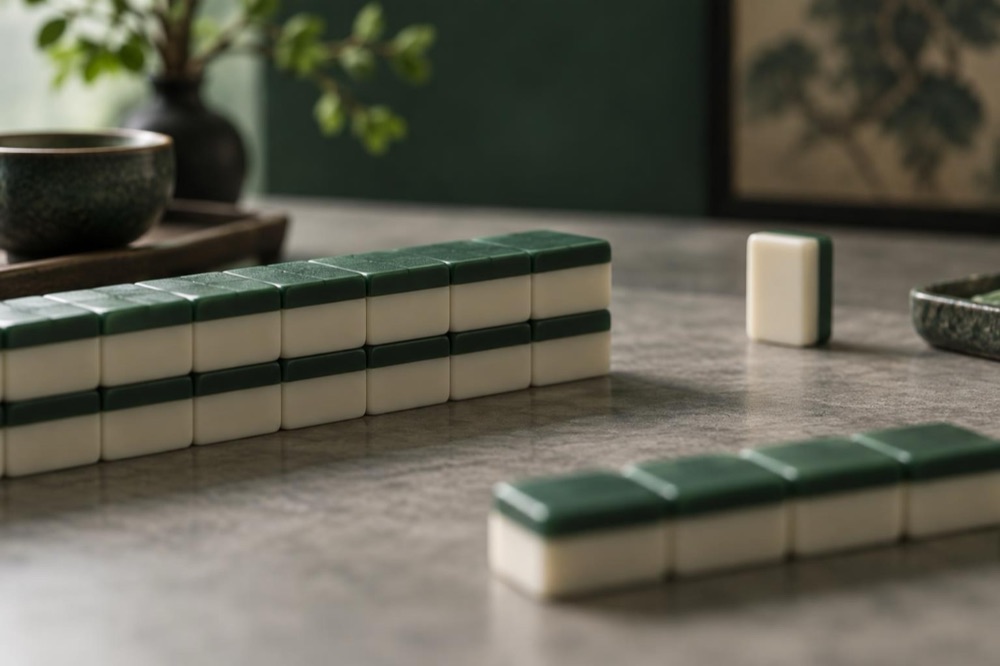
The winning hand is four sets of three tiles plus a pair, 14 tiles in total. In the 13-tile Hong Kong style, four sets of three plus a pair wins you the round9. A set can be a pung (three identical tiles), a kong (four identical tiles, which requires drawing a replacement tile) or a chow (three consecutive tiles of one suit)8.
Variants trim or expand this. Three-player Japanese mahjong (sanma) removes the 2 through 8 of characters, leaving 27 types and 108 tiles10. Malaysian three-player mahjong uses 84 tiles: one suit, honors, 16 flowers and 4 jokers3. Fuzhou style plays with 132 tiles, having removed one honor, probably the White dragon3. Vietnamese mahjong adds 16 bonus tiles: four flowers, four seasons, four kings and four queens11. Macau's licensed Traditional Mahjong builds four rows of 17 two-tile stacks into a square wall, while its simplified Simple Mahjong uses 14 stacks and a five-tile winning hand of one set and one pair12.
Hong Kong Old Style: the three-fan minimum and the fan cap
Hong Kong Old Style is the system you will meet in mahjong parlors in Hong Kong and across much of southern China. Its two signature rules are the minimum and the cap.
The minimum: most Hong Kong games require three fan to win (三番起糊). A hand with only one or two fan cannot be declared1. Flowers help here, but only partly: each flower tile (spring, summer, autumn, winter, plum, orchid, bamboo, chrysanthemum) counts as one fan, but these are not counted toward the three-fan minimum; they are added only after you have won13. The dealer's position also counts for at most one fan toward the minimum13.
The cap: hands are cut off at a maximum. In common Hong Kong play the cap is 8 or 10 fan, or sometimes no cap at all, and it is agreed before the game starts1. In the 13-tile version used by the GodGame platform, hands exceeding 13 fan are counted as 13 fan13.
What earns fan? Small patterns add up quickly. A triplet or kong of 1s, 9s or wind tiles (么九刻) is one fan; robbing another player's kong (搶槓和) is one fan; Thirteen Orphans is 13 fan; and four kongs (十八羅漢, Eighteen Immortals) is 13 fan5. Macau's licensed Traditional Mahjong lists one-fan hands including any dragon pung or kong, the prevailing wind, your own seat wind, robbing an exposed kong, winning on a kong's replacement tile, an all-pung hand, a chow hand, a mixed one-suit hand, a win on the last tile, little three dragons, little four winds and mixed terminals; two-fan hands include the heavenly and earthly hands, a full flush, Thirteen Orphans, big three dragons, big four winds and pure terminals12.
If you declare a win on a hand under three fan, it counts as a false win (食詐糊), and the offender pays all three other players1. Malaysian three-player mahjong takes a different route: it requires a minimum of five fan to win, and hands that reach "Max Fan" conditions, such as Thirteen Unique Wonders, Nine Gates, four kongs or sixteen flowers, simply double the score6.
Hong Kong Old Style: how much each player pays
Once the fan are counted, the money moves. Hong Kong Old Style prices the game with a base unit agreed before play. A common setting is "一二蚊" (one-two dollars). Under it, a three-fan self-draw win costs each player HKD 8; if instead you win off a discard, the discarder pays HKD 16 and the other two players pay HKD 4 each1.
The general principles behind that example:
- Self-draw (自摸): each player pays the same amount. The calculation is simple because everyone pays identically1.
- Discard win (出銃): the player who discarded the winning tile pays double, and the other two pay single1.
- Dealer wins and loses double: in Macau's licensed rules, when the dealer wins, all three other players pay double; when a non-dealer wins, the two other non-dealers pay single and the dealer pays double12.
The same discarder-pays-double logic appears elsewhere. Malaysian three-player mahjong has the discarder lose double the winning points while the third player loses only the single amount6, and in the American game the player who discarded the winning tile pays double the worth of the hand7. The dealer's double liability on a self-draw loss is formalized in Japanese play as oya-kaburi (親かぶり): when a child wins by self-draw, the dealer pays twice the normal amount14.
Three-player Japanese mahjong, which has no fourth player to share the bill, has evolved several ways to split a self-draw payment: some rules split the dealer's tsumo equally between the two children, others weight a child's tsumo between dealer and child at 2:1 or 5:3, and some simply skip the absent north player's share, which lowers a tsumo win by about a third for the dealer and a quarter for a child compared with a discard win10.
Japanese mahjong: fu and han, and the point limits
Riichi mahjong, the Japanese variant, scores every hand with two numbers: han from your yaku (see riichi mahjong rules) and fu from the hand's structure. The two multiply into a basic point value, which is then rounded up and multiplied depending on who won and how.
A worked example: a 40 fu 2 han hand won by a non-dealer (child). On a self-draw (tsumo), the dealer pays 1,300 points and each other child pays 700; on a discard win (ron), the discarder pays 2,6002. The same hand taken as a closed wait instead scores 40 fu 3 han, paying 1,300 from each child and 2,600 from the dealer on a tsumo2.
Fu itself is a count of details: how your sets were formed (concealed pungs beat exposed ones, terminals and honors beat simples), whether the pair is honor tiles, and how you won. The highest fu count that ever appears in a standard score table is 110, because hands of 120 fu or more always carry at least 4 han and reach the mangan threshold anyway2. Under unlimited-fu rules (aotenjou), the theoretical maximum is 170 fu, from four concealed kongs of terminals plus an honor pair wait2. One regional quirk: some local rules refuse to combine the pinfu yaku with a self-draw win, scoring it as 20 + 2 = 22 fu rounded up to 302.
The limits come in two layers. First, fu is capped at 110 in practice and payments are capped at mangan, a fixed ceiling reached at 5 han, or 4 han and 40 fu, or 3 han and 70 fu. Above mangan, payments step through fixed levels rather than doubling forever. A popular optional rule, kiriage mangan, rounds 30 fu 4 han and 60 fu 3 han up to mangan, turning a child's 7,700 into 8,000 and a dealer's 11,600 into 12,0002. Some game titles count those 7,700 and 11,600 hands as a special rule category of their own15.
Competitive play adds structure on top. In Mahjong Fight Club's four-player mode, starting points are 20,000 for East-only games and 25,000 for half-games, with placement points of +5,000 for first and -5,000 for fourth, and uma of 12,000 points on the table varying by how many players finish above the starting point15. In its three-player mode, each honba (repeat counter) adds 600 points15.
For comparison, the official Mahjong Competition Rules used in Chinese tournament play require a hand to score at least 8 points before it can be declared a win16, a minimum in the same spirit as Hong Kong's three fan.
Points for pungs, kongs and pairs
Before fan tables existed, mahjong was scored the classical way, and the older systems still in use (Chinese Classical, Malaysian, Western) follow the same recipe: score a flat amount for going out, add points for your melds, then double.
- Chinese Classical: score 10 or 20 points for Out, then count points for pungs, kongs and pairs, then double3.
- Malaysian four-player: score 50 points for Out, then count points for pongs, kongs, pairs and flowers, then double3. Western/British scoring is the same with a 20-point base3.
- Malaysian three-player: kongs carry the big numbers. A concealed gong is worth 100 points, and a revealed gong 50 points, with the discarder of a revealed gong's fourth tile losing double, 100 points6.
The doubling step is where classical hands explode: a 100-point hand with 6 doubles is worth 6,400 points7. Vietnamese mahjong follows Chinese Classical scoring, with the twist that only the winner's hand is scored in most rules, and points double for every set built on a king or queen tile with a matching number11.
In ts'ung shap, the earliest American account of the game, individual captures carried their own prices: a pair (tái) counted 10 for each spot on it, a three-piece combination that was a multiple of 10 counted 1 for each spot, and a sweep (táp tí) counted 4017.
Claim priority when two players want the same tile
Scoring only starts once someone wins, and sometimes two players want the same discarded tile at the same moment. The universal answer is a fixed priority order: a winning call (Mahjong) beats a kong, a kong beats a pung, a pung beats a pair, and a pair beats a chow7.
If one discard would let two or three players win at once, Macau's licensed rules give the win to the player seated to the discarder's lower right, counting counterclockwise12.
Two related rules shape when you can claim at all. An exposed chow may only be declared off the discard of the player on your left, and in some parts of China chows are not allowed at all8. Three-player Japanese mahjong bans chi entirely, to prevent early cheap wins10.
Betting mahjong for money in Japan
In Japan, mahjong points are routinely converted into cash, and the conversion has its own vocabulary. The rate is quoted per 1,000 points18:
| Name | Rate per 1,000 points |
|---|---|
| 点1 (ten-ichi) | JPY 10 |
| 点5 (tengo) | JPY 50 |
| ピン (pin) | JPY 100 |
| リャンピン | JPY 200 |
| デカピン | JPY 1,000 |
| デカデカピン | JPY 10,000 |
Parlors post rates with weather-style names: a sign reading 風速0.5 (wind speed 0.5) means JPY 50 per 1,000 points18.
The parlor itself does not take a cut of the game. It charges by the hour, and the law caps the fee: JPY 600 per hour per person at a fully automatic table, or JPY 500 at other tables, plus consumption tax; calculated per table, the caps are JPY 2,400 and JPY 2,000 per hour4. In practice, a research survey found parlors charge around JPY 1,000 per hour for adults and as little as JPY 500 for students, making mahjong a relatively affordable night out19.
Where money changes hands between players, the legal line is strict in principle: gambling other than public gambling is a crime under the Penal Code, and money stakes are not treated as momentary entertainment no matter how small the amount18. The recognized exceptions matter in practice. When the loser's payment does not come from the players themselves, or the winner's gain does not reach the player, there is no gambling offense: this is exactly the structure of sponsored competitive tournaments, where prize money comes from sponsors18. Video mahjong machines in arcades follow the same logic as pachinko-adjacent games: players can bet with borrowed medals, but won medals cannot be exchanged for anything of value18. Casino resorts offering mahjong among their table games price it in house points instead: at Paradise City in South Korea, a riichi declaration earns +2 points on a win20.
China: recreational play versus gambling stakes
Mainland China draws its line at profit motive and stake size, not at the tiles. The guidance is consistent across official notices: mahjong or poker with money stakes among family members or relatives, not for profit, is not treated as gambling21, and the same applies to games with small stakes among non-relatives, which are generally not to be deemed gambling and not punished22. The test is subjective: the player must intend to gain property through gambling, and actual gain is not required23. Where amounts are small and the purpose is only recreation, participation does not constitute a crime24.
Licensed venues sit on the legal side by charging fixed fees rather than taking a cut. Chess and card rooms that only charge fixed venue and service fees are not treated as gambling15, and mahjong parlors in China offer automated tables, charge players by the hour for the room and sell drinks and food25.
Hong Kong is stricter. All gambling is illegal except regulated horse racing, football betting and Mark Six, activities licensed by the government (mahjong parlors are the example given), and social gambling exempted under section 3 of the Gambling Ordinance26. A 1999 enforcement notice addressed the misconception directly: it is a common misconception that playing mahjong for money does not contravene the law, and where rental or commission is charged for tables, tiles and chips, the players themselves may be committing a gambling offense27. In other words, home games among friends are one thing; a club that charges for the table is another.
Macau, uniquely, licenses mahjong as a casino-style game: its Legal Mahjong Gaming Rules define two variants, Traditional Mahjong (four players) and Simple Mahjong (two to four players), played under official rules12. If you want to see how those licensed halls work in practice, see mahjong parlors across Asia, and for the wider picture of which Asian games are legal where, see where Asian games are legal.
Common Questions
How many tiles are in a mahjong set?
The standard Chinese set has 136 tiles: 108 suit tiles (bamboos, circles and characters, each numbered 1 to 9) plus 28 honor tiles (winds and dragons). Variants differ: three-player Japanese mahjong uses 108 tiles, Malaysian three-player uses 84, and some regional sets add flowers, seasons or jokers.
How many honor tiles are there?
There are 28 honor tiles in a standard set: 16 wind tiles (four each of East, South, West and North) and 12 dragon tiles (four each of the red, green and white dragons). Some regional sets remove one honor, as in Fuzhou style, which plays with 132 tiles.
What is a chicken hand in Hong Kong mahjong?
A chicken hand (雞糊) is a winning hand worth no fan at all, or fewer than the table's minimum. Since most Hong Kong games require three fan to win, a chicken hand cannot be declared as a normal win and is treated as a false win if you claim it.
What happens if you win with a hand below the three-fan minimum?
In Hong Kong Old Style it counts as a false win (食詐糊). The offender pays all three other players, typically the amount a three-fan hand would have cost. That is why experienced players count their fan carefully before declaring a win.
How many points is a concealed kong worth?
It depends on the system. In Malaysian three-player mahjong a concealed gong is worth 100 points and a revealed one 50. In classical and Western scoring, kongs of terminals or honors score more than kongs of simple tiles, and the whole hand is then doubled for patterns.
Who pays double on a discard win in Hong Kong mahjong?
The player who discarded the winning tile pays double, and the other two players pay a single share each. On a self-draw win, everyone pays the same, except that a winning dealer is paid double by all three opponents.
Can you play mahjong for money in Japan?
Cash mahjong between players is technically a gambling offense in Japan regardless of the amount, though enforcement centers on organized games. Licensed parlors are legal because they charge only table fees, and sponsored tournaments with prize money are treated as competition, not gambling.
Sources27 sources
- How to play mahjong, Cosmopolitan Hong Kong, January 17, 2025
- 麻雀の得点計算, Wikipedia (Japanese), 2026
- Mahjong FAQ: variants and scoring, Sloperama, 2002
- 風俗営業等の規制及び業務の適正化等に関する法律, e-Gov Japan, August 24, 2026
- GodGame Hong Kong Mahjong rules, GodGame, archived April 1, 2016
- Malaysian mah-jongg rules, Sloperama, 2026
- How to play mahjong: rules and guidelines, NAJapan, 2007
- Chinese mahjong culture guide, China Educational Tours, 2026
- Mahjong tiles and play, Slate, October 19, 2024
- 三人麻雀, Wikipedia (Japanese), 2026
- A quick look at mahjong around the world, McGill Mahjong Blog, August 6, 2015
- Legal Mahjong Gaming Rules, DICJ Macau, August 5, 1991
- GodGame Hong Kong Mahjong rules, GodGame, 2026
- 連荘, Wikipedia (Japanese), 2026
- Ministry of Public Security notice, Article 9, Anyang government, September 12, 2024
- McGill Mahjong Blog, McGill Mahjong Blog, 2017
- The game of mah-jongg (Culin 1893), Smithsonian Institution, 1893
- 麻雀, Wikipedia (Japanese), 2026
- Gambling in Japan, Oxford Brookes University, September 2007
- Paradise City casino game guide, Paradise City, September 26, 2026
- Family mahjong and card games guidance, Jiangsu government, March 13, 2019
- Notice on applying the law in gambling violation cases, Shiwanchengqu Justice Bureau, February 16, 2024
- Gambling determination test, Beijing Miyun government, June 29, 2020
- Criminal Law interpretation on gambling, NPC China, April 19, 2002
- Mahjong in China, WinMahjong, 2026
- Gambling policy guidance, Home Affairs Bureau Hong Kong, archived June 14, 2010
- Enforcement notice on mahjong gambling, Hong Kong Government, April 26, 1999