Mahjong is the game most people picture when they think of gambling in Asia: four players, a wall of tiles built into a square, and the clatter of discards hitting the table. At its heart it is a race. You draw a tile, you throw one away, and you try to be the first to assemble a complete hand. Almost every regional version, from Cantonese to riichi to Taiwanese, shares the same skeleton, so if you learn the core once you can sit down almost anywhere in Asia and follow what is happening. This page covers that common core: the tiles, the deal, the claims, the winning hand and how a full game is structured. For how the regional versions differ, see mahjong variants.
What you need to play: 136 tiles and 4 players
The standard game needs four players and a set of 136 tiles. The set is made of five kinds of tiles: the three suits, bamboo, characters and dots, each running from 1 to 9 with four copies of every tile, plus four copies of each of the four winds and four copies of each of the three dragons1.
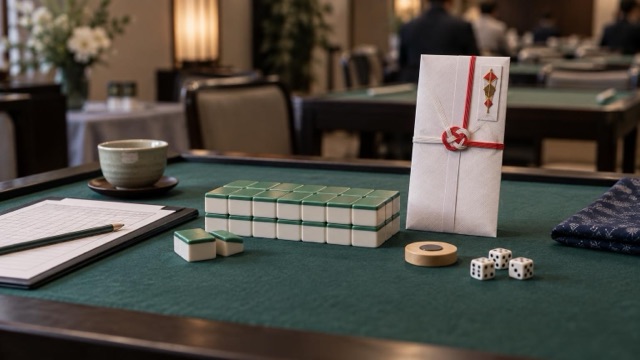
Alongside the tiles you need a dealer marker, three dice and a mahjong table1. The dice decide where the wall is broken and who deals, and the marker shows which player is currently the dealer, which matters for scoring because the dealer pays and receives double1.
Each player starts with 13 tiles and wins with 14, arranged as four sets and one pair2. The dealer is the exception at the start: the dealer takes 14 tiles and makes the first discard, which gets the game moving1.
If you want a detailed tour of every tile in the set, including the flower and joker tiles some variants add, see mahjong tiles.
Setting up the wall and the first deal
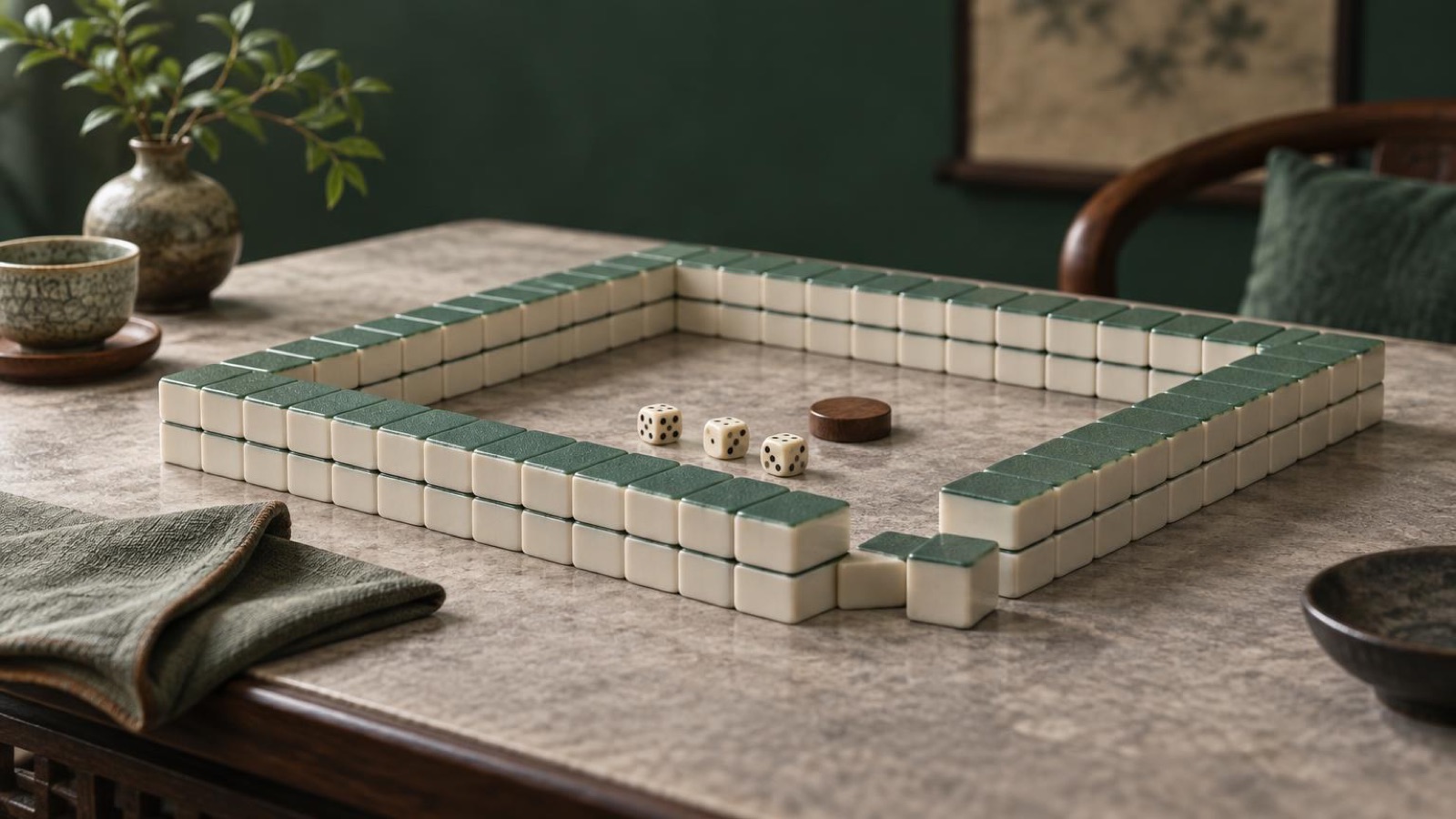
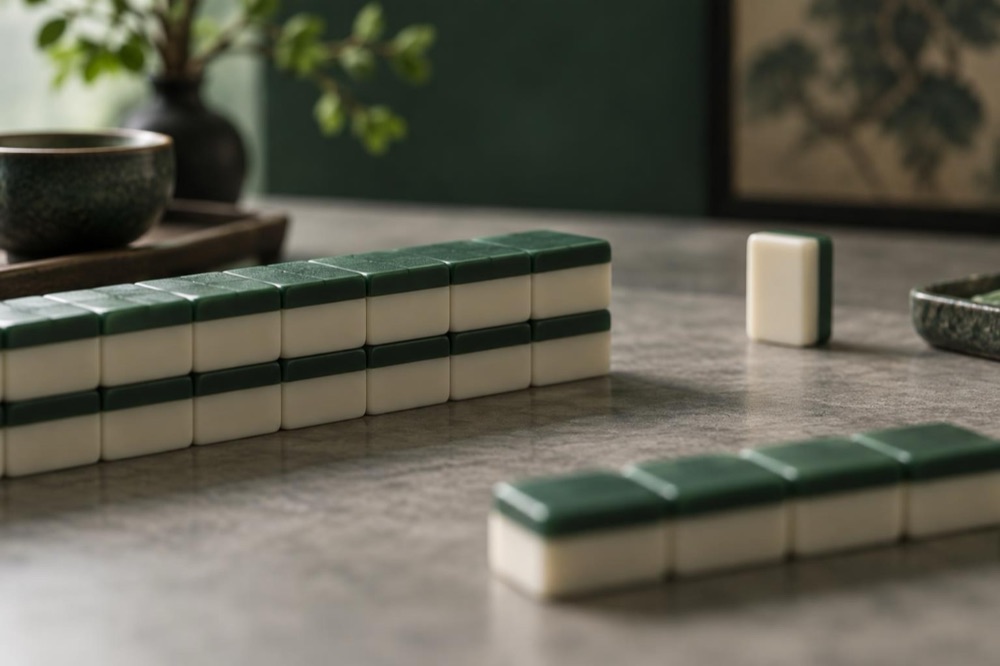
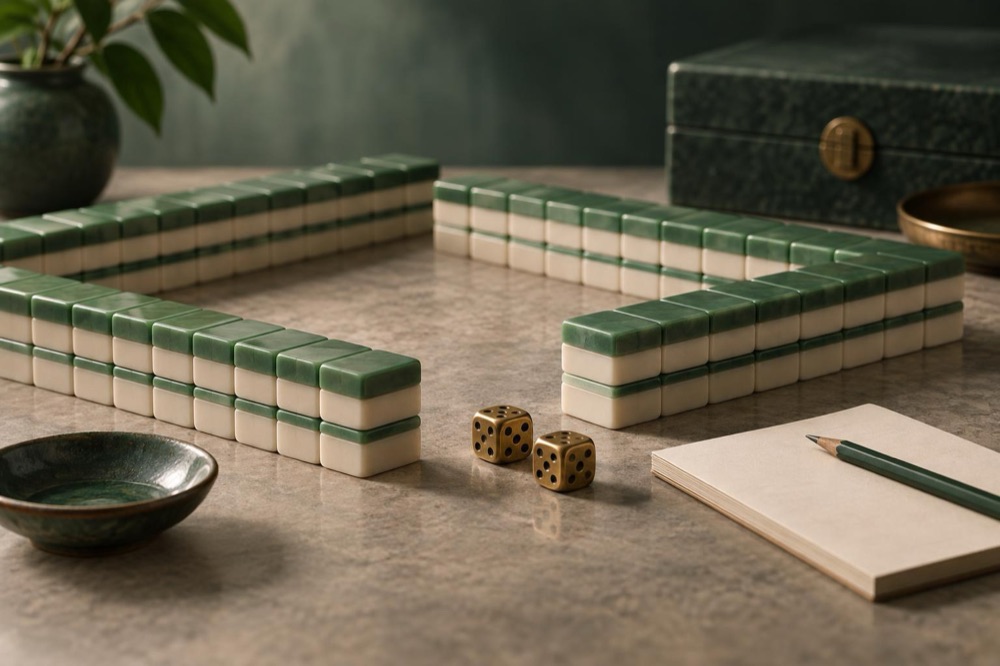
Before any tiles are dealt, the players build the wall. Each player takes a section of tiles and stacks them in rows of two, face down, forming a square in the middle of the table. In the traditional 136-tile game each side of the square is 17 stacks of two tiles, so four rows of 171. Some simplified versions use a smaller wall of 14 stacks per side1.
The dealer then throws the three dice. The count tells you where to break the wall and in which direction to count, and dealing begins from that break, going around the table until each player has 13 tiles and the dealer has 141.
From there the rhythm of the game is simple and repeats every turn:
- Draw one tile from the wall.
- Decide whether it helps your hand.
- Discard one tile, face up, into the middle.
- The next player, going counterclockwise, draws and does the same.
Every discard is public information. Players watch the discards closely, both to guess what opponents are collecting and because a discard can be claimed before the next player draws. That claiming rule is what turns mahjong from solitaire into a four-way contest, and it is the next thing to understand.
Claiming tiles: pung, kong and chow
You do not have to rely only on your own draws. When another player discards a tile you need, you can claim it in three ways.
Pung. A pung is a set of three identical tiles. If you hold two copies of a tile and a third copy is discarded, you can call "pung", take the tile, expose the set face up in front of you, and then discard a tile yourself. Calling interrupts the normal turn order: play continues from you, not from the player after the discarder1.
Kong. A kong is a set of four identical tiles. If you hold three copies and the fourth is discarded, you can call "kong" and take it. After any kong, whether open or concealed, you draw one tile from the end of the wall as a replacement and then discard one, so your hand stays at the right size1. A kong can also be declared from your own draw if you collect all four copies yourself, and a concealed kong stays hidden rather than being exposed1.
Chow. A chow is a run of three consecutive tiles in one suit, like the 4, 5 and 6 of bamboo. Here the rule is much stricter: only the player to the right of the discarder, the lower house, may claim a discard to form a chow, and claiming it means giving up that turn's draw from the wall1. You cannot chow off the player across from you or the player to your left.
One thing you cannot do is take a discard back once it is on the table1. Declaring a pung and then changing your mind is also punished in the official Macau rules: declining a pung voids your right to win that hand1.
A few variants trim these claims down. The Macau "simple mahjong" game has no chow or pung at all, and players may take another player's discard only to win the hand outright1. Vietnamese mahjong adds its own twist: if you discard a bonus tile, including the Flower Joker, while another player is waiting to win, that player may treat your bonus tile as her winning tile and win off your discard7.
Call priority when two players want the same tile
Because claims interrupt the turn order, two players sometimes want the same discard at the same moment. The resolution is straightforward: winning beats everything. If one discard lets two or even three players complete a winning hand, the player seated to the lower right of the discarder, counting counterclockwise, is the one who wins1.
Between non-winning claims, a pung or kong outranks a chow. Since only one player can chow a given tile anyway, the lower house rule and the priority rule rarely clash, but if the lower house calls chow while another player calls pung on the same tile, the pung takes it.
There is also a special claim that only happens on kongs. If a player declares an open kong by adding the fourth tile to an exposed pung, and that fourth tile is exactly the tile you need to win, you can rob the kong and win the hand on it5. In Hong Kong scoring this robbing-the-kong win counts as one fan, and it is not counted together with a win on the last tile of the round5.
The winning hand: four sets and a pair
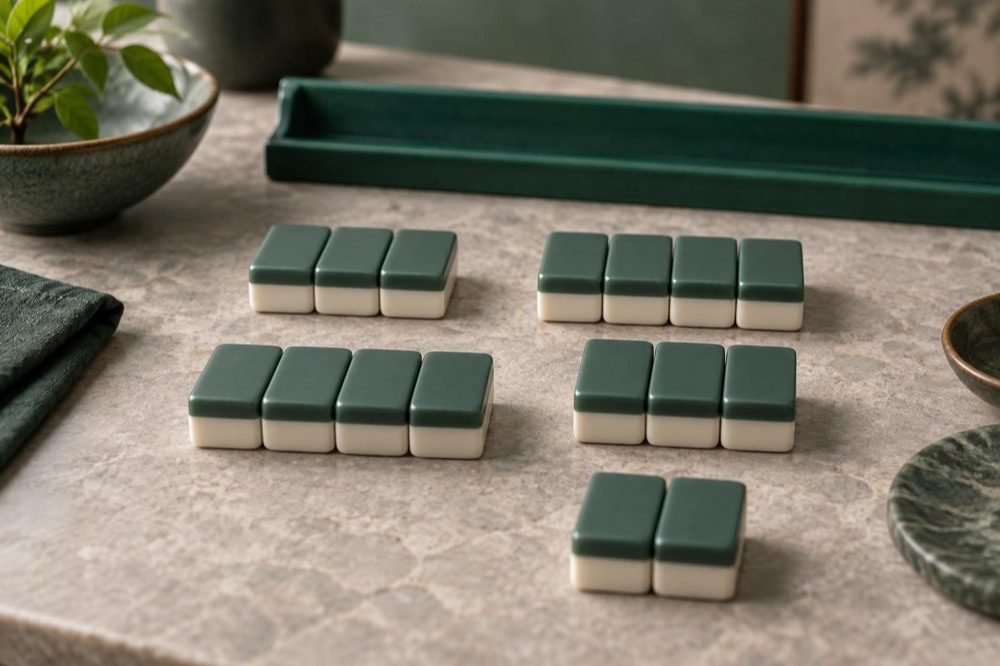
Every standard hand has the same shape: four sets and one pair, 14 tiles in all1. The sets can be any mix of pungs, kongs and chows, and the pair is any two identical tiles.
You get there in one of two ways:
- By your own draw. You draw the 14th tile you need from the wall yourself. In Cantonese play this is called a self-draw win, and it pays more: every player pays you the same amount4.
- Off a discard. Another player throws out the exact tile you need and you call it. In Cantonese play the discarding player pays double and the other two players pay single4.
The pair of payment rules is worth a concrete example4.
| Win type | Who pays | Amount |
|---|---|---|
| Three-fan self-draw win | each player | HKD 8 |
| Discard win | the discarder | HKD 16 |
| Discard win | the other two players | HKD 4 each |
Some hands are special and do not follow the four-sets-and-a-pair shape at all, such as the thirteen orphans hand of one of every terminal and honor tile plus a pair1. Those are rare and score heavily.
Fishing, draws and when no one wins
While you are one tile away from a complete hand you are "fishing", and any tile that would finish your hand is your winning tile. Other players have to be careful about what they throw once someone is visibly close.
Not every hand ends with a winner. If the wall runs out of tiles before anyone completes a hand, the hand is a draw: no one scores, the tiles are shuffled back and the hand is replayed. In the official Macau rules, a win on the very last tile of the round is a recognized scoring hand worth extra fan1, which is the last chance to salvage something from a dying hand.
Some modern variants handle draws differently. In the three-player Sega NET Mahjong arcade game there are no midgame draws at all, and even a fourth kong does not cause a draw, though a fifth kong cannot be declared8. On a double win in that game, the dealer wins if they are the furthest-upstream player8.
Three-player mahjong itself is a real format, worth knowing about if you see it in Japan. It uses 108 tiles, a 27-type set with the 2 through 8 of characters removed, and has no north seat6. Chi is not allowed, to prevent early wins6. Payments are adjusted too: in the simplest handling, a self-draw win pays about a third less for the dealer and about a quarter less for a non-dealer than a win off a discard, a rule called tsumo-son, because the missing north player's share is not paid6. Some Kyoto and Tokyo rules instead double the self-draw income, a rule called baidori6.
Scoring basics: open and closed kongs, hand values
Scoring is where regional variants diverge most, and each has its own page, but the shared ideas are worth knowing before you sit down.
A winning hand is scored in fan (or han in Japanese play), which double the value of the hand for each one earned. In Hong Kong mahjong the common rule is that you need at least three fan to declare a win at all4. In the Chinese official competition rules the bar is higher: a hand must score at least 8 points to declare a win3.
Typical one-fan hands in the traditional game include a pung or kong of any dragon, a pung or kong of the prevailing wind or your own seat wind, robbing an exposed kong, winning on the replacement tile after a kong, an all-pung hand, a mixed one-suit hand, a win on the last tile, little three dragons and little four winds1. Two-fan hands include the heavenly hand, the earthly hand, a full flush, thirteen orphans, big three dragons, big four winds, pure terminals and all honors1.
Kongs matter to scoring in two ways. First, a concealed kong is part of a concealed hand, and hands built entirely without exposing sets score more than hands built from open claims. Second, kongs create replacement draws from the end of the wall, which slightly changes what tiles remain live. In the Taiwanese 13-tile rules, robbing the kong is worth one fan and is not counted together with a win on the last tile5, and little four winds, three wind triplets plus a wind pair, is worth 13 fan5.
Payment structure is consistent across most versions: when the dealer wins, all three other players pay double, and when a non-dealer wins, the dealer pays double and the two other non-dealers pay single1. For a full walkthrough of how fan, faan, han and fu work across the variants, see mahjong scoring.
The full game: four rounds of winds and the 16-game minimum
A single hand of mahjong takes only a few minutes, but a full game is much longer. The game is organized into rounds named after winds: an east round, a south round, a west round and a north round. Within each round, each of the four players deals once, so a full four-round game is at least 16 hands, and longer if hands are drawn and replayed or if the dealer keeps winning and stays on.
Shorter formats are common. A two-round game, east and south only, is a standard length in Japanese play, and in the three-player version the east-south game is 6 hands in total, three per round, not counting draws6.
The dealer marker moves around the table as the deal rotates, and the prevailing wind changes with each round, which feeds back into scoring: a pung of the prevailing wind or of your own seat wind earns fan1, so the same set of tiles is worth different amounts at different points in the game.
Playing for money: where it is legal and where it is not
Mahjong is played for stakes in much of Asia, and the rules around that differ sharply by place, so it is worth knowing where you stand before money hits the table.
Hong Kong. All gambling is illegal except for the government-approved horse racing, football betting and Mark Six lottery, activities licensed by the authorities such as mahjong parlors, and social gambling exempted under section 3 of the Gambling Ordinance9. So playing for money in a licensed mahjong parlor is lawful, but the same game in an unlicensed private club where rental or commission is charged for tables, tiles and chips is not, and the players themselves can be committing an offense9. A common misconception that playing mahjong for money does not contravene the law is exactly that, a misconception9. If you want the parlor experience, see mahjong parlors.
Mainland China. The consistent official line is that mahjong among relatives and friends, not for profit and with small stakes, is lawful entertainment protected by law11. The same applies in chess and card rooms when they are used for normal leisure play and only charge fixed venue and service fees12. Games with money stakes among relatives without a profit motive are not punished, though they should be stopped if conducted in public places16, and small-stakes games among non-relatives are also not punished17. The line is profit motive: using mahjong as a gambling tool in a card room violates the Public Security Administration Punishment Law and can rise to a criminal matter15. Wuhan police set a concrete benchmark: not gambling if fewer than 10 unrelated people play and the average individual stake is under CNY 1,00018.
Japan. Playing mahjong for money is a crime regardless of the venue or its name, including mahjong parlors, mahjong teaching facilities, homes and inns10. Japanese law and precedent treat any money stake, however small, as taking the game out of mere entertainment19. The exception is competitive mahjong: where the loser's payment is not made by the player, as in sponsored tournaments with prize money, there is no gambling offense19. So a casual game with friends at a parlor is fine as long as no money rides on it.
Singapore. Club mahjong rooms operate on a no-gambling basis: the terms for booking a mahjong room at a club such as Seletar state plainly that no gambling is allowed20.
Macau. Mahjong is one of the games with official rules published by the gaming regulator, and it is offered in licensed venues under those rules1.
If you are curious about playing online instead, see online mahjong, and for a jurisdiction-by-jurisdiction comparison, see where Asian games are legal.
Common Questions
How many tiles does each player start with?
In the standard four-player game each player starts with 13 tiles and wins with 14, made up of four sets and a pair. The dealer begins with 14 and discards first.
Can I claim a chow from any player's discard?
No. Only the player to the right of the discarder, called the lower house, may claim a discard to form a chow, and claiming it means giving up that turn's draw from the wall.
What happens if two players call mahjong on the same tile?
If one discard lets two or three players win, the player seated to the lower right of the discarder, counting counterclockwise, is the one who wins the hand.
What is a closed kong worth compared to an open kong?
Both are four identical tiles, but a closed kong is kept hidden in your hand while an open kong is exposed on the table. Closed sets generally score more because they show a fully concealed hand.
Is playing mahjong for money illegal in Japan?
Yes. Japanese police guidance states that mahjong gambling is a crime regardless of the venue or its name, including mahjong parlors, homes and inns. Playing without money stakes is fine.
What happens when the wall runs out of tiles?
The hand is a draw and no one wins it. In some variants, such as three-player Sega NET Mahjong, there are no midgame draws and a fourth kong does not end the hand.
How long is a full game of mahjong?
A full game runs through four rounds of winds, east, south, west and north, with each player dealing once per round, so at least 16 hands. Shorter formats stop after two rounds.
Sources20 sources
- Mahjong Gaming Rules, DICJ Macau, 1991
- Casino Game Guide, Paradise City, 2026
- McGill Mahjong Blog, McGill Mahjong, 2017
- How to Play Mahjong, Cosmopolitan Hong Kong, 2025
- Taiwan 13-Tile Mahjong Rules, Godgame, 2016
- 三人麻雀, Wikipedia, 2026
- A Quick Look at Mahjong Around the World, McGill Mahjong, 2015
- 連荘, Wikipedia, 2026
- Mahjong Gambling Enforcement Notice, Hong Kong Government, 1999
- Guidance on Mahjong Gambling, National Police Agency Japan, 2026
- Notice on Applying the Law in Gambling Violation Cases, Chengqu Government, 2024
- Mahjong Entertainment and the Law, China Peace, 2023
- Chess and Card Room Guidance, Beijing Miyun Government, 2020
- Family Mahjong and Card Games, Jiangsu Government, 2019
- Gambling Among Relatives, Yunnan Government, 2019
- Relatives' Mahjong Not Treated as Gambling, Shanxi Qixian Procuratorate, 2026
- Ministry of Public Security Notice, Anyang Government, 2025
- Wuhan Police Set Mahjong Gambling Criteria, China Daily, 2017
- 麻雀, Wikipedia, 2026
- Booking Conditions, Seletar Club Singapore, 2026