The tile set and the winning hand
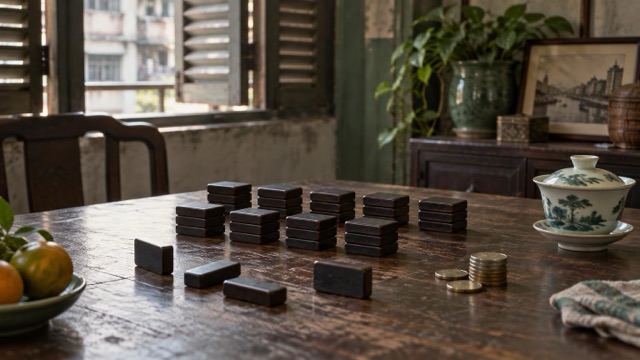
A standard Hong Kong mahjong set contains 144 tiles. The basic set is 136 tiles, and playing with 8 flower tiles on top of that is common, which brings the count to 1446. Each tile type has four copies in the set1.
The tiles divide into three suits, numbered 1 through 9: circles (dots), bamboo (sticks), and characters. Alongside the suits sit the honor tiles. There are seven distinct honor tile types, and a standard 144-tile set contains four copies of each, for 28 honor tiles in total1. The honors are the four winds (East, South, West, North) and three dragons (red, green, white). Flower tiles, when used, are the eight seasonal and floral tiles: spring, summer, autumn, winter, plum, orchid, bamboo, and chrysanthemum.
Each player holds 13 tiles during play6. The goal is a winning hand of 14 tiles: four sets of three tiles plus one pair1. A set can be a chow (a run of three consecutive tiles in one suit), a pung (three identical tiles), or a kong (four identical tiles), and the pair is any two matching tiles7. A player wins once a winning hand of four sets and a pair is assembled8.
You build your hand by drawing a tile on your turn and discarding one, and by claiming other players' discards to complete chows, pungs, and kongs. When your 13 tiles plus one more form four sets and a pair, you declare a win, either off another player's discard or by the tile you drew yourself.
The three fan minimum: why a chicken hand cannot win
Here is the rule that most separates Hong Kong mahjong from casual versions played elsewhere: you cannot win on just any four sets and a pair. Your hand must score at least three fan to go out. Most Hong Kong games use three fan as the minimum2, and the rulebook used by local tournament play states it plainly: the hand must have three fan or more before it can win9.
A hand that completes four sets and a pair but scores no fan at all is called a chicken hand, and it is worth zero fan, so it cannot win10. If you count up your hand after declaring a win and find no fan, you have not won anything.
Fan come from the shape and content of your hand. Some common examples from the 13-tile scoring list:
- All Chows (four chows plus a numbered pair): 1 fan11
- Terminal or Wind Triplet, a pung or kong of identical 1s, 9s, or wind tiles: 1 fan11
- Dragon Triplet, any pung or kong of red, green, or white dragons: 1 fan11
- Concealed Hand, no chows, pungs, or open kongs, winning on a discard: 1 fan11
- Robbing the Kong, winning on a tile another player uses to declare a kong: 1 fan11
- All Pungs with no pung or kong declared during play: 8 fan2
- Big Three Dragons, pungs of all three dragons: 8 fan11
Flowers add fan too, but they do not count toward the minimum. Each flower tile in your hand counts as 1 fan, scored only after you win, and it is not counted in the three fan requirement12. The dealer also counts at most 1 fan toward the minimum12.
The three fan minimum has been part of the local game since the 1970s, when the so-called 3-3 system was adopted: hands must be 3 fan to go out, and the value of All Pungs and Half Flush hands was raised to 3 fan6.
False win penalty: paying all three players
What happens if you declare a win with a hand under three fan? It counts as a false win, and the penalty is severe: the offender pays all three other players2.
This is the practical reason the three fan rule matters so much. Declaring a win you are not entitled to is not a neutral mistake that gets waved off. You pay every opponent at the table, as though you had lost to each of them. Before you call a win, count your fan carefully, including flowers only if they push you over the line on top of an already valid hand.
Fan cap: 8 fan, 10 fan or uncapped
The fan cap is set by the players at the start of the game. It is commonly 8 fan or 10 fan, and some groups play with no cap at all2. Ten is the most common choice among experienced players3.
The cap works as a ceiling: once your hand reaches the cap, it scores as the cap no matter how much higher the raw fan count goes. Under a 10 fan limit, a hand worth 10 fan or more is worth 128 points3. The local tournament rulebook uses a 10 fan cap and treats all limit hands as 10 fan regardless of their nominal value9.
Some rule sets cap differently. In the GodGame 13-tile version, hands exceeding 13 fan are counted as 13 fan12. The classic limit hands sit at or above these numbers: Thirteen Orphans, the hand of all 1s and 9s, the seven honor tiles, and one pair among them, is 13 fan, as is Little Four Winds and Eighteen Immortals, the four-kong hand11. Heavenly Hand, where the dealer wins on the initial deal, is 10 fan13. Under a 10 fan cap, all of these simply score the cap.
Agree on the cap before the first deal. It changes how much the biggest hands cost, and it changes your strategy: near the cap, extra fan in an already huge hand are worth nothing.
Payment rules: discard wins versus self-draw wins
There are two ways to win, and they are paid differently.
If you win off another player's discard, the discarder pays the winner double, and the other two opponents pay single3. The player who threw you the winning tile bears the cost of the mistake.
If you win by self-draw, meaning the tile you drew yourself completes your hand, the payment is simple: each player pays the same amount2. Nobody is singled out, because nobody fed you the winning tile.
The same structure appears in the written scoring rules: on a discard win, the discarder pays the winner points times two and the other two opponents pay points times one; on a self-draw win, each player pays the winner points times two3. Some tables use a harsher discard split where the discarder pays everything and the other two pay nothing, and the self-draw split can likewise be set so each opponent pays a single share6.
One detail worth knowing: if you complete a winning hand by replacing a flower tile, that counts as a self-draw win, not as a win off a kong draw12.
Worked example: what a three-fan win costs each player
The easiest way to see the whole system is with real numbers. Suppose your table plays what locals call one-two dollars, where the base unit is small cash amounts per point.
A three fan hand won by self-draw costs each player HKD 8. If instead you win the same three fan hand off a discard, the discarder pays HKD 16 and the other two players pay HKD 4 each2.
Notice what the numbers show. On the self-draw, three opponents pay HKD 8 each, so you collect HKD 24. On the discard win, you collect HKD 16 plus HKD 4 plus HKD 4, which is also HKD 24, but the burden has shifted: the player who discarded pays four times what the other two pay. The total is similar, but who pays is very different, which is why experienced players watch their discards carefully late in a hand.
Hong Kong Old Style scoring and payouts
Hong Kong Old Style is the name given to the traditional local scoring system. Its scoring type is exponential: each fan roughly doubles the value of the hand, so the point value climbs steeply as fan accumulate6.
The fan to points conversion, from the written Old Style rules:
| Fan | Points |
|---|---|
| 1 | 32 |
| 8 | 384 |
| 9 | 528 |
| 10 | 792 |
| 11 | 1056 |
Under a 10 fan limit, a hand worth 10 fan or more is worth 128 points, which reflects the doubling structure applied from the base3. The classic method is to score by counting doubles and then convert to points14, and many groups simply pay one chip per point to the winner15.
The payout rule is winner only: only the player who wins the hand collects, and there are no side payments between losers6. Concealed kongs are displayed rather than hidden6.
The tournament rulebook gives a parallel table in its own units: a 3 fan hand pays 32 on a discard win or 16 times three on a self-draw; a 4 fan hand pays 64 or 32 times three; a 6 fan hand pays 128 or 64 times three; a 7 fan hand pays 192 or 96 times three9. The pattern is the same one you saw in the worked example: the discard win total equals the self-draw total, but the discarder carries the double share.
One modern change some tables adopt: the classic payout system is replaced with a discarder-pays-all system, where the player who fed the winning tile covers the entire payment6. Ask which system your table uses before you sit down, because it changes the cost of a careless discard dramatically.
Where to play: mahjong parlors
A small number of mahjong parlors still operate in Hong Kong under license, and they are one of the few authorized gambling outlets in the city alongside horse racing, football betting, and the Mark Six lottery4. The government's position is that all gambling is illegal except these regulated avenues, licensed activities such as mahjong parlors, and exempted social gambling4.
What is a parlor like? A recent visit to a parlor in Wan Chai describes exactly what a newcomer finds: rows of tables, regulars who have played for decades, and staff who will teach newcomers the game16. Parlors of this kind typically offer automated mahjong tables, charge players for the room by the hour, and sell drinks and food17. You pay for the table and the refreshments, and the stakes are between you and your tablemates.
The legality line is about premises, not the game itself. It is the type of premises in which a mahjong game takes place that determines legality, and it is unlawful to play in non-bona fide establishments, including clubs or associations that charge rental or commission for tables, tiles, and chips18. Under those circumstances the players themselves may be committing a gambling offense18. It is a common misconception that playing mahjong for money does not contravene the law; it can, depending on where and how the game is run18. Licensed parlors are the exception, and only a small number hold legal operating licenses19.
For most residents, the game is played at home with family and friends, especially at Chinese New Year, and social gambling of this kind falls on the exempted side of the line4. If you want the parlor experience without the stakes, the Wan Chai parlor that inducts newbies is a good place to see the culture firsthand16.
Playing online: apps and platforms
If you want to learn the rules before sitting at a real table, or just play for fun, there are free options.
The Hong Kong Mahjong app is available on Android and Windows5. It is a four player game using the rules of Hong Kong mahjong, played against AI powered opponents, and it is a variation of authentic Chinese style mahjong5. For a beginner it is unusually well suited: the game provides a comprehensive description of the rules, detailed instructions, a beginners tutorial, configurable settings, and even an undo move feature5.
The popular GodGame Hong Kong mahjong title is free to use and runs on virtual game currency only. It does not offer cash transaction gambling, though it does sell virtual currency and items as paid in-game services12. You can set how much virtual currency one fan equals, which makes it a good way to practice the scoring and payment mechanics described above without any money at risk12.
Playing the game online for virtual currency is one thing; real money online gambling in Hong Kong is another matter entirely, and the authorized online options are limited to the Hong Kong Jockey Club's betting services. For that side of things, see gambling in Hong Kong and online gambling in Hong Kong.
Common Questions
How many tiles are in a Hong Kong mahjong set?
A standard set has 144 tiles. The basic set is 136 tiles, and playing with 8 flower tiles on top of that is common, which brings the total to 144.
How many honor tiles are there?
There are 28 honor tiles in total. A set contains four copies of each of the seven distinct honor tile types, which are the four winds and three dragons.
What happens if you win with fewer than three fan?
A hand under three fan counts as a false win. The player who declared it wrongly pays all three other players, so it is an expensive mistake.
Who pays when you win off a discard?
The player who discarded the winning tile pays double, and the other two players pay single. On a self-draw win, all three opponents pay the same amount.
What is the minimum fan to win in Hong Kong mahjong?
Three fan. Most games require a hand to have at least three fan before it can go out, so a zero-fan chicken hand cannot win.
Can you play Hong Kong mahjong on Android or Windows?
Yes. The Hong Kong Mahjong app is available on Android and Windows. It plays authentic Hong Kong rules with AI opponents and includes a tutorial for beginners.
Are mahjong parlors legal in Hong Kong?
Yes, a small number of parlors hold licenses issued under the Gambling Ordinance. Unlicensed premises that charge table rental are not legal, and playing there can expose players to charges.
Sources19 sources
- Limit Hands in Hong Kong Mahjong, TileBuddy, 2026
- How to Play Mahjong, Cosmopolitan Hong Kong, 2025
- Hong Kong Old Style Scoring, Mahjong Wiki, 2026
- Gambling Policy, Home and Youth Affairs Bureau, 2026
- Hong Kong Mahjong App, Google Play, 2026
- Hong Kong Old Style Overview, Mahjong Wiki, 2026
- Mahjong Game Rules, Mahjong Time, 2026
- Chinese Mahjong Culture, China Educational Tours, 2026
- GGHK Classical Hong Kong Mahjong Rulebook, GGHK, 2023
- Mahjong Around Hong Kong, Holiday (PressLogic), 2019
- GodGame Hong Kong 13-Tile Rule Guide, GodGame, 2016
- GodGame Hong Kong Mahjong Rules, GodGame, 2026
- Hong Kong Mahjong Rules Document, Google Docs, 2026
- Mahjong Rules, Gareth J M Saunders, 2013
- Mahjong FAQ 17, Sloperama, 2016
- All About Mahjong: Hong Kong Parlour Inducts Newbies into Beloved Game, South China Morning Post, 2025
- Mahjong in China, WinMahjong, 2026
- Press Release on Mahjong Gambling, Hong Kong Government, 1999
- HKPU Final Report on Gambling, Home Affairs Bureau, 2008