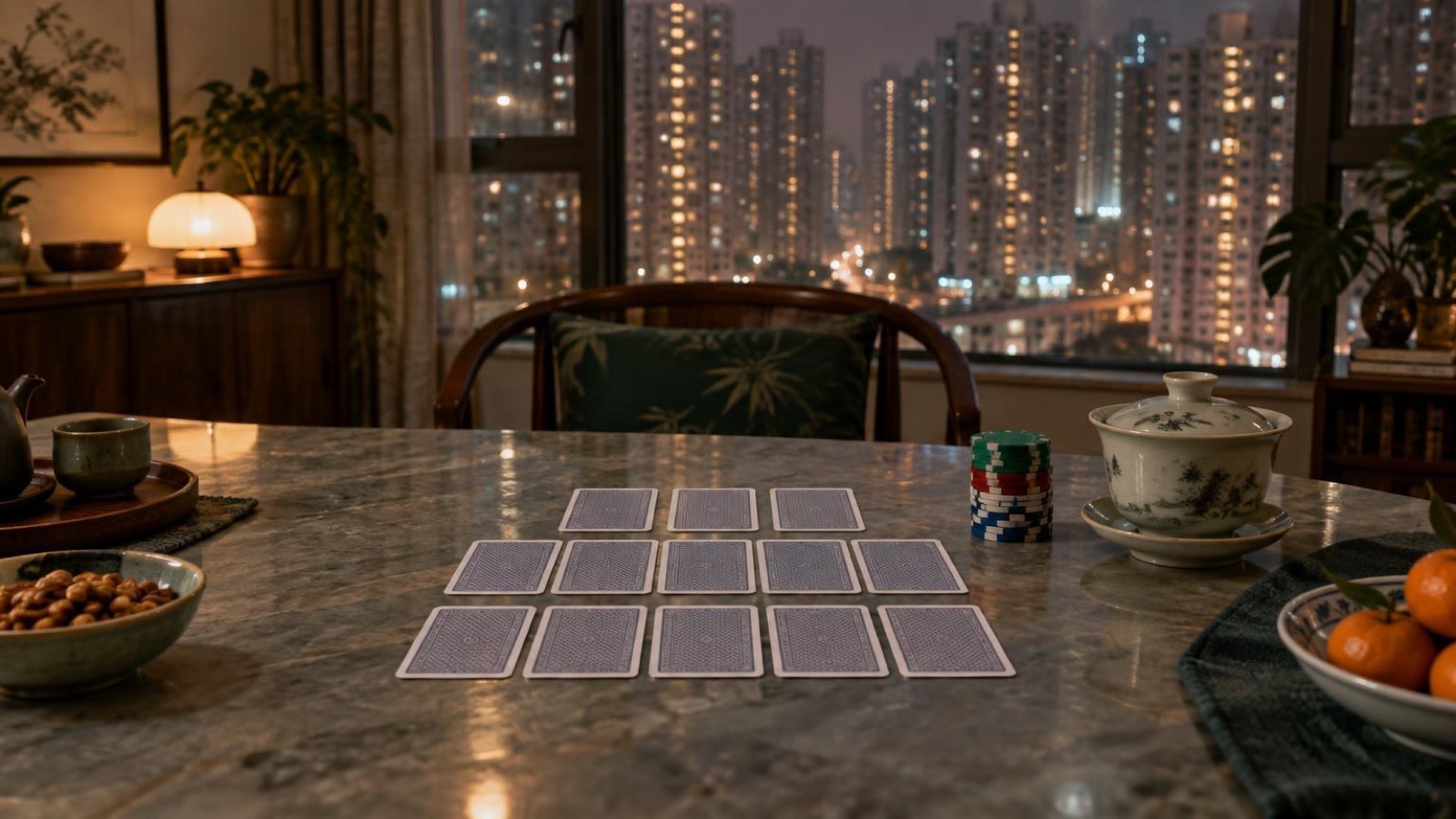
Thirteen Cards is one of the great social card games of the Chinese-speaking world. In Cantonese Hong Kong it goes by Sap Sam Cheung, in Mandarin it is shisan zhang (十三張), and in English most people call it Chinese poker or 13-card poker. Whatever the name, the idea is the same: you get 13 cards, you sort them into three poker hands, and you compare those hands against every other player at the table. There is no betting round by round as in Texas Hold'em, no bluffing someone off a pot. The skill is almost entirely in how you slice your 13 cards, which makes it a game people learn quickly and play for a lifetime.
The 13-card deal: how a round works
A game seats two, three or four players, and four is the classic number because the deck deals out perfectly1. One standard 52-card deck is used, with no jokers and no wild cards1. Before any cards move, each player needs chips or money on the table: to receive a hand you must have at least three betting units for the game you are in, and a full buy-in is equivalent to 25 times the limit condition of the game, with no short buy-ins allowed1.
The dealer shuffles and deals 13 cards to each player, face down. Players then pick up their cards and the quiet part of the game begins: everyone studies their 13 cards and arranges them into three hands, set face down in front of them. Once all players have set their hands, everyone reveals, and the comparing starts. Each player matches each of their three hands against the corresponding hands of every other player, one opponent at a time. You win or lose each comparison separately, so in a four-handed game you are playing three separate little matches at once.
Because there is no draw, no betting after the deal and no community cards, a full round moves fast. Deal, arrange, reveal, settle. That rhythm is a big part of why the game works so well at a family table or among friends over tea: the whole table stays involved in every hand, and nobody sits out waiting for a turn to act.
A newer offshoot called Open Face Chinese poker changes the dealing. Instead of receiving all 13 cards at once, players start with 5 cards dealt face up which they place into their rows, and from then on cards come one at a time until everyone holds 13, over nine dealing rounds in total3. Because you build your rows in public, card by card, the game becomes a puzzle of what to keep and what to risk, and it has become a favorite of poker professionals worldwide.
How hands are arranged
The heart of the game is the split. Your 13 cards must be arranged into three separate poker hands: one 3-card hand in front and two 5-card hands behind it1. The layout is strict and always the same:
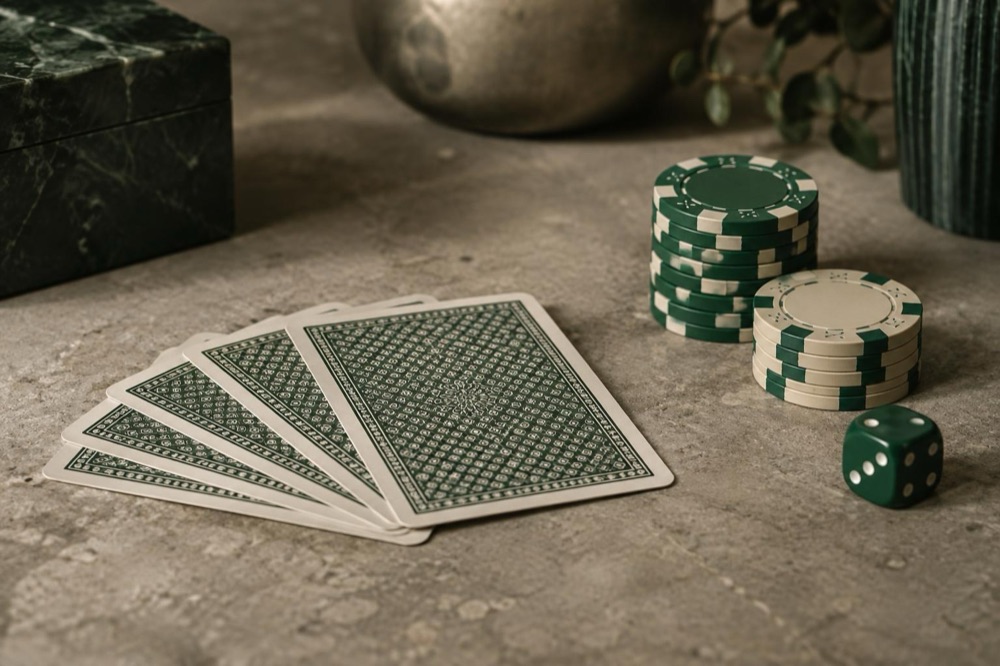
- Front hand (top): 3 cards
- Middle hand: 5 cards
- Back hand (bottom): 5 cards
The rule that governs everything is that your hands must get stronger as you move back. Your back hand must beat or tie your middle hand, and your middle hand must beat or tie your front hand. If you set your hands out of order, for example a stronger middle than back, your hand is "fouled" and you lose all three comparisons automatically. Sorting your cards legally is the first skill; sorting them well is the second.
The 3-card front hand uses simple rankings: three of a kind at the top, then pairs and high cards. The two 5-card hands use the standard poker rankings, from high card up through one pair, two pair, three of a kind, straight, flush, full house, four of a kind, straight flush and royal flush4. A hand in poker consists of five cards5, so the front row is judged on a compressed scale while the back two rows play like ordinary poker hands.
Scoring is done in units. You win or lose one unit per hand per opponent, so a clean sweep of one player across all three rows is three units. On top of that, most house rules pay bonuses for premium hands placed in specific rows1:
| Bonus hand | Where it sits | Extra units |
|---|---|---|
| Three of a kind | Front | 3 |
| Full house | Middle | 2 |
| Four of a kind | Back | 4 |
| Straight flush | Back | 5 |
| Straight flush | Middle | 10 |
| Full house | Middle | 2 |
The pattern behind the bonuses is simple: the harder a big hand is to place in a given row, the more it pays. A straight flush in the middle row, where it must still be weaker than your back hand, is a genuine rarity, hence the 10-unit premium. A full house in the middle is a strong but achievable set, worth 2 extra units1.
A worked example shows how a hand plays out. Suppose you are dealt a flush, a middle pair and three scattered low cards. A natural set is the flush in back, the pair in the middle, and your best three leftovers (say queen high) in front. Against an opponent who set two pair in back, a small pair in the middle and jack high in front, you win the back with the flush, win the middle with the bigger pair, and win the front with the queen. That is 3 units, plus any royalties your hands earn. Against a second opponent who found three queens in front, you lose the front but likely still take the middle and back, so you net 1 unit from that player. Every opponent is settled separately, which is why four-handed games swing so much.
Where the game is played in Hong Kong
For most of its history in Hong Kong, Thirteen Cards has been a home game, played at the family table during festivals, at mahjong parlors' social cousins, or among friends after dinner. That is still where most hands are dealt. The game needs nothing but a deck and a stack of chips, and a round takes minutes, so it travels well to any gathering.
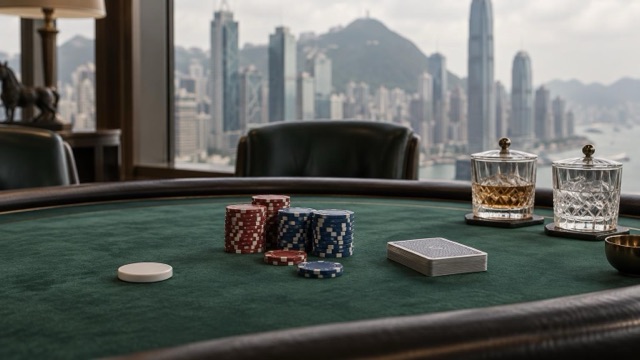
Organized poker in Hong Kong is another matter. There are no traditional casinos in the city, and public poker games are prohibited2. What exists instead is a private club scene. Major concentrations of clubs are found in Central around Lan Kwai Fong and in Kowloon around Mong Kok and Kwun Tong2. These clubs require membership, and you generally need to complete a formal membership application before you can sit down and play2.
A few named venues give you a picture of the scene. The Hong Kong Poker House offers six poker tables, customized chips, a bar and a DJ booth in a stylish setting2. The Match Poker Esports Arena sits on the 4th floor of Silver Fortune Plaza, 1 Wellington Street, in the heart of Lan Kwai Fong, and has been described as the only legal poker room in Hong Kong6. The Hong Kong Poker Studio operates in Kowloon7. The games at these clubs are typically community poker variants rather than Thirteen Cards, but the club scene is where Hong Kong players who want organized card action go, and some members travel abroad to play poker three or four times a year, in groups of 30 to 406.
For bigger tournament action, Hong Kong players often head to Taipei. The APT Taipei Poker Classic takes place across two venues: the CTP Asia Poker Arena, Asia's largest permanent poker room, and the CML, the Chinese Mahjong League8. That puts a full festival schedule within easy flying distance of Hong Kong.
If you want the broader picture of what gambling exists in the city, see gambling in Hong Kong and poker in Hong Kong.
Thirteen or Chinese poker: names you'll meet
The naming around this game can confuse a first-timer, so here is the map. Sap Sam Cheung is the Cantonese name, literally "thirteen cards," and it is what the game is called in Hong Kong. Shisan zhang is the same name in Mandarin, used in mainland China and overseas Chinese communities. In English, the game is usually called Chinese poker or 13-card poker, and the terms are interchangeable9.
Open Face Chinese poker, or OFC, is the modern variant described above, with 5 cards up front and the rest dealt one at a time over nine rounds3. It is the same scoring skeleton but a completely different playing experience, closer to a solitaire-style puzzle than to the set-and-reveal of the original.
In Vietnam the same game appears as Mậu Binh, with the identical 13 cards split into a 3-5-5 structure10. If you know one, you know them all; only local bonus schedules and settlement customs differ.
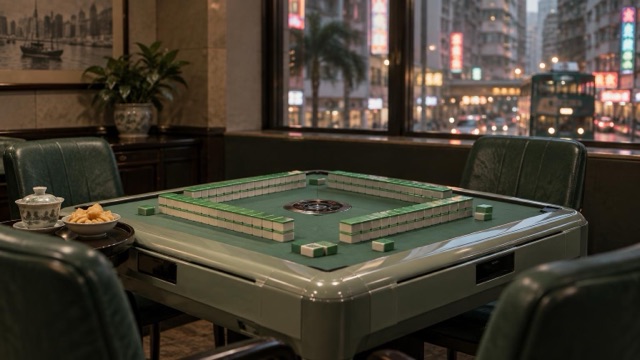
One caution on names: 十三張 also shows up in Hong Kong mahjong talk, because Hong Kong mahjong is itself a 13-tile game, and hands there are capped at 13 fan11. If a Hong Kong friend mentions "thirteen" over a table, check whether tiles or cards are in play before assuming. The card game and the tile game are entirely separate, though they share the culture of arranging a dealt set into the best possible shape. For the tile side of that culture, see mahjong in Hong Kong.
The settlement structure is where the game's character shows. Beyond the basic unit payments between players, certain hands earn extra units: a full house placed in the middle row pays 2 additional units, and three of a kind in the front row pays 3 additional units12. Those bonus payments reward the risk of putting a strong hand in the wrong-sized row, which is the heart of the game's strategy.
=== 27 note: the 1893 Tá t'in kau claim is not in the facts, so the paragraph was rebuilt around the supported bonus-settlement facts.
Who can play
Anyone can learn Thirteen Cards. The rules are simple: you arrange your 13 cards into three rows, and the payouts follow fixed unit counts, with bonuses such as 2 additional units for a full house in the middle4. Many people in Hong Kong pick it up as a social game first, playing for points among family and friends before ever staking money.
The legal side is brief and worth knowing. Hong Kong's gambling policy restricts commercial gambling to a small number of regulated avenues: horse racing, football betting and the Mark Six lottery run by the Hong Kong Jockey Club, plus licensed activities such as mahjong parlors13. Social gambling in private settings is treated differently and is exempted, which is the category a home game of Thirteen Cards falls into. Playing cards with friends at home is not the same thing as running a commercial game, and the distinction is what keeps the private club scene and the family table on the safe side of the line. For the full picture, see gambling laws in Hong Kong.
Playing for money: what to know
Thirteen Cards is very often played for small stakes, and the unit system makes the money side easy to follow. Agree on the unit before you sit down, say HK$10 a unit, and every comparison settles in those units. A clean 3-0 sweep of one player is 3 units; a 2-1 split is 1 unit. Bonuses add on top, so a 10-unit royalty for a middle straight flush can swing a whole session in one hand1.
Two practical rules from the formal game are worth borrowing for any stakes game. First, to receive a hand you must have at least three betting units on the table, so nobody plays a hand they cannot fully settle1. Second, a buy-in should be 25 times the game's limit, with no short buy-ins, which keeps everyone solvent for a full session rather than one bad hand1.
The old doubling tradition is still fun to use: make the first player or dealer pay and be paid double, echoing the tsò chong rule recorded over a century ago12. Many families also play royalties only, no per-hand units, which keeps the stakes tiny and the big hands exciting.
If you play in any setting where money changes hands, keep it social and private. The Hong Kong Jockey Club, the city's only legal betting operator, offers only cash and account-based betting with no credit at all14, and the same no-credit instinct is wise at a card table: never play on borrowed money, and set a session limit before the first deal. If gambling ever stops being fun, help is available in Hong Kong.
Common Questions
How many cards does each player get in Thirteen Cards?
Each player receives 13 cards from a standard 52-card deck, with no jokers or wild cards. Those 13 cards are then split into three separate poker hands of three, five and five cards.
Is Thirteen Cards the same as Chinese poker?
Yes. Sap Sam Cheung, shisan zhang and Chinese poker all refer to the same family of games: 13 cards dealt to each player and arranged into three rows. Open Face Chinese poker is a newer variant with a different dealing method.
Can you play Sap Sam Cheung with a standard deck?
Yes. The game uses a standard 52-card deck with no jokers or wild cards, so any ordinary playing deck will do. Nothing special needs to be bought or prepared.
Is Thirteen Cards popular in Hong Kong?
It is a familiar home and social game in Hong Kong card culture, though public poker rooms are heavily restricted. Private members-only clubs in Central and Kowloon are where organized poker gets played in the city.
How many players can join a game?
The game is played with two, three or four players. Four is the classic table size, since the whole 52-card deck deals out evenly.
Is Thirteen Cards a gambling game?
It can be played for stakes or purely for fun at home. Hong Kong law permits social gambling in private settings, while commercial gambling outside the Hong Kong Jockey Club's licensed activities is not allowed.
Sources14 sources
- Poker terms, Americas Cardroom, 2026
- Poker in Hong Kong, SoMuchPoker, February 23, 2026
- Open Face Chinese poker guide, CoinPoker, April 13, 2023
- Poker hand rankings, GGPoker, 2026
- Hand rankings, partypoker, 2026
- Match Poker Esports Arena news, SoMuchPoker, October 24, 2024
- Hong Kong Poker Studio, The Hendon Mob, 2026
- APT Taipei Poker Classic announcement, Asian Poker Tour, April 11, 2024
- Chinese poker, 888poker, December 6, 2018
- Online card games basic rules, V9Bet, March 21, 2026
- Hong Kong 13-tile mahjong rules, GodGame, 2026
- Chinese games with dice (Culin 1893), Smithsonian Institution, 1893
- Gambling policy, Home and Youth Affairs Bureau, Hong Kong, 2026
- Responsible gambling, Hong Kong Jockey Club, 2026