Where mahjong gambling is legal and where it is not
Across most of Asia, the mahjong you see in a commercial venue is not a gambling product in the way a casino table is. The venues make their money from table fees, and whether money changes hands between players is a separate question that each jurisdiction answers differently.
Japan is the clearest case. The National Police Agency states flatly that mahjong gambling is a crime regardless of the place or the name of the venue, including mahjong parlors, mahjong teaching facilities, homes and inns4. Japanese parlors, called janso, are therefore set up as fee-charging entertainment venues: you pay for the table by the hour, and the house has no stake in who wins. Playing for money inside one is a separate matter between the players, and it is not lawful.
Mainland China takes a similar line with a different emphasis. Recreational mahjong with small stakes, played not for profit, is generally not treated as gambling and is not punished5. Chess and card rooms that charge only normal venue and service fees are treated the same way6. The line is crossed when a profit motive appears: gambling with mahjong tiles in a chess and card room violates the Public Security Administration Punishment Law and, in serious cases, the Criminal Law7.
Hong Kong is the exception in the region, and the only place where a commercial mahjong venue is licensed as a gambling outlet in its own right. The government's gambling policy restricts betting to a small number of regulated avenues: horse racing, football betting and the Mark Six lottery run by the Hong Kong Jockey Club, plus gaming activities licensed by a public officer appointed under the Gambling Ordinance, of which mahjong parlors are the main example1. A small number of parlors still hold these licenses and operate legally9.
Macau, which licenses casino games, also has official rules for mahjong played in its gaming venues, including detailed payout and liability rules for the traditional game10. Singapore, by contrast, has no licensed mahjong parlor sector, and playing at an unlawful gambling place is an offense for the player11.
For a fuller comparison across all twelve jurisdictions, see where Asian games are legal, and for the game itself, how to play mahjong.
Japan's mahjong parlors: table fees and house rules
A janso is built around the table, not the cashier. You walk in, the staff seats you at a table (fully automatic tables that shuffle and stack the tiles are the norm), and you pay for the time. The house does not take a cut of any winnings because there are not supposed to be winnings; the fee structure exists precisely to keep the parlor on the right side of the law4.
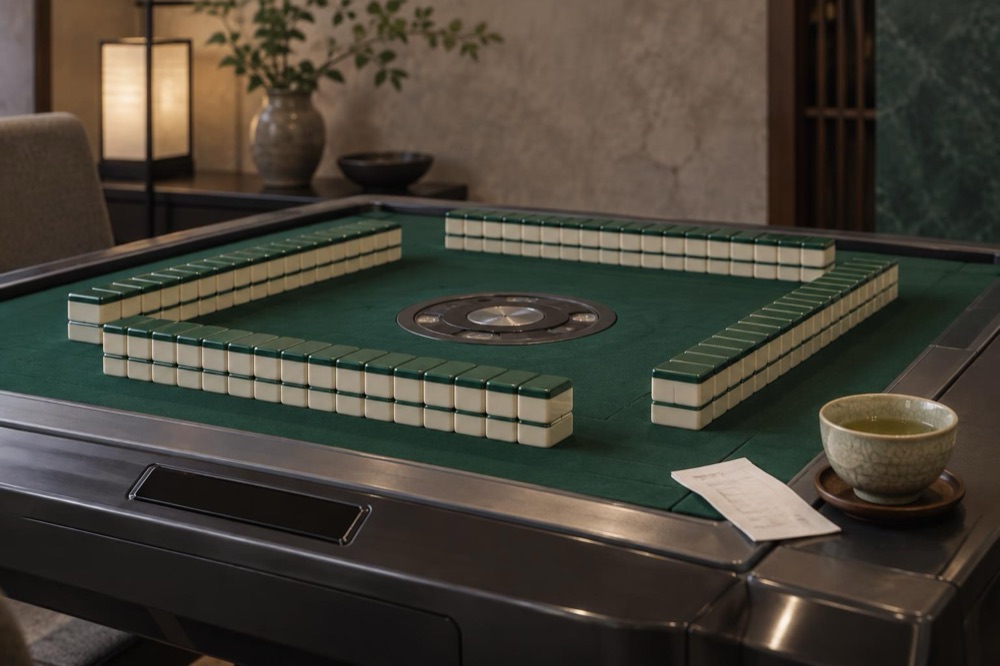
What you get for your fee is the table, the tiles and the setting. Most shops follow riichi mahjong rules, the Japanese variant with riichi declarations, dora tiles and yaku requirements, covered in detail on our riichi mahjong rules page. Some parlors also offer three-player mahjong, called sanma. Dedicated three-player parlors exist west of the Chukyo area, and a small number of free-play parlors in the capital area now offer it; modern automatic tables can usually be set for three players2.
Three-player mahjong has its own scoring quirks that matter if you are settling points. Because there are only two losers instead of three, a tsumo win under the simplest rules pays about a third less for the dealer and about a quarter less for a child than a ron win, an adjustment called tsumo-son. Other rulesets split the missing north player's share between the two payers, or in the baidori system common in Kyoto and Tokyo rules, the winner receives the full ron-equivalent points from both players, doubling income on a tsumo2.
House rules vary from shop to shop, so it is worth asking before you sit down, especially about local yaku. Some hands that appear in online mahjong, such as Sanrenkou, Suurenkou, Daisharin and Purenchan, are rarely accepted in freelance janso even though online services use them2. If you are still learning the tile set, our mahjong tiles page covers every tile you will handle.
Legal caps on hourly table fees
The hourly fee is regulated. Japan's law on mahjong parlors caps what a shop may charge per hour, and the caps differ depending on whether the fee is calculated per table or per person2.
Charged per person, the maximum is JPY 600 per hour at a fully automatic table and JPY 500 per hour at any other mahjong table, plus the consumption tax equivalent. Charged per table, the maximum is JPY 2,400 per hour for a fully automatic table and JPY 2,000 for other tables, again plus tax2.
| How the fee is charged | Fully automatic table | Other tables |
|---|---|---|
| Per person, per hour | JPY 600 plus tax | JPY 500 plus tax |
| Per table, per hour | JPY 2,400 plus tax | JPY 2,000 plus tax |
In practice, many shops advertise rates below these caps, and student rates are commonly lower still, often around the JPY 500 mark. Rates are usually posted near the entrance or the counter, so check before you sit down. A few hours of play at the per-person cap costs a few thousand yen per person, which makes a janso session comparable in price to a few rounds at an internet cafe rather than a night at a casino.
If money does change hands privately between players, parlors use a shorthand for the rate.
- A sign reading "風速0.5" means JPY 50 per 1,000 points2
- "ピン" or "テンピン" means JPY 100 per 1,000 points2
- "点1" means JPY 10 per 1,000 points2
- "デカピン" means JPY 1,000 per 1,000 points2
- "デカデカピン" means JPY 10,000 per 1,000 points2
Be aware that settling points for money inside a parlor is gambling under Japanese law, wherever it happens4.
Deposits: the azukarikin system
Many Japanese parlors ask for a deposit when you sit down, called azukarikin. The typical range is JPY 5,000 to JPY 10,000, held by the shop for the duration of your visit2.
The system works like a coat check for money. You hand over the deposit at the start, the shop deducts your table fees as they accrue, and you settle up and collect the balance when you leave. It protects the shop against players who walk out mid-session and it means you are not fishing for cash at the table every hour.
Practically, bring enough cash for the deposit plus your expected fees. If you are settling points at the end of a session, the deposit also serves as the pot from which any settlement is drawn, which is one reason the amounts run higher than the hourly fee alone would suggest. When you leave, count the return with the staff at the counter; it is a normal part of the routine, not a sign of distrust.
Hong Kong: how the Gambling Ordinance treats mahjong premises
Hong Kong's Gambling Ordinance (Cap. 148) makes any unauthorized gambling activity unlawful except where the law specifically permits it8. The permitted avenues are narrow: horse racing, football betting and Mark Six through the Jockey Club, social gambling exempted under section 3, and gaming activities licensed by the public officer appointed by the Secretary for Home and Youth Affairs, with mahjong parlors named as the example1.
A small number of parlors hold these licenses and operate legally, mostly long-established family businesses9. They are genuine gambling venues in a way Japanese janso are not: playing for money at the tables is part of what the license covers. The games follow Hong Kong-style rules, and Macau's official mahjong rulebook, which mirrors the traditional game played across the region, gives a sense of how these tables work: a winning dealer is paid double by all three other players, and when a non-dealer wins, the two other non-dealers pay single while the dealer pays double10.
The official rules also spell out liability situations regular players will recognize. A discard that lets another player complete a full flush of nine exposed tiles, big three dragons or big four winds makes the discarder pay for all players; so does discarding after holding back the last honor tile, or breaking a pung, or failing to declare a win. False win penalties are paid at two fan by the dealer and two fan to the dealer plus one fan to the other players. All-honors and all-terminal hands never require liability payment10.
Basic table discipline is codified too: discarded tiles may not be taken back, declining a pung voids a win on that tile, players may not look at others' hands, and a winner may win only up to the amount of money actually in hand at the table10. For how fan and scoring work across variants, see mahjong scoring.
Entry is restricted: no person under 16 may enter a mahjong parlor3. Licensed premises also operate within prescribed business hours, and games continued outside those hours become illegal12.
Playing for money is not automatically legal for players
Here is the point that catches out both visitors and locals: the legality of a money game depends on the premises, not on the game itself. In Hong Kong, it is the type of premises in which the mahjong games take place that determines whether the game is legal12.
Inside a licensed parlor, playing for money is lawful. At home, social gambling is exempt under section 3 of the Ordinance8. But in what the government calls non-bona fide establishments, including mahjong clubs or associations operating without a license, playing for money is unlawful12. The government has specifically flagged the misconception that playing mahjong for money does not contravene the law; it does, in the wrong premises12.
The same premises-based logic applies in mainland China, with a family dimension added. Games among relatives with money stakes, played without a profit motive, are not punished, though they should be stopped if conducted in public places13. Games with small stakes among non-relatives, again without profit, are also not punished6. Small gatherings of relatives and friends with tiny winnings, played purely for leisure, are legal entertainment protected by law14. The 2026 interpretation on gambling criminal cases states the principle directly: recreational activities with small money stakes not for profit, and businesses such as chess and card rooms charging only normal venue and service fees, are not treated as gambling16.
So the practical rule of thumb across the region: money mahjong is safe in a licensed Hong Kong parlor, tolerated at home in small social games, and unlawful in any commercial venue that is not licensed for it.
Penalties for players at commercial tables
The risk at an unlicensed commercial table falls on the players, not just the venue. In Hong Kong, where rental or commission is charged for providing tables, tiles and chips, the participants in the game may be committing a gambling offense themselves12. This is the Luen Yi Wui pattern the authorities have warned about: a club or association that looks like a private members' setup but charges for the equipment puts every player at the table at risk12.
In Singapore, the equivalent offense is playing with an unlicensed gambling service provider or at an unlawful gambling place, which carries a fine not exceeding $10,000 or imprisonment for a term not exceeding six months, or both11.
The practical takeaway in one sentence: if a venue charges you for the table in a jurisdiction that does not license mahjong gambling, playing for money there can expose you personally, whatever the operator tells you about the setup being private or members-only.
What to bring and what to expect on a first visit
For a Japanese janso, bring cash: enough for the azukarikin deposit of JPY 5,000 to JPY 10,000, plus your hourly fees at up to JPY 600 per person per hour plus tax2. Expect a smoky, lively atmosphere in many shops, the same sensory mix that characterizes Japan's gaming halls generally. Walk in, state whether you want a four-player or three-player table, and the staff will seat you. Automatic tables mean no manual wall-building; the tiles rise ready-shuffled. Rates and any student discount are posted at the counter, so ask there rather than at the table.
For a Hong Kong parlor, bring cash for your stake, since a winner may win only up to the amount of money in hand at the table10. Expect fast, talkative Cantonese-style play with the dealer paying and receiving double10. You must be at least 16 to enter3. The parlors are concentrated in older neighborhoods and are easy to miss from the street, often marked with a traditional signboard rather than anything that advertises the gaming inside.
In both countries, the venue is a social space first. Regulars take the game seriously, so if you are new, say so; staff in Japanese parlors are used to helping beginners set up, and Hong Kong regulars will generally slow down for a newcomer at a quiet table. If you want to practice before you go, our pages on mahjong variants and online mahjong cover the rule differences and the free apps you can learn on.
Common Questions
Is playing mahjong for money illegal in Hong Kong?
It depends on the premises. Playing for money is lawful inside a licensed mahjong parlor, and social games at home are exempt. Playing for money in an unlicensed club or any venue that charges table rental or commission is an offense for the players themselves, not just the operator.
What is azukarikin in Japanese mahjong parlors?
Azukarikin is a deposit, typically JPY 5,000 to JPY 10,000, that a Japanese mahjong parlor holds from you when you sit down. It covers your table time and any settlement, and you get the balance back when you leave.
How much does it cost per hour to play at a mahjong parlor in Japan?
The legal maximum is JPY 600 per person per hour at a fully automatic table and JPY 500 per person at other tables, plus consumption tax. Charged per table instead, the caps are JPY 2,400 and JPY 2,000 per hour.
Can students get a discount at Japanese mahjong parlors?
Many parlors charge students a reduced hourly rate, commonly around JPY 500 per hour against the standard adult rate. Ask at the counter, since rates and any student proof required vary by shop.
What makes a mahjong establishment bona fide in Hong Kong?
A bona fide establishment is one licensed by the public officer appointed under the Gambling Ordinance, such as the licensed mahjong parlors. Unlicensed clubs and associations that charge rental or commission for tables, tiles and chips do not qualify.
Do players face charges if a parlor charges table rental or commission?
Yes. In Hong Kong, where rental or commission is charged for tables, tiles and chips, the players themselves may be committing a gambling offense, not only the operator. In Singapore, playing at an unlawful gambling place carries a fine up to $10,000 or up to six months in prison.
Sources16 sources
- Gambling, Home and Youth Affairs Bureau, Hong Kong, 2026
- 風俗営業等の規制及び業務の適正化等に関する法律, e-Gov, Japan, 2026
- Mahjong parlour entry age, Hong Kong Government, June 27, 2012
- まあじゃん賭博に関する注意喚起, National Police Agency of Japan, 2026
- 不以赌博论处的情形, China Peace, May 23, 2023
- Notice on Applying the Law in Gambling Violation Cases, Chengqu District Justice Bureau, February 16, 2024
- 棋牌室娱乐与赌博的界限, Beijing Miyun District Government, June 29, 2020
- 賭博政策, Home Affairs Bureau, Hong Kong, 2026
- 香港麻雀館研究報告, Hong Kong Polytechnic University, 2009
- Legal Mahjong Gaming Rules, Gaming Inspection and Coordination Bureau, Macau, August 5, 1991
- Gambling Control Act 2022, Singapore Statutes Online, June 17, 2024
- Warning against mahjong gambling in non-bona fide establishments, Hong Kong Government, April 26, 1999
- 亲属间娱乐活动处理规定, Yumen Municipal Government, February 3, 2019
- 亲友间小聚搓麻是娱乐不是赌博, Qixian County Procuratorate, May 26, 2026
- 家庭成员间娱乐活动不以赌博论处, Jiangsu Provincial Government, March 13, 2019
- 关于办理赌博刑事案件的解释, Chinese Embassy in Mali, August 12, 2026