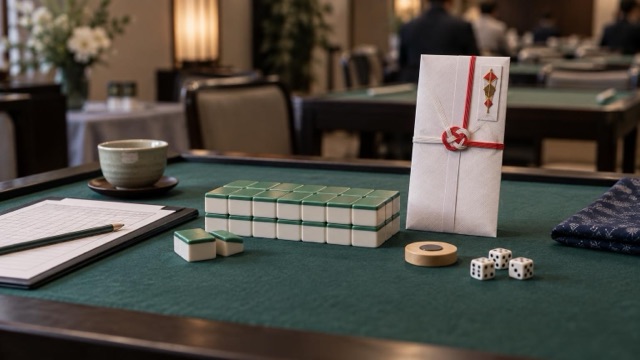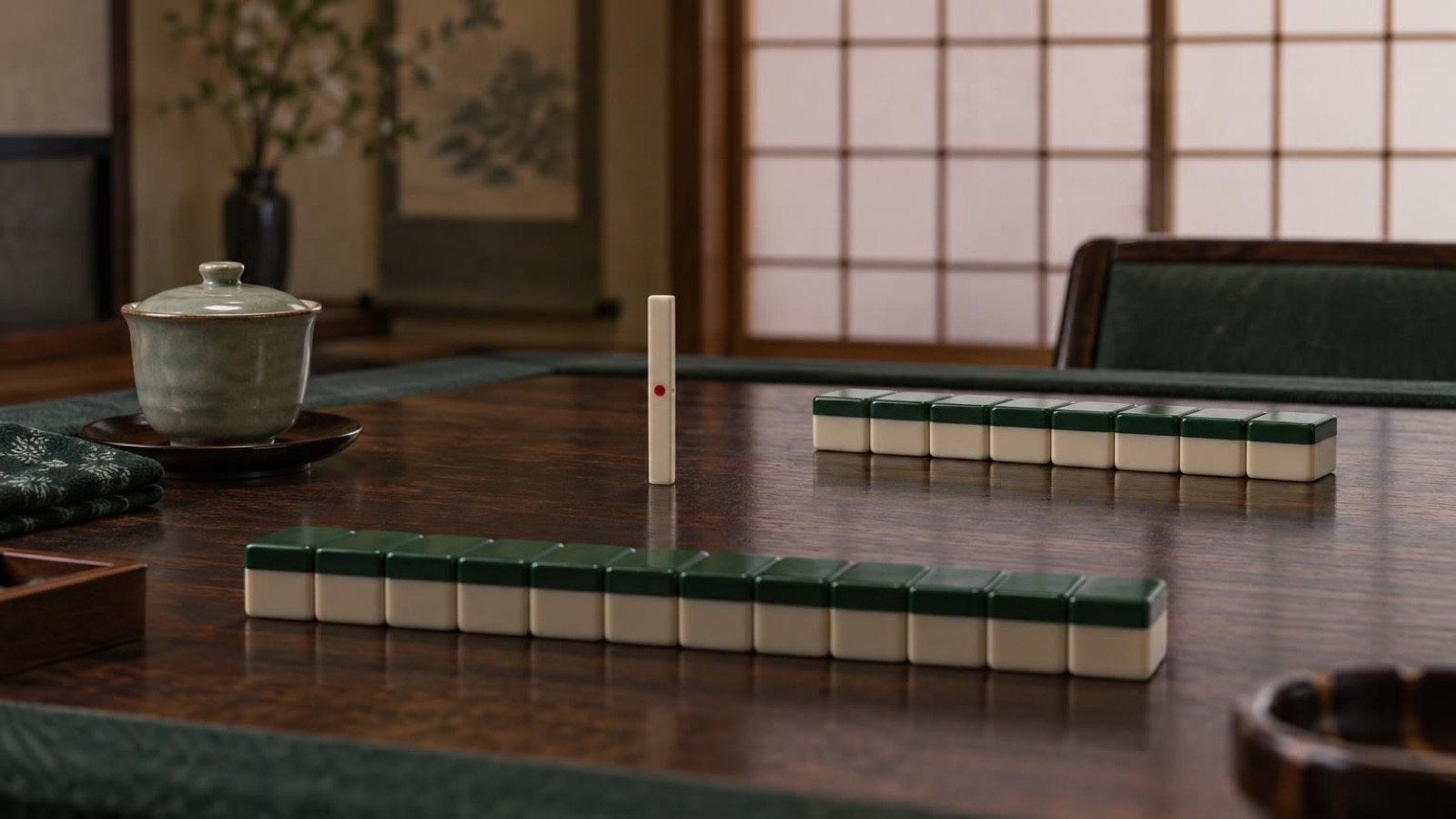
Riichi mahjong, also called Japanese mahjong, is the variant you will meet in mahjong parlors across Japan, in clubs from Minneapolis to Manchester, and in online apps played by millions. What makes it different from Cantonese or Taiwanese mahjong is a handful of rules that shape every decision at the table:
- Yaku minimum. You cannot win without a yaku, a named scoring pattern.
- Riichi declaration. You can lock your hand in for a point bet and a scoring boost.
- Dora. Bonus tiles can multiply your score.
- Furiten. Passing up a winning tile blocks you from winning on discards.
This page walks through those rules in the order you meet them in a game, from the first deal to the final hand. If you are new to the game itself, start with how to play mahjong; if you want the arithmetic of han and fu, that is on the riichi scoring system page.
Tiles, walls and the 13-tile starting hand
A standard mahjong set contains 34 kinds of tiles, four copies of each: three suits numbered 1 to 9, plus honor tiles made up of winds and dragons. The full count is 136 tiles. Three-player mahjong, a growing format in Japanese parlors, uses a reduced set of 27 kinds and 108 tiles, with the 2 through 8 of the character suit removed4.
| Set | Tile kinds | Total tiles | Notes |
|---|---|---|---|
| Four-player riichi | 34 | 136 | Three suits of 1 to 9, plus winds and dragons |
| Three-player (sanma) | 27 | 108 | Character suit 2 through 8 removed4 |
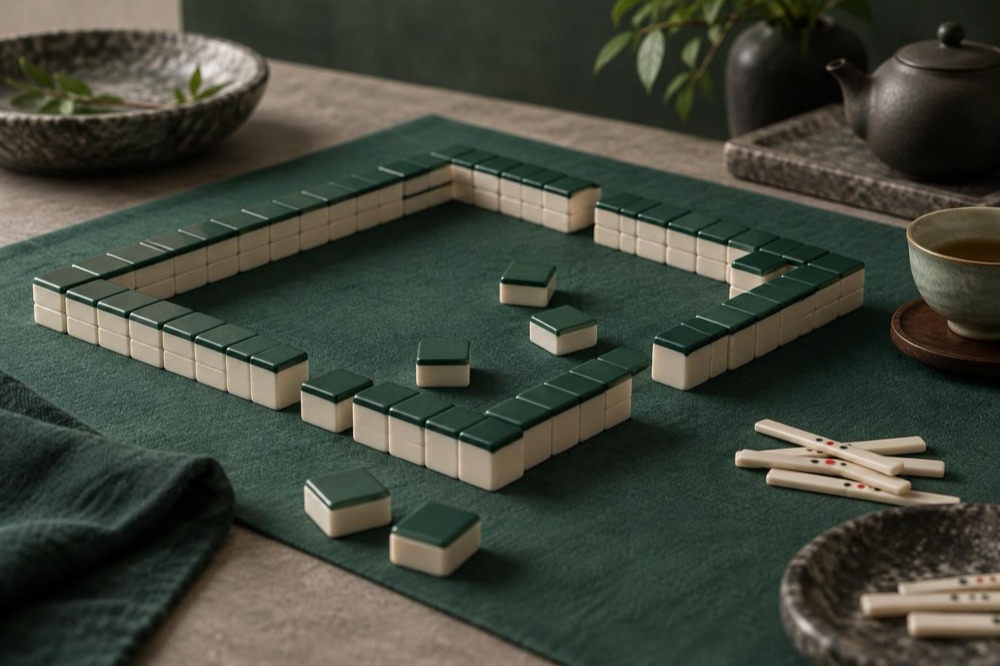
Before play begins, the tiles are shuffled face down and built into a wall: four rows of stacks, two tiles to a stack, arranged in a square. The traditional rule set describes a wall of 17 stacks per row1. Each player then draws a starting hand of 13 tiles, and the dealer draws a 14th to begin. Thirteen is the number the classic game revolves around: the standard hand is built on thirteen tiles, a structure that goes back to the earliest ancestor of the game5, though not every variant uses a 13-tile hand. Your turn is draw one, discard one, and the aim is to arrange those 13 tiles so that one more tile completes a winning shape.
The honor tiles deserve a word because they carry weight in scoring:
- Winds: east, south, west and north
- Dragons: red, green and white
In the Hong Kong tradition the green dragon tile is the 發財, and a winning hand containing a set of them earns extra fan6. Riichi mahjong uses the same honor tiles, and sets of them are among the most common yaku.
The winning hand: four sets and a pair
The winning hand in mahjong is always the same shape: four sets and one pair, 14 tiles in all1. A set is one of three things:
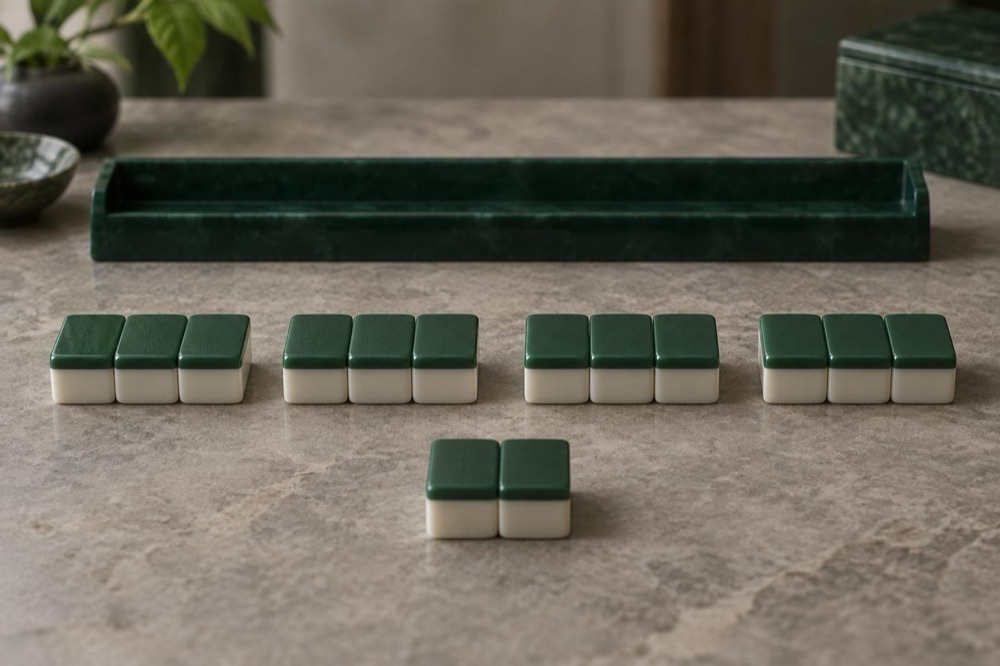
- Pung: three identical tiles
- Chow: three consecutive tiles of the same suit
- Kong: four identical tiles counted as one set
The pair is two identical tiles. Simple as that sounds, the whole strategy of the game is in which sets you chase and how you expose them.
Not every game uses the full shape. Simple Mahjong, a parlor variant with a five-tile hand, asks for just one set and one pair1. But riichi, like Cantonese mahjong, keeps the classic four-and-a-pair structure.
What makes riichi distinctive is the yaku requirement. A yaku is a named scoring pattern in the hand, such as a closed hand won by self-draw, a set of dragons, or seven pairs. In riichi you cannot declare a win at all unless the hand contains at least one yaku; a hand that is structurally complete but patternless scores nothing and cannot even be called. Other variants draw the line in different places:
| Variant | Minimum to declare a win |
|---|---|
| Riichi (Japanese) | At least one yaku2 |
| Mahjong Competition Rules (Chinese official) | At least 8 points2 |
| Mangan Mahjong | Mangan size or nothing is exchanged2 |
Riichi's one-yaku rule is the same idea in its simplest form: a win has to be worth something.
Declaring riichi
Riichi, the declaration that gives the variant its name, is a bet on your own hand. When your hand is one tile from winning and fully concealed, with no sets claimed from other players, you may declare riichi by placing a point stick on the table. From that moment your hand is locked: every tile you draw must be discarded unless it wins. In exchange:
- The riichi itself counts as a yaku, so even a hand with no other pattern can win
- It adds a han to the score
Waiting on your final tile is its own stage of the game. A player who needs just one more tile to complete the hand is said to be fishing7, and from that point every discard and draw from the wall matters. Not every game ends with a winner: when the last 14 tiles remain in the wall, the game is drawn and no scores are taken2. A drawn game simply resets the table for the next hand, so a fishing hand that never completes costs you nothing in that round.
Riichi also changes the table around you. Once you have declared, other players know you are waiting, and the furiten rule governs what happens next. If a tile you are waiting on is discarded and you do not call it, you are in furiten: you may not win on a discard, only on a self-drawn tile. This is the rule that gives riichi mahjong its defensive depth, because a player who passes on a winning tile has told the table something and lost the right to pounce later.
Calls on discards: pungs, kongs and the chow restriction
When a player discards a tile, the other three get a chance to claim it, and the claims have a strict priority order1:
| Priority | Call | Who may claim |
|---|---|---|
| 1 | Mahjong (win) | Any player |
| 2 | Kong | Any player |
| 3 | Pung | Any player |
| 4 | Chow | Only the player to the discarder's right |
A chow is different from the rest: only the player to the discarder's right, the next player in turn order, may claim a discard to form a chow, and doing so forfeits that turn's draw1.
Claiming any tile opens your hand. An open hand is visible to everyone and loses access to some yaku, which is why strong players prefer to keep the hand closed and simply draw toward the win. There is also a small trap called kuikae: you may not make an open pung or chow and then discard a copy of the tile you just called in the same turn. The McGill club's tournament rules state plainly that "kuikae is disallowed"2.
Three-player mahjong shows how flexible the chow rule is:
- In the standard three-player rules, chows are not allowed at all, to prevent early wins4
- In the Shin Sanma variant, a chow from the player to your left is allowed, which is why the format is sometimes called "three-player four-mahjong"4
- In Yokosuka Mahjong, another three-player form, chows are possible too4
In four-player riichi, the restriction to the player on your right is fixed.
When two players win on the same discard
Sometimes one discard completes two hands at once. The default resolution is positional: if one discard lets two or three players win, the player seated to the lower right of the discarder, counting counterclockwise, takes the win1. The player closer to the discarder's right in turn order wins, and the other player is out of luck for that hand.
Not every rule set accepts that outcome. Some allow double ron, where both players win and both are paid, and the JanKenSo online rules go further and allow triple ron, three winners on a single discard8. In the Sega NET Mahjong MJ three-player arcade rules, a double ron is resolved in favor of the dealer if the dealer is one of the winners and is the furthest-upstream player8. If you are playing in a tournament, check which convention the organizers use before the first hand, because it changes how you defend when two players declare riichi.
Kongs: open, closed and the extra draw
A kong is four identical tiles declared as a single set. The mechanics are the same whether the kong is open or closed: a player holding three identical tiles may kong when the fourth is discarded, kongs may be exposed or concealed, and after any kong the player draws one tile from the dead-wall end of the wall and then discards one, keeping the hand at its proper size1. That extra draw is the kong's real attraction, because every extra draw is another chance at the winning tile.
Kongs interact with the rest of the rules in ways worth knowing:
- A fourth kong by one player can trigger a draw in some rule sets, ending the hand with no score; the Sega NET arcade rules instead let play continue and simply forbid a fifth kong8
- A kong also turns a new dora indicator, which is why players sometimes declare a kong they do not strictly need: it reshuffles the bonus value of every hand at the table, including their own
How a win is paid
The winner is paid by the other players, and the amounts depend on whether the win was by discard or by self-draw, and whether the winner is the dealer. The core formulas in riichi are fixed9:
| Situation | Who pays what |
|---|---|
| Non-dealer wins on a discard | Discarder pays 4x the basic point |
| Dealer wins on a discard | Discarder pays 6x the basic point |
| Dealer wins by self-draw | Each non-dealer pays 2x the basic point |
| Non-dealer wins by self-draw | Dealer pays 2x, each other non-dealer pays 1x |
Fractions under 100 points are rounded up at the moment of payment9.
The basic point itself comes from the hand's fu and han, and every win starts with a base of 20 fu awarded automatically9. A closed hand won on a discard adds 10 fu for the closed-hand win9. The same hand can score differently depending on how the wait is read: a 3-han hand taken as a closed wait counts 40 fu and pays 1,300 to 2,600 points, where the same tiles read as a two-sided wait count 30 fu and pay less9. The full tables and the mangan cutoff are on the riichi scoring system page.
Dealer advantage runs through the payment rules in other variants too. In the Macau parlor rules, a winning dealer is paid double by all three other players, and when a non-dealer wins, the two other non-dealers pay single while the dealer pays double1. The principle is the same everywhere: the dealer's wins cost more, which is why keeping the dealer seat matters.
Draws, tenpai and hands with no score
Not every hand ends with a winner. If the wall runs out and nobody declares mahjong, the hand is a draw: no scores are taken, and the tiles are reshuffled. What happens next depends on the renchan rule in force8:
- Tenpai renchan: a dealer who was tenpai, one tile short of a winning hand, keeps the dealer seat
- Agari renchan: the dealer repeats only by winning, and a tenpai dealer at a draw still passes the seat on
Renchan itself is simply one player serving as dealer across multiple consecutive hands, and its opposite, rinchan, is the dealer changing to the player on the dealer's right8.
Draws with no score are a familiar idea across Japanese games. In the hanafuda game Koi-Koi, if both players run out of cards without forming a yaku, the game is a draw and no points are scored10. Mahjong's exhausted-wall draw works the same way: nothing is won, nothing is paid, and the game moves on.
Some rules go further and refuse to score weak wins at all. In Mangan Mahjong, a hand that wins but scores below mangan, meaning less than five han, or less than 4 han and 40 fu, or less than 3 han and 70 fu, exchanges no points2. Riichi does not go that far, but its one-yaku minimum serves the same purpose: a hand that is merely complete, with no pattern behind it, is not a win.
The full game: rounds and hands
A full game of riichi is organized into rounds named after winds, and each round contains one hand for each player's turn as dealer. The minimum game is the East Round and the South Round together, the hanchan format. In three-player mahjong, an east-south game is six hands, three in each round, not counting drawn hands4. In four-player play the same structure gives eight hands at minimum, and games run longer whenever the dealer repeats.
Shorter formats are common online and in parlors:
- East-only games (tonpuusen): just the East Round. The Sega NET arcade rules apply agari renchan to them, so the dealer repeats only on a win8
- JanKenSo online rules: use tenpai renchan instead, where a tenpai dealer at a draw also keeps the seat8
Which format you are playing changes the strategy a lot: in a one-round game, the dealer seat is worth fighting for early, because there is no South round to recover in.
Where you can play riichi
Riichi has spread far beyond Japan. A few markers of how wide the game now runs:
- Competitive mahjong tournaments in Japan are organized with sponsors who provide prize money to the winners, rather than players paying each other2
- Because the loser's payment does not come from the players themselves in these sponsored events, they fall outside the gambling offenses that apply to betting mahjong in Japan2
- In mainland China, mahjong is widely treated as a recreational activity rather than gambling, though legal sanctions can apply where gambling is involved3
- Club and tournament play, online and in person, is how most players outside Japan encounter the riichi form of the game
Online play is where most people now learn the game. Mahjong Soul is a Chinese game featuring the Japanese rules11, and Sega NET Mahjong MJ Arcade runs both three-player and four-player games with their own published rule sets8. Mahjong Fight Club, a long-running Japanese platform, does not allow riichi with fewer than 1,000 points7. For where to find physical tables, see mahjong parlors, and for playing online, see online mahjong.
Playing for money in Japan
Here is the one point of law that matters to a player in Japan: betting mahjong is a crime regardless of the place or the name of the venue, including mahjong parlors, mahjong teaching facilities, homes and inns12. The gambling offense carries a fine of up to JPY 500,000 or a petty fine for a person who gambles13, and repeated gambling can be charged as habitual gambling, which carries imprisonment of up to 3 years14. Courts treat money stakes as gambling regardless of the amount, so betting mahjong is in principle illegal at every rate, from JPY 10 per 1,000 points to far higher3. Wagering for money has been strictly and unambiguously illegal in Japan under legislation dating to 190815.
The exception is competitive play. Where the loser's payment is not made by the player, or the winner's gain does not reach the player, as in sponsored tournaments with prize money put up by a sponsor, there is no gambling offense3. That is how Japan's professional mahjong leagues and prize tournaments operate legally.
Mahjong stakes in Hong Kong and mainland China
In mainland China, the official position on mahjong is that it is a recreational game, and the law draws its line at profit and scale. Mahjong among relatives and friends, not for profit, with small winnings and purely for leisure, is treated as legal entertainment protected by law16. Official guidance is explicit on both sides of the line:
- Games with money stakes among relatives, without a profit motive, are not punished17
- Games with small stakes among non-relatives are not punished either17
- Chess and card rooms offering normal games for leisure are lawful and protected18
- Mahjong played without a profit motive is generally not treated as gambling19
Hong Kong is different, and the type of premises decides the question. Licensed mahjong parlors are authorized under the Gambling Ordinance, alongside regulated horse racing, football betting and the Mark Six lottery21. Playing mahjong for money in unlicensed premises where rental or commission is charged for tables, tiles and chips is unlawful, and the participants may be committing a gambling offense23. It is a common misconception that playing mahjong for money does not contravene the law; it does, outside the licensed and exempted settings23. Games continued outside the prescribed business hours of a licensed mahjong school become illegal23, and any unauthorized gambling activity is unlawful except where permitted by law24.
| Setting | Position |
|---|---|
| Mainland China, relatives, no profit motive | Not punished16 |
| Mainland China, non-relatives, small stakes | Not punished17 |
| Hong Kong, licensed mahjong parlor | Authorized under the Gambling Ordinance21 |
| Hong Kong, unlicensed premises with table charges | Unlawful; participants may commit an offense23 |
Stakes themselves have a long history of being counted in chips rather than cash. In the Hong Kong game Shengguan Tu, each player contributes 100 chips to the common pool at the start of a session25, a structure that survives in the way parlor mahjong is settled today.
Common Questions
How many tiles are used in a game of mahjong?
A standard four-player set has 136 tiles: 34 kinds with four copies each. Three-player mahjong uses a reduced set of 27 kinds and 108 tiles, with the 2 through 8 of the character suit removed. The wall is built from stacks of two tiles arranged in a square.
What happens if two players call mahjong on the same discard?
The player seated to the discarder's lower right, counting counterclockwise, takes the win. Some rules allow double or even triple ron, where two or three players all win on the same discard, but the default in many rule sets is that only one player wins.
How many points is a closed kong worth?
A kong does not have a fixed point value on its own. It adds fu to the hand's total, and the amount depends on whether the kong is open or closed and what tiles it is made of. The full calculation is covered on the riichi scoring page.
Can you claim a chow from any player's discard?
No. Only the player to the discarder's right, the next player in turn order, may claim a discard to form a chow, and claiming it means giving up that turn's draw. Pungs and kongs can be claimed from any player.
What is a fishing player in mahjong?
A fishing player is one whose hand is complete except for one tile, so they are waiting to win. In Japanese this state is called tenpai. At an exhausted-wall draw, a tenpai dealer can keep their seat under the common tenpai renchan rule.
Is playing mahjong for money legal in Japan?
No. Betting mahjong is a crime regardless of the venue, including parlors, homes and inns, and courts treat money stakes as gambling no matter the amount. Sponsored tournaments where the loser does not pay the winner directly are the exception.
How much do people typically stake in mahjong games in China?
Official guidance does not set an amount, but it draws the line at small stakes. Games among relatives with no profit motive are not punished, and games among non-relatives are tolerated only when the money involved is small. Larger stakes can be treated as gambling.
Sources25 sources
- Legal Mahjong Gaming Rules, DICJ Macau, 1991-08-05
- McGill Mahjong Club, McGill Mahjong Club, 2017-01
- 麻雀 (Mahjong), Wikipedia Japan, 2026
- 三人麻雀 (Three-Player Mahjong), Wikipedia Japan, 2026
- Flowers and Kings: An Hypothesis of Their Function in Early Ma Que, The Mahjong Tile Set, 2026-09-27
- 十三張麻雀規則 (13-Tile Mahjong Rules), GodGame, 2026-09-27
- 麻雀格闘倶楽部 (Mahjong Fight Club), Wikipedia Japan, 2026
- 連荘 (Renchan), Wikipedia Japan, 2026
- 麻雀の得点計算 (Riichi Mahjong Score Calculation), Wikipedia Japan, 2026
- こいこい (Koi-Koi), Wikipedia Japan, 2026
- Chinese Anime and Japanese Mahjong: Clandestine Battle Between Digital Content Economies, Baker Institute, 2023-05-10
- 遊技場営業等の利用に関する注意 (Notice on Use of Amusement Businesses), National Police Agency of Japan, 2026-09-25
- 賭博罪に関する資料 (Materials on Gambling Offenses), Ministry of Internal Affairs and Communications, 2010-07-07
- 大相撲野球賭博問題 (Sumo Baseball Gambling Issue), Wikipedia Japan, 2026
- Gambling in Japan, Oxford Brookes University, 2007-09
- 亲友间小聚搓麻是否违法 (Is Mahjong Among Relatives Illegal), Qixian Procuratorate, 2026-05-26
- 关于办理赌博违法案件适用法律的通知 (Notice on Applying the Law in Gambling Violation Cases), Shaowu Chengqu Justice Bureau, 2024-02-16
- 棋牌室娱乐活动法律提示 (Legal Notice on Chess and Card Room Entertainment), Beijing Miyun District Government, 2020-06-29
- 麻将娱乐与赌博的界限 (The Line Between Mahjong Entertainment and Gambling), China Peace, 2023-05-15
- 家庭成员间打麻将是否违法 (Is Family Mahjong Illegal), Jiangsu Provincial Government, 2019-03-13
- 賭博活動 (Gambling Activities), Home Affairs Bureau Hong Kong, 2026-09-27
- Gambling in Hong Kong: Consultation Paper, Home and Youth Affairs Bureau Hong Kong, 2025-04
- Mahjong Schools and Gambling Offences, Hong Kong Government, 1999-04-26
- Gambling Ordinance Statement, Hong Kong Government, 2025-06-04
- 香港聖冠圖研究 (Study of Hong Kong Shengguan Tu), National Taiwan Normal University, 2005-06