The variants you will meet at the table
Mahjong looks the same everywhere: four walls of tiles, a dealer, dice, and a race to complete sets. The differences are in the details, and they change how each game feels.
The Mainland and Hong Kong versions are the closest to the classic game: 136 tiles, 13-tile hands, and scoring in fan, the doubles that multiply your payout. Riichi, the Japanese version, keeps the 136-tile set but layers on a declaration bet and concealed-hand bonuses. Taiwanese mahjong deals bigger hands of 16 tiles. Malaysian three-player mahjong is the outlier: fewer players, fewer tiles, jokers, and a higher minimum to win. If you want the shared basics of tiles, turns and melds, see how to play mahjong; for the tiles themselves, see mahjong tiles.
Here is the quick comparison:
| Variant | Tiles | Hand size | Minimum to win | Players |
|---|---|---|---|---|
| Mainland (classic) | 136 | 13 | Varies by table | 41 |
| Hong Kong | 136 (144 with flowers) | 13 | 3 fan | 46 |
| Riichi (Japan) | 136 | 13 | 1 yaku | 44 |
| Taiwanese | 136 | 16 | Varies by table | 42 |
| Malaysian 3-player | 88 | 13 | 5 fan | 33 |
Chinese (Mainland) rules: 136 tiles and the classic game
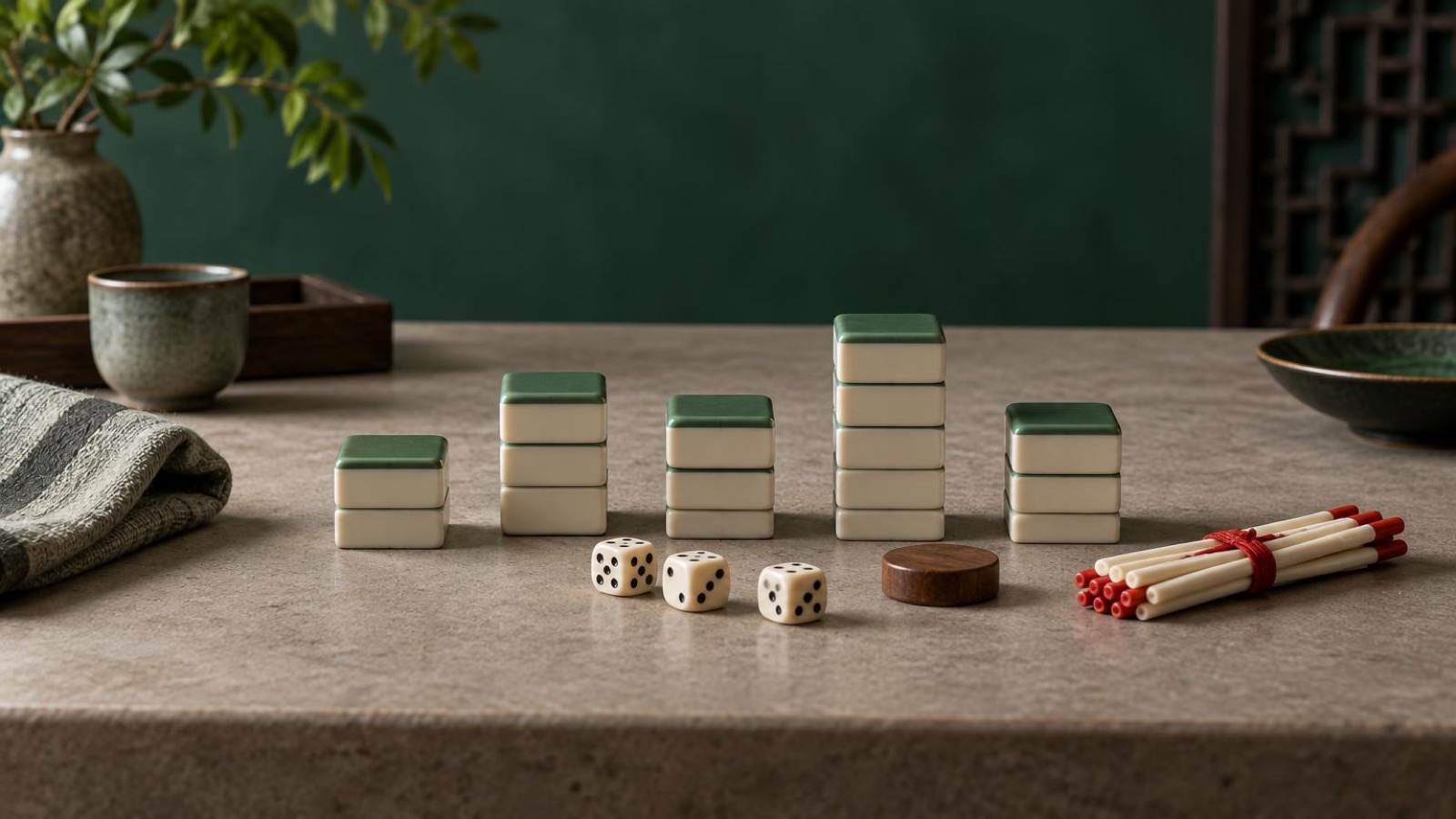
The Mainland game is the baseline most other variants are built on. Four players use a set of 136 tiles: 36 each of bamboos, characters and dots, plus 16 wind tiles and 12 dragon tiles. In northern China, flower and season tiles are left out entirely and the set is just those 136 tiles1.
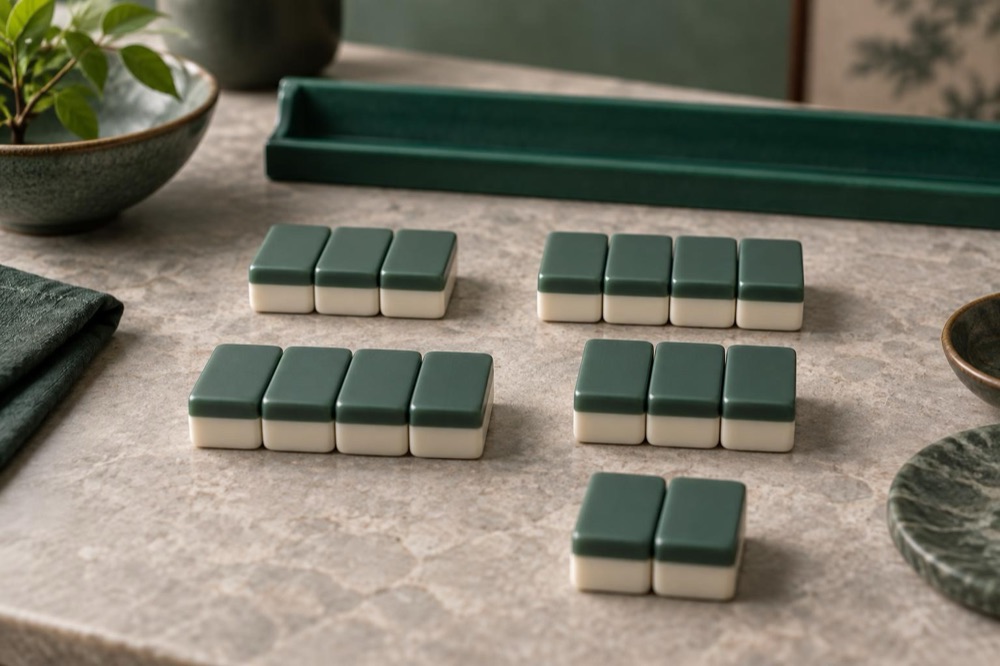
Each player draws 13 tiles, with the dealer starting with an extra 14th tile. All 136 tiles are shuffled face down and players build four square walls of 34 tiles each1. A player wins by assembling four sets (a chow, pung or kong) plus one pair, 14 tiles in total1.
A few rules shape the flow of the game. An exposed chow may only be declared off the discard of the player on your left, and in some areas of China the chow is not allowed at all1. Any player completing a kong, four identical tiles, immediately draws an extra tile from the wall before discarding1.
Stakes at casual tables vary widely. One common description puts a single base at 200 to 1,000, with some games reaching 10,000; a "ping hu" hand might cost 2 yuan while a "clean dragon" can run to roughly 50 yuan per hand9.
Hong Kong rules: the three-fan minimum and payment customs
Hong Kong mahjong uses the same 136-tile base set, with 8 flower tiles commonly added7. Each player builds a wall 17 tiles long and 2 tiles high without flowers, or 18 tiles long when flowers are in play7. Hands are 13 tiles, and the winning hand is the familiar four sets plus a pair6.
The rule that defines the Hong Kong game is the minimum: most games require 3 fan to declare a win6. A hand that falls short is a "false win," and the offender pays all three other players6. Flowers help here: each flower tile (spring, summer, autumn, winter, plum, orchid, bamboo, chrysanthemum) counts as 1 fan, though flowers are not counted toward the 3-fan minimum itself and only score after you win10. The dealer can count at most 1 fan toward the minimum10.
Tables usually agree on a fan cap before starting, commonly 8 or 10 fan, or no cap at all6. Big hands have fixed values: Little Four Winds (three wind triplets plus a wind pair) and Thirteen Orphans are each worth 13 fan, as is Eighteen Immortals, four kongs11.
Payment follows a simple pattern. On a self-draw win, each player pays the same amount; on a discard win, the discarder pays double and the other two players pay single6. Under a typical "one-two dollar" stake, a 3-fan self-draw win costs each player HKD 8, while a discard win costs the discarder HKD 16 and the other two players HKD 4 each6. For a fuller treatment of fan values, see mahjong scoring.
Riichi (Japanese) rules: the 13-tile start and riichi declaration
Riichi mahjong, the version you will find in Japanese parlors and in most online mahjong apps, also uses 136 tiles, with flower and season tiles omitted4.
Each player starts with 13 tiles, and the dealer draws a 14th to begin4. The signature mechanic is the riichi declaration: a player whose hand is one tile from winning, fully concealed, may declare riichi and stake 1,000 points on the win. The declaration itself earns extra points; in one casino adaptation of the game, a win after a riichi declaration earns 2 extra points12. For the full rules around riichi, yaku and dora, see riichi mahjong rules, and for how hands turn into payments, see the riichi scoring system.
Taiwanese rules: 16-tile hands
Taiwanese mahjong keeps the familiar tile set but deals bigger hands: you hold 16 tiles and go out on 172. Everything else scales up accordingly, and the larger hand means more possible combinations and, players say, more dramatic hands than the 13-tile game.
The wall setup matches the bigger hands. Dealing continues until all players have 16 tiles in 16-tile variations, compared with 12 tiles dealt before the final pass in 13-tile variations13. The winning structure is the same four sets and a pair, just one set bigger.
Malaysian three-player mahjong: 88 tiles, three walls and the Fly
Malaysia has its own three-player game, and it plays very differently from everything above. The set contains 88 tiles, though only 84 are needed3. The breakdown: 36 dot tiles, 16 wind tiles, 12 dragons, 8 flowers and seasons, plus 4 each of Faces, Animals and Fly tiles3.
There is no North player, so the three players are called East, South and West3. The dealer starts with 14 tiles and the other players with 1314. Each player builds a 14-tile-long wall, 2 tiles high, so the table has three walls instead of four14.
The Fly is the game's joker, and it drives most of the strategy:
- The Fly can represent any tile in making a 3-tile set3.
- You use 1 Fly to chow a discard, and 2 Fly to chow counts as a pong; you may also use 2 Fly to pong a discard14.
- You cannot pong with 3 Fly, and a Fly cannot appear in a gong set3.
- A Fly can act as a flower, contributing 1 fan when you are short of the minimum14.
- Each Fly is worth 50 points on its own3.
The minimum to win is 5 fan, much higher than Hong Kong's 33. Fan comes from many small sources: one face, one animal, four animals, four flowers, four seasons, your own flower or season, a pong of North or East wind, a pong of your own wind, a pong of a dragon, a mixed one-suit hand, all chows with a dot pair, seven twins, stealing a gong, and winning on a loose tile are each worth 1 fan; all pong/gong hands and a dealer's East wind pong are worth 2 fan; two pongs and a dragon pair and a pure single suit are worth 3 fan3.
Hands that hit "Max Fan" double the score: 13 Unique Wonders (only with all three suits), Nine Gates, a pong of four winds, four gongs, four Fly, winning on the first or last tile, sixteen flowers, or a hand of 10 fan or more3.
Rounds are quick, about 5 to 15 minutes each, and there are no round winds and no fixed number of rounds; the game ends when two or more players agree to stop3. Malaysia also has a four-player version with 164 tiles, including 24 flowers and 4 jokers15.
Scoring and payouts compared: fan, points and who pays
Every variant answers three questions differently: how the hand is valued, who pays, and how much.
In Hong Kong mahjong, fan convert to points and then to money at a stake the table agrees on beforehand. In the old-style game, on a discard win the discarder pays the winner double the hand's points and the other two opponents pay single; on a self-draw win each player pays double16. In the old-style table 3 fan is worth 8 points, and 64 points is 8 fan16, and one Hong Kong rulebook pays 6-fan hands at 128 points on a discard or 64 from each player on a self-draw, and 8-fan hands at 256 or 128 each, with a 10-fan cap and limit hands always counting as 10 fan17.
Riichi pays by formula from a shared pool of points, with the hand's han and fu converted into fixed payments; the details are worth a page of their own at riichi scoring system. Malaysian three-player works in raw points instead: winning itself carries a base of 100 points, a concealed gong costs 100 points from both losing players, a revealed gong 50, and a Max Fan hand doubles the score to 200 points3. On a self-draw win, each player loses double the winning points to the winner3.
When two players call the same tile
Disputes over a discarded tile are settled by a fixed order of priority. In general, "Mahjong" beats everything, then kong, then pung, then chow18. If two players can win on the same discard, the win goes to the caller whose winning set ranks highest: kong before pung, before pair, before chow18.
A round is drawn, with no scores taken, when the last 14 tiles remain in the wall18. A player who needs only one tile to win is said to be "fishing"18. A full game runs four rounds named after the winds, a minimum of 16 winning hands18.
Playing for money: where the law draws the line
Money is where the variants' home jurisdictions differ sharply, and it is worth knowing before you sit down.
In Japan, betting mahjong is a crime regardless of the place or the name of the venue, including mahjong parlors, teaching facilities, homes and inns19. That is why Japanese parlor mahjong is played for table fees and ranking points rather than cash pots.
In mainland China, the official position distinguishes recreation from gambling: relatives playing mahjong or poker with money at stake, without a profit motive, are not punished, and the same applies to small-stakes games among non-relatives20. Small gatherings of relatives and friends, not for profit, with tiny sums and purely for leisure, are treated as legal entertainment21. In practice mahjong is widely viewed as a recreational activity rather than gambling, though it remains subject to sanctions when real gambling is involved9.
In Hong Kong and Macau, mahjong is treated as a game of chance that is legal to offer in licensed venues under official rules. Macau's regulator publishes the exact game rules for its legal mahjong: two variants, Traditional Mahjong and Simple Mahjong, with defined equipment of 136 tiles, one dealer marker, three dice and a standard table22. The official payout rules there mirror the folk game: a winning dealer is paid double by all three players, and when a non-dealer wins, the two other non-dealers pay single while the dealer pays double22. For a fuller picture across the region, see where Asian games are legal.
Other styles you may meet
A few more variants round out the picture. Vietnamese mahjong adds eight tiles to the usual flowers and seasons: four kings and four queens join the set, making 16 bonus tiles in all, and you must reveal and replace all bonus tiles dealt in your opening hand, though flowers drawn later can be kept and discarded23. Filipino mahjong uses the standard 144-tile set and runs four rounds, extendable to taste; the only tile that cannot be discarded is a flower, since flowers must be exchanged from the flower wall24. Western and British mah-jongg uses 144 or more tiles, with optional jokers15. And in a curious hybrid found in some regions, a card game called Daun Tiga replaces the 10s, jacks, queens and kings of a deck with wind tiles, East, North, West and South respectively25.
Common Questions
How many tiles are in a mahjong set?
It depends on the variant. Mainland, Hong Kong and riichi sets use 136 tiles, and the classic full set has 144. Malaysian three-player is smaller, with 36 dot tiles, 16 wind tiles and 12 dragons.
Which mahjong variant is easiest for beginners?
Most players find Hong Kong or Mainland rules the gentlest entry point, since the hand structure is simple and scoring is fan-based. Riichi adds yaku requirements and complex point tables, while Malaysian three-player has unusual joker rules.
What does a winning mahjong hand look like?
In every variant, a winning hand consists of four sets of chow, pung or kong, plus a pair. The variants differ in how many tiles you hold, how you claim discards and how the hand is scored.
What is the Fly tile in Malaysian mahjong?
The Fly is a joker. It can stand in for any tile when making a three-tile set, can be used to chow or pong discards, and can act as a flower worth 1 fan. It cannot be part of a gong, and you cannot pong with three Fly tiles.
Is playing mahjong for money illegal in Japan?
Yes. Betting mahjong is a crime regardless of the venue, including parlors, homes and inns. That is why Japanese parlor mahjong is played for table fees and ranking points rather than cash pots.
How long does a round of Malaysian three-player mahjong take?
Each round takes about 5 to 15 minutes. There are no round winds and no fixed number of rounds; the game simply ends when two or more players agree to stop.
What happens if two players call mahjong on the same tile?
The win goes to the caller whose winning set ranks highest: a kong beats a pung, which beats a pair, which beats a chow. In general, calls resolve in the order mahjong, kong, pung, chow.
Sources25 sources
- Mahjong, China Educational Tours, 2026
- Mah Jongg Rules, Gareth Saunders, 2013
- Malaysian 3-Player Mah-Jongg, Sloperama, 2026
- Gambling in Japan, Oxford Brookes University, 2007
- Mahjong Game Rules, Mahjong Time, 2026
- How to Play Mahjong, Cosmopolitan Hong Kong, 2025
- Hong Kong Old Style Mahjong Overview, Mahjong Wiki, 2026
- Riichi Rules 2016, European Mahjong Association, 2016
- Answer on mahjong stakes in China, Zhihu, 2026
- GodGame Hong Kong Mahjong rules, GodGame, 2026
- Limit Hands in Hong Kong Mahjong, TileBuddy, 2026
- Paradise City casino game guide, Paradise City, 2026
- Mah Jongg dealing chart, Righto, 2009
- Malaysian 3-Player Mah-Jongg, Sloperama, 2026
- Mah-Jongg FAQ 02b, Sloperama, 2002
- Hong Kong Old Style Scoring, Mahjong Wiki, 2026
- GGHK Classical Hong Kong Mahjong Rulebook, GGHK, 2023
- How to Play Mahjong Rules Guidelines, Brown, 2007
- Guidance on mahjong gambling, National Police Agency Japan, 2026
- Notice on Applying the Law in Gambling Violation Cases, 2024
- Prosecutorial news on mahjong among relatives, 2026
- Legal Mahjong Gaming Rules, DICJ Macau, 1991
- A Quick Look at Mahjong Around the World, McGill Mahjong, 2015
- Official Filipino Mahjong Rules, Mahjong Pros, 2026
- Daun Tiga, Pa Gow or Sam Cheong, 2017