
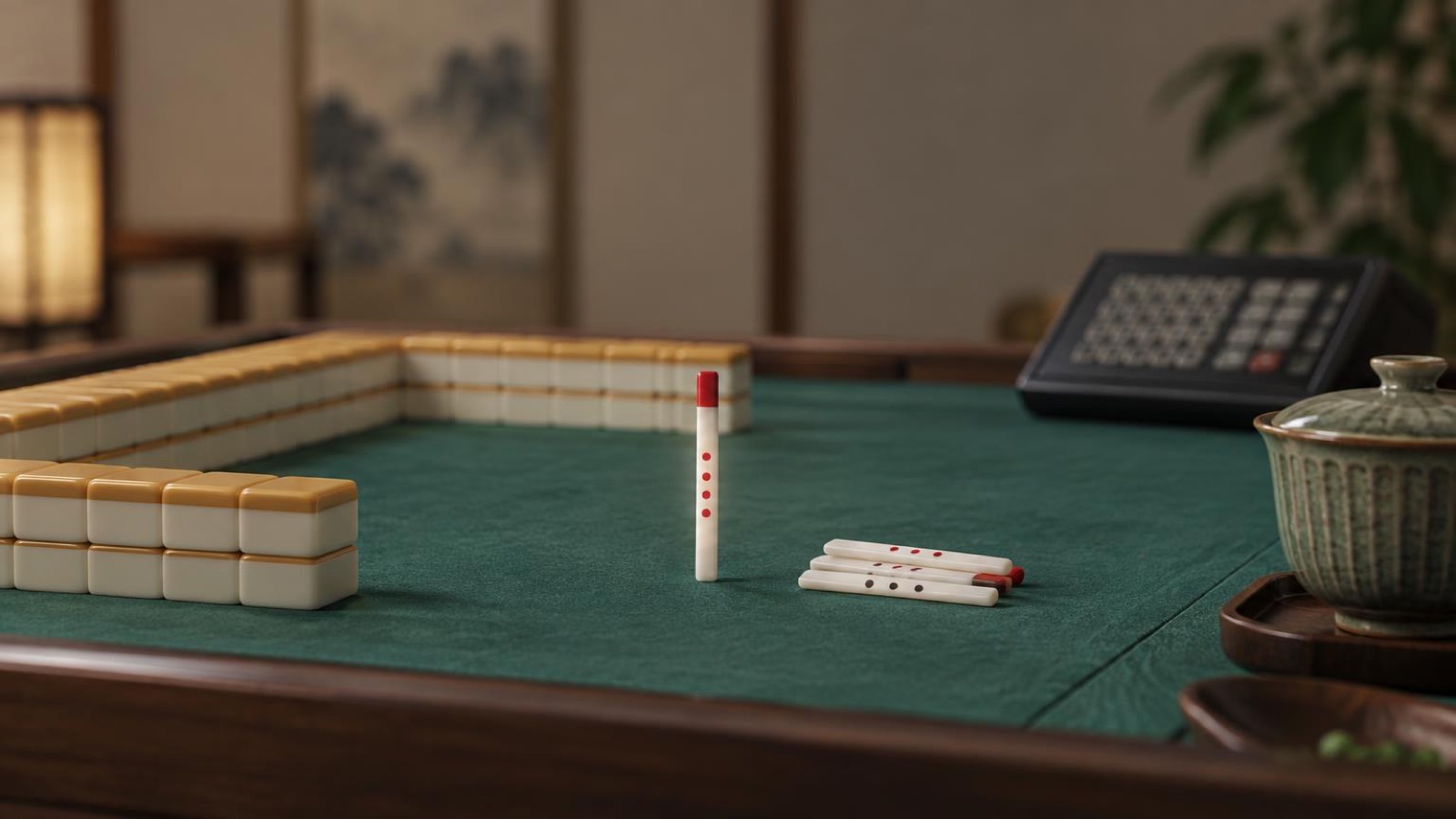
The two numbers behind every score
Riichi scoring looks complicated because two separate values feed into it. The first is han, which counts the value of your yaku and any dora you hold. The second is fu, a smaller base number built from the shape of your hand. Once you have both, you look up a table and the payout falls out.
Han is the number that matters most. A hand with three han beats a hand with one han almost every time, even if the fu is lower. Fu only shifts the score by small amounts at low han counts, and once you reach the higher tiers the fu value stops mattering at all because the hand is capped.
The practical way to think about it: han decides which row of the table you are on, and fu decides where in that row you land. Beginners usually learn han first, play a few dozen hands, then pick up fu once the yaku are familiar.
Yaku: the patterns that give you han
A yaku is a named pattern in your finished hand. You need at least one to win, and each yaku carries a han value. Some are worth one han, some two, and a few jump straight to a fixed high score.
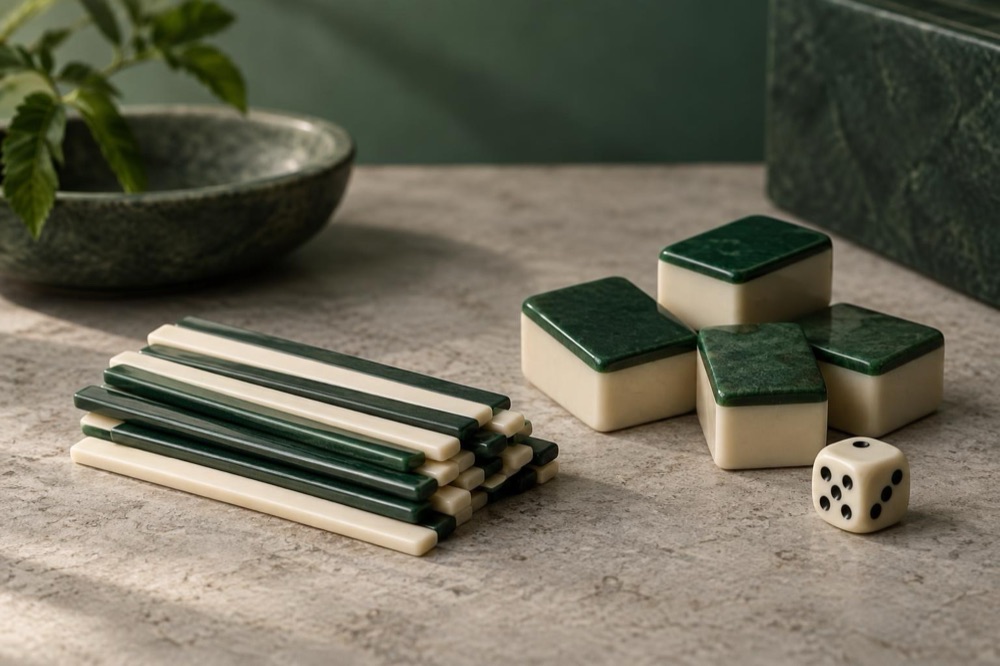
The common one-han yaku you will meet in your first sessions include:
- riichi
- tanyao (all simples, no terminals or honors)
- pinfu (all sequences with a two-sided wait)
- iipeiko (two identical sequences)
- yakuhai (a triplet of dragons, the seat wind or the round wind)
Each of these is worth one han on its own.
Two-han yaku include chiitoitsu (seven pairs), sanshoku doujun (the same sequence in all three suits), ittsuu (1-2-3, 4-5-6, 7-8-9 in one suit), and toitoi (all triplets). These are worth more because they are harder to complete.
Above that sit the yakuman, the top-tier hands. Kokushi musou (thirteen orphans), suuankou (four concealed triplets), daisangen (three dragon triplets) and a handful of others score the maximum. A yakuman does not need han or fu at all; it pays a fixed amount.
Dora are not yaku. They add han to a hand that already has a yaku, but a hand with only dora and no yaku cannot be declared. This trips up a lot of new players, who see three dora and assume the hand is worth something.
Fu: the smaller number underneath
Fu is a base value built from the structure of your hand. It starts at 20 for any closed hand that wins, and then you add points for specific features.
| Feature | Fu added |
|---|---|
| Closed ron | 10 |
| Tsumo (except pinfu) | 2 |
| Pinfu tsumo | 0 (hand total fixed at 20 fu) |
| Pair of dragons, the seat wind or the round wind | 2 |
| Closed triplet, terminals or honors | 8 |
| Closed triplet, simples | 4 |
| Open triplet, terminals or honors | 4 |
| Open triplet, simples | 2 |
| Closed kan, terminals or honors | 32 |
| Closed kan, simples | 16 |
| Two-sided wait | 0 |
| Closed wait, edge wait or pair wait | 2 |
The total is then rounded up to the next ten. So a hand that comes to 32 fu is scored as 40 fu. The only exception is the 25 fu chiitoitsu hand, which is not rounded.
Fu matters most at one and two han. At three han it still shifts the score a little. At the higher tiers, the table ignores fu entirely and pays a flat rate.
Reading the payout table
Once you have han and fu, you read the score table. The table has rows for fu and columns for han, and each cell gives the points the winner collects.
The dealer always pays and receives more than the other players. A dealer ron pays a larger amount than a non-dealer ron at the same han and fu, and a dealer tsumo collects from each of the three opponents.
Once han reaches the top tiers, the table switches to fixed values. A hand at the mangan level pays a set amount for a non-dealer ron and a larger set amount for the dealer. The tiers above that, haneman, baiman, sanbaiman and yakuman, each pay progressively more, again with the dealer receiving the higher figure.
A few rulesets use a slightly different cap for a hand that reaches mangan through fu alone, but the standard table covers almost every game you will sit down at.
Riichi, ippatsu and the bonus sticks
The riichi declaration itself is worth one han, and it comes with a side bet. When you declare riichi you place a bet on the table. If you win the hand, you take that bet back along with any other riichi sticks that have piled up from earlier hands.
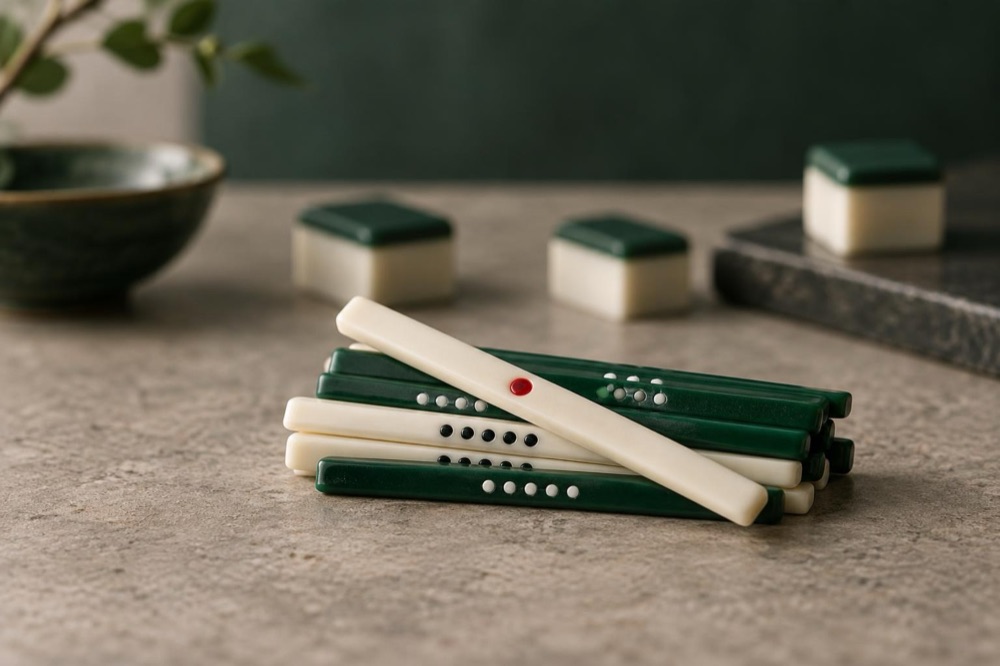
Ippatsu is a bonus han you can earn if you win within one go-around of declaring riichi, without anyone calling a tile in between. It is worth one han and stacks with the riichi han, so a riichi plus ippatsu hand starts at two han before anything else.
The honba counter adds a small amount to every win. Each honba is paid by the discarder on a ron or split between opponents on a tsumo. Honba build up when the dealer wins or when the hand ends without a winner, and they reset when the dealer loses.
Worked examples
Take a closed hand with riichi, pinfu and a two-sided wait, won by ron. That is two han and 30 fu. A non-dealer ron pays the two-han, 30-fu figure from the table. If the same hand is won by tsumo, pinfu forces 20 fu, and the payout is split between the three opponents plus the dealer.
Now take a hand with yakuhai (a dragon triplet), a closed triplet of nines, and a pair of the round wind, won by ron. That is one han from the dragon plus fu from the triplets and the wind pair. The fu comes to 20 base, 10 for the closed ron, 8 for the closed triplet of nines, 8 for the closed dragon triplet, 2 for the wind pair, which comes to 48, rounded up to 50. One han and 50 fu pays the one-han, 50-fu figure for a non-dealer ron.
A third example: a hand with chiitoitsu, riichi and two dora. That is two han from chiitoitsu, one from riichi, two from dora, so five han. Five han is mangan, worth the fixed mangan payout for a non-dealer ron regardless of the 25 fu.
Where riichi sits in the wider mahjong world
Riichi is one of several mahjong scoring systems, and it is the one most associated with Japan. Cantonese, Taiwanese and Malaysian rules all use different counting methods, and the numbers do not transfer between them. If you have played one of those, expect to relearn the payout side from scratch.
The yaku and the tile set are shared across most variants, so the hand-building skills carry over. It is the scoring layer that changes. You can read more about how the variants differ in Mahjong Variants Compared, and the wider scoring picture across all the major systems in Mahjong Scoring Explained.
If you are new to the game itself, the tile set and the basic flow are covered in Mahjong Tiles Explained and How to Play Mahjong. The full ruleset, including yaku, riichi and furiten, is in Riichi Mahjong Rules.
Playing riichi at a parlor or online
Mahjong parlors across Japan charge a table fee rather than taking a cut of winnings, and the points on the table are not cash. You pay for the seat and the time, and the score at the end decides who is ahead. The same model runs in parlors across Asia, covered in Mahjong Parlors Across Asia.
Online riichi apps use the same scoring system but with points rather than money. Apps like Mahjong Soul have made the game far more accessible, and the scoring works exactly as it does at a physical table. Whether those apps count as gambling depends on whether real money changes hands, which is covered in Mahjong Soul and Online Mahjong for Money and Free Mahjong Apps.
Competitive riichi has grown quickly, with pro leagues and tournaments running across the region. The prize structures and league formats are set out in Competitive Mahjong.
Common Questions
What is the difference between han and fu in riichi?
Han counts the value of your yaku and any dora, and it drives the score upward. Fu is a smaller base value built from how the hand is shaped, such as pairs, triplets and waits. Han matters far more once a hand climbs past a few han.
Do you need a yaku to win a hand?
Yes. A hand with no yaku cannot be declared, no matter how many tiles it uses. You need at least one valid pattern, such as riichi, tanyao or a triplet of dragons, before you can call a win.
Are dora the same as yaku?
No. Dora add han to a hand that already has a yaku, but they are not a yaku on their own. A hand holding only dora and no valid pattern cannot be declared, which catches out a lot of new players.
What happens if you win but have no yaku?
The win is not valid and you cannot declare it. If you call a win that has no yaku, the hand is void and you may face a penalty payment depending on the table rules. Always check your yaku before declaring.
Is riichi mahjong gambling?
In Japan, playing mahjong for small prizes at a parlor is common, but betting money on games is restricted. Online mahjong apps that use points rather than cash sit outside gambling rules in most cases.
Can beginners learn riichi scoring quickly?
The basics take an evening. Start by learning a handful of yaku, then add fu and the payout table. Most players pick up the full system within a few weeks of regular play.
Sources1 sources
- 麻雀の得点計算, Wikipedia, 2026















