How online mahjong for money works
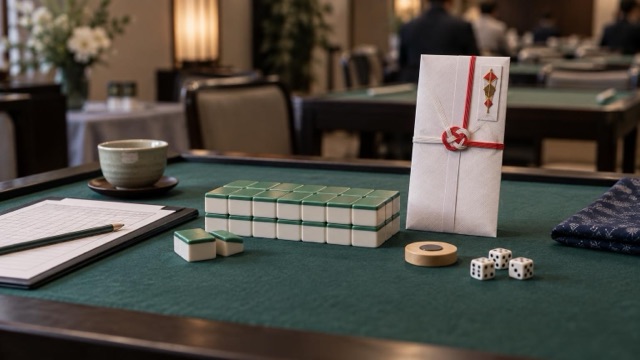
A real-money mahjong game online works the same way a cash game at a table works. Four players (or three, on sites that offer the Japanese three-player variant) each pay into the game, play a hand of mahjong, and settle the scores in money at the end. The scoring is what turns the game into gambling: the winner of a hand receives the full value of the winning hand from each of the other players, and pays out nothing to anyone5.
In Japanese parlors and on Japanese-style sites, the money side is handled with a rate. A common rate is called "pin" (or "ten-pin"), where JPY 100 is paid per 1,000 points, so a big hand can move real money quickly between players2. The same structure is what makes online mahjong for money a gambling offense in Japan, which we cover below.
The practical difference between the three kinds of online mahjong is who pays the winner:
- Free apps: no money changes hands at all. You play for points, ranks or cosmetics.
- Competitive tournaments: prize money comes from sponsors and entry fees, not from the losing players at the table.
- Cash games: the losers pay the winner directly, per hand or per session. This is the form that is treated as gambling across most of East Asia.
If you want the full rules of the game itself, see how to play mahjong, and for the tile set in detail, see mahjong tiles.
Playing mahjong for money is a crime in Japan
Japan is the strictest of the jurisdictions on this page. Gambling other than the public sports (horse racing, motorboat racing, bicycle racing and motorcycle racing) is a crime under the Penal Code, and that includes mahjong played for money2. The National Police Agency states it plainly: mahjong gambling is a crime regardless of the place or the name of the venue, whether that is a mahjong parlor, a "mahjong education facility," a private home or an inn7.
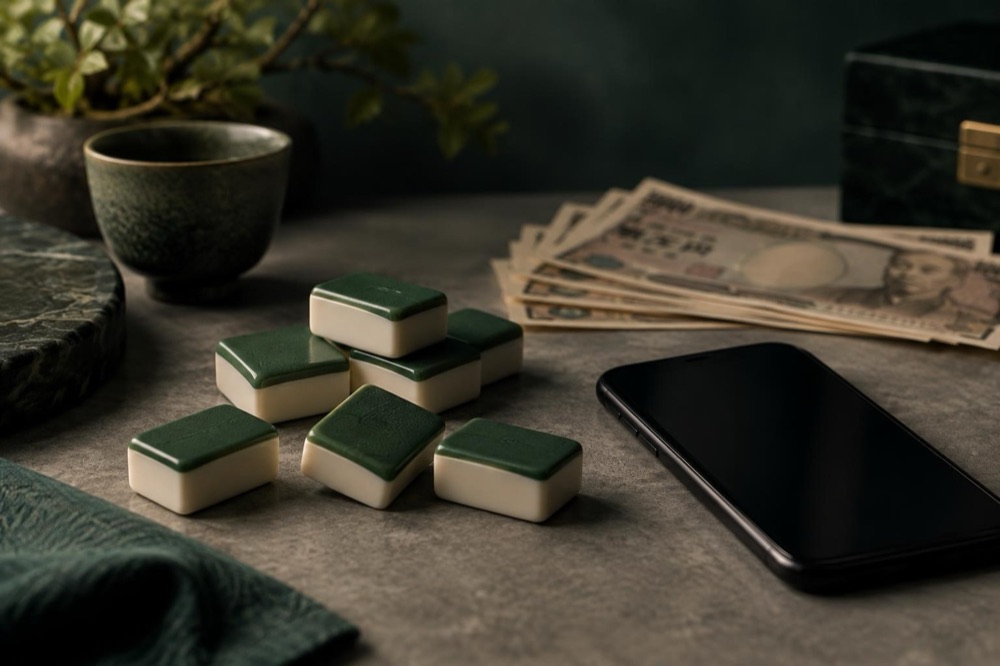
There is no small-stakes exception in Japan. Japanese law and court precedent treat money stakes as gambling regardless of the amount, so betting mahjong is in principle illegal at every rate, from a few hundred yen upward2.
The same rules apply online, and this is the part that surprises people. The police and the Consumer Affairs Agency both state that connecting from within Japan to gamble on an online casino is a crime even if the operator is legally licensed overseas8. A foreign license does not make it legal, and the police enforce strictly9. The National Police Agency adds that even free versions and free point-based play on casino sites must not be used8.
For players, the risk is concrete: playing is a gambling offense, and repeating it can bring the heavier habitual gambling offense10. A police research paper puts it the same way: using a smartphone in Japan to access an overseas casino makes it a domestic crime, and not knowing it was illegal does not excuse it11. Online pachinko falls under the same ban12.
This applies to everyone in Japan, citizens and visitors alike, because the crime is committed at the moment of connecting from Japanese territory. For the wider picture of what gambling is allowed in the country, see gambling in Japan.
The exceptions that keep competitive mahjong legal in Japan
If all money mahjong is a crime, how does Japan have professional mahjong leagues, televised tournaments and prize money? The answer is in who pays. There is no gambling offense where the loser's payment is not made by the player, or where the winner's gain does not come from the other players at the table, as in competitive tournaments where a sponsor provides the prize money2.
That single distinction is what the whole competitive scene rests on. Players pay an entry fee to an organizer, the organizer or a sponsor puts up the prize pool, and the losers at the table never pay the winners directly. Structured that way, the game is a competition, not gambling, and it is the same logic that keeps the four public sports legal: online wagering in Japan is only allowed on horse racing, motorboat racing, bicycle racing and motorcycle racing operated by the government or municipal bodies13.
So the practical rule for anyone in Japan is simple. Free apps, competitive tournaments with sponsor-funded prizes and the public sports are on the safe side of the line. Any game where the losers pay the winners directly, in a parlor, at home or through an app, is on the wrong side, at any stake. You can read more about the tournament scene in competitive mahjong.
China: a recreational game, unless it is run for profit
Mainland China draws the line in a different place from Japan: the question is not whether money changes hands, but whether anyone is playing for profit.
Official guidance is that mahjong or card games with money stakes among family members or relatives, without a profit motive, are not treated as gambling, and games with small stakes among non-relatives are not punished either3. A legislative guidance document says the same: taking part in gambling where the amounts involved are very small and the purpose is only recreation does not constitute a crime14. A 2023 official news piece confirms that mahjong entertainment is not treated as gambling and generally not punished when it is not for profit, when stakes are small, or when chess and card rooms charge only fixed venue and service fees15. A prosecutor's office put it most recently in 2026: small gatherings of relatives and friends playing mahjong with tiny winnings, purely for leisure, are legal entertainment protected by law16.
The line is profit. Playing mahjong in a chess and card room for leisure is lawful and protected, but using mahjong or poker as a gambling tool in those same rooms breaks the Public Security Administration Punishment Law, and in serious cases the Criminal Law17. Beijing's own regulations state that organizing gambling for profit or making a living from gambling is pursued under the Criminal Law18. Local enforcement notices, such as one from Dingcheng District in Changde, prohibit gambling for profit in every form, including mahjong, dominoes, dice, the internet, WeChat red packets and Texas Hold'em19.
Cross-border gambling is treated especially severely. The National Immigration Administration states that gambling abroad, gambling online, and providing funds or technical support for gambling all violate the Criminal Law and the Public Security Administration Punishment Law, and this applies to Chinese citizens20. Independent operator listings warn plainly that hefty fines and imprisonment are among the risks of gambling online from China21.
Hong Kong has its own rules, and they surprise many players. It is a common misconception that playing mahjong for money does not break the law; in fact it is unlawful to play in non-bona fide establishments, or on unlicensed private premises where rental or commission is charged for tables, tiles and chips, and players in those situations may be committing a gambling offense22. Very often it is the type of premises, not the game, that determines legality22. A small number of mahjong parlors remain licensed to operate legally23, and licensed mahjong schools have prescribed business hours, outside which the games become illegal22. See gambling in Hong Kong and mahjong parlors for more.
Stakes and payouts in Chinese mahjong games
Where money mahjong is played legally, the stakes follow the scoring system. In Japanese-style games, the rate system described above (JPY 100 per 1,000 points at the "pin" rate) is the standard way points become cash2.
At the tournament end of the scale, the sums are large. The World Series of Mahjong gave away total prizes of one million American dollars, over 1.3 million Canadian dollars, with first place taking half6. Entry was not cheap: the World Series of Mahjong Zung Jung tournaments cost approximately USD 1,250 just to enter24.
For the scoring systems behind these numbers across the different regional variants, see mahjong scoring.
Free mahjong apps and browser games
The free side of online mahjong is huge and, in most of Asia, entirely legal to play. Social casino-style games are freely available on social networks, websites, apps, smartphones and tablets25. Free mahjong sits in this category: no cash ever changes hands between players.

The best-known example is Mahjong Soul, a Chinese-made game that features Japanese riichi rules1. It is free to play, runs in a browser and on phones, and its anime-style presentation is part of a wider story of Chinese and Japanese digital content crossing borders1. For a full breakdown, see Mahjong Soul.
A few things worth knowing about the free app world:
- Games come and go. Hangame's three-player mahjong service ended on January 17, 2018, which is typical of the shelf life of smaller online mahjong products2.
- Free tournaments exist. Some communities run tournaments with no entry fee at all; the MSMC annual mahjong tournament, for example, charges nothing to register6.
- Apps are on every platform. The Hong Kong Mahjong app was updated on Google Play in August 2026 with support for the latest Android API level, and the Hong Kong Jockey Club's betting app supports iPhone, iPad, Android phones and Windows phones26.
- Free does not mean a casino app. The Japanese authorities' warning about "free versions" of online casino sites, mentioned above, is about real-money casino products with free modes, not about genuinely free mahjong games8.
The general rule of thumb: if the app never asks you to put money on the table against other players, it is a game. If it does, everything in the Japan and China sections above applies to it. For the broader landscape of playing Asian games online, see playing Asian games online.
Mahjong at Paradise City casino
If you want to play mahjong-flavored casino games for money legally, the closest thing is in South Korea. Paradise City in Incheon is a major foreigner-focused resort casino27.
| Detail | Paradise City, Incheon |
|---|---|
| Gaming tables | 16027 |
| Baccarat tables | about 6027 |
| Opening hours | 24 hours27 |
| Parking | available27 |
| Address | 321beon-gil 186, Yeongjonghaeannam-ro, Jung-gu, Incheon |
The mahjong connection is through the casino's table games. Paradise Casino's Incheon Airport branch offers baccarat, blackjack and roulette in its gaming zone28, and the wider Paradise group runs properties including Paradise Casino Jeju Grand, open 24 hours at 80 Yeon-ro, Jeju City29.
The most mahjong-like casino product in the region is Mahjong Bacarat, offered under official rules in Macau. Each round deals a full ten seats of two tiles each regardless of the number of players; players may bet on one or more seats, each seat may carry backing bets, and the player with the highest bet turns the tiles4. A player wins if the sum of their two tiles exceeds the banker's; if the points are equal, the higher single tile wins, and if both banker and player hold a tight ten, the banker wins regardless of tile size or combination4. Only one person per seat may turn the tiles, and no one may leave the table to look at tiles during a round4. If the banker wins the first round and continues, the bank plus winnings becomes the new bank, which may only be increased, not reduced4.
Note that these casino games are games against the house, not player-versus-player mahjong. For the full picture of what visitors can do in the country, see gambling in South Korea, and for the tile-based table game closest to real mahjong, see pai gow tiles.
The rules of play: tiles, hands and calls
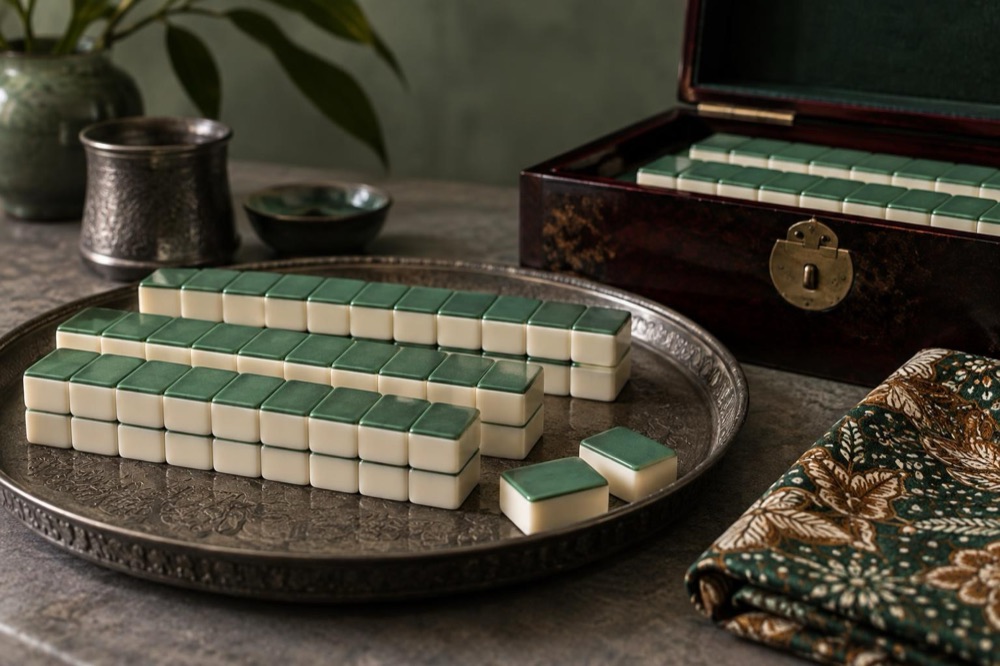
Whether you play in an app or at a table, the mechanics are the same. Macau's official Legal Mahjong Gaming Rules describe the traditional game: four players, a wall built as four rows of 17 two-tile stacks each, arranged in a square30. A winning hand is 14 tiles made up of four sets and one pair30.
The three-player Japanese variant, now common online and in dedicated parlors west of the Chukyo area, adjusts the standard calls: chi is not allowed in the standard three-player rules, to prevent early wins.
Key mechanics from the official Macau rules:
- Discards are final. A discarded tile may not be taken back, and declining a pung voids a win. Players may not look at others' hands, and an accidental look bars that player from declaring a kong that round30.
- Kongs. A player holding three identical tiles may kong when the fourth is discarded. The kong may be exposed or concealed, and after any kong the player draws one tile from the wall end and discards one, keeping the hand at 13 tiles30. A concealed kong is worth twice the points of an open kong5.
- Dealer advantage. A winning dealer is paid double by all three other players; when a non-dealer wins, the two other non-dealers pay single and the dealer pays double30.
- Liability. Special hands carry special liability: discarding after holding back the last honor tile, breaking a pung, failing to declare a win, or letting a player complete a big flush of nine exposed tiles, big three dragons or big four winds makes the discarder pay for all players. A false win is paid at two fan by the dealer and two fan to the dealer plus one fan to the other players30. All-honors and all-terminal hands never require liability payment30.
- Fishing. A player who was fishing for a special hand when the game ends receives 40 percent of the value the hand would have had if completed5.
- Simple Mahjong. Macau also licenses a fast five-tile version, two to four players, with a hand of one set and one pair, a wall of 14 stacks per side, and one-fan hands including robbing an exposed kong, winning on the last tile of the round, and winning with a Green Dragon (發財) tile30.
For the full rules walkthrough, see how to play mahjong, and for the Japanese variant specifically, riichi mahjong rules.
Claim priority: which player takes the tile
Priority questions come up the moment two players want the same discard. The basic rule in the official Macau rules: only the player to the right of the discarder (the "downstream" player) may claim a discard to form a chow, and doing so forfeits that turn's draw30.
When one discard lets two or three players win at once, the win goes to the player seated to the lower right of the discarder, counting counterclockwise30. This applies in both Traditional and Simple Mahjong, and it is the answer to one of the most common first-timer questions: the seat, not the speed of the call, decides who takes the hand.
In the Japanese three-player game, the equivalent situation is handled differently. On a double ron in the arcade rulesets, the dealer wins if they are the furthest-upstream player2. Tsumo payments are also adjusted: in the split-payment ruleset, a child's tsumo is paid by the dealer and the other child at roughly 2:1, while a dealer's tsumo is paid equally by both children, a rule called marudori.
Drawn games and the full game structure
Not every hand ends with a winner. When the wall runs out, the hand is a draw and, in the Japanese arcade rules, the East-only game (tonpuusen) uses agari renchan, meaning the dealer continues only after a win, not after a draw2. The three-player arcade rules go further: there are no midgame draws at all, a fourth kong does not cause a draw, and a fifth kong simply cannot be declared2.
A full game, in the traditional structure, runs through the winds: each player takes the dealer seat in turn, and the game ends after the last hand of the final wind. The scoring across those hands, and the way fan, faan, han and fu differ between the Chinese and Japanese systems, is covered in mahjong scoring, and the regional differences in mahjong variants.
Common Questions
How many tiles are used in mahjong?
A standard four-player set has 136 or 144 tiles. Macau's traditional game builds a wall of 17 stacks per side, while the three-player Japanese variant uses a reduced set of 27 types, 108 tiles, with the 2-man through 8-man tiles removed.
How many players does Chinese mahjong have?
Traditional mahjong is a four-player game. Macau's official rules allow two to four players for Simple Mahjong, and some variants, like Mangan Mahjong, are designed for four or eight players in two teams.
What is a 'fishing' player in mahjong?
A player who is one tile away from completing a special hand is said to be fishing for it. Under some scoring systems, a player who was fishing for a special hand when the game ends still receives 40 percent of what the hand would have been worth.
What happens if two players call mahjong on the same discard?
In Macau's official rules, if one discard lets two or three players win, the win goes to the player seated to the lower right of the discarder, counting counterclockwise. In Japanese three-player arcade rules, on a double ron the dealer wins if they are the furthest upstream.
Is there a download for free mahjong games?
Yes. Free mahjong apps and browser games run on social networks, websites, smartphones and tablets. Mahjong Soul is a free Chinese-made app using Japanese riichi rules, and the Hong Kong Mahjong app is available on Google Play for Android phones.
What platforms does the Hong Kong Mahjong app run on?
The Hong Kong Mahjong app is available on Google Play for Android phones and was updated in August 2026 with support for the latest Android API level. The Hong Kong Jockey Club's separate betting app supports iPhone, iPad, Android phones and Windows phones.
What is a closed kong worth?
A closed, concealed kong is worth twice the points of an open kong. After declaring any kong, exposed or concealed, the player draws a replacement tile from the end of the wall and discards one to keep the hand size correct.
Sources30 sources
- Chinese Anime and Japanese Mahjong: Clandestine Battle Between Digital Content Economies, Baker Institute
- 連荘, Wikipedia (ja)
- 家庭成员之间打麻将构成赌博吗?, Jiangsu government
- Mahjong Bacara rules, DICJ Macau
- How To Play Mahjong Rules Guidelines, web.archive.org
- McGill Mahjong blog, McGill Mahjong
- 遊技場営業等の利用について, National Police Agency
- オンラインカジノ等の注意喚起について, National Police Agency
- オンラインカジノを利用した賭博事犯について, National Police Agency
- ギャンブル依存症 A5パンフレット 12, SCGA
- オンラインカジノの違法性等に関する論点整理, National Police Agency
- オンラインカジノを利用した賭博事犯について, Kokusen
- Best Online Casinos for Players from Japan, Wizard of Odds
- 关于赌博罪的立法解释, NPC
- 麻将娱乐与赌博的界限, China Peace
- 亲友间小聚搓麻的法律意见, Shanxi procuratorate
- 棋牌室里打麻将违法吗?, Beijing government
- 北京市禁止赌博条例, Beijing government
- 鼎城区公安局禁赌通告, Dingcheng District government
- 跨境赌博的违法性, National Immigration Administration
- Best Online Casinos for Players from China, Wizard of Odds
- Mahjong gambling warning, Hong Kong government
- 香港麻将馆研究报告, Hong Kong government
- World Series of Mahjong entry, web.archive.org
- Gaming and gambling: safer play, Responsible Gambling Council
- 香港赛马会流动投注服务, web.archive.org
- Paradise City casino overview, Readers Eden
- 파라다이스 카지노 인천공항, Visit Korea
- Paradise Casino Jeju Grand, Visit Korea
- Mahjong rules, DICJ Macau