
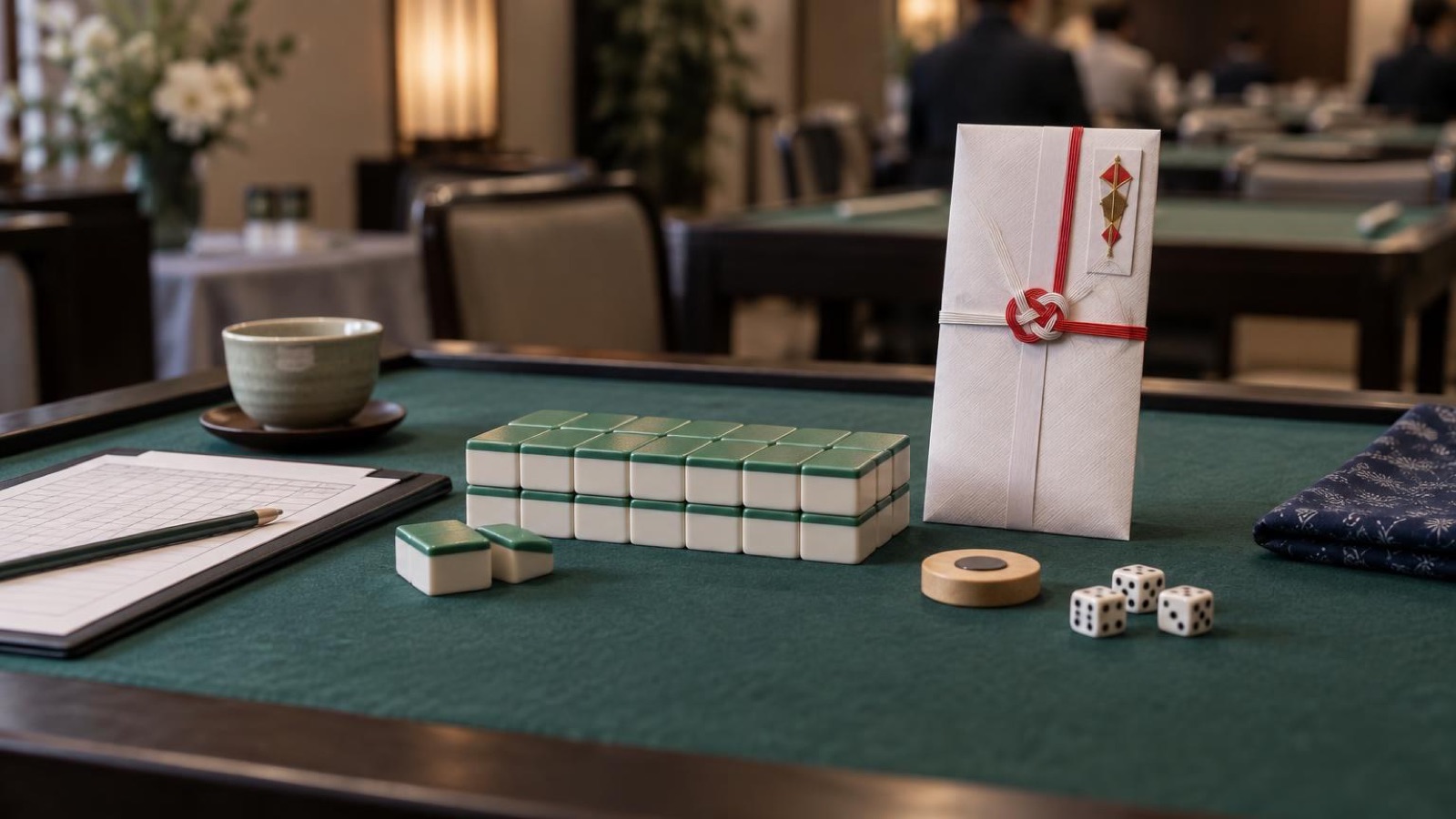
What competitive mahjong is: the rules most leagues share
Organized mahjong competition takes several forms across Asia, and most of them share the same skeleton. The best-known competitive format in Japan is the arcade league: machines such as Mah-Jong Fight Club connect cabinets over a network so players compete against opponents nationwide, and the game tracks your results with a formal rating system3. A competitive rules table in that league starts players with a base of 12,000 points on the table, and placement points vary depending on how many players finish above the original 30,000-point starting line3.
Away from the arcades, club and tournament play tends to follow one recognized ruleset per event. The MSMC annual tournament, for example, uses standard Japanese riichi rules with no red fives in play8. International bodies have their own rulebooks: the Mahjong Competition Rules used in Chinese official competition require a hand to score at least 8 points before a player may declare a win, which forces competitors to build hands of genuine complexity rather than grabbing the first cheap finish8. Online platforms carry the same rules to a wider audience; Mahjong Soul, a Chinese-made game built on Japanese riichi rules, has become one of the main ways new players encounter competitive mahjong9.
Three-player mahjong, a Japanese variant with 108 tiles, has its own competitive scene, with dedicated parlors west of the Chukyo area and three-player tables on many online sites10. Whatever the format, the common thread is that the money, where it exists, comes from entry fees, sponsors and prize pools, not from players betting against each other at the table. That distinction is what separates a tournament from gambling, and the next two sections explain how it works in Japan.
Betting on mahjong in Japan is a crime
Japan draws the line sharply. Betting mahjong for money is a crime regardless of the place or the name of the venue: a mahjong parlor, a "mahjong teaching facility," a private home or an inn all count the same way11. The offense carries a fine of up to JPY 500,000 or a petty fine for the player11. The same logic applies to online gambling: connecting from inside Japan to wager money, including on overseas-licensed sites, is the crime of gambling under Penal Code Article 185, and repeating it can bring the heavier habitual gambling offense4.
Japanese law and case law treat money of any amount as not being "for momentary entertainment," so gambling mahjong is in principle illegal at every rate, from a friendly JPY 100 game upward4. The classic betting rate in Japanese mahjong parlors is known as pin (tenpin), where JPY 100 corresponds to 1,000 points4.
None of this makes the parlors themselves illegal. A jansou (mahjong parlor) is a legitimate business that charges for table time, and a 2007 study described it as a relatively affordable pastime, with fees capped by law at JPY 600 per person per hour on a fully automatic table and JPY 500 on other tables12.
| Table type | Per person per hour | Per table per hour |
|---|---|---|
| Fully automatic table | JPY 6007 | JPY 2,4007 |
| Other tables | JPY 5007 | JPY 2,0007 |
These maxima are plus the consumption tax equivalent7. What the parlor sells is the seat, the automatic table and the setting. The moment cash changes hands between players based on the result, it becomes gambling.
Japan: why competitive tournaments can pay prizes legally
If betting is a crime, how does the Kyushu Championship hand its winner JPY 4,000,0001? The answer is in who pays. Japanese commentary on the game's legal position is explicit: no gambling offense applies where the loser's payment is not made by the losing player, or where the winner's gain does not pass through the other players' hands. Sponsored competitive tournaments, where a sponsor provides the prize money to the winner, are the standard example of a lawful arrangement4.
In a tournament, the players' entry fees go into the event's coffers, the sponsor tops up the prize pool, and the winner is paid by the organization, not by the three players who lost to her. No player pays another player based on the outcome of a hand, so the element that makes parlor betting a crime is absent. This is the same principle that lets Japan's public gambling (horse racing, boat racing and the rest) exist alongside the Penal Code: the betting is authorized by special laws, and anything outside those methods falls back into the offense4.
The prize money on offer is real. The Kyushu Championship's 2026 conditions list a first prize of JPY 4,000,0001. At the international level, the World Series of Mahjong ran Zung Jung rules tournaments in 2007, 2008, 2010 and 2013, with another in 20158, and entry was not cheap: it cost approximately $1,250 (USD) just to enter2. Those entry fees, pooled and redistributed by the organizer rather than wagered player to player, are what make the model work.
For a first-time competitor, the practical path is: find a club or online league playing a recognized ruleset, play rated games until you qualify for higher tables, and enter tournaments where the prize comes from the organizer. You can read more about the parlor side of the scene in mahjong parlors across Asia, and about the online apps in online mahjong.
China: recreational play tolerated, gambling sanctioned
Mainland China takes a different approach: the game itself is fine, the profit motive is not. Official guidance is that mahjong or poker played among relatives with money stakes, not for profit, is not punished5, and the same notice extends that to non-relatives playing with only small amounts of money involved6. A 2023 official news piece summed it up: recreational mahjong not run for profit, with small stakes, is not treated as gambling and generally not punished, and chess and card rooms that only charge fixed venue and service fees are in the clear13.
The protection runs in both directions. Playing normal chess and card games in a chess and card room for leisure "is not only not illegal, it is protected by law"14. But using mahjong or poker tiles as gambling tools in those same rooms violates the Public Security Administration Punishment Law and can, in serious cases, cross into the Criminal Law14. Provincial guidance repeats the family exception: mahjong or card games with money stakes among family members or relatives, without a profit motive, are not treated as gambling15, and a 2026 prosecutorial news item put it in the words people actually use: relatives and friends having a small gathering, with tiny amounts changing hands and only leisure in mind, is legal entertainment protected by law16. At the national level, participation in gambling involving very small amounts, purely for recreation, does not constitute a crime17.
Hong Kong is the outlier in the region: mahjong parlors there are a licensed, regulated category of gambling, sitting alongside the Hong Kong Jockey Club's horse racing, football betting and Mark Six lottery as the territory's authorized gambling outlets18. The legality of any given game turns on the premises: it is unlawful to play for money in non-bona-fide establishments or on unlicensed private premises where rental or commission is charged for the tables, tiles and chips, and under those circumstances the players themselves may be committing an offense19. A common misconception that playing mahjong for money does not contravene the law is exactly that, a misconception19. Macau, for its part, lists mahjong, mahjong baccarat and mahjong pai gow among its permitted casino games of fortune, with full official rules published for each20.
How a full game is structured
A competitive game is built from hands grouped into rounds. In the traditional four-player game, the equipment is a set of 136 tiles, one dealer marker, three dice and a standard table20. The wall is built as four rows of stacked tiles, two tiles per stack, 17 stacks per row, arranged in a square20. A winning hand is 14 tiles: four sets and one pair20.
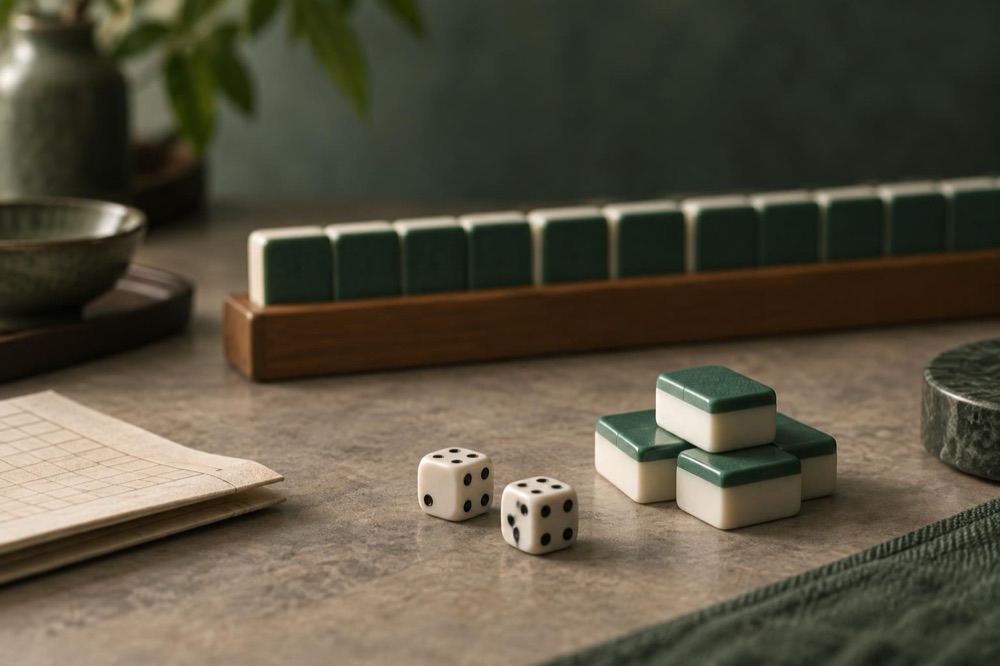
The three-player variant compresses this: it uses 27 types and 108 tiles, with the 2m through 8m tiles removed10. A tonnan (east-south) game in three-player mahjong runs east and south rounds of 3 hands each, 6 hands in total when draws are not counted10. Four-player tournament formats similarly run through the east and south rounds, with the dealer seat rotating and the game ending after the final hand of the south round, or continuing into a west round if no player has finished above the starting line.
In league play, the structure is wrapped in a points system. The arcade competitive table starts each player at 30,000 points with placement points calculated from the 12,000-point base on the table3. Your final placement, not just your raw score, determines your rating movement, so a tournament is as much about managing the endgame as winning hands. If you are new to the mechanics of a hand, how to play mahjong walks through tiles, turns and melds from scratch.
Winning hands and call priority: mahjong, kong, pung, chow
The calls are the grammar of the game, and competitive rulesets are strict about them.
- Pung: a set of three identical tiles, claimed from a discard by any player.
- Kong: a set of four identical tiles. A player holding three identical tiles may kong when the fourth is discarded; kongs may be exposed or concealed, and after any kong the player draws one tile from the wall end and discards one20.
- Chow: a three-tile sequence in one suit. Only the player to the discarder's right may claim a discard to form a chow, and doing so forfeits that turn's draw20.
- Mahjong: the winning hand of four sets and one pair20.
Call priority matters when claims collide. If one discard lets two or three players win at once, the player seated to the discarder's lower right, counting counterclockwise, takes the win20. In the three-player game, chi is not allowed at all under standard rules, to prevent early cheap wins10, though some local versions such as Yokosuka mahjong do permit it10.
The fan (scoring) tables reward harder hands. One-fan hands in the traditional Macau rules include a pung or kong of any dragon, a pung or kong of the prevailing wind or your own seat wind, robbing an exposed kong, winning on the replacement tile after a kong, an all-pung hand, a chow hand, a mixed one suit, winning on the last tile, little three dragons, little four winds and mixed terminals20. Two-fan hands include the heavenly hand, the earthly hand, a pung or kong of a double-value wind, a kong-on-kong win, a full flush, thirteen orphans, an all-pung hand with no exposed pungs, big three dragons, big four winds, pure terminals and all honors20. The full scoring picture across variants is covered in mahjong scoring.
Scoring details that change results: kongs, draws and liability
Tournament results often turn on the fine print, and three areas produce the most arguments.
Dealer payments. When a non-dealer wins by self-draw (tsumo), the dealer pays double the normal amount, a rule known as parent liability21. More generally, a winning dealer is paid double by all three other players, and when a non-dealer wins, the two other non-dealers pay single while the dealer pays double20.
Liability (pao) rules. Some hands make one player pay for everyone. Under the Macau casino rules, discarding a tile that lets a player complete a full flush with nine exposed tiles, big three dragons or big four winds, holding back the last honor tile and discarding something else, or breaking a pung after failing to declare a win, makes the discarder pay for all players20. All-honors and all-terminal hands never require liability payment, and discarding a fresh dragon or wind tile that lets another player win requires no liability payment either20. In Japanese tournament play, the MSMC enables the responsibility rule for Big Three Dragons, Big Four Winds, All Honors, All Terminals, Perfect Green and Four Kans8. The arcade league adds its own quirk: Mahjong Fight Club is the only one among the listed services with the Pao renchan (eight consecutive dealer wins) rule21.
Kongs, draws and special wins. Robbing the kong, winning on the tile a player uses for an open kong, scores 1 fan and does not count as a last-tile win22. In Hong Kong mahjong as played online, a winning hand completed via flower replacement counts as a self-draw win, not as a kong draw win22. The MSMC disallows kuikae: you may not make an open pon or chi and then discard a copy of the called tile in the same turn8. In the three-player arcade game there are no midgame draws: a fourth kong does not end the hand, a fifth kong cannot be declared, and on a double ron the dealer wins if they are the furthest-upstream player21.
Vietnamese mahjong shows how far local rules can stretch the same ideas. Discarded tiles are thrown randomly into the pile, as in Hong Kong old style, and discarded joker tiles can be used to create open melds or for another player to declare a win23. If you discard a bonus tile, including the flower joker, while another player is waiting, that player may treat your bonus tile as her winning tile and win off your discard23. Vietnamese scoring otherwise resembles Chinese classical scoring, with only the winner's hand scored in most rules and points doubled for sets on matching king and queen tiles24.
Variants you will meet: Chinese, riichi and house rules
Every tournament tells you its ruleset up front, because the variants genuinely differ. The main families are compared in mahjong variants, but here is what to expect at the table.
Chinese classical and casino rules. The Macau traditional game uses 136 tiles with winds and dragons; the "simple" casino version uses 112 tiles, drops the winds, keeps only the Green Dragon among the honor tiles, and allows two to four players instead of the fixed four20. Hong Kong old style, the basis of most Cantonese play, is the ancestor of several of these.
Japanese riichi. The dominant competitive ruleset in Japan and increasingly internationally, with riichi declarations, dora and furiten; the details are in riichi mahjong rules. Mahjong Soul runs Japanese rules despite being a Chinese product, which tells you how far the ruleset has traveled9.
Three-player mahjong. Beyond the smaller tile set, regional rules vary: some areas, especially on the Seto Inland side of western Japan, remove the 2s through 8s instead of the manzu tiles10. Tsumo wins are adjusted in different ways: some rules pay the winner ron-equivalent points from both other players, doubling income, a practice called baidori common in Kyoto and Tokyo rules10; others add 1,000 points to each of the other two players' payments, called sen-ten kafu10.
Tournament and house hybrids. Organizers keep inventing formats. Clear Mahjong is designed for two teams of two, with a team losing if any of its players drops below 0 points, or a team winning by completing all five conditions (Large Straight, Three Colors One Chii, All With Orphans, Three Concealed Pons, Seven Pairs)8. Mangan Mahjong scales to 4 or 8 players8. The MSMC's rulebook, with its no-red-fives, kuikae and responsibility-rule provisions, is a good example of how a club pins down every ambiguity before the tiles are thrown8.
The practical advice for a first tournament is simple: read the ruleset document before you sit down, because the differences listed above, kong handling, liability, draws and dealer payments, are exactly where an unfamiliar rule will cost you a placing. If you want the tile-level basics first, start with mahjong tiles and the general legality picture in where Asian games are legal.
Common Questions
How many tiles are used in Chinese mahjong?
The traditional game uses 136 tiles: 36 in each of three suits (bamboo, characters and dots), plus 16 wind tiles and 12 dragon tiles. Simpler casino versions in Macau use a 112-tile set that drops the winds.
How many players does a mahjong table need?
Standard mahjong takes four players. Casino versions in Macau allow two to four, and Japan has a dedicated three-player variant with 108 tiles, played in specialist parlors west of the Chukyo area and on many online sites.
What happens if two players call mahjong on the same discard?
Under the Macau casino rules, the player seated to the discarder's lower right, counting counterclockwise, wins. In Japanese three-player arcade rules, on a double ron the dealer wins if they are the furthest-upstream player.
What is a 'fishing' player in mahjong?
A fishing player is one who is one tile away from a winning hand and is waiting to see what other players discard. In Vietnamese mahjong, if a waiting player sees you discard a bonus tile, they can treat it as their winning tile and win off your discard.
Can mahjong tournaments in Japan pay prize money?
Yes. Betting mahjong for money is a crime in Japan, but no gambling offense occurs where the loser does not pay the winner directly. Sponsored tournaments where a sponsor provides the prize money fall outside the gambling offense.
What stakes are typical in mahjong games in China?
Recreational play among relatives with small money stakes is not punished, and games among non-relatives with only small amounts involved, played for leisure rather than profit, are not treated as gambling either.
What is the difference between an open and a closed kong?
An open (exposed) kong is declared when you hold three identical tiles and the fourth is discarded by another player, so the set is shown face up. A closed (concealed) kong is made from four identical tiles already in your hand and stays hidden until you win.
Sources24 sources
- 九州チャンピオンシップ, Wikipedia
- McGill Mahjong (archived), Internet Archive
- 麻雀格闘倶楽部, Wikipedia
- 麻雀, Wikipedia
- 关于办理赌博违法案件适用法律若干问题的通知, Anyang government
- 治安管理处罚裁量标准, Suwei Chengqu government
- 風俗営業等の規制及び業務の適正化等に関する法律, e-Gov
- McGill Mahjong, McGill Mahjong blog
- Chinese Anime and Japanese Mahjong: Clandestine Battle Between Digital Content Economies, Baker Institute, May 10, 2023
- 三人麻雀, Wikipedia
- 遊技場営業利用について, National Police Agency
- Gambling in Japan, Oxford Brookes University, September 2007
- 打麻将算不算赌博?, China Peace, May 15, 2023
- 棋牌室打麻将违法吗?, Beijing Miyun government, June 29, 2020
- 家庭成员打麻将是否违法, Jiangsu government, March 13, 2019
- 亲友小聚搓麻,输赢金额微小, Shanxi Qixian procuratorate, May 26, 2026
- 赌博罪的法律答复, NPC, April 19, 2002
- Gambling, Home and Youth Affairs Bureau, Hong Kong
- Press release on mahjong gambling, Hong Kong government, April 26, 1999
- Mahjong rules, DICJ Macau, August 5, 1991
- 連荘, Wikipedia
- GodGame Hong Kong Mahjong rules, GodGame
- A quick look at mahjong around the world, McGill Mahjong blog, August 6, 2015
- A quick look at mahjong around the world (archived), Internet Archive















