
The words at a glance
| Term | Language | What it means |
|---|---|---|
| Mahjong (má jiàng) | Mandarin | The tile game; the name means sparrow6 |
| Chow | Cantonese/English | Three tiles of one suit in sequence3 |
| Pung | Cantonese/English | Three identical tiles3 |
| Kong | Cantonese/English | Four identical tiles3 |
| Riichi | Japanese | Declaration that your hand is one tile from winning1 |
| Pin / tenpin | Japanese | JPY 100 per 1,000 points1 |
| Sanma | Japanese | Three-player mahjong2 |
| Baidori | Japanese | Tsumo paid at ron value by both opponents in sanma2 |
| Kugi-yomi | Japanese | Reading the nails on a pachinko board4 |
| Todome-uchi | Japanese | The deliberate final shot of a pachinko session4 |
| Santen hoshiki | Japanese | The three-shop prize exchange system4 |
| Bainin | Japanese | The buyback businesses that purchase pachinko prizes4 |
| Ping hu | Mandarin | The ordinary hand: four sequences plus a pair3 |
| Peng hu | Mandarin | Nineteenth-century slang for playing for points6 |
Mahjong terms every table uses: chow, pung and kong
Almost every mahjong conversation in any language runs through the same three words, because they describe the only three ways tiles can be grouped.
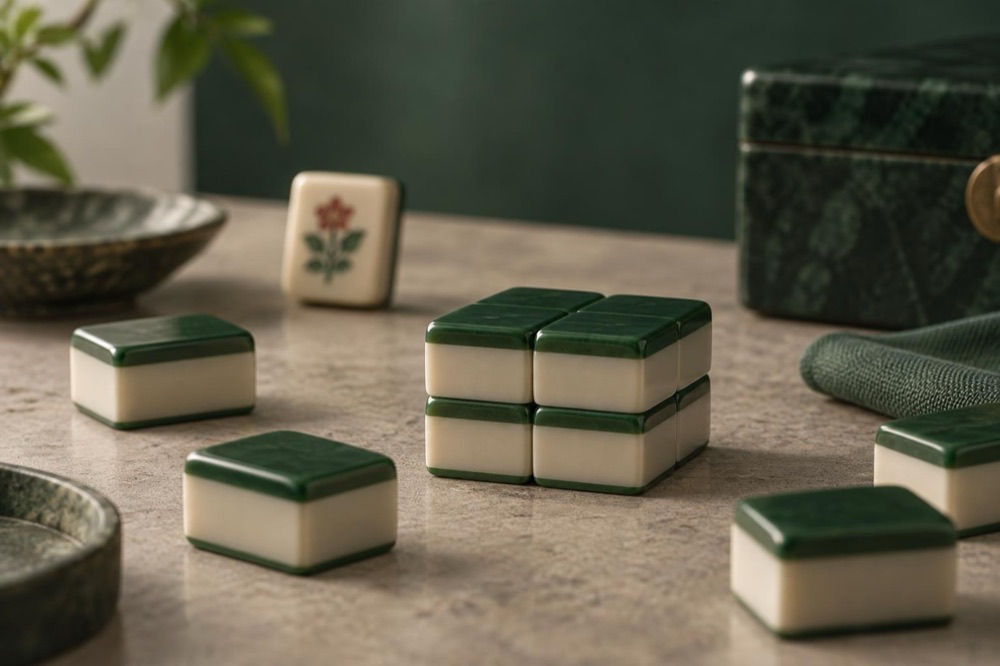
A pung is three identical tiles. You can build one by holding a pair and claiming the matching discard, or by drawing the third tile yourself. A kong is four identical tiles. A chow is three tiles of the same suit in sequence, such as 3, 4 and 5 of characters.
The rules around claiming tiles are where the table talk gets specific. Only the player sitting to the right of the discarder may claim a discard to form a chow, and doing so forfeits that turn's draw3. A player holding three identical tiles may kong when the fourth is discarded. Kongs can be exposed or concealed, and after any kong the player draws one tile from the wall end and discards one, keeping the hand at thirteen tiles3.
Some variants strip this back. In the simple mahjong variant played in Macau, there is no chow and no pung at all. Players may only take a discard in order to win, and a kong keeps the hand at five tiles rather than thirteen3.
A few house rules matter enough that regulars will mention them before the first hand:
- Discarded tiles may not be taken back.
- Declining a pung voids your right to win on that tile.
- Players may not look at each other's hands, and an accidental look bars that player from konging for the rest of the round.
- A winner may only collect up to the amount of money actually in hand3.
Scoring names are the other half of table talk. A pung or kong of any dragon scores, as does a pung or kong of the prevailing wind or your own seat wind. So do robbing an exposed kong, winning on the replacement tile after a kong, an all-pung hand, a chow hand with no dragon or honor pair, mixed one suit, winning on the last tile, little three dragons, little four winds and mixed terminals3. Higher-value hands include the heavenly hand, the earthly hand, a pung or kong of a double-value wind, kong on kong, a mixed one suit chow hand, full flush, thirteen orphans, an all-pung hand with no exposed pungs, big three dragons, big four winds, pure terminals and all honors3.
'Sparrow': where the word mahjong comes from
The name is a bird. In Mandarin the tile game is pronounced má jiàng, and in Shanghainese and the older Ningbo and Suzhou dialects it was mo ziang6. The older card game that carried the same name was pronounced má què, which means sparrow6.
The tile game is best understood as that card game plus winds, either the four directions alone or the directions plus the tiles known as dragons6. So the tile version is not a different game so much as the same game with a fixed set of extra tiles.
The game was known across China under various names from at least the 1870s6. By the late 1880s a version called mo ziang had reached prominence in Ningbo and spread to Shanghai6. Around 1883 and 1884 it had not yet reached Suzhou, where a different game prevailed6. In Cixi, in Ningbo, gambling was described as rather popular in 1885, with the local game taken as a fashion6.
The name traveled west with a deliberate spelling. J. P. Babcock applied the word "Mah-Jongg," pronounced "Mah-ZHONG," and trademarked it in the U.S. Patent Office6. That is why English speakers say mah-jongg with a hard j sound while Mandarin speakers say má jiàng.
One more piece of old slang is worth knowing because it shows up in nineteenth-century writing. In the novel Haishang hua liezhuan, published between 1892 and 1894, the gameplay was called peng hu, meaning playing for points6. And in Xiamen in Fujian, a 1888 reference describes a leaf or card game called zhuo ma que, literally "snatch sparrows"6.
Japanese mahjong calls: the ready hand and the riichi declaration
Japanese mahjong has its own vocabulary layered on top of the Chinese terms, and it is the vocabulary you will hear in a Tokyo parlor.
The most important word is riichi, the declaration that your hand is one tile from winning. A player with one tile short of winning is considered to have a "ready hand" and is "waiting" for tiles to complete the hand1. It is also the name of the modern competitive variant, and it has grown well beyond Japan.
Betting rates in Japanese mahjong are quoted as hundreds of yen per 1,000 points. A rate of JPY 100 is called pin, or tenpin1. So when someone says the game is tenpin, they mean each 1,000 points is worth JPY 100. That is the number you agree on before the first hand, and it is the number that decides what the evening costs.
The legal position is separate from the slang. Japanese law and case law treat money in gambling as outside the exemption for casual entertainment regardless of the amount, so betting mahjong is in principle illegal at every rate1. There is one narrow exception: no gambling offense applies where the loser's payment is not made by the player, or where the winner's gain does not reach the player, as in a sponsored competitive tournament with prize money1. That is why tournament play and cash play are treated so differently.
Three-player mahjong and the sanma vocabulary
Three-player mahjong, called sanma, has its own terms because the arithmetic changes.
A sanma set uses 27 tile types and 108 tiles, excluding the 2 through 8 of one suit2. Chi is not allowed under standard rules, to prevent early wins2. Some variants relax this: in one common form, chi from the player to your left is allowed, which is why that version is also called "three-player four-mahjong"2.
Payment is where sanma gets its own slang. On a tsumo, the winner receives ron-equivalent points from both opponents, doubling the income. This is called baidori, and it is common in Kyoto and Tokyo rules2. When a child wins on a tsumo, the dealer covers the absent north player's share entirely; when the dealer wins on a tsumo, the two children split it. That is called oya sanbai kaburi, roughly "dealer pays triple"2.
Different platforms handle this differently, which is why players argue about it. Some use split payment, some use a north share split, and some use tsumo-son scoring2. If you sit down at an online sanma table, check which convention is running before you commit to a rate.
Pachinko jargon: kugi-yomi, todome-uchi and other player skills
Pachinko has the deepest slang of any game in the region, because the machine itself is the opponent and reading it is the skill.
Start with the physical facts:
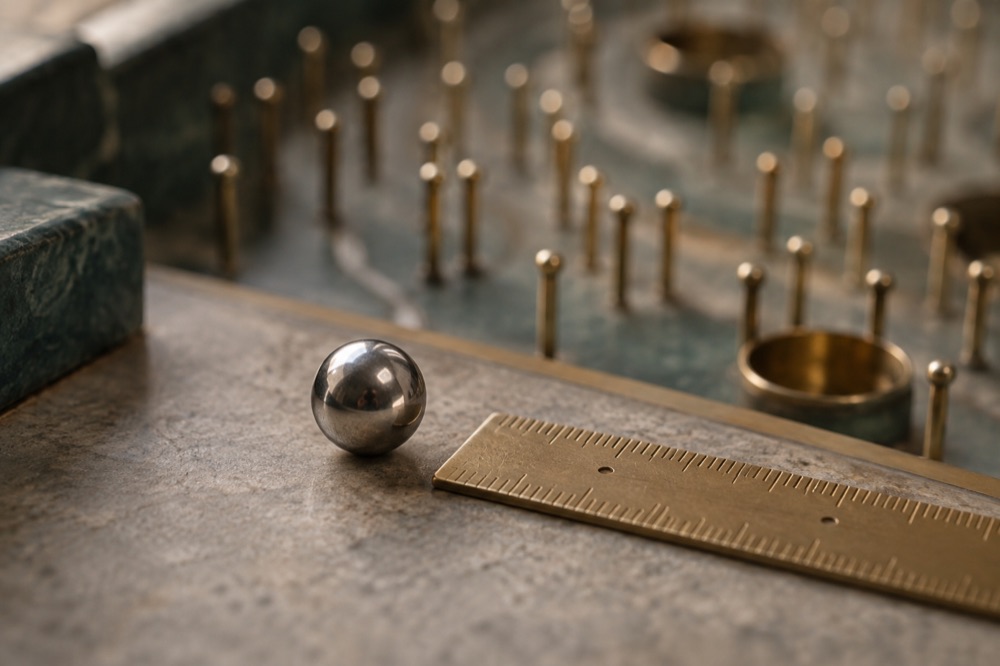
- A pachinko ball is a steel ball 11 mm in diameter and 5 grams in weight4.
- Machines fire one shot every 0.6 seconds, and are-pachi machines fire within one shot every 0.5 seconds4.
- The return rate to players is about 85 percent, so the parlor's actual take is roughly 15 percent of ball rental fees4.
That single number explains most of the strategy talk you will hear: players are trying to find machines set looser than the average.
Kugi-yomi is the core skill. It means reading the nails. The small metal pins on the board decide how balls fall, and experienced players study their spacing and angle before spending money, looking for a path that feeds the payout pockets more often than the machine's setting suggests.
Todome-uchi is the finishing shot, the deliberate final ball aimed to land in a specific pocket. It matters because the last ball of a session is often the one that decides whether the session ends up or down.
Machine generations have their own labels. One common type is written as 4.7号機, the generation used by the pachislo machine Kaiji1. Players use these generation names the way car enthusiasts use model years, because the generation tells you what the machine can and cannot do.
Parlor economics have their own vocabulary too. Under the rules for Type 4 adult entertainment businesses, offering prizes based on game results is permitted under certain conditions for pachinko, pachislo, arrange ball machines, jan-kyu machines and some other gaming machines1. That matters to regulars because it shapes how prizes are exchanged after play.
Santen hoshiki and bainin: the three-shop system in plain words
The three-shop system, santen hoshiki, is the arrangement that lets Japanese players convert pachinko prizes into cash even though cash gambling is not what the parlor is licensed to do.
The structure is simple once you see it:
- You play at the parlor and win balls.
- You exchange the balls at the parlor's prize counter for prizes.
- You take those prizes to a separate business nearby, which buys them back.
The three parties are the parlor, the prize counter and the buyback shop, and keeping them formally separate is the whole point of the system.
Bainin refers to the buyback side of that chain, the businesses that purchase prizes. When regulars talk about where the rate is better, they are talking about bainin, not about the parlor.
For a visitor, the practical version is this: you do not need to understand the corporate structure. You need to know that the balls you win are exchanged for prizes at the counter, and that the prizes have a resale value at a nearby shop. The parlor itself will not hand you cash.
Machine types in Japanese: Amadexi, Middle and Light middle
Pachinko machines are sorted into categories, and the category names are the first thing a regular will tell you.
| Category | What it describes | Practical effect |
|---|---|---|
| Amadexi | Machines built around a digital slot-style payout feature | Higher swing, higher ceiling |
| Middle | The middle band of the payout specification range | Balanced cost per hour |
| Light middle | The lighter end of that middle band | Lower ceiling, gentler cost per hour |
The categories describe how the machine pays and how it is regulated, not how fun it is. The practical consequence is cost. A machine with a lower payout ceiling will drain a fixed budget more slowly, which is why light middle machines are the usual recommendation for a first session. A machine with a higher ceiling will swing harder in both directions.
The generation label matters here too. A machine written as 4.7号機 belongs to a specific regulatory generation, the one used by the pachislo machine Kaiji1. Two machines that look identical on the floor can be from different generations and behave completely differently.
Chinese hand names: ping hu and the clean dragon
Chinese mahjong hand names are more descriptive than the Japanese ones, and a few of them are worth knowing because they come up constantly.
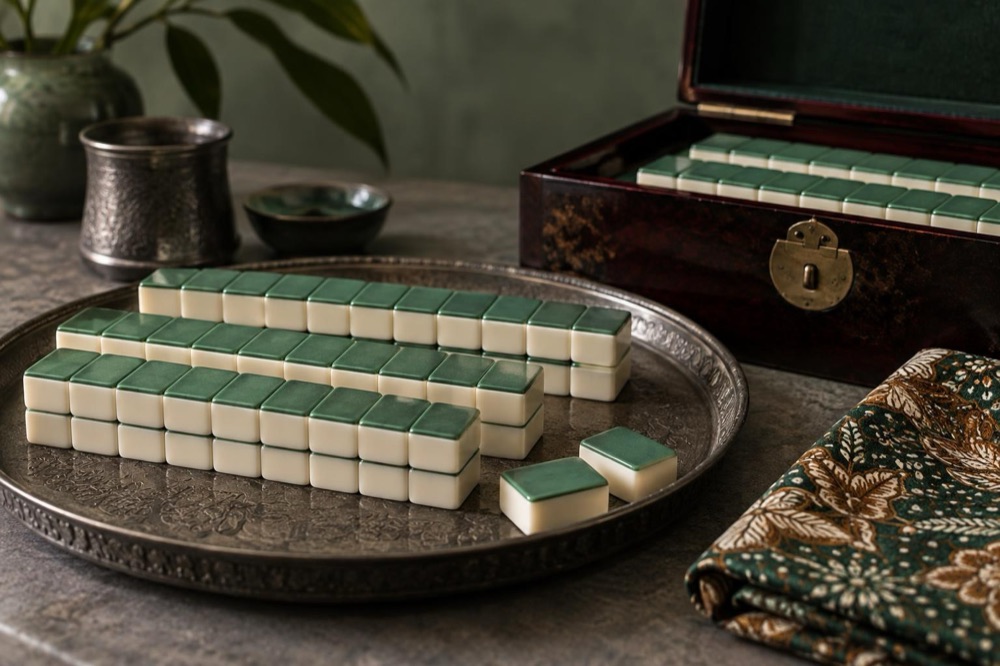
Ping hu is the ordinary hand: four sequences plus a pair, with no special tiles. It is the hand you will build most often, and it is worth the least.
The dragon hands are where the names get vivid. A pung or kong of any dragon scores, and the "clean" versions refer to hands built around a single dragon or a single suit without mixing in unrelated tiles. Little three dragons and big three dragons are the two-step versions of the same idea, and they are scored separately3.
The old slang for the game itself is worth one line. In nineteenth-century Shanghai writing, playing was called peng hu, playing for points6. That is the ancestor of the modern scoring vocabulary.
What the slang does not change: betting laws in Japan and China
The vocabulary is shared across borders. The rules are not.
In Japan, mahjong gambling is illegal regardless of the place or the name of the venue, including mahjong parlors, mahjong teaching facilities, homes and inns5. The amount of money does not change that1. Online casino gambling is also illegal: connecting from Japan to gamble on an online casino is a crime even if the operator is legally run overseas, and this applies to free versions and free bonuses as well7. Police treat it as a priority8.
In China, gambling is prohibited by law and regulation9. The line that matters in practice is between a social game and a betting game. Games among relatives with money stakes and no profit motive are not punishable, and games with small stakes among non-relatives and no profit motive are also not punishable10. A court applied exactly that reasoning when it held that a small-stakes mahjong game among relatives and friends did not constitute gambling and revoked the penalty10. Outside that line, the position is strict: gambling abroad, online gambling, and providing funds or technical support for gambling all violate Chinese law9.
In Hong Kong, all gambling is illegal except regulated horse racing, football betting and the Mark Six lottery, licensed activities such as mahjong parlors, and exempt social gambling11. That is why the mahjong parlor is a licensed, ordinary part of the city while an unlicensed game is not.
Common Questions
What does mahjong literally mean in Chinese?
The name comes from the word for sparrow. In Mandarin the tile game is pronounced má jiàng, and in Shanghainese and the old Ningbo and Suzhou dialects it was mo ziang. The older card game with the same name was pronounced má què, which means sparrow.
What is a pung in mahjong?
A pung is three identical tiles. You can form one by holding a pair and taking the matching discard, or by drawing the third tile yourself. A kong is four identical tiles, and a chow is three tiles of the same suit in sequence.
Is playing mahjong for money illegal in Japan?
Yes, if money changes hands. Japanese guidance states that mahjong gambling is a crime regardless of the place or the name of the venue, including mahjong parlors, teaching facilities, homes and inns. The amount of money does not change that.
What is sanma in mahjong?
Sanma is three-player mahjong. It uses 108 tiles, dropping the 2 through 8 of one suit, and chi is usually not allowed so that hands cannot be finished too quickly. Tsumo payments are adjusted because there is no fourth player to pay a share.
How old is pachinko?
Pachinko grew out of earlier Japanese ball and prize games and became a mass parlor industry in the twentieth century. Modern machines fire a steel ball 11 mm across and 5 grams in weight, at a regulated rate of one shot every 0.6 seconds.
Can foreigners enter pachinko parlors in Japan?
Yes. Pachinko parlors in Japan are open to anyone, including visitors, and there is no nationality rule. You buy balls at the counter, play, and exchange remaining balls for prizes at the parlor's prize counter.
How many tiles are in a standard mahjong set?
A standard Japanese set has 34 tile types and 136 tiles. Three-player mahjong uses 108 tiles, leaving out the 2 through 8 of one suit. Chinese sets add flower and season tiles on top of the 136.
Sources11 sources
- 麻雀, Wikipedia, 2026
- 三人麻雀, Wikipedia, 2026
- Legal Mahjong Gaming Rules, DICJ, 1991-08-05
- パチンコ, Wikipedia, 2026
- 遊技場営業, National Police Agency, 2026-09-25
- Mahjong terms 1780-1920, The Mahjong Tile Set, 2026-09-27
- オンラインカジノ, National Police Agency, 2026-09-25
- オンラインカジノ実態調査報告書, National Police Agency, 2025-01
- 跨境赌博, 国家移民管理局, 2021-02-05
- 赌博违法案件法律适用通知, 汕尾市城区司法局, 2024-02-16
- Gambling policy, Home and Youth Affairs Bureau, 2026















