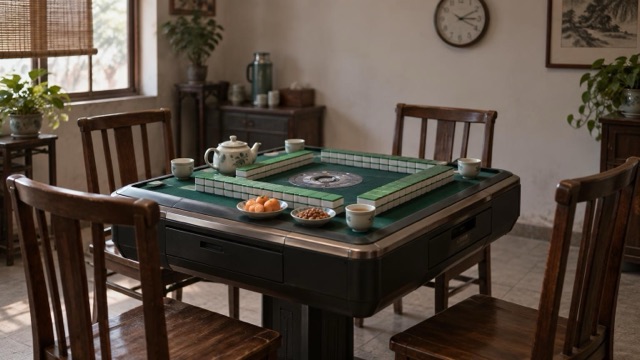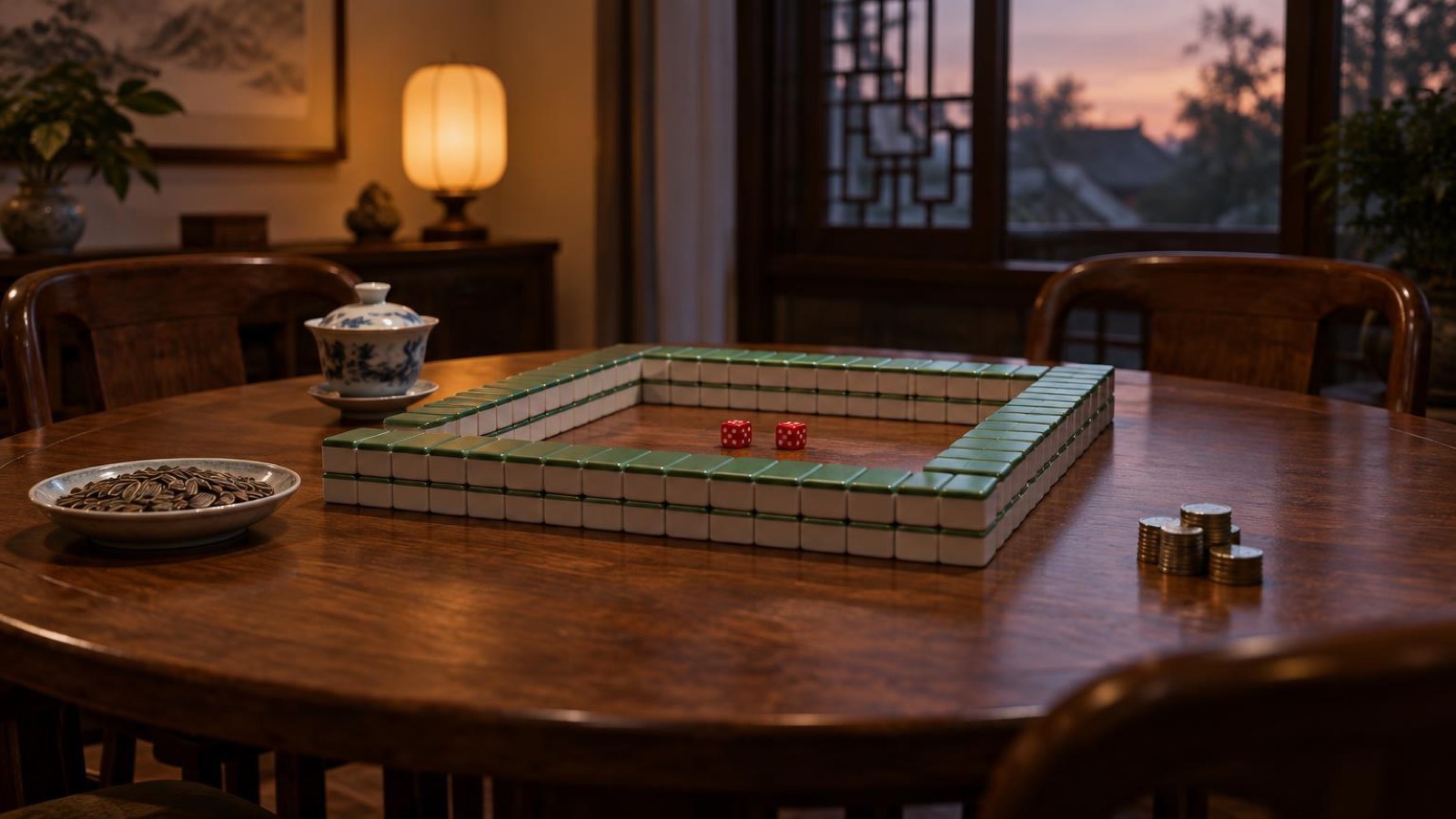
Mahjong is woven into daily life across China in a way few games anywhere can match. Retired neighbors play it in courtyards and park pavilions, families play it at holidays, and dedicated parlors rent out rooms with tables that shuffle and stack the tiles automatically. It is a game of skill, memory and quick pattern reading, and it is the ancestor of the Japanese, Korean and Southeast Asian versions played around the world today. This page covers the tiles, the rules, the scoring, where you can actually sit down and play in China, and where the line sits between a friendly game and illegal gambling.
The tile set: suits, honors and flowers
A standard Chinese mahjong set contains 136 tiles1. The bulk of the set is made up of suits, which are numbered runs of tiles, plus honor tiles such as winds and dragons. Many sets also include flower and season tiles, which push the count to 144; these are bonus tiles that are drawn and immediately replaced rather than kept in the hand.
Before each hand, all 136 tiles are shuffled face down on the table and players build four square walls, with 34 tiles in each wall1. Dice are rolled to decide where the wall is broken and who draws first, which is why every set comes with a pair of dice even though the game itself is all tiles.
The exact contents of the set depend on where you are, and this is one of the most striking things about mahjong: the same game has wildly different tile counts by region1:
| Style | Tiles in set | What is different |
|---|---|---|
| Standard Chinese | 136 | Three suits plus honors |
| Singapore | 148 | Basic set plus 4 animal flowers1 |
| Fuzhou | 132 | One honor tile removed, probably the White dragon1 |
| Korean | 104 | Dots, Craks, Winds, Dragons and 4 flowers only1 |
| Malaysian 3-player | 84 | One suit, honors, 16 flowers and 4 jokers1 |
The Malaysian variant is also the best-known example of three-player mahjong, using a stripped-down set with jokers to keep the game moving with one seat empty1. Japanese riichi mahjong sits at 136 tiles because the flower and season tiles are omitted from Japanese play5, and the European riichi rulebook confirms the same 136-tile count6. So if you buy a set in China and a friend learned the game in Japan, you will be playing slightly different games with almost the same tiles.
Basic rules and how a hand is won
Traditional Chinese mahjong is played by four people, and the goal is to assemble a complete hand of 14 tiles7. Every winning hand, in every version of the game, has the same shape: four sets and one pair2. In the 13-tile Hong Kong style, four sets of three tiles plus a pair wins you the round9.
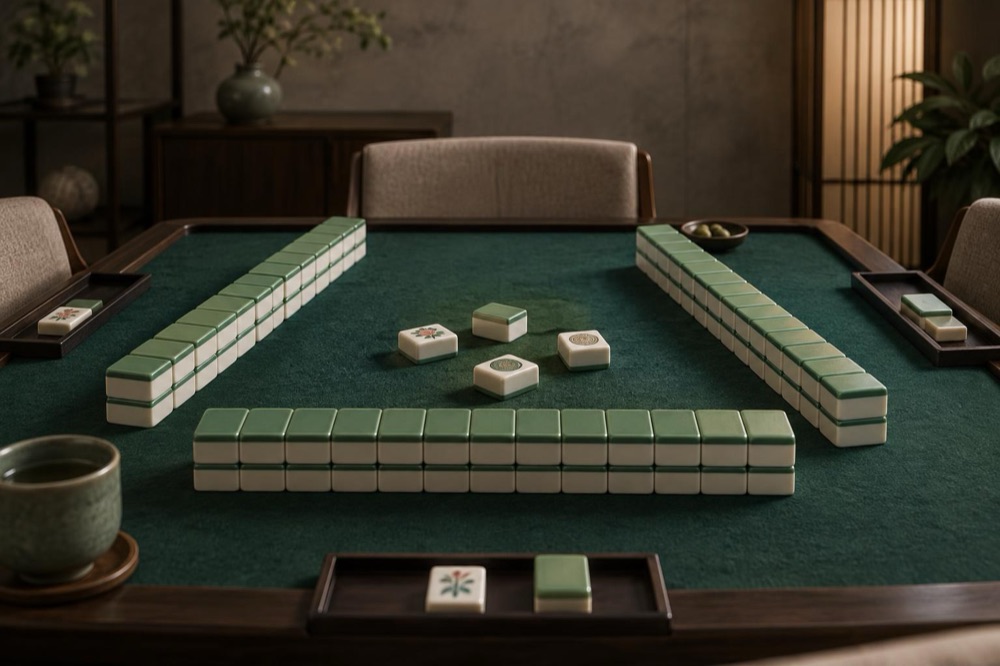
The three kinds of set are:
- Chow: a run of three consecutive tiles in the same suit, like 4-5-6 of dots
- Pung: three identical tiles, like three red dragons
- Kong: four identical tiles
A kong has one special twist: any player completing a kong immediately draws an extra tile before discarding, so the hand stays at the right size1.
Play moves turn by turn. You draw a tile, and if it does not help your hand, you discard it face up in the middle of the table. The heart of the game is the claim: when a player discards a tile you need to complete a chow, pung or even the winning pair, you can call it and take it. When two players want the same discard, there is a strict order of priority: kong first, then pung, then pair, then chow10. Another way to put it is that pung takes precedence over chow, and a mahjong call, meaning the winning call, takes precedence over all11. Dutch rules list the same ladder: limit hand, then pair, then pung, then chow, with mahjong always first12.
Because of this priority system, a hand can end suddenly. A player who is one tile from winning can call a discard from anyone at the table and win on the spot, which is why experienced players watch the discards as closely as their own hand.
One rule worth knowing before your first game: under the official Mahjong Competition Rules, a player's hand must score at least 8 points in order to declare a win13. In casual home play this minimum is usually ignored, but in organized and competitive play a hand that is technically complete but worth too few points does not count, so you cannot just grab the cheapest combination of sets.
Regional versions add their own flavor. Vietnamese mahjong, for example, has a special hand called the "No Flowers, No Leaves" hand, which wins without any jokers, bonus tiles or honor tiles and carries a huge bonus; the rules around it are complicated and obscure even to experienced players14.
Scoring and common rule differences
Scoring is where mahjong styles really part ways, and it is the part newcomers find hardest. The good news is that the underlying logic is shared almost everywhere.
In Chinese Classical mahjong, you score 10 or 20 points for going out, then count up points based on your pungs, kongs and pairs, then apply doubles1. Chinese Official mahjong works differently: you score by counting points for the characteristics of the hand1. So the same winning hand can be worth different amounts depending on which style the table agreed to play.
Some concrete point values from a published scoring table give a feel for how it works:
- An open pung of simple tiles (2 through 8) is worth 2 points; an open pung of honors (1s, 9s, dragons and winds) is worth 4 points12
- A concealed pung of simple tiles is worth 4 points; a concealed pung of honors is worth 8 points12
- A standing hand, meaning a hand that was one tile from winning, is worth 100 points15
- Winning on a tile drawn from the loose tiles at the end of the wall is worth 10 points15
Payments also differ by style. In one common system, the winner receives 8 points or chips from each of the three opponents, plus points equal to the hand value from the player whose discard ended the hand8. That last part matters: throw away the tile someone wins on and you pay extra, which is why defensive play is a real skill.
Some classical rules go further and have all players score points, not just the winner, though this is an option rather than the norm16. Vietnamese mahjong appears to use scoring identical to Chinese Classical, except that only the winner's hand is scored in most rules, though sources on this are inconsistent14.
When money is on the table in China, stakes are usually expressed as a base unit per point. A single base can run from 200 to 1,000, which is treated as a normal level, and some players go as high as 10,00017. In practice, the stakes are whatever the four players agree before sitting down, and the agreement matters both for the wallet and for the law, as covered below.
Where to play: homes, parlors and public spaces
Most mahjong in China happens at home. Playing mahjong or any other game with friends or relatives for recreation is an ordinary part of social life18, and family games over the holidays are a fixture of Chinese culture. If you are invited to a home game, that is the most authentic way to experience the game, and the host will usually be delighted to teach you.
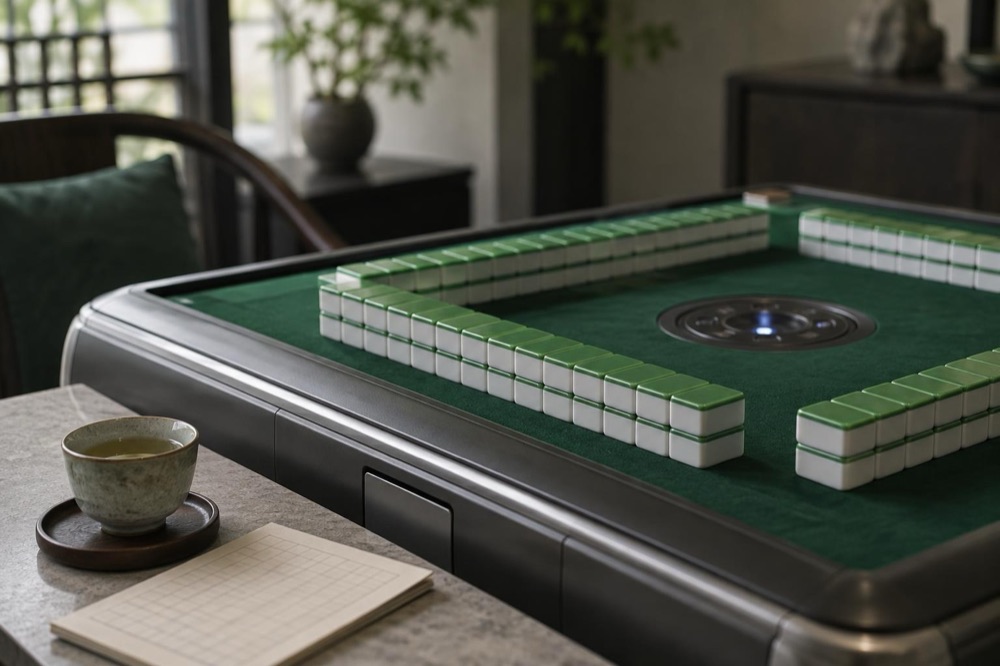
The commercial version is the mahjong parlor. Such parlors offer automated mahjong tables, charge players for using the room by the hour, and sell drinks and food3. The automatic tables are a genuine pleasure for beginners: press a button and the table rises, shuffles the tiles and builds the walls for you, which removes the slowest and most error-prone part of the game. You pay for the room, not per hand, so the cost is split among the four players and works out to a modest hourly rate per person.
A close cousin is the chess and card room, or qipai shi, which rents tables for mahjong, poker and other games. Playing normal games there for leisure is not just tolerated but protected by law19, and these rooms are found in every Chinese city. We cover them in detail on our page about chess and card rooms.
In Hong Kong, mahjong parlors, called mahjong houses, have a long history, and a small number still hold legal operating licenses3. They are a distinct Hong Kong institution rather than a mainland one, and worth seeking out if you are in the city.
Organized play exists too. University clubs and community groups run tournaments; one annual club tournament in Montreal, for example, books a room from 2:00 PM to 9:00 PM for a full afternoon of competition13, which gives a sense of how long a proper session runs. For foreigners in mainland China, the practical route into organized games is through legal clubs: foreigners can play in clubs such as those in Beijing or Sanya, but must provide a passport for registration, and payouts in those clubs are in points or tickets rather than cash20.
If you cannot find a table, the digital version is everywhere. Mahjong Soul, a game made in China, features Japanese riichi rules and has become one of the most popular ways to play online5. We cover apps and where they stand in our page on card and mahjong apps.
Mahjong and gambling: what the law says
Gambling as a business is illegal in mainland China, full stop20. But mahjong occupies a special place, because the law distinguishes between recreation and gambling, and most mahjong played in China is recreation.
The practical rules, drawn from official guidance, come down to this:
- Playing mahjong or cards with family members or relatives, with money at stake but no profit motive, is not treated as gambling22
- The same applies to games among relatives with money stakes, and to games with small money stakes among people who are not relatives4
- Playing for fun in chess and card rooms, where the room only charges fixed venue and service fees, is not treated as gambling and is generally not punished19
- Playing mahjong with friends or relatives for recreation should not be considered illegal18
The line is crossed when profit becomes the point. Using mahjong or poker in a chess and card room as a tool for gambling is illegal under the Public Security Administration Punishment Law, and in some cases criminal under the Criminal Law19. Organizing gambling for profit or making a living from gambling is pursued under the Criminal Law of the People's Republic of China, as set out in the Beijing Municipal Regulation on Prohibiting Gambling21. For Chinese citizens, the prohibition also reaches outward: gambling abroad, gambling online, and providing funds or technical support for gambling all violate the Criminal Law and the Public Security Administration Punishment Law23, and cross-border gambling is strictly prohibited23. Online sports betting is likewise a criminal offense24.
Put simply for a visitor or expat: a small-stakes game with friends is fine, a licensed parlor or club is fine, and anything organized for profit, including cash games run out of a card room, is not. We cover the wider picture on our pages about gambling in China and gambling laws in China, and what applies to you as a visitor on gambling in China as a visitor.
Common Questions
How many tiles are in a Chinese mahjong set?
A standard Chinese set has 136 tiles: three suits of 36 tiles each plus honors. The 144-tile version adds flower and season tiles. Regional sets vary, from 84 tiles in the Malaysian three-player game to 148 in Singapore style.
Is playing mahjong for money illegal in China?
Small-stakes games among family and friends for fun are not punished. Organizing games for profit, gambling for a living, or running games in chess and card rooms as disguised gambling are illegal, and can be treated as crimes.
What is the difference between Chinese and Japanese mahjong?
Japanese riichi mahjong uses 136 tiles because flower and season tiles are omitted, while Chinese sets often carry 144. Riichi also has its own scoring system and rules, and it is the version featured in the popular Chinese-made game Mahjong Soul.
How long does a typical game of mahjong last?
A full session of several hands typically fills an evening, and a single hand moves quickly once players know the rules. Parlors in China charge by the hour, so a visit of a few hours is the normal pattern.
Can tourists join mahjong games in China?
Yes. Foreigners can play in legal clubs, such as those in Beijing or Sanya, but must provide a passport for registration. Payouts in those clubs are in points or tickets rather than cash.
What does 'pung' mean in mahjong?
A pung is a set of three identical tiles, like three red dragons. It is one of the building blocks of a winning hand, along with chows (runs of three) and kongs (four of a kind).
Is mahjong played with dice?
Yes. Dice are used at the start of each hand to determine where players break the wall of tiles to begin drawing, which is why the wall is built first and the dice decide the break.
Sources24 sources
- Mahjong FAQ, Sloperama, 2002
- Mahjong Game Rules, Mahjong Time, 2026
- Study on mahjong parlours, Hong Kong Polytechnic University, December 2008
- Mahjong entertainment and the law, ChinaPeace, May 2023
- Chinese anime and Japanese mahjong, Baker Institute, May 2023
- Riichi rules, Mahjong Europe, 2016
- Mahjong games, CrazyGames, 2026
- A Guide to Mahjong, Mahjong MIL, 2024
- The ancient game of mahjong, Slate, October 2024
- How to play mahjong, NAJapan, 2007
- Mahjong rules, Gareth Saunders, archived 2013
- Mahjong rulebook, Mahjong Bond, 2019
- McGill Mahjong Club, McGill Mahjong Club, 2016
- A quick look at mahjong around the world, McGill Mahjong Club, August 2015
- Mahjong in China, WinMahjong, 2026
- How to play mahjong, archived, NAJapan, archived 2025
- Mahjong stakes in China, Zhihu, September 2026
- Playing mahjong with friends not illegal, China Daily, July 2017
- Notice on applying the law in gambling violation cases, Shiwu Chengqu government, February 2024
- Poker in Asia: China, Somuchpoker, August 2026
- Beijing Municipal Regulation on Prohibiting Gambling, Beijing government, November 2023
- Chess and card room guidance, Beijing government, June 2020
- Cross-border gambling press release, National Immigration Administration, February 2021
- Online football betting warning, Chinese government, August 2026